Account Takeover Prevention at the Network Edge
Blocking bot traffic at the network edge stops account takeover before it reaches login systems.
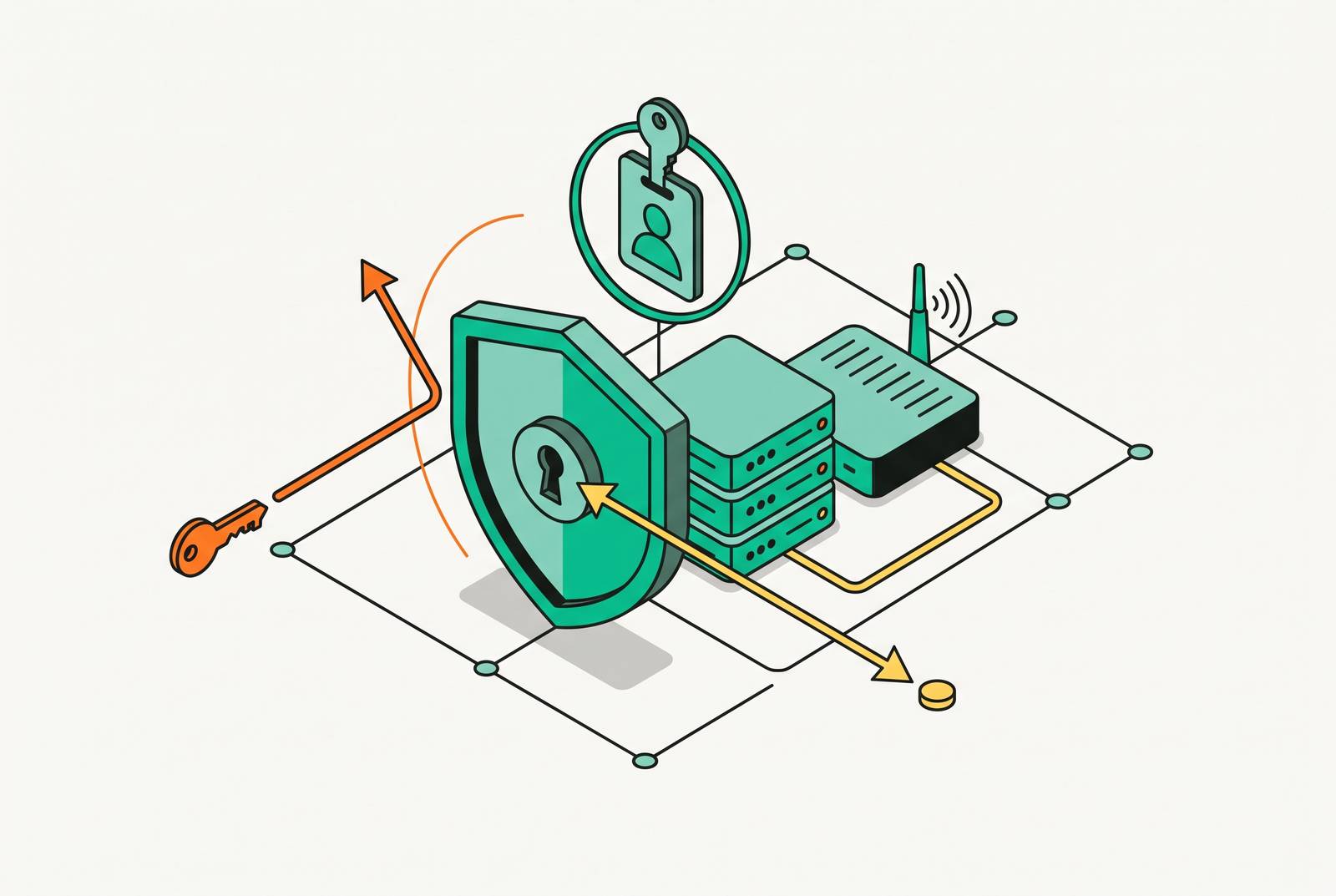
Account takeover fraud crossed $15 billion in a major national market. In 2025, ATO hit 6 million consumers, and the FTC clocked total fraud losses at $12.5 billion in 2024, figures that dwarf prior years. Those aren't separate problems. Most of that money moves because somebody's login credentials got typed into the right box by a bot pretending to be a person. The industry's response has mostly been to stack detection tools after the login screen, which is a bit like installing a smoke detector in the room that already burned down. The network edge, the point where a request first hits infrastructure before it ever reaches application code, is where account takeover actually gets stopped. Everything after that is cleanup.
How the credential-stuffing attack chain works, from breach dump to session
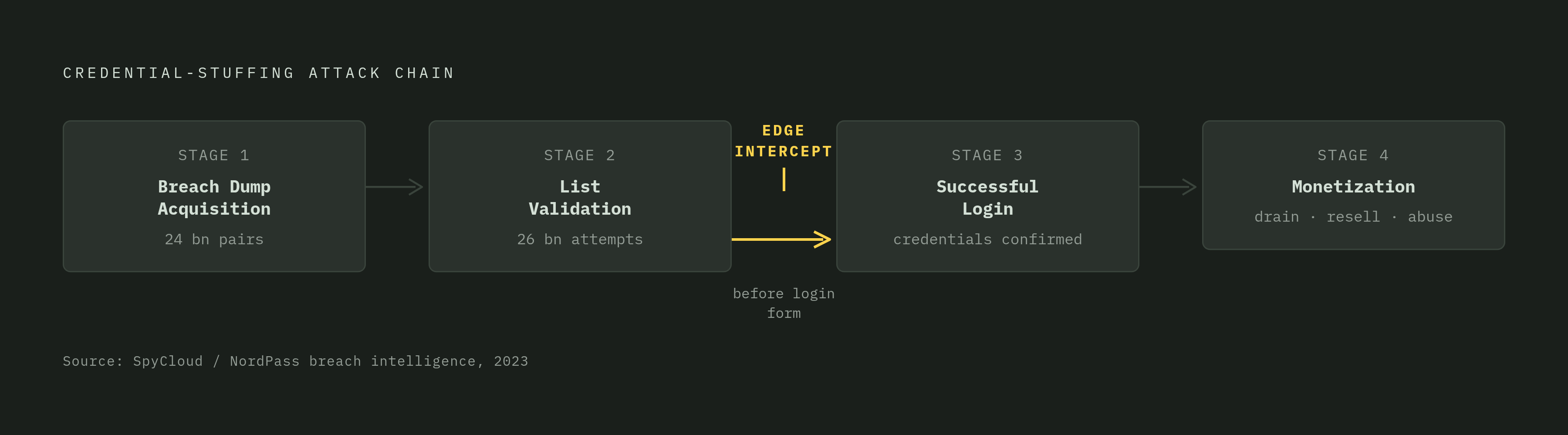
Credential stuffing runs on an assembly line, and each station is boring and automatable. That's the whole reason it works so well. First comes breach dump acquisition: someone buys or scrapes a list of email-password pairs. Then list validation, where those pairs get tested against login endpoints by botnet infrastructure firing requests around the clock, not a person clicking buttons. Then a login succeeds, and the account gets monetized: drained, resold, used to abuse a loyalty program, or quietly redirected by changing a shipping address before anyone notices.
The scale here was never built for human comprehension, because it was never built by humans clicking anything. More than 24 billion stolen credential pairs are in underground databases right now, and attackers test them at a rate of 26 billion attempts. Verizon's 2025 Data Breach Investigations Report found compromised credentials were the initial access vector in 22% of the 12,195 confirmed breaches it analyzed. When Verizon looked at SSO logs directly, the median share of daily authentication attempts classified as credential stuffing came out to 19%, climbing to 20-25% in enterprise systems. On a lot of login pages, one in five requests isn't a person.
The credential supply keeps refilling itself. HaveIBeenPwned absorbed the Synthient Credential Stuffing corpus in November 2025, adding 1.3 billion unique passwords, 625 million of which had never shown up in the service before. That's a pipeline of continuously harvested credentials feeding straight back into the assembly line.
Session hijacking is the newer wing of the chain, and it skips the login page. Analysis across 4.2 billion authentication attacks found a 127% jump in session hijacking instances in 2025. Steal a valid session token and authentication stops mattering, because the attacker already looks logged in.
Why post-login detection alone cannot contain attacks that succeed at the authentication step
Identity and MFA tools answer one question well: who is this, at the exact moment they're proving it. What happens to the session after that factor passes is a different question, and most of these tools never ask it. Adversary-in-the-middle attacks and session theft both live in that blind spot, downstream of the one moment MFA actually inspects.
Fraud suites have the same problem from a different angle. They score transactions after login, hunting for patterns that suggest a real theft in progress. An automated or hijacked session that hasn't cashed out yet looks completely normal to a fraud model, because it's designed to imitate normal right up until the payout moment.
Rate limiting alone catches somewhere in the 20-30% range of ATO attempts. That leaves the majority uncaught, and closing that gap takes device intelligence and behavioral signals that rate limiting was never built to provide. Logging has its own blind spots: SIEM and EDR tools watch the endpoint, WAFs watch the network, and neither one watches what a third-party script does inside a user's browser. Stacking three tools with three separate blind spots does not cancel out the gaps. They compound.
The cost curve settles the argument on its own. Pre-login interception is the cheapest, highest-recall point in the whole chain, because it stops a bot before it ever gets a chance to guess right. Post-login recovery is expensive and lossy by comparison, and the damage isn't only financial: 42% of ATO victims close their account entirely on the platform where the takeover happened. That's a customer lost to a fraud problem the platform could have stopped three steps earlier.
Edge-layer controls and the point in the attack chain where they intercept
Four tools do the heavy lifting at the edge, and each earns its keep at a different point in the chain.
Bot management identifies and blocks automated credential-stuffing traffic before login attempts get processed at all, reading behavioral signals, TLS fingerprints, IP reputation, and declared user agents. Rate limiting enforces thresholds per IP, ASN, or header pattern, catching brute-force attempts and unsophisticated stuffing, but it hits a ceiling fast against distributed, multi-IP campaigns, and that ceiling is exactly where the 20-30% coverage figure comes from. WAF rules block malformed requests, injection attempts, and known attack signatures before they reach application logic, and most modern WAFs ship rulesets built specifically for login endpoints. Credential-stuffing detection matches incoming authentication requests against automation signals, velocity, IP clustering, missing device fingerprints, and header anomalies, without waiting for the login attempt to finish and fail.
Browser fingerprinting adds another layer, capturing device and network signals (IP, geolocation, VPN or proxy detection, browser version, OS, screen resolution) to risk-score a session the moment it starts, before a single credential gets submitted. WAFs increasingly treat AI bots as their own category, distinct from the scrapers of a decade ago, leaning on declared user agents like GPTBot or ClaudeBot, TLS fingerprints, and behavioral scoring, with controls ranging from blocking specific crawlers outright to per-prompt inspection on applications exposing LLM endpoints. Anyone buying into this space should ask vendors point blank to separate AI scrapers pulling training data, AI tools doing retrieval, and AI agents running autonomous tasks. Those are three different threats wearing the same trench coat.
Every malicious request stopped at the edge is one fewer request that ever touches authentication logic, session infrastructure, or fraud scoring downstream. Stop it early, and three other systems never have to deal with it.
The scale at which edge infrastructure must operate to match modern attack volumes
DDoS numbers are a useful stand-in for how much traffic edge infrastructure has to sort through now. The global internet absorbed 47.1 million DDoS attacks in 2025, and the all-time volumetric record, 31.4 Tbps, was set by the Aisuru botnet in December 2025. It lasted 35 seconds. Network-layer attacks overall rose 509% year over year.
The Aisuru-Kimwolf botnet isn't a one-trick pony built for volumetric floods alone. The same infrastructure runs credential stuffing, AI-driven web scraping, spam, and phishing campaigns. That matters more than it looks at first glance: the operators running DDoS botnets and the operators running credential stuffing are frequently the same people, renting out the same infrastructure toward whichever job pays that week.
Edge infrastructure built to absorb DDoS and edge infrastructure built to catch credential stuffing aren't two separate procurement decisions, then. They're facing the same adversary. Handling that takes real capacity, not aspirational capacity: 449 Tbps of network bandwidth, over 13,000 direct network interconnections, and enough geographic spread that 95% of the internet-connected world sits within roughly 50 milliseconds of a data center. Proximity isn't a nice-to-have here. Every millisecond of latency added by edge inspection gets paid by a legitimate user waiting for a page to load, not by the botnet that doesn't care how long anything takes.
How WAF detection accuracy varies across vendors and what the benchmarks measure
Vendors love to quote their OWASP Top 10 block rate, and for good reason: nearly everyone clears 97-99% on it. Leading WAAP vendors broadly hit that range on default rulesets. If that were the whole test, shopping for a WAF would take about four minutes.
The gaps appear once benchmarks dig past the headline number. SecureIQLab's 2025 Cloud WAAP CyberRisk Validation, run on the same OWASP-based methodology across vendors, scored AWS WAF at 73.61% against 87.24% for the competing edge platform tested. Same test, same methodology, a 14-point spread. That's not noise; that's a different product.
Methodology can flip the story entirely for the same vendor. In one major analyst evaluation, an edge platform landed as a top-tier leader with the strongest current offering assessed. In SecureIQLab's v5.0 testing, that same platform posted a 60.9% Complete Security Score, a 93.6% operational efficiency score, and a false positive avoidance score around 81%, landing it in the Upcomer tier rather than the leader tier. Two credible evaluations, two very different placements, same product. Anyone citing a single benchmark as gospel skipped the part where they were supposed to read the methodology section.
What separates top-tier vendors is edge case coverage, operational efficiency, and false positive rates, not the headline OWASP number. It's edge case coverage, operational efficiency, and false positive rates, the unglamorous stuff that never makes a press release. For ATO specifically, ask whether every point of presence runs the full security stack or traffic gets rerouted to centralized scrubbing centers once an attack starts. A network where each PoP carries full capability handles a spike differently than one that has to shuttle traffic to a handful of dedicated locations after local capacity runs dry. During a real attack, that architectural difference is the gap between absorbing the load and becoming the bottleneck.
The boundary between bot management and deeper behavioral intelligence
There is a recognized ceiling to what WAAP bot mitigation alone can cover: organizations running consumer-facing apps that rely solely on it will increasingly need to bolt on additional anomaly-detection tooling, a limitation the industry broadly acknowledges. That's a description of where bot management's jurisdiction ends, not a knock on it. It's a description of where its jurisdiction ends.
Sophisticated credential-stuffing operations have adapted specifically to beat network-layer inspection. They rotate IPs constantly, run real browsers instead of headless scripts to fake human browsing patterns, and route through residential proxies that look, from the network's point of view, exactly like somebody's home internet connection. All of that can walk straight through bot management and land on the login form looking clean.
Session hijacking makes the case even sharper. That 127% jump across 4.2 billion analyzed authentication attempts represents attackers skipping the login moment entirely and operating on stolen session tokens instead, a threat the network edge structurally cannot see, because it happens after authentication has already succeeded.
Closing that gap takes a different kind of signal: behavioral biometrics, keystroke dynamics, mouse movement, interaction timing, the small physical tells that separate a human hand on a mouse from a script replaying a stolen session. These live in the browser and application layer, not the network layer, and no amount of edge tuning substitutes for them. Bot management stops the flood at the door. It was never built to notice the intruder who already has a key.
How to evaluate ATO prevention tools by the layer of the attack they defend
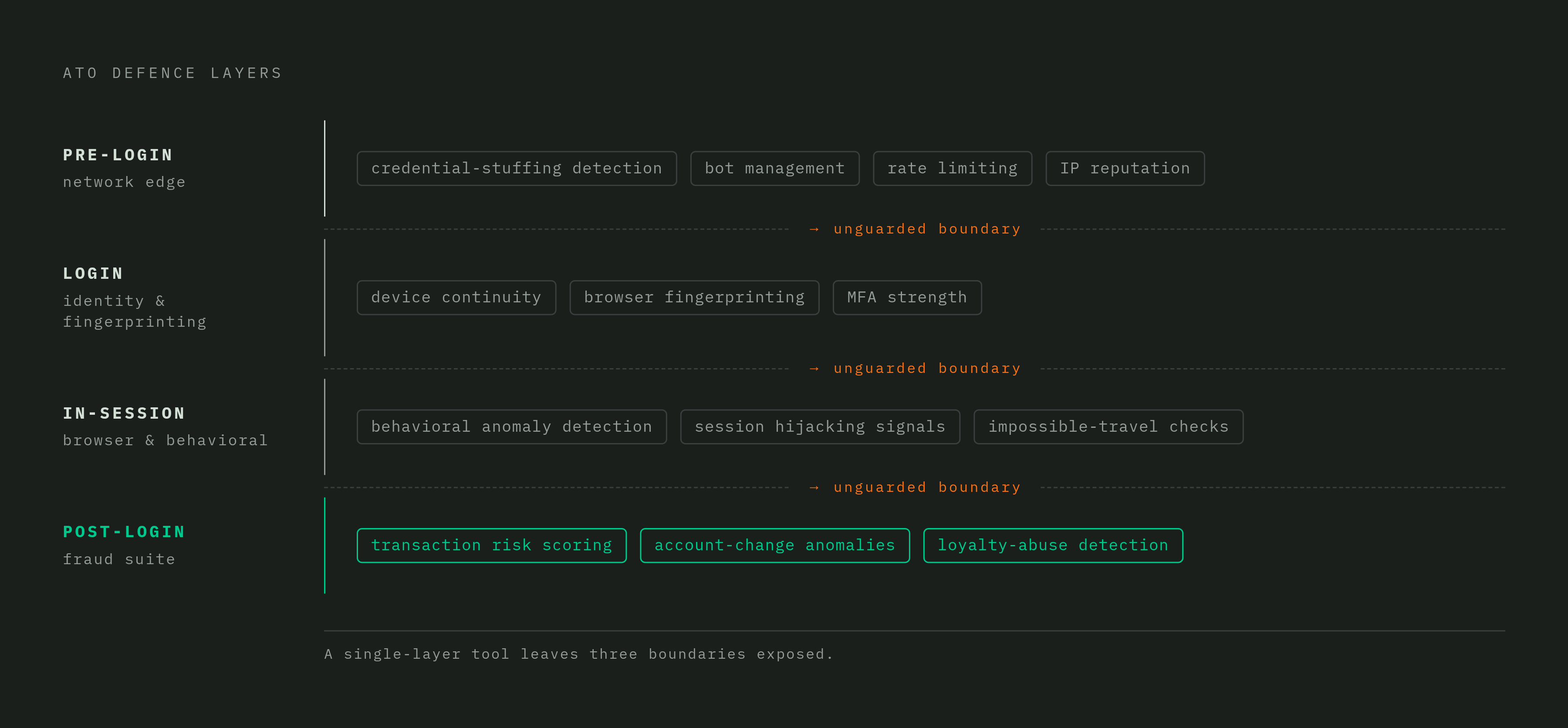
Vendor comparisons love a feature grid: identity here, fraud suite there, network tools in the third column, everybody gets a checkmark. That format hides the only question that actually matters: where the current stack has a hole.
Four points cover the full chain, and each sits at a different layer. Pre-login is credential-stuffing detection, bot management, rate limiting, and IP reputation, living at the network edge. Login is device continuity, browser fingerprinting, and MFA strength, sitting at the identity and fingerprinting layer. In-session is behavioral anomaly detection, session hijacking signals, and impossible-travel checks, at the browser and behavioral layer. Post-login is transaction risk scoring, account-change anomalies, and loyalty-abuse detection, at the fraud suite layer. A tool that excels at one layer and stays silent on the other three answers only part of the question. It's an incomplete answer being sold as a full one.
Judge any ATO product against four questions: does it cover all four points or just one, how fast does it infer risk, what's the false-positive rate against real users logging in normally, and can it hand off evidence-grade signals to whatever system enforces the block downstream. A tool that flags risk but can't produce a signal clean enough to act on is just generating noise with extra steps.
MFA earns its own line item here because the spread in quality is enormous. SMS and email one-time codes are the weakest link, vulnerable to SIM swapping, phishing, and the plain fact that email accounts get compromised too. Passkeys and hardware security keys sit at the top, genuinely phishing-resistant in a way OTP codes have never managed. Matching MFA strength to the actual risk of the account it protects is the entire point of choosing one over the other. It's the entire point of choosing one over the other.
Sources
- Top 6 Account Takeover Prevention Software for 2026
- Account Takeover Prevention Software: 10 Tools for 2026
- Account Takeover Prevention & Protection Software | Accertify
- Account Takeover Prevention in Banking: 15 Vendors Benchmarked (2026)
- imperva.com
- Credential Stuffing Statistics 2026: ATO, Bots, APIs & Leaks
- cyberfenceplatform.com