WAF Rule Tuning to Eliminate False Positives in Production
Structured tuning prevents the security decay that costs organizations millions.
Web application firewalls fail the same way almost every time. Someone flips the switch to blocking mode too early, a legitimate request gets a 403, an executive complains, and the security team quietly widens an exception until the rule barely does anything. Eliminating false positives is an ongoing process rather than a switch you flip once and walk away from. It is a process with phases, and skipping phases is what turns a tuning problem into a security failure. According to industry research, 39% of organizations disable or substantially weaken WAF rules within six months of deployment, so the tuning failure becomes visible as a security failure a few months later. This piece covers the process end to end: what the logs look like before anyone has touched them, why detection mode has to come first, how anomaly scoring shapes the workload, how to write exceptions that don't gut the rule, how to move to blocking mode in stages, and how to keep the whole thing from rotting once it works.
False positives cost an organization on three fronts at once, and none of them are hypothetical. A blocked checkout form or a webhook that silently stops firing is a user experience problem that shows up as a support ticket or a lost sale. A flood of false alarms is an alert fatigue problem, and once a security team stops trusting its own tooling, real attacks start sliding through the noise. Then there's the compliance angle, which gets less attention than it deserves: when a WAF rule fires on user input, the data that tripped it (passwords, addresses, payment fields) often gets written straight into the log in plain text. That's a GDPR, CCPA, or PCI DSS problem waiting for an auditor to find it. Vendors sometimes pitch a low-sensitivity "set it and forget it" mode as the fix, but that's not tuning, it's just turning the volume down. A WAF that requires a request to trip a dozen rules before it blocks anything isn't quieter in any useful sense, it's just easier to sneak past.
None of this is abstract risk. Exploitation of web application vulnerabilities accounted for 42% of non-misuse breaches in the Verizon 2025 DBIR, and a WAF that's been de-fanged to stop annoying the marketing team leaves exactly that surface open. The April 2025 attack on Marks & Spencer, estimated at $400 million in lost revenue, is a decent reminder of what's actually at stake when a team decides disabling a rule is easier than tuning it. The way out requires holding both accountable: false positives get tuned down and broken security gets fixed. It's a structured, iterative process, and it starts with looking honestly at what the logs say before anyone touches a single rule.
What production WAF logs look like before any tuning has happened
A WAF running its default managed rule set in blocking mode can produce false positive rates anywhere from 0.1% to 5% of legitimate traffic on day one, depending on the application and which rule sets got turned on. That range is wide because the sources of noise are so mundane. Monitoring tools and vulnerability scanners generate request shapes that look exactly like reconnaissance, because in a sense they are. Webhook payloads from partners like Shopify or Stripe carry JSON field names that happen to match injection signatures. A Jenkins pipeline posting structured data to an API can trip the same alarms as an attacker probing for weak input validation. Rich text editors submit raw HTML on every save, which is catnip for XSS rules. And ordinary users writing ordinary sentences set off rules that were never built to understand context: someone typing "I would like to select the blue option" gets flagged for the word "select," because a SQL injection rule can't tell a database query and a customer picking a paint color apart.
Where to actually find this stuff depends on the platform, and knowing where to look is half the battle. AWS WAF logs to S3 and gets queried through Athena, where the terminatingruleid and action fields are the first things worth filtering on. Azure Front Door WAF logs to Log Analytics, where KQL queries against FrontDoorWebApplicationFirewallLog can be filtered, and the details_matches_s field shows exactly which part of the request tripped the rule. ModSecurity and the Core Rule Set write an audit log with the matched data, rule ID, and each rule's contribution to the anomaly score. Whatever the platform, the question to answer before touching anything is the same: which rule fired, on which URI or parameter, matching what content, and how often. Frequency is what separates a real pattern from a one-off fluke, and mistaking one for the other is how tuning work turns into whack-a-mole.
Detection mode as the non-negotiable first phase
Detection mode goes by different names depending on the vendor: "count mode" in AWS WAF, "detection mode" in Azure, "DetectionOnly" in ModSecurity. Same idea everywhere. Rules evaluate the traffic, logs get written, and nothing actually gets blocked. That last part is the whole point. A false positive in detection mode is invisible to the user and shows up only as a log entry. A false positive in blocking mode is a 403 error, a support ticket, and often an executive asking why the new security tool just broke the thing they were trying to do.
Two weeks is the minimum window to run before drawing conclusions, since that's roughly enough time to capture weekly patterns like batch jobs, scheduled reports, and partner integrations that only run on a specific day of the week. During that stretch, full logging needs to be on from day one, since tuning depends entirely on what's being logged. Resist the urge to build exceptions off the first day's data too, since a single unusual day of traffic can produce a pattern that doesn't hold up over the full window. Tagging known-internal traffic (monitoring tools, CI/CD IP ranges, partner webhook sources) makes it possible to separate expected noise from genuine unknowns later, when the query gets run. And the query itself, run through Athena or KQL, should produce a per-rule false positive rate, turning the decision about what to fix first from a guess into a number.
An honest chunk of organizations, more than half by some estimates, get stuck here indefinitely and never leave detection mode, which defeats the purpose of having a WAF in the first place. Detection mode is a phase. It's not a destination, and treating it like one is just false positive avoidance wearing a security tool's clothes. The tuning work starts at the top of that ranked list of rules by false positive volume, regardless of which rule sounds scariest by name.
Anomaly Scoring and Paranoia Levels' Effect on Tuning Work
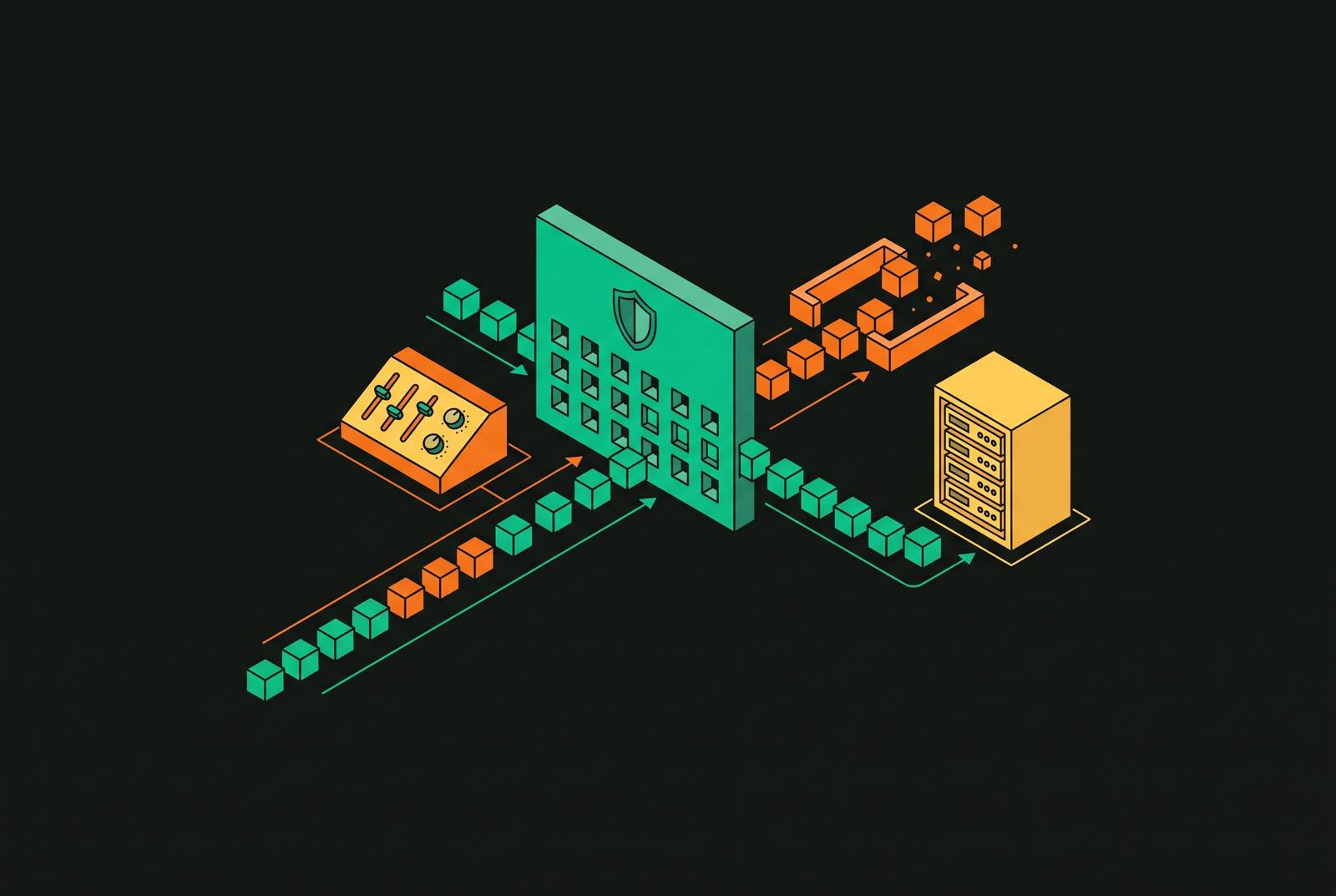
Most WAFs on the market build on top of the OWASP Core Rule Set, a community-maintained rule library covering the OWASP Top Ten and released under Apache 2.0. CRS doesn't block on a single rule match. It works through anomaly scoring: each rule that fires adds points based on how severe the pattern is, and the WAF only blocks once the total score crosses a threshold that's configurable. That design matters, because it means one coincidental match doesn't have to mean a blocked request.
How much of the rule set is active gets controlled by paranoia level. Paranoia Level 1 runs the foundational detection rules and carries a meaningfully lower false positive rate than higher levels, making it the sensible starting point for most enterprise applications. Levels 2 through 4 turn on progressively more aggressive detection, and the false positive rate climbs right along with it. The practical trade-off is this: Paranoia Level 1 in blocking mode with a handful of targeted exceptions beats Paranoia Level 2 with a sprawling exception list, because the exception list itself becomes something that has to be maintained, audited, and eventually cleaned up. Every exception is a small, permanent chore.
Version matters too. CRS 4.0, released in 2024, cut false positive rates significantly through a range of improvements to its detection and scoring architecture. Platforms still shipping CRS 3.x configurations are going to generate more noise on a modern application than they need to, so it's worth checking which version sits under the hood. Azure WAF's default rule sets derive from CRS. Google Cloud Armor's preconfigured rules support CRS 3.0, 3.3, and 4.22, with 4.22 as the currently recommended version. AWS WAF ships a managed Core rule set inspired by CRS, though not a direct port. Some platforms layer proprietary managed rules on top of or instead of CRS, and this substitution directly determines how fast new CVE protections appear and causes the rule set to shift on a team that thought it was done tuning, without that team's awareness. Understanding which architecture is in play matters for the next step, because suppressing one rule's contribution to an anomaly score is a completely different operation from excluding a field from an entire managed rule group.
Writing surgical exceptions without disabling protections
The rule that should never get broken: don't disable a rule globally when it can be disabled for one field, one URI, or one parameter instead. A global disable removes protection from every request on the application, not just the handful causing false positives, and that's how a WAF quietly stops doing its job while everyone still thinks it's running at full strength.
AWS WAF gives a few tools for this. A ScopeDownStatement restricts a managed rule group to specific URI paths or request characteristics, and it's the right move when a rule only misfires against one endpoint rather than the whole application. ExcludedRules turns off a specific managed rule ID application-wide, which should be the fallback when a ScopeDownStatement genuinely can't isolate the problem, reserved for later in the process. Rate-based rules can get scoped tightly too: a rule counting only POST requests to /api/v1/auth with a missing or suspicious User-Agent can be capped at ten requests per five minutes without touching legitimate API clients hammering other endpoints hundreds of times a minute. For JSON payloads, the JsonBody field match type with MATCH_PATTERN inspects specific keys instead of the raw body, which cuts false positives and shaves processing overhead on large requests at the same time.
Azure Front Door WAF offers its own set of scalpels: exclusions by RequestHeaderNames, RequestCookieNames, RequestBodyPostArgNames, RequestBodyJsonArgNames, and QueryStringArgNames. The specificity of these types is the entire value proposition, so the narrowest one that solves the problem is always the right one to reach for. When nothing narrow enough exists, a per-rule action override from Block to Log keeps the rule watching without blocking, and that log-mode data should get reviewed for about a week before deciding whether to re-enable blocking or carve out a tighter exclusion.
A few concrete cases make the principle stick. A free-text delivery note field that trips several rules at once should get excluded from those specific rules, or from all detection rules if the noise is broad, but the rules themselves stay intact everywhere else. A site that teaches JavaScript and legitimately accepts JavaScript code as form input will correctly trigger an XSS rule by signature, even though the content isn't malicious in that context; the exception belongs on that one parameter for that one URI, not on XSS detection sitewide. And on SQL injection specifically, requiring both an injection delimiter and a SQL keyword together (rather than either one alone) knocks out false positives from ordinary punctuation without weakening actual injection detection. One useful test for evaluating any WAF platform: can a specific rule be turned off for a specific URI or parameter without taking it down everywhere? If the answer is no, that's not a tuning limitation, it's an architectural one.
The phased rollout from detection to blocking mode
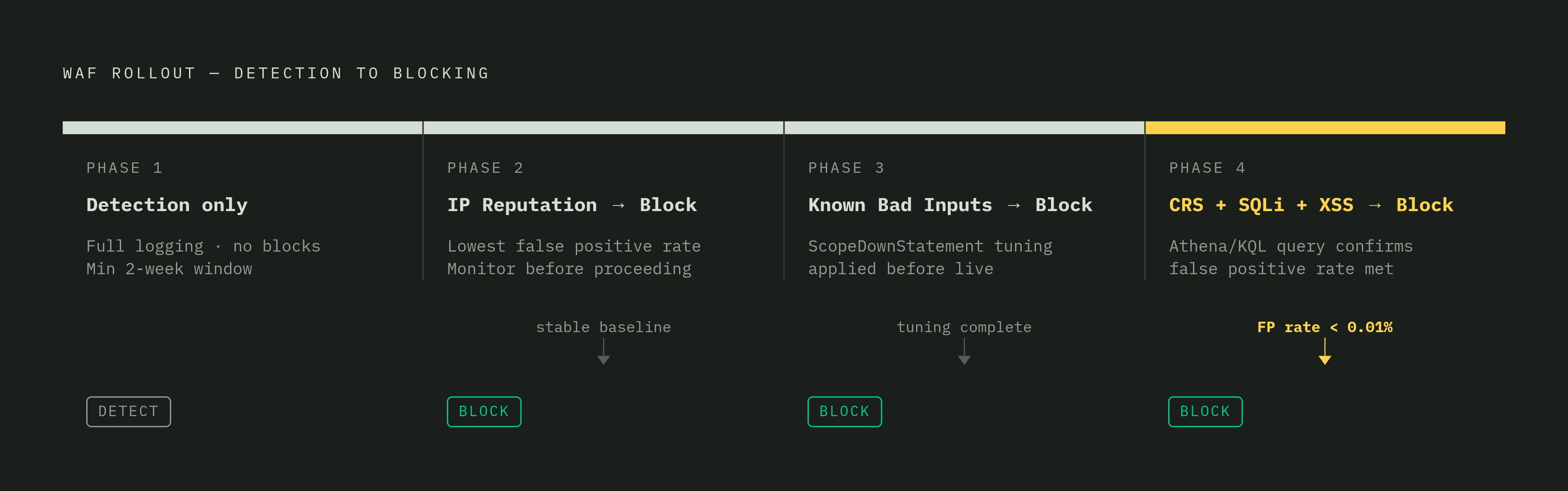
Teams that flip the entire WAF to blocking mode in one move tend to hit their first blanket-exception request within about six weeks, which is roughly the point where pressure builds enough that someone decides disabling a rule is faster than tuning it. Phasing the rollout is what prevents that escalation from happening in the first place.
The sequence matters. Since it carries the highest confidence and lowest false positive rate of any group, phase one is the IP reputation rule group; switch it to block and monitor it for a short window before touching anything else. Phase two is the Known Bad Inputs group, which targets well-understood patterns and should get ScopeDownStatement tuning before it goes live. Phase three covers the Core Rule Set along with SQL injection and XSS groups, the highest-noise, highest-effort tier, and it only moves to blocking once the Athena or KQL query confirms the exception list actually covers the patterns that were misfiring.
The number that should gate each switch: two to four weeks of systematic tuning typically brings a false positive rate down from that initial range to under 0.01%. That's the threshold where flipping a group to block mode is a defensible decision instead of a hopeful one. Each switch is a production change and deserves to be treated like one, with a documented rollback plan, a 48-hour monitoring window with a named owner, and a rollback trigger defined in advance (some rate of new 403 reports that means immediate revert to count mode, decided before the switch, not during the panic after it). Once every group is in blocking mode, a full sweep across the entire rule set, not just per group, confirms the false positive rate holds under the target threshold end to end.
Ongoing maintenance: preventing exception list sprawl and handling managed rule updates
Reaching blocking mode isn't the finish line. Two things keep eroding a tuned configuration after that point: the application itself changes and creates new false positive patterns, and managed rule set updates introduce new rules into an environment that was tuned around the old ones.
A quarterly allowlist audit is the practical fix for the first problem. Pull the full exception list, meaning IP allowlists, rule exclusions, ScopeDownStatements, and skip rules, and for each one ask whether the original justification still holds. Has the internal tool that needed the exception been decommissioned? Has the partner's request format changed since the exception was written? An exception carved out for an analytics tool nobody uses anymore isn't neutral, it's a hole in the fence that stays open long after the reason for opening it is gone. Applications change, traffic patterns change, user agents change, and an exception list has to reflect what's true now, updated to match the present rather than frozen at whatever was true eighteen months ago.
Managed rule updates need their own discipline, because a vendor pushing a new CRS version or a new proprietary rule set can introduce fresh false positives into an environment that was already tuned and quiet. New rules should land in detection mode first, get watched against the same per-rule false positive process used for the initial rollout, and only move to blocking once the numbers support it. Skipping that step and letting an update auto-promote straight to blocking is how a team ends up back at square one, staring at a flood of 403s and wondering where all the tuning went.