Layer 7 DDoS Mitigation for HTTP Application Endpoints
Sophisticated attacks mimic legitimate traffic, forcing defenses to work faster than attacks arrive.
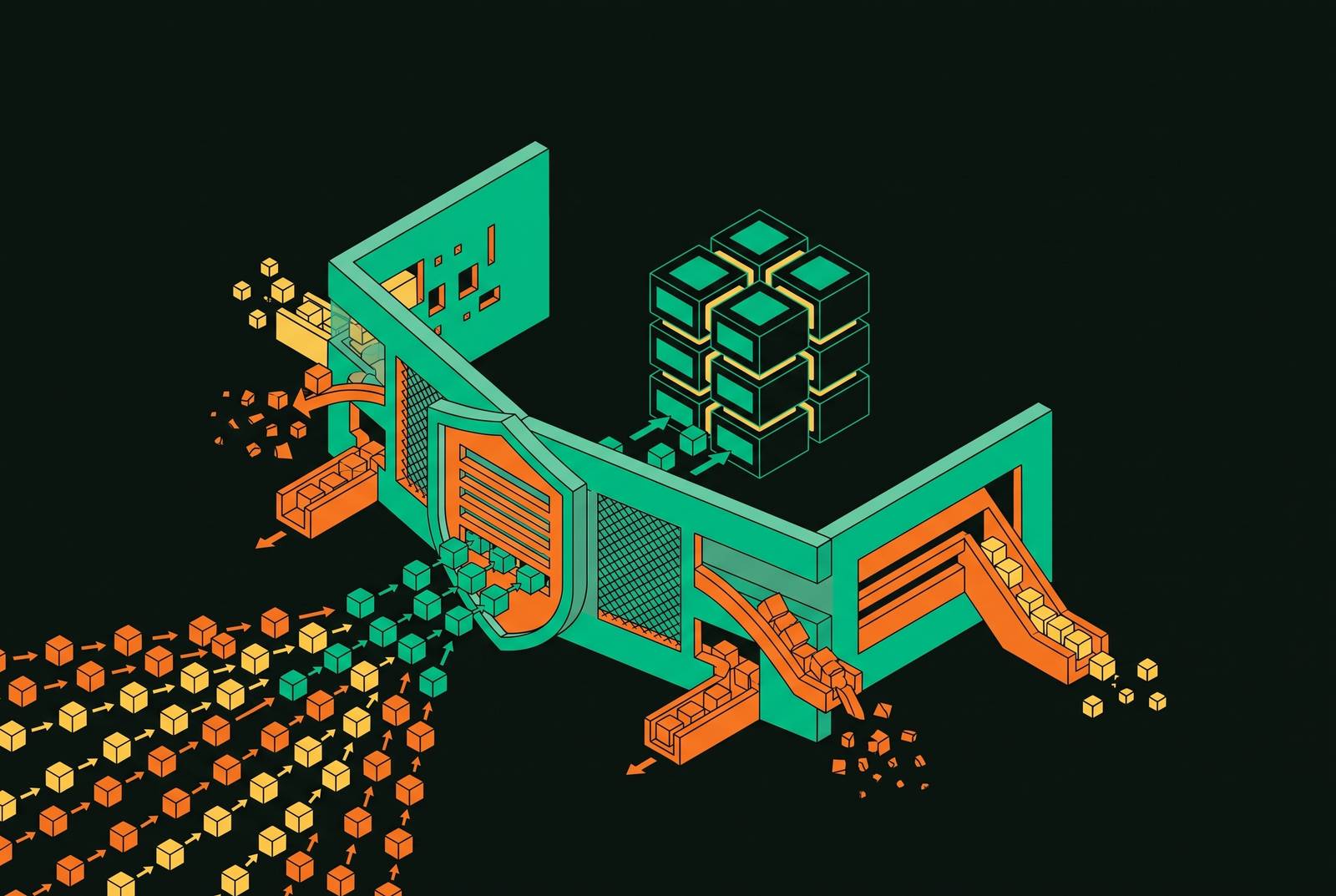
An attacker running a Layer 7 flood doesn't need to break anything. That's the annoying part. The request completes its TLS handshake politely, uses a normal HTTP method, follows the exact route a real user would follow, and still knocks a server sideways. L7 attacks don't target bandwidth, they target work. Every request forces the server to do something expensive: parse JSON, hit a database, check a cache that isn't there, authenticate a session. Send enough of those cheap little requests and the server drowns in its own to-do list.
Two broad families cover most of what shows up in the wild. High-rate floods hammer CPU, database, and cache. Low-and-slow attacks starve sockets and worker threads while barely registering on a bandwidth graph. Both get the job done, they just clock in on different shifts.
HTTP GET and POST floods with cache-busting are the blue-collar version of this attack. Random query strings force cache misses on every request, so nothing gets served from the edge and everything lands on the origin. Attackers point this at the expensive routes on purpose: search, login, checkout.
HTTP/2 Rapid Reset (CVE-2023-44487) and its 2025 cousin, MadeYouReset, work by opening a pile of streams and killing them with RST_STREAM before the server finishes the work. Proxies choke on the bookkeeping. Rapid Reset forced a scramble of urgent patches across CDNs, proxies, and gRPC servers, and that scramble is still shaking out in places.
Slowloris and RUDY take the opposite approach: dribble out partial headers or body data just slowly enough to stay under the timeout, and tie up sockets and worker threads for as long as the server allows. This works at under 1 Mbps, which is why it slides past anything watching for volume, and it still works against Apache setups that haven't been hardened.
GraphQL deep recursion is the cheat code of the bunch. A handful of nested or aliased queries can trigger enormous resolver and database load, so an attacker doesn't need scale, just a well-crafted query. WebSocket floods exploit a blind spot instead: WAF inspection often stops after the upgrade handshake, so a pile of idle or junk frames on an open connection sails through unguarded. Login spray spreads authentication attempts thin enough to dodge per-IP rate limits while still loading up auth CPU and session stores. Prefix scatter, the L7 cousin of carpet-bombing, spreads small request volumes across many endpoints so no single route trips a threshold.
The thread connecting all of it is mimicry. Stay under the volumetric alarms, and let the server do the expensive part.
How large and fast the L7 threat has grown
Total DDoS attack volume more than doubled to 47.1 million in 2025, a 236% jump from 2023. Four in every hundred HTTP DDoS attacks now exceed 1 million requests per second. That used to be a headline number. Now it's a Tuesday.
The clearest illustration came from the Aisuru-Kimwolf botnet's "Night Before Christmas" campaign in Q4 2025, which threw hyper-volumetric HTTP floods exceeding 200 million requests per second, weeks after a separate record-setting 31.4 terabit network attack. The delivery mechanism wasn't some exotic server farm. It was infected Android TVs sitting in living rooms, quietly enlisted into a botnet while somebody's kid watched cartoons.
Generative AI companies got singled out for a different kind of spike: month-over-month increases in HTTP DDoS traffic as high as 347%, observed in September 2025. Whatever's driving that, scraping wars, competitive sabotage, bored teenagers with serious computing hardware, the AI sector is now a preferred target, not a bystander.
The number that should reframe budget conversations is this: 71% of HTTP DDoS attacks in Q2 2025 came from already-known botnets. That's an opening, not a scary stat. Most of this fight isn't defense against the unknown, it's pattern-matching against threats somebody has already logged, and treating every incoming flood as a novel mystery wastes the one advantage defenders actually have.
Why speed of response is the constraint that shapes every mitigation decision
Here's the number that breaks most conventional security tooling: 71% of HTTP DDoS attacks and 89% of network-layer attacks are over in under 10 minutes. Some run just 35 seconds. A human analyst can't read the alert, open the dashboard, and deploy a countermeasure in 35 seconds. Nobody's that fast, and pretending otherwise is how incident response plans turn into fiction.
Even a short attack leaves a mess. An application hammered for even a short burst can keep working through the backlog long after the attack ends, including crashed workers, a connection pool that never quite recovers, and a cache that has to warm back up from empty. The flood recedes, but the mud stays.
That's exactly why the on-demand scrubbing center model is structurally out of step with the threat. That model runs on a sequence: detect, escalate, reroute traffic, scrub. Each step takes time, and the sum of those steps routinely outlasts the attack itself. By the time the scrubbing center spins up, the botnet's already clocked out. On-premise mitigation appliances share the same timing problem, plus a second one: they cap out at whatever capacity sits in the rack, and a 200 million rps flood is designed to exceed fixed, finite hardware limits.
The only architecture that matches a 35-second attack window is one that's already running, all the time, on every request, automatically. Static rule sets written after the fact don't help either. If the rule gets deployed after the attack was observed, the attack already won.
The layered defense architecture that handles what single controls cannot
No single control solves this. Not a threshold, not an appliance, not a CDN, not a WAF, not an autoscaler cranked up to eleven. Effective mitigation looks more like a relay race than a wall: edge, identity, API gateway, application code, data tier, observability, and incident response all have to hand off cleanly, and a fumble anywhere in that chain costs the whole race.
Layer one is edge capacity and scrubbing, sized to absorb attack traffic and legitimate peak traffic at the same time, because the two show up together and the system doesn't get to pick. This is a prerequisite, not a solution. Keeping the pipe open just means the application behind it is now free to fail from a flood of perfectly valid, perfectly expensive requests.
Layer two is application-aware filtering: a WAF that inspects requests for protocol violations, malformed headers, and origin error signals, and does it at the edge before traffic ever reaches origin, not bolted onto a server that's already sweating. Around 20% of HTTP DDoS attacks now involve fake or headless browsers or other suspicious HTTP fingerprints, so IP reputation alone leaves a significant share of attack traffic unaddressed.
Layer three is rate limiting, but not the flat per-IP kind that a botnet rotating through thousands of addresses shrugs off. Useful rate limits get scoped by route, identity, fingerprint, geography, and behavior, and they set different budgets for different costs. A login endpoint and a cached product image are not the same liability, and treating them the same is how the login endpoint loses.
Layer four is bot detection. Automated bot traffic made up more than 30% of all internet traffic in 2025, and most of it isn't hostile, so a blunt block button punishes legitimate crawlers along with attackers. Real bot management sorts traffic into block, challenge, rate-limit, or allow, watching for rotating user agents, headless browser fingerprints, and session behavior that doesn't match a human. Cryptographic bot authentication lets known good bots prove who they are, and machine-learning baselines flag anomalies against a per-application "normal," catching the bots nobody's cataloged yet.
Layer five is runtime control at the API layer specifically: capping GraphQL recursion depth and query complexity at the gateway rather than deep in the resolver, inspecting WebSocket frames after the handshake instead of assuming coverage ends there, and controlling gRPC keepalive rates and metadata churn. Message size limits and per-request cost budgets shrink the blast radius of any one abusive call.
Layer six is cross-customer threat intelligence, turning "71% of attacks come from known botnets" from a statistic into a weapon. When a botnet hits one customer on a shared network, every other customer on that network gets the update immediately, no manual signature-writing required. Layer seven is just good application design: aggressive caching, circuit breakers, request queuing, and separating expensive endpoints (search, auth, payment) from lightweight ones so a flood on one path doesn't take the whole app down with it.
What to look for when evaluating L7 DDoS protection platforms
Start with always-on versus always-available, because this is where most procurement decisions go wrong. Always-on means every request already passes through the mitigation layer. Always-available means the mitigation layer needs to be switched on, which takes time a 35-second attack simply won't grant. Given that some attacks last as little as 35 seconds, always-available is a structural mismatch with the threat, and any vendor pitching it as adequate is selling last decade's threat model.
Scrubbing capacity matters at a scale that would have sounded absurd five years ago. The 2025 benchmark sits north of 200 million requests per second at the HTTP layer, and a platform needs to absorb that without rerouting delay. Rule depth matters too. Ask whether the platform actually inspects for protocol violations, suspicious patterns, and origin errors at L7, or whether it's really just a network-layer tool wearing an L7 label.
Bot management should live inside the mitigation path, not sit off to the side as a separate product requiring its own routing rules. Rate limiting needs to scope by route, method, header, geography, fingerprint, and behavior, not just source IP. And the size of the threat intelligence network behind the platform is worth asking about directly: a bigger customer base sees more botnets sooner, and that lead time is the whole game.
Observability during an active attack deserves scrutiny too, meaning real-time visibility into pressure patterns and mitigation decisions, not a summary emailed over the following week. Pricing model matters more than it sounds. A vendor that charges by scrubbed traffic volume is billing the customer for the attack, which is a strange incentive to build a business model on. Consumption-based pricing on clean traffic only is the fairer arrangement worth insisting on. Finally, check the integration surface: Terraform, CLI access, public APIs, and hooks into existing SIEM and alerting tools, because a platform that can't plug into the workflow already in place just becomes one more dashboard nobody checks.
How leading platforms approach L7 mitigation and where they differ
One common architecture ties always-on, in-line HTTP DDoS detection into a global edge network, so mitigation decisions get made before traffic ever reaches origin infrastructure. Managed L7 rule sets, current as of documentation dated April 2026, cover known attack tools and patterns, protocol violations, requests generating excessive origin errors, and traffic spikes hitting origin or cache beyond expected levels.
The cross-customer intelligence piece is the mechanism worth paying attention to, the one most sales decks bury under buzzwords. When a botnet gets flagged attacking one customer on the network, the protection extends to every other customer immediately, without a rule being hand-written first. That's the mechanism that makes even a 200 million rps campaign like Aisuru-Kimwolf more manageable: shared intelligence means a known botnet's signatures are already in the system before the next target is hit.
Bot management, WAF, rate limiting, and DDoS mitigation running on one policy and data plane also matters more than it sounds. Traffic that has to hop between separate products for separate checks adds latency and creates seams, and seams are exactly where attacks slip through. Pricing on this model is flat-rate regardless of traffic volume, with no charge for attack traffic scrubbed at the edge, avoiding the perverse billing-for-the-attack problem described above.
The catch lies in tiering, the part vendors mention last for a reason. More capable WAF rule sets, advanced bot management, and granular DDoS configuration typically sit behind higher-tier plans, so the baseline offering and the fully-armed version are not the same product. Evaluating any platform on this list means checking not just whether the capability exists, but which tier it actually ships in. The gap between "available" and "available to you" is where budget conversations usually start, and where they usually get contentious.