DMARC Policy Enforcement for Enterprise Email Authentication
A complete sender inventory is what makes p=reject safe to reach.

Publishing a DMARC record does not, by itself, protect an enterprise domain from spoofing. Protection comes from moving to enforcement without shutting out legitimate senders. That requires a complete sender inventory, working SPF or DKIM alignment, and a measured progression from p=none to p=reject. The difficult part is accounting for every system that sends mail under the organization’s name.
Why DMARC enforcement became mandatory, not advisory, in 2024–2026
Google and Yahoo began requiring bulk senders to publish DMARC records in February 2024. Microsoft followed for Outlook, Hotmail, and Live accounts starting May 5, 2025. Gmail escalated further in November 2025, moving beyond temporary deferrals to enforcement that included temporary and permanent rejections. Authentication became a condition of delivery.
Payment security standards have put more pressure on organizations that handle cardholder data to deal with threats that come through email. EU frameworks NIS2 and DORA also make email authentication relevant to cybersecurity obligations, although neither explicitly mandates SPF, DKIM, or DMARC. Their scope differs. NIS2 covers sectors including banking, energy, healthcare, and digital infrastructure, while DORA applies only to financial entities.
Publication requirements are not the same as a universal mandate to adopt p=reject. Nevertheless, domains without properly configured authentication now face SMTP-level rejection from major mailbox providers. Technical and security teams therefore have two related obligations, keeping legitimate mail deliverable and establishing a policy that protects the domain.
What DMARC actually measures and why the policy ladder exists
DMARC checks whether an authenticated domain aligns with the domain in the visible From header. Authentication alone is not enough. SPF authorizes sending infrastructure by IP address at the SMTP envelope level, while DKIM attaches a cryptographic signature to the message header. A message can pass both checks individually yet fail DMARC because neither authenticated domain aligns with the identity the recipient sees. DMARC requires an aligned pass through either SPF or DKIM.
The three policies give domain owners a way to discover those mismatches before blocking mail. At p=none, DMARC collects reports but does not ask receivers to act on messages that fail. At p=quarantine, it directs failing messages to spam. At p=reject, it asks the receiving server to block them entirely. The ladder separates discovery from consequences.
Aggregate reporting, known as RUA, supplies the evidence for that progression. Reports show where mail comes from and the authentication results, so the domain owner can tell which legitimate systems need fixing and which traffic is unauthorized. Without RUA, a team cannot tell well enough which mail enforcement will affect.
Where most organizations are actually stuck and why
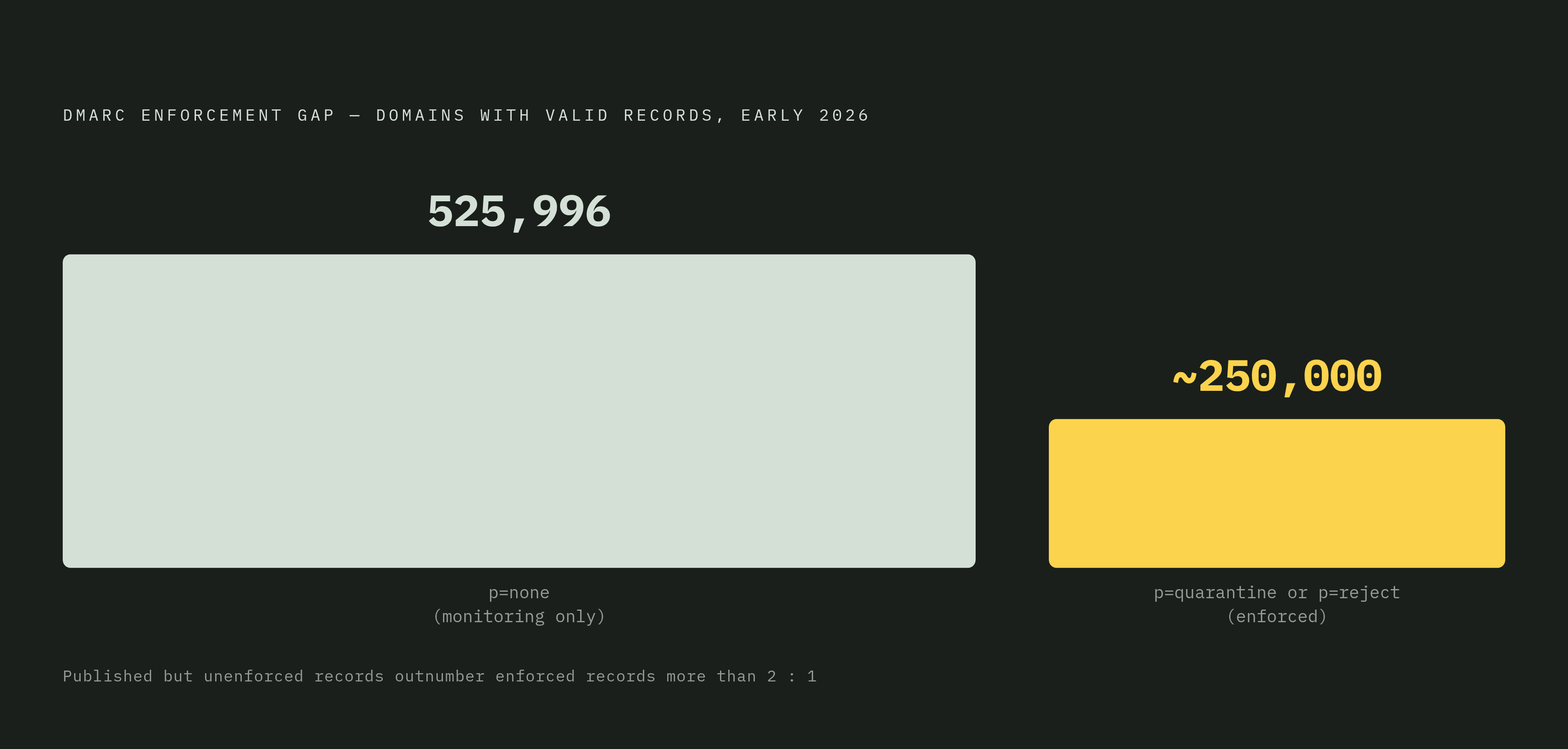
State of Email Authentication 2026 found that 525,996 domains with valid DMARC records in early 2026 remained at p=none, representing more than half of the domains studied. Published records had outpaced enforced records by nearly two to one. The gap is substantial. Organizations are adding the mechanism for protection faster than they are activating it.
A monitoring-only policy does not request that spoofed messages be quarantined or rejected. Other receiving-side defenses may still intervene, but the domain owner’s DMARC policy supplies no barrier. The record also makes that absence of enforcement visible.
Teams usually have the technical tools they need but struggle to coordinate the work. Fast-growing companies accumulate SaaS sending platforms faster than they coordinate authentication, while dedicated email security teams are common at Fortune 500 organizations and rare in the mid-market. A domain may have one DNS owner but many business units deciding who can send mail on its behalf.
Why moving to enforcement breaks legitimate mail and how that happens
Third-party platforms cause most alignment problems. CRM, marketing automation, customer support, payroll, and survey tools may send legitimate messages without properly aligning SPF or DKIM to the organization’s domain. The platform can authenticate its own identity successfully while failing to authenticate the identity shown to the recipient. Turning on enforcement exposes that mismatch immediately.
Subdomains create a parallel trap. A root-domain DMARC policy extends to subdomains by default, but SPF and DKIM authentication do not inherit in the same way. Separate sending systems using subdomains need their authentication configured independently. Meanwhile, SPF has a 10-lookup limit, so a growing chain of vendor includes can exhaust the lookup budget and cause authentication failures. A record can look comprehensive while being structurally unable to do its job.
When legitimate messages begin landing in spam, pressure to restore delivery can push the team back from p=quarantine to p=none. The rollback treats the symptom by removing enforcement. It does not repair the missing alignment. Nor is quarantine a final answer, because spoofed messages can still reach spam folders and be opened. Teams should sequence discovery and repair before enforcement and retain the policy that exposed the gaps.
Mapping every sending source before touching the policy
For a team preparing to enforce DMARC, aggregate reports are the starting point. During p=none, they reveal IP addresses sending mail that claims the domain in the From header, together with SPF and DKIM results per source. Teams should watch reports for 30 to 90 days that cover major sending periods, including spikes tied to seasons or campaigns. A quiet week is not a complete inventory.
The inventory needs to cover more than corporate mail servers. Marketing platforms, CRM and sales automation tools, customer support ticketing systems, transactional email services, HR and payroll platforms, and survey tools all need explicit attention. Each source needs an alignment assessment. Does its envelope-from domain align for SPF, and does its signing domain align for DKIM? A legitimate source failing both checks is a future enforcement casualty.
Reports also need business context. A forgotten marketing subdomain or a vendor tool bought without IT’s help may look unfamiliar even though it poses no threat. Conversely, appearing in a report does not establish that a sender is authorized. Teams must reconcile report data with the people responsible for the systems, so that the inventory is verified. This work spans teams because the people who buy a sending service rarely also manage DNS.
Resolving SPF and DKIM alignment failures before advancing policy
Once the inventory is in place, each legitimate source needs a way to pass authentication that aligns with the visible From domain. For third-party platforms, teams should first check whether they support custom DKIM signing. Most modern platforms support it. The configuration should use a key of at least 2048 bits, register the selector in DNS, and verify that the signing domain aligns with the From header domain.
SPF repair requires attention to the lookup budget. Flattening resolves vendor includes into their underlying IP addresses and publishes those addresses directly, reducing lookups while preserving authorization scope. It is not maintenance-free. If vendor IP ranges change and the flattened record stays the same, mail that was authorized before can fail SPF. Teams also need an explicit subdomain policy, using the sp= tag rather than leaving the consequences of root-policy inheritance unexamined.
Some legacy senders cannot support custom DKIM and use a fixed envelope-from domain that does not align. Those systems force a decision before enforcement, either migration to a platform supporting alignment or acceptance that their messages will fail. There is no policy setting that repairs an incapable sender. Once these decisions and repairs are complete, the pct= parameter offers a controlled way to test enforcement against a fraction of failing messages before extending it to all of them.
The controlled progression from p=quarantine to p=reject
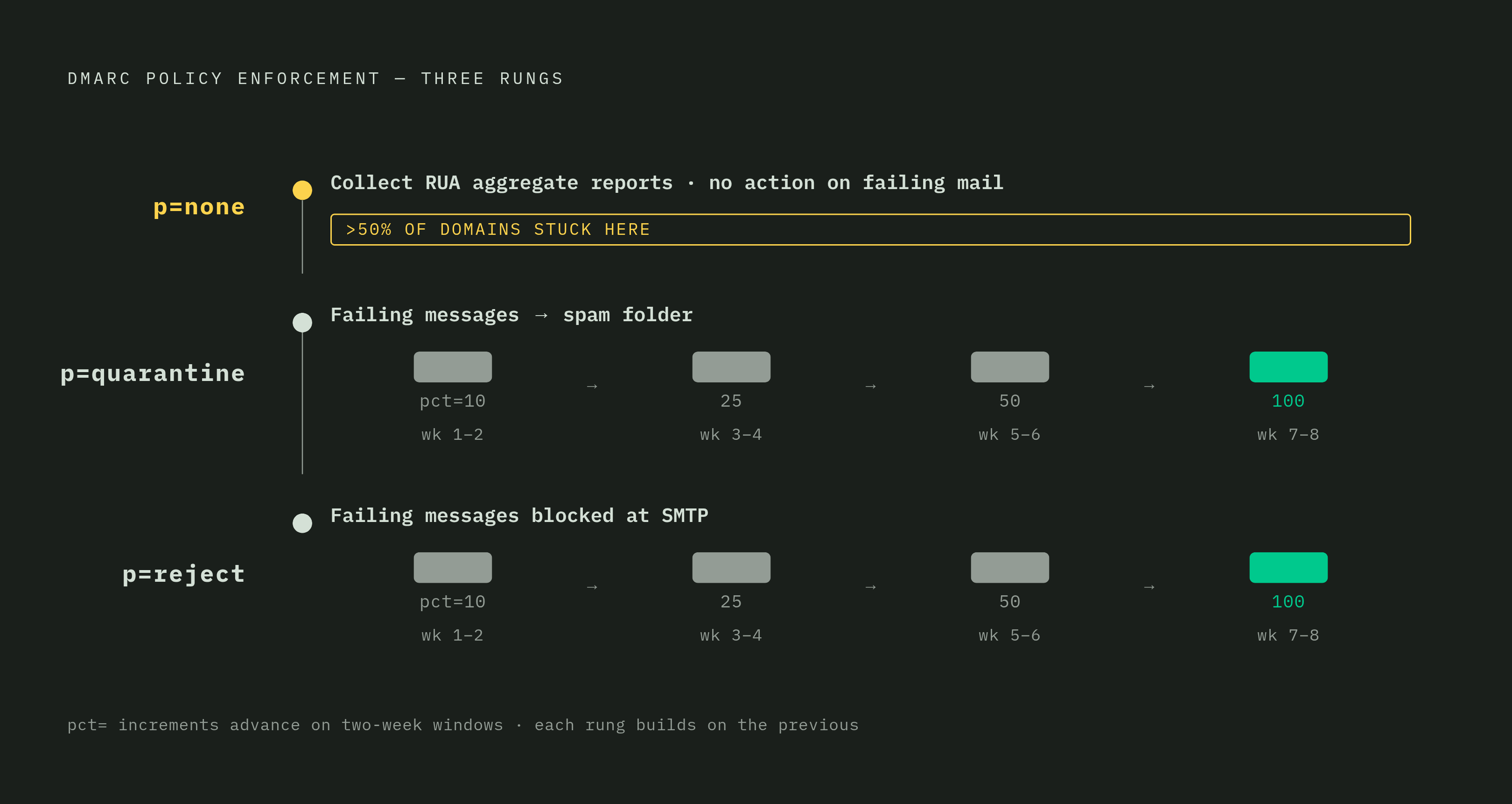
The recommended progression begins with p=quarantine at pct=10, with daily aggregate-report review for at least two weeks. If legitimate mail caught by quarantine is negligible, the percentage advances to 25, then 50, then 100 over successive two-week windows. Incremental rollout is the professional default. Failures during those windows point to a missed source or an incomplete repair.
Quarantine lets teams hear about missing mail because messages go to spam folders, where users may find and report them. Once p=quarantine at pct=100 remains stable for 30 or more days without reports of legitimate messages in spam, the progression can move to p=reject at pct=10 and repeat the incremental process. Rejection changes the feedback. The receiving server normally rejects failing messages at SMTP level, and the sending server receives a 5xx error. Rare, non-preferred implementations may silently drop them, making thorough quarantine validation especially important.
Full enforcement also unlocks a visible benefit. Brand Indicators for Message Identification, or BIMI, becomes available at p=quarantine or p=reject with pct=100 and a Verified Mark Certificate. Supporting inboxes can then display the organization’s logo. Reaching rejection is not itself the sole BIMI requirement, but completing the enforcement progression can support both domain protection and a recognizable inbox identity.
What DMARC enforcement measurably prevents and what it does not
At receiving servers that check and honor DMARC, p=reject blocks unauthorized messages impersonating the organization’s exact domain. That is a specific, valuable boundary. It does not stop lookalike domains, cousin domains, display-name spoofing using a different From domain, or phishing sent through compromised legitimate accounts. Those attacks need other controls because an exact-domain authentication check does not cover the ways they deceive people.
CISA’s BOD 18-01 made rejection policies a requirement for US federal domains, so enforcement became something they had to put in place. Where governments require enforcement, far fewer phishing messages have reached inboxes than in places without those mandates. The financial context is serious. The FBI IC3 2025 Report describes an April 2025 business email compromise incident in which an Oregon city government reported losing over $6 million, which was recovered through a recall. That case illustrates the stakes of impersonation, while DMARC’s ability to have prevented it on its own remains unproven.
AI-generated phishing increases the value of checking identity independently of persuasive writing. Messages tailored to each recipient can be made in large numbers, so what a message says is a less reliable reason to trust it. Authentication tests the domain claim. That boundary also covers third-party senders, so aggregate reporting helps teams check whether vendors that send mail on their behalf keep the required alignment in place.
Operationalizing DMARC as a continuous program, not a one-time project
At full rejection, the work shifts from preparing an inventory to keeping it accurate. New SaaS tools, campaign platforms, vendor changes, and acquisitions can introduce unauthenticated senders. RUA must remain configured and actively reviewed, with documentation that supports ongoing monitoring and audit readiness. Otherwise, the first sign of change may be legitimate mail failing delivery.
Key and record maintenance also continues. DKIM keys should rotate at least every six months, quarterly for high-volume or sensitive streams, and immediately when a signing vendor relationship changes. The old selector should remain live for at least seven days after cutover to protect in-transit messages, with retired selectors subsequently removed. Flattened SPF records also need updates as vendors change IP ranges.
This discipline fits the identity-first approach of Zero Trust, continuously checking whether a sending source is authorized rather than treating an established relationship as permanent trust. The DNS layer makes that policy operational because SPF, DKIM, and DMARC records are published there. Cloudflare is one option for managing those DNS records, with Zero Trust identity controls and gateway capabilities that can complement an enterprise authentication program.
AI agents that send outreach, notifications, or transactional messages need to be in the same inventory as other sending systems. As those workflows expand, their owners must coordinate authentication just as a marketing or payroll team must. DMARC enforcement is infrastructure maintenance, with no completion date attached.