Zero Trust Adoption Roadmap for Regulated Industries
Compliance mandates force a specific sequence that generic Zero Trust pitches ignore.

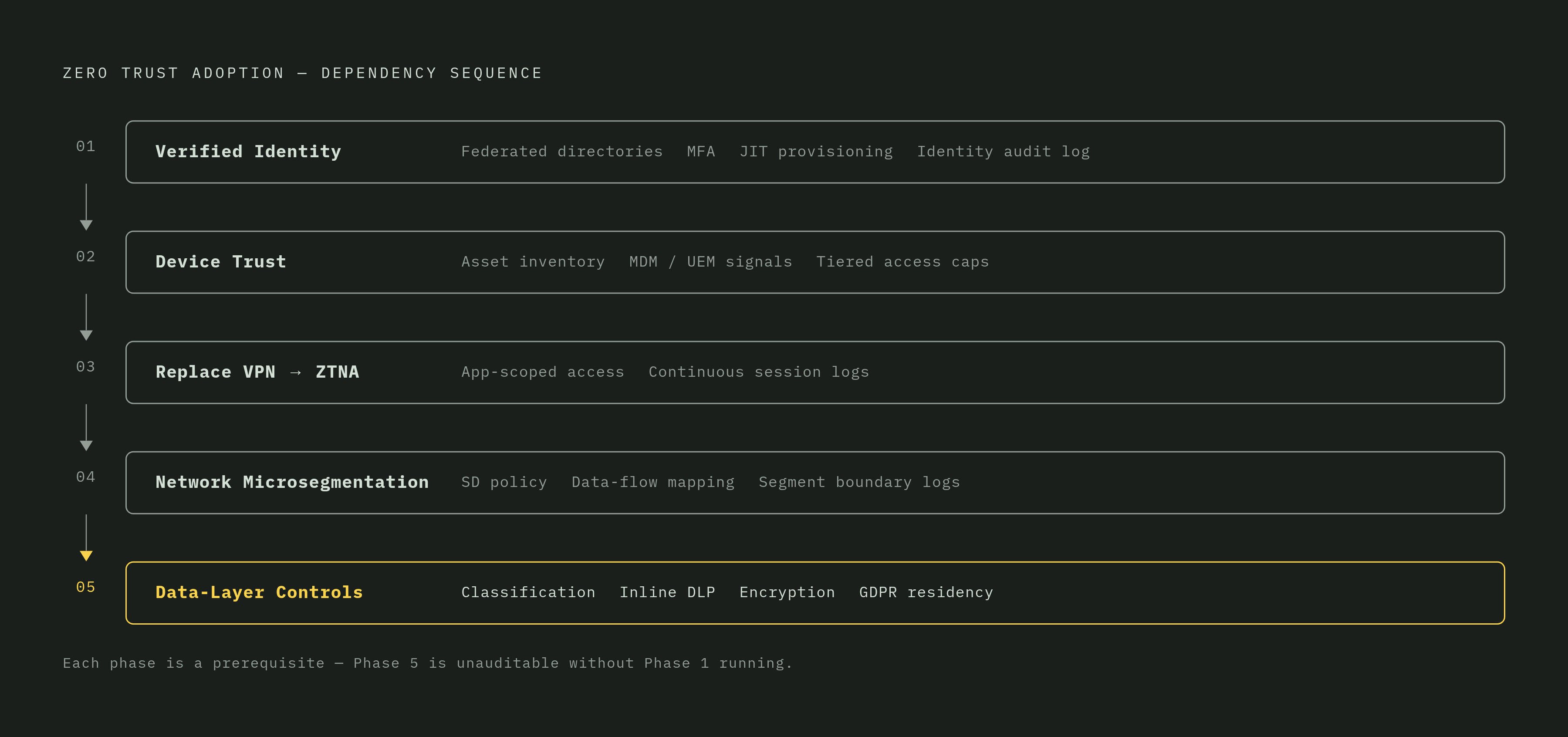
Zero Trust adoption in regulated industries doesn't follow the vendor pitch deck. Compliance mandates, audit obligations, and data sovereignty law force a specific order of operations, and if you skip a step, the whole chain becomes unauditable. This piece maps that order, phase by phase, and gets into why each one has to happen before the next.
The generic Zero Trust pitch says: kill implicit trust, verify every request, enforce least privilege. Fine advice, if you're writing a slide. But HIPAA, PCI-DSS, GLBA, FedRAMP, and CMMC don't just tell you what to protect; they tell you how the controls need to be documented and in what order they need to fire. A control has to be provable before you extend it, not bolted on after an assessor asks where the logs are. Data sovereignty rules, GDPR's cross-border transfer restrictions chief among them, restrict which architectural moves are even legal to attempt. On-premises setups still held over half of 2025 zero-trust spending, per Mordor Intelligence, which tells you regulated workloads don't just pack up and move to cloud-native controls because a vendor says they should.
Here's the tell. Gartner's 2023 forecast put only 10% of large enterprises on track for a mature, measurable Zero Trust program by 2026, even though most claim they already have an initiative underway. That's a lot of motion without much to show for it. Most of these programs are missing the identity, device, and workload pieces that regulators actually check, so the phases below are ordered by compliance dependency, not by whatever's easiest to buy and install this quarter.
The regulatory pressure actually driving adoption, and what it demands from an architecture
Executive Order 14028, signed in 2021, told federal agencies to adopt Zero Trust architecture by the end of fiscal year 2024. That single order set procurement budgets in motion and set the tone for private industry watching from the sidelines. The DoD Zero Trust Strategy raised the stakes further: every DoD contractor has to hit Target Level zero trust by FY 2027. Gartner still expects most U.S. federal agencies to miss full implementation through 2026, mostly for lack of funding and people who know how to do the work. Any contractor measuring their own rollout against Washington's timeline should take that as a warning, not a comfort.
The sector mandates ask for different things architecturally, and the differences matter more than people give them credit for. Healthcare, under HIPAA, needs audit logging on every access event touching PHI, segmentation that separates clinical networks from administrative ones, and resilience against ransomware; healthcare spending in this space is climbing at a steep rate annually because of it. Financial services, under PCI-DSS and GLBA, needs microsegmentation wrapped around the cardholder data environment plus continuous monitoring, and BFSI alone accounted for close to a quarter of 2025 zero-trust revenue. The defense industrial base, under CMMC, needs identity verification at every tier of the supply chain and zero standing privileges, full stop. GDPR's cross-border rules constrain where identity and policy decisions even get computed, a big part of why hybrid SASE models are growing faster than almost anything else in this market.
Strip away the acronyms and one demand repeats across every framework: access decisions that are logged and provable, not just technically enforced. A firewall rule nobody can produce evidence for during an audit might as well not exist.
Identity sits underneath all of it. Microsoft's Digital Defense Report 2025 found password-based attacks make up 99% of roughly 600 million daily identity attacks. The attack surface regulators care about most is the one most organizations wire up last, which is backwards, but it's also why identity has to be Phase 1.
Phase 1, establishing a verified identity layer before anything else moves
Compliance frameworks audit access by identity. If your identity records are incomplete, inconsistent, or split across three directories that don't talk to each other, no log you produce downstream will hold up. Tailscale's 2025 survey of hundreds of IT and security professionals found only a third of organizations run just-in-time access, and roughly a quarter enforce least privilege with manual approval workflows. That's the widest gap in the entire Zero Trust stack between what companies say they do and what they actually run.
The work here is unglamorous. Federate every identity provider, Active Directory, Okta, Azure AD, whatever mess has piled up over the years, into one authoritative directory. Turn on MFA everywhere, and push for phishing-resistant methods like FIDO2 or WebAuthn on anything touching privileged accounts or regulated data. Build just-in-time provisioning so accounts exist only for the length of a session and disappear afterward, instead of sitting around as standing privileged credentials waiting to get stolen. Build the identity audit log first, timestamps, authentication method, device context, because every later phase depends on that evidence trail.
Companies keep making the same mistake: putting off privileged access management until network controls are in place. Regulators check PAM first, not last. HIPAA's minimum necessary standard and CMMC's AC.2.006 both demand documented least-privilege assignments, and the log built in this phase is what satisfies both.
Phase 2, device trust as the second verification dimension regulators require
A verified user on an unverified laptop is still a hole in the fence. CMMC Level 2 and above, along with PCI-DSS 4.0, require endpoint security posture as a condition of access, not a courtesy check after login. In regulated environments, the device inventory itself is usually the first problem: contractor laptops, personal phones, that one unmanaged Chromebook someone in accounting refuses to give up. You can't check posture on a device you don't know exists.
Start with a full inventory: managed, unmanaged, contractor-owned, all of it. Feed MDM and UEM signals, OS patch level, disk encryption status, EDR enrollment, straight into the access policy engine. Define posture tiers, fully managed corporate device, managed contractor device, unmanaged device, and cap the access scope for each tier accordingly. Block or sandbox unmanaged devices at the policy layer instead of some network chokepoint. That shift, from thinking in perimeters to thinking in policy, is the whole point of this phase.
Clinical workstations and OT/ICS endpoints complicate things, since plenty of them can't run an endpoint agent at all. Policy has to account for device classes that will never be "fully managed" the way a laptop is. The output here is a device compliance report tied to every access event, paired with the identity log from Phase 1. Together, they satisfy HIPAA's workstation security standard and PCI-DSS Requirements 8 and 12.
Phase 3, replacing VPN with Zero Trust Network Access across the workforce
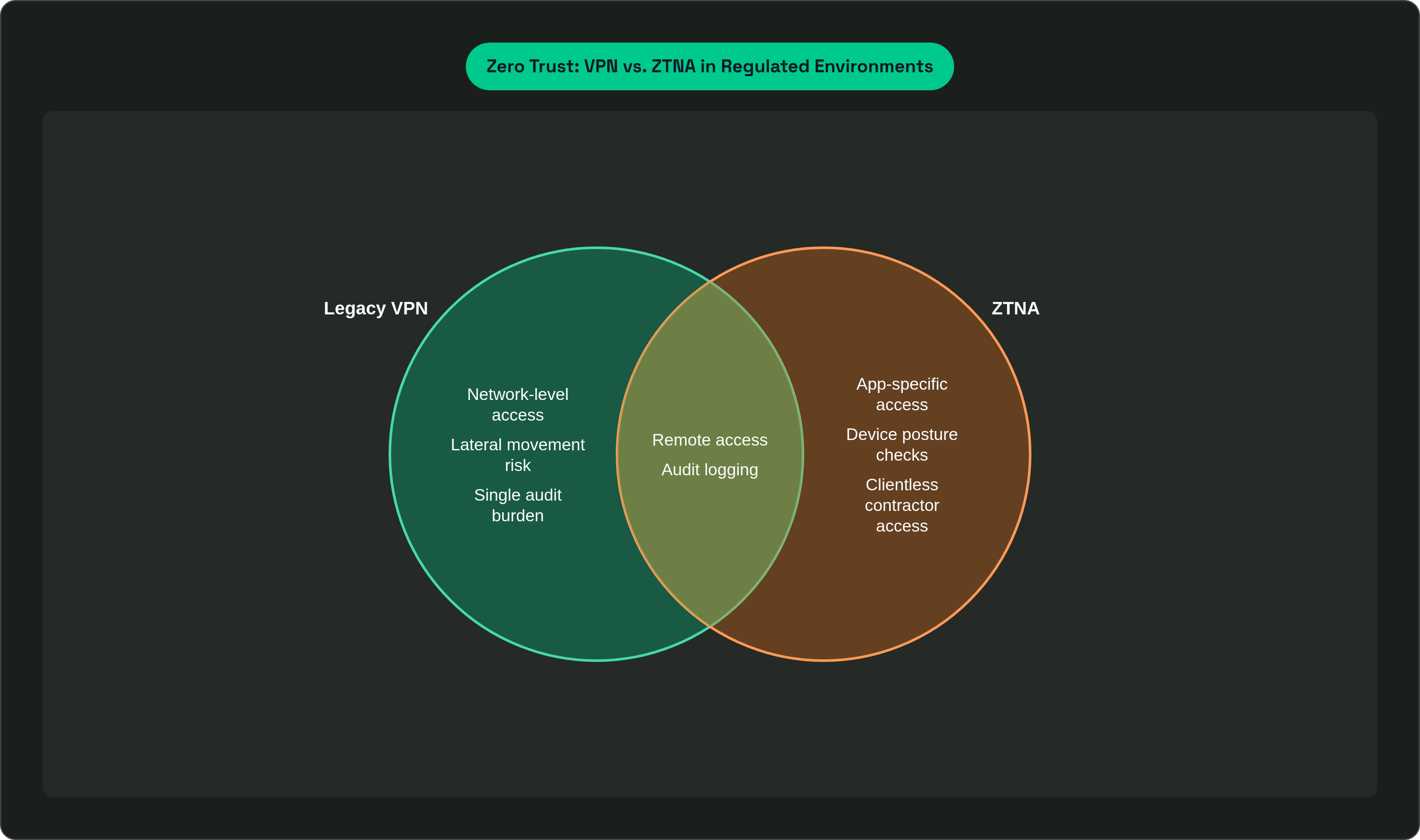
VPNs are worse in regulated environments than the general case, and the numbers back that up. Zscaler's ThreatLabz 2025 report found 56% of organizations reported a VPN-exploited breach in the prior year, a sharp jump from where that number sat a few years back. The problem is architectural: VPNs grant network-level access, so once someone's in, lateral movement toward the regulated data store is unrestricted and often unlogged at the application layer. Tailscale's 2025 State of Zero Trust report found legacy VPNs still account for 41% of company usage, meaning most regulated organizations are running VPN and ZTNA side by side during the transition. Nobody enjoys running two access systems at once, and it shows.
ZTNA fixes the blast radius problem by design. Users get access to a specific application, not a network segment, so a stolen credential compromises one app instead of the whole subnet. Every grant gets logged with identity, device posture, application, and time, which satisfies the continuous monitoring language in FedRAMP and CMMC. Clientless, browser-based access covers contractors and third parties who can't install an agent, which in regulated supply chains is nearly everyone outside the core team.
Migration has to happen in order. Run ZTNA alongside VPN at first, and don't cut over until every application dependency is mapped; breaking a clinical scheduling app at 2 a.m. is a bad way to discover an undocumented dependency. Move the lower-sensitivity applications first to prove the model works before touching anything with regulated data behind it. Decommission VPN segments only once the ZTNA path is confirmed stable. Don't leave both running indefinitely out of caution, since that just doubles your attack surface and your audit burden. Zscaler's 2025 report found 65% of organizations plan to replace VPN within the year, so the market's already moving. Regulated industries just need to move slower and check their work more.
Phase 4, network microsegmentation to contain lateral movement inside the perimeter
ZTNA alone doesn't satisfy segmentation requirements, and treating it like it does is a common, expensive mistake. PCI-DSS wants network-level isolation of the cardholder data environment specifically; application-layer policy helps but doesn't check that box on its own. HIPAA's technical safeguards require access controls, audit controls, and transmission security for PHI systems, but stop short of explicitly demanding network-level isolation from the rest of the enterprise. Segmentation still has to happen, on its own terms, no matter what ZTNA already covers.
Start by mapping data flows, not network diagrams. Where does regulated data actually move: payment processing nodes, PHI systems, all of it. Define segments by how sensitive the workload is, not by whatever the existing network topology happens to look like, and treat traffic moving between segments with the same scrutiny as traffic coming in from outside. Use software-defined policy rather than VLAN-based segmentation, since VLANs can't be audited at the application layer, and an auditor asking you to prove it is not a hypothetical. In OT and ICS environments, especially in healthcare and critical infrastructure, segment by protocol; ICS traffic should never mix directly with enterprise TCP/IP flows without a policy enforcement point sitting in between.
That on-premises spending figure from Mordor Intelligence matters again here: microsegmentation tooling has to work inside the physical data center, not just in a cloud console. The output of this phase is network flow logs proving no traffic crossed a segment boundary without policy authorization, the specific evidence PCI-DSS Requirement 1 and the network pillar of NIST SP 800-207 ask for.
Phase 5, data-layer controls and the compliance obligations that require them last
Data controls go last for a reason that runs deeper than tidy sequencing. Classifying data properly means knowing who's accessing it and from where, which means the identity layer and the device layer already have to be working. Try to retrofit classification onto access flows you never controlled in the first place, and you end up with an inventory full of holes. Worse, DLP rules that fire without any upstream context throw off false positives at a rate that buries compliance teams; people stop trusting the tool within a month.
The work here: classify data at rest and in motion by regulatory category, PHI, PII, PCI scope, CUI, since each carries its own handling and logging rules. Put inline DLP at the secure web gateway layer so outbound traffic gets checked for regulated data patterns before it leaves the building. Make encryption in transit and at rest a hard policy condition, not a best-effort line in a slide deck. For GDPR specifically, document the legal basis behind every cross-border transfer and confirm your enforcement points actually honor data residency limits. Hybrid SASE architectures handle this by keeping the policy logic local while still centralizing visibility, part of why they're growing so fast.
Shadow AI is the newest crack in this layer, and it's a big one. IBM's 2025 Cost of a Data Breach Report found organizations with ungoverned shadow AI paid roughly $670,000 more per breach, on average, than those without it. An employee pasting patient records into an unapproved chatbot is a DLP failure, and DLP has no chance of catching it without identity and device context feeding it clues from earlier in the chain.
Put all five phases together and you get a logged, policy-enforced chain: user identity, device posture, application access grant, network segment, data interaction. That's the evidence trail auditors actually want, and it's also the trail most organizations, whatever they tell their board, cannot currently produce end to end.
Integrating SASE as the operational layer that holds the phases together
SASE is what keeps these five phases from turning into five separate vendor consoles nobody has time to reconcile. It folds ZTNA (Phase 3), secure web gateway with DLP (Phase 5), CASB, and SD-WAN into one control plane with one logging system. Gartner found that consolidating five previously separate controls into a single SASE fabric cuts ongoing network security operating costs by 40%, a number that gets a CFO's attention well before the compliance argument does.
The compliance argument holds up on its own, though. Fragmented tooling means fragmented logs, and every tool has its own schema, its own retention policy, its own API quirks. Correlating five different log formats for one audit is slow, manual work, exactly the kind of process where mistakes creep in at the worst moment. A single SASE platform produces one normalized event stream that feeds a SIEM with the full picture already stitched together: who, what device, what app, what data, what path across the network.
Hybrid SASE earns its keep on data residency specifically. Sensitive data processing stays on-premises or in-region, while policy enforcement and identity checks route through the cloud fabric. That split satisfies GDPR and sovereign cloud rules without giving up centralized visibility, something that used to feel like a contradiction in terms. Financial services held over a quarter of 2025 SASE spending, and healthcare and life sciences make up the fastest-growing segment, both leaning hard into the hybrid model for exactly this reason.
Cloudflare is one of eight vendors that cleared Forrester's bar for a fully integrated SASE platform in the Forrester Wave: SASE Solutions, Q3 2025, covering SD-WAN, SSE, and ZTNA in a single fabric across more than 335 cities. For regulated organizations, that kind of consolidation isn't a nice-to-have. Audit complexity is the cost center nobody budgets for correctly, and fewer systems to reconcile before a filing deadline makes the whole process less painful for everyone involved.