Local Development Environments That Match Edge Runtime Behavior
Developers unknowingly ship edge bugs because local environments hide real production constraints.
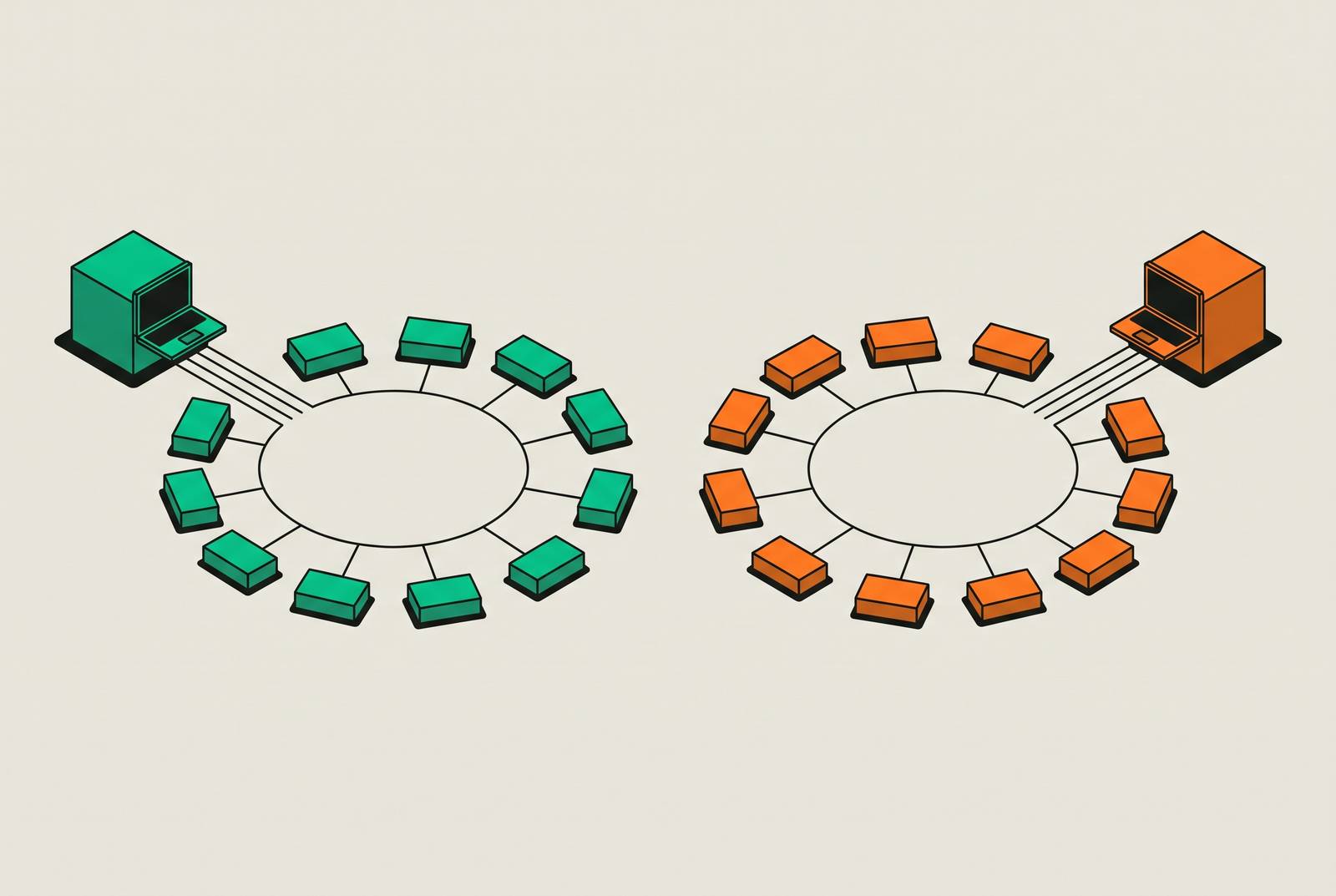
Edge bugs rarely announce themselves as bugs. Code passes every test, deploys without a hitch, then quietly misbehaves in production while the logs stay clean. The environment lies to the developer about what production actually looks like. A local machine runs code with no network hops, no CPU budget, and no distributed cache, so anything that depends on those constraints simply won't fail until it's live and users are watching. Fixing this means building a local setup that mirrors the edge's actual limits instead of a generic dev server that happens to run the same files.
Three kinds of mismatch cause most of the damage. Timing assumptions break because a laptop executes everything instantly, with no real network between a function call and its data. Runtime constraints go untested because nothing locally enforces the CPU ceilings or memory limits the production edge imposes on every isolate. And distributed state, meaning cache invalidation, replication lag, eventual consistency, has no honest local stand-in at all; there's nothing on a laptop that behaves like a fleet of edge nodes arguing about which one has the freshest copy of a key.
Take a chain of five sequential database calls. On a laptop, that chain finishes before a developer can blink, because there's no wire between the code and the data. In production, each call crosses a real network to a real region, and those costs stack. Five calls at 20 milliseconds each is 100 milliseconds a user feels; locally it reads as zero every time. No unit test catches that, because the test was never measuring the thing that matters.
Edge runtimes make this worse than a typical cloud deploy would, on purpose. They run on V8 isolates, not containers, with CPU time metered per request instead of wall-clock time on a server that never sleeps. The gap between "runs on a laptop" and "runs on the edge" is wider than most developers expect, and the failure modes are less familiar because the whole architecture is different from the VM-shaped mental model most people carry around.
What the edge runtime actually constrains that your laptop does not
The isolate is the whole story. Containers boot an OS image or at minimum a Node process; V8 isolates share a process and start extremely quickly, which is why edge platforms can spin up thousands of them without blinking. That speed comes at a cost: CPU time is budgeted per request, not amortized over a server's lifetime, and there's no shared mutable state between requests by design. There is no shared mutable state between requests by design. Locally, none of this is enforced, so a handler that burns through a heavy JSON transform or a large regex will run fine on a dev machine and then time out the moment it hits the real CPU budget in production.
The API surface is narrower too. Edge runtimes expose a Web-standard set of APIs, with compatibility shaped by efforts like WinterCG, not the full Node.js standard library. Reach for a Node built-in that isn't part of that surface, and a permissive local runner might let it slide, only for the deployed Worker to throw an error the first time a real request hits it.
Timezone handling is a quieter trap. Production edge runtimes run in UTC no matter where the request originated or where the code was written. A developer working on a machine set to Pacific time can write date logic that looks correct locally and produces the wrong day, or the wrong hour, once it's running on infrastructure that doesn't know or care what timezone the developer's laptop thinks it's in.
Then there's KV. Writes in one region take real time to propagate globally, so a key written in Amsterdam might not be readable in Singapore for a stretch of time that varies but is never zero. A local emulator, having no regions to propagate between, returns the value instantly. The race condition this creates in production simply doesn't exist on a laptop, so no local test will ever surface it.
Cache semantics follow the same pattern. The edge cache spans a large, distributed fleet with real invalidation logic, real TTL expiry, and stale-while-revalidate behavior that depends on which node answered the request. Locally, the Cache API can be exercised, but exercising the API contract isn't the same as exercising the cache layer it's supposed to represent. Purges behave differently, staleness windows behave differently, and none of that shows up until deploy.
How Wrangler and Miniflare close the gap by running the real runtime locally
The fix for most of this is honesty about what's running underneath the local dev command. Wrangler and its Vite plugin both use Miniflare, and Miniflare runs workerd, the open-source C++ runtime that actually executes Workers in production. It's the same engine, running locally.
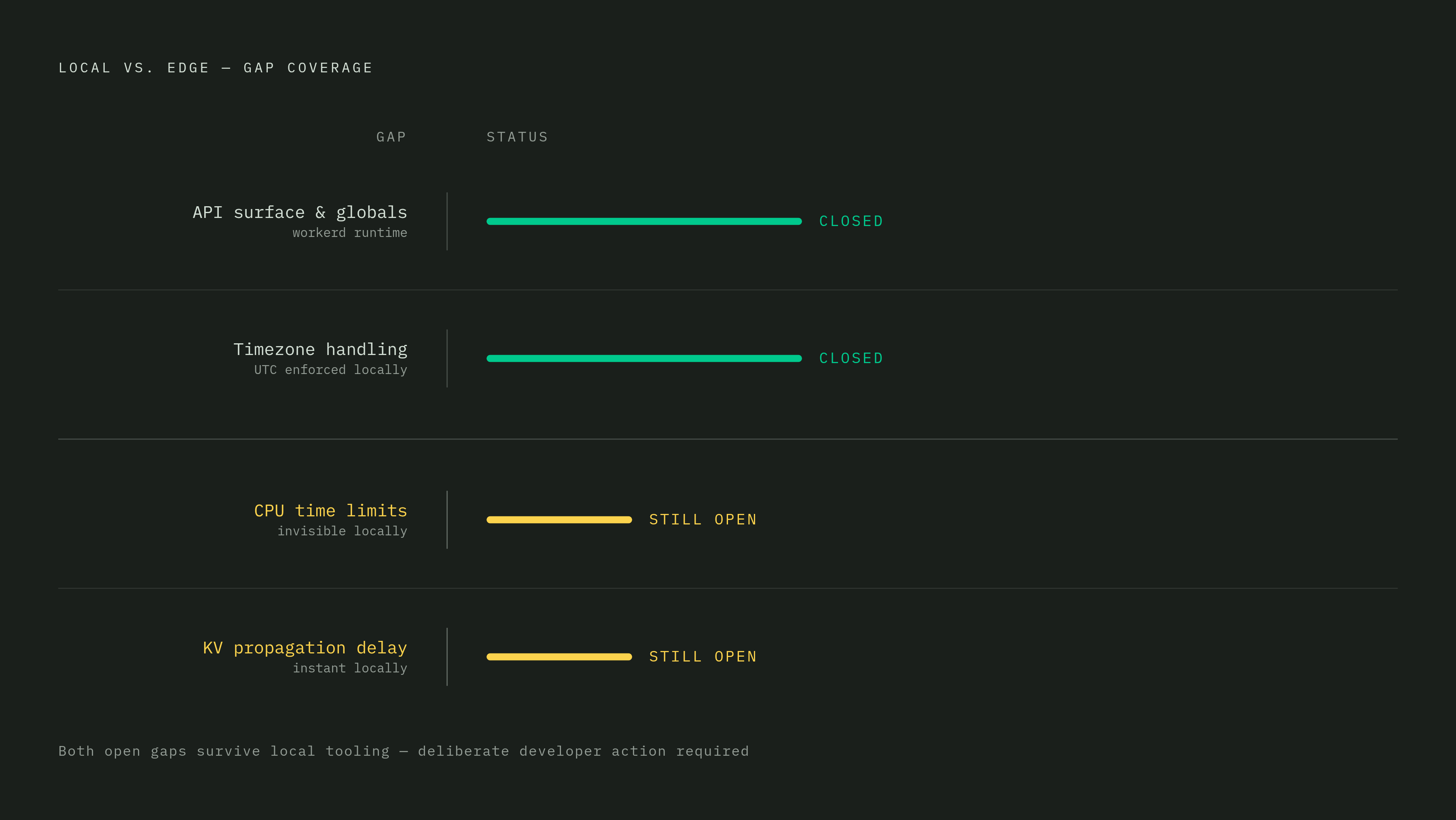
That single design choice closes several gaps automatically. Code runs against the same globals and the same Web APIs it will hit in production, so API surface mismatches show up immediately instead of at deploy time. Local workerd runs with TZ set to UTC, so date and time logic behaves the same locally as it will in production regardless of what timezone the developer's laptop is set to. Bindings for KV, D1, Durable Objects, and R2 are emulated using the same underlying code paths as production, not hand-rolled stand-ins that drift from reality over time.
Hot reload and a one-command deploy make this the default workflow rather than an extra testing step nobody bothers with. That matters more than it sounds: tooling that developers have to opt into on purpose gets skipped under deadline pressure; tooling that's just how wrangler dev works gets used every time.
None of this touches the harder gaps, though. CPU time limits still aren't enforced locally, so a handler that would time out in production runs to completion on a laptop without a warning of any kind. Distributed cache behavior across regions isn't replicated, and KV propagation delay is still instant locally, so the eventual-consistency race condition described above is exactly as invisible under Miniflare as it was under a naive local server. The tooling closes the runtime gap, but the developer still owns the rest.
Running multiple Workers locally so Service Bindings and Tail Workers behave as they do in production
For a long time, Workers running in separate wrangler dev sessions couldn't talk to each other. Service Bindings and Tail Workers, the mechanisms that let one Worker call another or observe another's logs, had no honest local equivalent, so teams either mocked the calls with HTTP stubs or skipped testing that layer entirely and hoped for the best at deploy time.
That's changed. Wrangler now accepts multiple config files in a single dev session, which brings several Workers into one local environment where they can call each other directly through Service Bindings, the same way they will in production.
This matters because Service Binding calls in production route through the real binding infrastructure rather than over an external HTTP hop. Testing that same call path through an HTTP mock locally introduces latency and failure behavior that has nothing to do with how the call actually performs once deployed. Getting the real binding into local dev means the thing being tested is the thing that ships. Tail Workers, the logging and observability layer, can now be attached locally too, so error-capture and log-shipping logic gets checked before deploy instead of being discovered broken after an incident.
The practical setup is mostly config: naming each Worker as a service and wiring the binding fields so one config references another by name. The mental model shift matters more than the syntax: treating each Worker as a named service in a small local network rather than an isolated process that happens to run on a port. That opens the door to developing and debugging more complex architectures end-to-end locally, including systems where a single gateway Worker routes requests out to several specialized downstream Workers, or agentic pipelines that fan out across multiple isolates before returning a result.
Using the remote bindings toggle to test against real data before deploying
Wrangler always executes Worker code on the local machine; what changes is whether the bindings that code talks to point at local simulations or real deployed resources. That's the entire distinction, and it's worth being precise about it, because conflating "where the code runs" with "where the data lives" is how developers end up confused about what they're actually testing.
Real data has a way of looking nothing like seeded fixtures. Production D1 tables accumulate schema edge cases nobody wrote a fixture for; R2 objects vary wildly in size in ways a handful of test files never will; KV namespaces develop referential patterns that only emerge at scale. Flipping bindings to remote lets a developer run local code against that real shape of data, and real timing, before deploy, catching a class of bug that no local fixture set would ever produce.
The risk here isn't subtle: remote bindings point at real resources, so writes through them are real writes. That demands explicit environment separation. A staging KV namespace and a non-production D1 database aren't optional nice-to-haves, they're the only thing standing between "testing against real data" and "corrupting production data by accident." The workflow that actually works is staged: iterate locally against simulated bindings first, flip to remote bindings against staging once the logic seems sound, then deploy. Each stage catches a different category of mistake, and skipping a stage just means finding that category's bugs later and more publicly.
Remote bindings still don't enforce CPU time limits, worth repeating because it's the one gap that follows a developer through every stage of this workflow. Real data doesn't mean real limits, and that gap needs deliberate profiling, not a toggle.
Simulating the constraints that the runtime won't enforce for you
CPU limits require the developer to go looking for the problem, because nothing local will flag it automatically. That means profiling CPU time during development, not just eyeballing wall-clock speed, and treating any synchronous operation that scales with input size, a loop over a large array, a regex against a long string, a recursive parse, as a suspect until proven otherwise. The Workers runtime exposes its own performance timing APIs for exactly this reason; using local execution speed as a stand-in for CPU cost is the mistake that gets caught in production instead of before it.
Latency needs the same deliberate simulation. Start by counting every database round-trip in a request path; any pair of calls that doesn't depend on the other's result should run in parallel, and finding those pairs is a code-review exercise, not a testing one. Then add artificial delay into local binding wrappers, even a rough fixed delay per call, to approximate the network hop to a real D1 instance. That alone tends to surface which code paths turn unacceptably slow once real latency is added back in. The number that matters is never a single call's latency; it's the sum across the whole request, the same sum that turned five fast local calls into a 100-millisecond wait earlier in this piece.
Cache testing has a hard ceiling locally: the Cache API contract can be exercised, but the actual multi-region invalidation behavior of the production cache cannot be replicated on a laptop. That calls for separate integration tests run against a staging deployment, checking TTL expiry and stale-while-revalidate behavior in an environment where those things are real. KV deserves the same suspicion. Any code path that writes a value and then immediately reads it back should be treated as a potential race, and the fix isn't smarter timing tricks, it's designing the code to tolerate a stale read in the first place. Even though workerd enforces UTC locally, date-formatting logic touching user-facing strings should still get tested with explicit UTC inputs; runtime enforcement is a backstop, not a substitute for a test that actually checks the output.
Local development discipline for Durable Objects and stateful agents
Durable Objects complicate local parity in a specific way: each object is addressed globally with its own storage attached, and while local emulation reproduces the storage and the addressing scheme, it can't reproduce the geographic placement that decides which real datacenter the object actually lives in. Hibernation adds another wrinkle. Objects that go idle and suspend, then wake on demand when a new request arrives, do hibernate locally, but the wake latency observed on a laptop bears little resemblance to production wake times. Tests written around fast local wake behavior can pass every time locally and then degrade the moment production hibernation patterns kick in.
The agents SDK pattern leans on this architecture directly: each agent is a Durable Object with embedded SQL storage, WebSocket connections for live UI updates, and alarm-based scheduling for anything that needs to run later. All of it can be exercised locally. What can't be skipped is seeding realistic state ahead of time, because schema and migration bugs hide in the gap between an empty local database and a production one that's accumulated months of real records.
Workflows add a durable, multi-step execution model with retry, sleep, and resume built in, and that model has its own local blind spot: step output size limits. A step that returns a large payload works fine locally and fails once deployed; the fix is writing large outputs to object storage and passing back a reference instead of the payload itself. Retry and failure paths need explicit local testing too, not just the happy path, because Workflows' durability guarantees only mean something if the step logic underneath is actually idempotent. Worth remembering on the billing side: Workflows charges for active CPU time, so a workflow sleeping or waiting on external input costs nothing while it waits. Local development should reflect that as a correctness question, not a cost one; a sleep step isn't "free wall-clock time" to skip testing, it's a state the code needs to resume from correctly.
Treat local SQLite state for Durable Objects as a schema artifact worth taking seriously in its own right. Run real migrations locally, seed data that looks like production data, and confirm the agent's state machine handles missing or partial state without falling over.
Applying the same environment-parity discipline to AI inference and MCP tool calls
Workers AI and AI Gateway bind into a Worker like any other resource, but the local-versus-production gap here is primarily about behavior. A model running locally, or worse, a stub that always returns the same canned output, will never reproduce the nondeterminism of a real inference call, the latency variance between requests, or the specific ways a production call fails. Testing only the success path means the failure path, what the agent does when inference returns an error, a malformed response, or a timeout, ships untested.
AI Gateway sits in front of LLM providers and handles caching, cost tracking, fallback routing, and prompt-injection guardrails without requiring changes to client code. Skipping it locally to save a step means skipping the logging and audit trail it generates, which is production behavior that never gets checked before it matters.
MCP tool calls open a different kind of risk entirely: every MCP connector is a potential entry point into an internal system, and local testing needs to exercise the authorization controls around that connector, not just confirm the tool invocation works when everything behaves. Default-deny write controls are far easier to catch locally, where a mistaken write can be undone, than in production, where it can't. The governance pattern worth building toward is a centralized MCP platform where each tool definition gets reviewed once before it reaches any agent, inheriting rate limits and role-based access from a shared template rather than being configured ad hoc every time.
None of this local testing reproduces what happens at scale: the population-level nondeterminism of a large model, its behavior under real concurrency, or the latency profile of a genuine remote inference call. Those need a staging or canary deployment, since local testing catches the failure paths but can't catch what only shows up under real load.
Building the pre-deploy checklist from everything the local environment cannot guarantee
The checklist writes itself once the gap categories are clear, and it should be organized around them rather than around the codebase's file structure. On timing and latency: has every sequential database call been checked for a parallelism opportunity, and has artificial latency been added somewhere in the local stack to reveal which aggregate paths turn slow under real network conditions? On CPU budget: has handler CPU time actually been profiled, using the runtime's own timing APIs, rather than inferred from how fast the handler feels on a laptop?
On distributed state, has every write-then-read code path been reviewed for the eventual-consistency race that local KV emulation can't produce, and has stale-read tolerance been designed in rather than assumed away? On caching, have TTL and invalidation behavior been checked against a staging deployment rather than trusted from local Cache API tests alone? On Durable Objects and Workflows, have migrations actually run against seeded, realistic state, and have retry and failure paths been tested on purpose, not just the case where everything succeeds on the first try?
And on AI and MCP tool calls: have the failure paths, the timeouts, the malformed responses, been tested with something other than a stub that always says yes, and does every MCP connector carry an authorization check that's been exercised locally before it ever reaches a production agent? None of this is exotic. It's a direct list of every constraint the local environment quietly declined to enforce, turned into questions a developer answers on purpose instead of finding out the hard way after the deploy button's already been pressed.