Data Residency Constraints in Cross-Border AI Inference
Hosting AI models abroad can quietly violate data protection laws with every API call.

I've spent the last two years watching engineering teams discover, usually around 2 AM during an incident review, that their "search query" to a hosted model is actually a regulated cross-border data transfer. Nobody plans to violate GDPR; it just happens quietly, one API call at a time, while everyone assumes someone else read the fine print. A prompt carrying a customer's account history becomes data in active processing the second it leaves your network, and the law had a name for that before your company existed.
That reframe changes what "compliance" means for anything running inference. GDPR's Chapter V doesn't care whether data moved as a database export or a JSON payload riding an API call. It cares whether personal data crossed a jurisdictional line without a lawful basis, full stop. Agentic workflows make the math worse, and this is where most teams get caught flat. Conversation history, documents pulled in through retrieval-augmented generation, agent memory: it all piles up inside a session and recrosses borders every time the agent takes another step. Run a ten-turn conversation through a RAG pipeline and you've racked up ten or twenty separate transfers, each one needing its own paper trail.
The concurrent compliance problem no sequential policy can solve
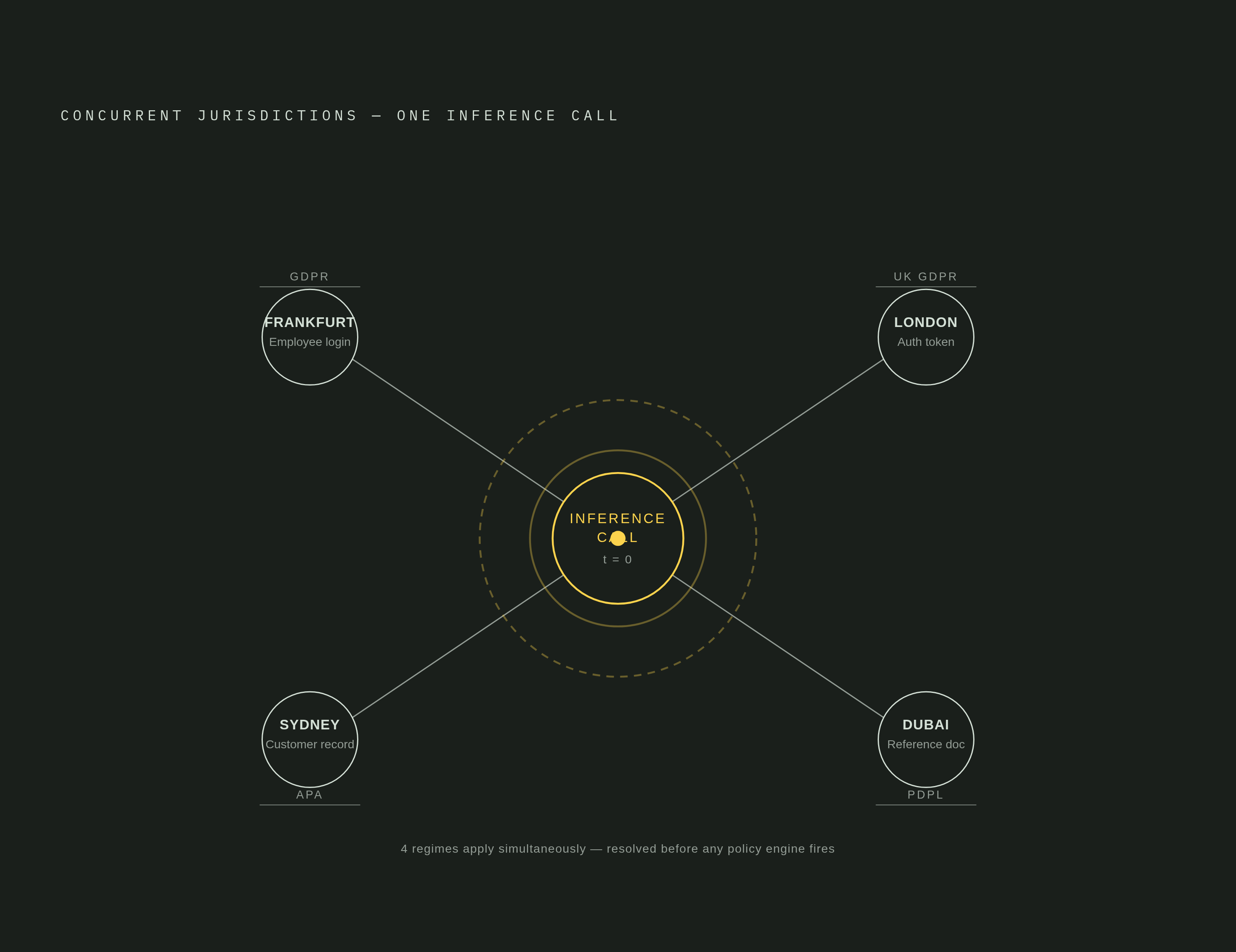
Try this: one inference call, four jurisdictions. An employee logged in from Frankfurt, a customer record pulled from a database in Sydney, a reference doc stored in Dubai, an auth token issued in London. Four privacy regimes apply to that single call, at the same instant, because the request has to route somewhere before any policy engine gets a vote.
Most enterprise governance still assumes batch transfers and storage decisions. A data engineer schedules an export, a lawyer reviews it, the transfer happens hours or days later with time to think it over. Inference doesn't work like that. By the time a policy check could theoretically fire, the call has already been routed, processed, and handed back to the user.
The 2025 numbers aren't subtle about the scale of the mess. Roughly one in three organizations reported a data sovereignty incident in the past year, and only about a third say they have full visibility into where their data actually lives. Put those two next to each other and you get a governance system that doesn't know what it's governing, which is a strange thing to still call governance.
How GDPR and the EU AI Act together tighten the compliance floor for inference
GDPR's transfer mechanisms, Standard Contractual Clauses, Binding Corporate Rules, adequacy decisions, apply to inference exactly the way they apply to a database migration. The regulation never cared about payload format. Most companies running production traffic through a third-party model API have never documented which mechanism covers that traffic, mostly because inference never made it onto anyone's checklist. It didn't feel like a transfer; it felt like calling a function.
The European Data Protection Board closed that loophole in April 2025, finding that large language models rarely meet the bar for true anonymization. That finding matters more than it sounds like it should: if you can't assume the data in a prompt has been de-identified or made unrecoverable, every prompt containing personal data gets treated as personal data. No exceptions for good intentions, and none for good engineering either.
Another layer stacks on top from the EU AI Act. General-purpose AI providers have carried obligations since August 2025, and high-risk systems now need documented data governance and impact assessments before they go near production. Draft guidance from the European Commission went further in 2025, calling for technical measures that physically keep training data and outputs inside defined geographic boundaries for high-risk systems. Written requirement, not a suggestion, not a best practice.
Enforcement backs this up with real money. GDPR fines crossed the billion-euro mark cumulatively in 2025. That kind of penalty structure turns "we'll sort out compliance later" into a bet you're probably going to lose. Anyone serving EU users through a hosted model API needs to treat each inference call as a documented, lawful transfer. Finding out what "documented" means to a regulator after the fact is a bad way to learn anything.
The CLOUD Act gap that a European data center address does not close
Here's an assumption worth killing early: deploying to a US hyperscaler's EU region does not make your data sovereign. Compliance and sovereignty solve different problems, even when they show up wearing the same paperwork and the same sales deck.
The US CLOUD Act lets American law enforcement compel American companies to hand over data those companies control, regardless of where the servers physically sit. A data center in Frankfurt owned by a US company is still, legally, reachable by a US subpoena. Geography doesn't sever jurisdiction; ownership does.
So the real question is which country's courts can compel the provider, not which country hosts the rack. GDPR compliance is available to almost any provider willing to document a lawful basis and a valid transfer mechanism. Sovereignty is narrower and harder: it means no foreign government can reach the data through its own legal system, and that depends entirely on where the provider is headquartered and incorporated. An open-weight model served by an EU-based company on EU infrastructure can be both compliant and sovereign. The same model, served through a US-controlled API from the same physical data center, can be compliant and never sovereign. No amount of contract language fixes that gap.
Provider jurisdiction belongs in vendor selection as a first-order variable, right up there with model quality or price, and it needs deciding before the contract gets signed. No SCC, no DPA, closes this; it's structural. You solve it in the architecture, or you carry the risk forever.
How Asia-Pacific jurisdictions are fracturing the global inference map
China's PIPL, Article 38, gives companies three paths for cross-border transfer: a government security assessment, a personal information protection certification, or a standard contract filed with the Cyberspace Administration of China. Critical Information Infrastructure Operators don't get those three options at all; their data stays in China, no exceptions. Shanghai regulators handed down the first administrative penalty specifically targeting unlawful cross-border transfers in May 2025. Enforcement has moved from statute to precedent, and precedent is the part that should worry people.
India took a different road. The DPDP Rules, notified in November 2025, run on a negative list: transfers are allowed by default until the Central Government names a country as blocked. No blacklist existed as of mid-2026, so cross-border AI processing involving Indian data can largely continue for now. That permission exists purely at the government's discretion, and India is actively pursuing mandatory local storage for AI processing of its citizens' data. The blacklist power sits loaded, and nobody's pulled the trigger yet.
Vietnam's first national data protection law took effect in 2026, adding transfer governance to a country that had none two years earlier. Look across the region and the pattern isn't subtle: every jurisdiction is tightening localization and hardening enforcement, and no shared regional standard is showing up to make any of it simpler. Design for one global inference endpoint and you're not saving engineering time. You're stacking up a liability with a deadline stapled to it.
Where cross-border inference architectures silently fail compliance
Nobody wakes up and decides to violate a data residency law on purpose. These failures happen because some component nobody was watching quietly did the thing the architecture diagram swore it wouldn't do.
Endpoint geography mismatch is the classic version. The model API a team assumes is serving from one region may actually be serving from another, and providers shift traffic across borders during a capacity crunch or a failover event without asking anyone's permission first. Cross-region defaults compound the problem: when a requested model isn't available locally, some providers route the request wherever it happens to be available, and that behavior has to be actively switched off. It's never off by default.
Then there's the subprocessor chain, longer than most people think to check. A single inference call might touch the primary model API, a retrieval service pulling documents for RAG, an embedding provider, a logging pipeline, and a guardrail service checking the output before it reaches the user. Five hops, and each one hosted in the wrong jurisdiction is its own separate violation, regardless of what the primary model did right.
Agentic systems make this worse. A multi-step agent that retrieves a document, calls a tool, updates memory, then calls another tool has just created a chain of data movements, and every link in that chain needs to clear the applicable regime on its own merits. Catching this after the fact, through log review or a quarterly audit, doesn't help much. By the time the log shows the violation, the transfer already happened and the GDPR clock started the moment it did. Real-time enforcement, cryptographic proof or policy-based routing at the network layer, actually stops the problem instead of writing the incident report afterward.
The three-tier architecture for keeping inference data inside jurisdictional boundaries
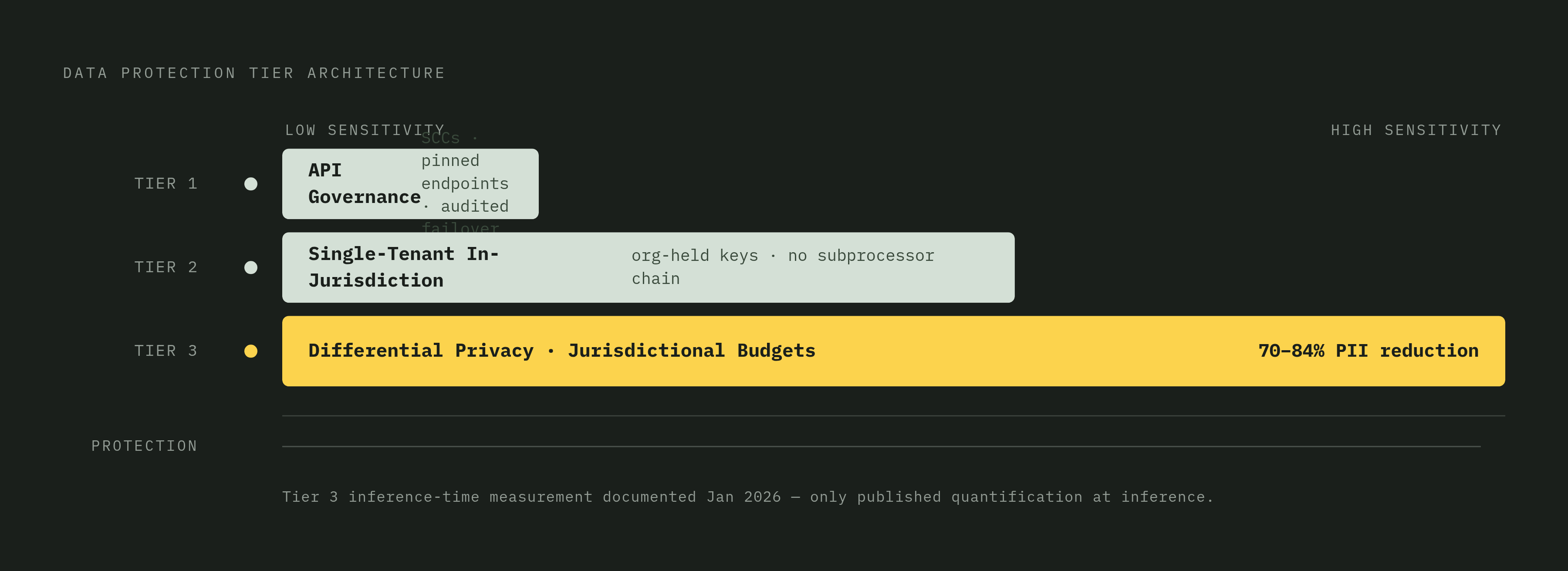
Treat compliance like a dial you turn based on data sensitivity and how exposed the use case is, not a switch you flip once and forget about.
Tier one: API governance with documented transfer mechanisms. Hosted model APIs used with explicit SCCs, DPAs naming the actual subprocessors involved, endpoints pinned to specific regions, failover routing audited rather than assumed, logs confirmed not to persist in the inference region. This is the floor. It's fine for low-sensitivity data moving between jurisdictions already covered by an adequacy decision, and not much further than that.
Tier two: single-tenant, in-jurisdiction deployment. An open-weight or licensed model running on infrastructure dedicated to one organization, sitting inside the required jurisdiction, with that organization holding its own encryption keys. Prompts and documents never leave the boundary, and the sprawling subprocessor chain from tier one collapses down to one accountable operator. This is the tier for anything touching the EU AI Act's high-risk category, or Chinese user data under PIPL.
Tier three: inference-time differential privacy with jurisdictional budgets, a research approach documented in work from January 2026 that enforces residency at the infrastructure level using a per-jurisdiction privacy budget. Reported results show a 70 to 84 percent cut in PII leakage while keeping model output quality intact. What makes it worth naming is that it's the only published approach quantifying privacy at inference time instead of training time.
Agentic workflows need handling layered on top of whichever tier applies, and this part gets skipped constantly. Run the model and the agent's reasoning in-region, send only non-sensitive summaries across any border, log where the data physically sat at each step so there's an actual trail instead of a reconstructed guess. Build in a way to roll a workflow back mid-execution if a step turns out to violate policy. Tying the three tiers together takes a centralized control plane, an AI gateway that enforces routing policy, tags every call with jurisdictional metadata, and produces the audit trail a regulator will eventually come asking for.
How edge-distributed inference turns a compliance constraint into a latency advantage
There's a physics argument buried in here that most compliance conversations skip entirely. An intercontinental round trip adds latency that often dwarfs the inference time itself, so keeping processing in-region gets you a performance win alongside the legal one, at no extra charge.
The practical version splits the work in two. Small, quantized models, roughly one to seven billion parameters, run at the edge close to the user, handling routing decisions, input classification, embedding lookups, guardrail checks. The heavy lifting, the actual generation from a large model, runs centrally, but centrally within the jurisdiction the data belongs to, not wherever compute happened to be cheapest that week. The edge node never holds the sensitive data long enough to become a transfer event in the first place.
Build a network with edge presence inside every regulated jurisdiction, reaching users in tens of milliseconds, and it ends up compliant by default. The compliance gets built into the architecture instead of bolted on afterward. Fast and compliant turn out to be the same design decision, and the economics are moving the right direction: Gartner's March 2026 projections show inference costs falling substantially through the rest of the decade, which means in-region deployment, a cost premium today, gets cheaper relative to centralized inference every year that passes. The compliant architecture is on track to be the cheap one too.
What AI governance and Zero Trust controls must cover that traditional security does not
Zero Trust was built to manage humans logging into applications, and AI agents broke that model quietly and fast. Non-human identities, agents, automated pipelines, model endpoints calling other model endpoints, now outnumber human identities inside plenty of enterprises, and most Zero Trust deployments have no real answer for what to do with that fact.
An ungoverned agent can move regulated data across a border just as effectively as a careless employee, or a malicious one. That means the attack surface agentic systems create needs the same jurisdictional controls as the inference pipeline feeding it. A centralized governance layer handles this by enforcing routing policy per jurisdiction, logging every call with jurisdictional metadata attached, running guardrails on a prompt before any data crosses a boundary, and generating the audit trail regulators are going to want eventually anyway.
Agentic tool use through protocols like MCP adds one more wrinkle: every external tool an agent calls is a potential point where data leaves the boundary, right alongside the main inference call. Organizations need visibility into every one of those connections, not just the primary model API, and that visibility is turning into baseline plumbing rather than a nice-to-have feature. This has to run at the network and inference layer, in real time, before the transfer happens. Leaving it downstream in the legal team's DPA review means the transfer already happened by the time anyone notices.
The organizational readiness gap that regulations are outpacing
AI adoption inside EU enterprises nearly doubled in a single year, per Eurostat's 2025 data. That means far more organizations are carrying this exposure today than were carrying it twelve months back, and most of them added it without adding anything close to the governance needed to match.
Gartner has tracked a sharp rise in inquiries about cloud sovereignty and geopatriation through the first half of 2025, which tells you where this sits on the priority list now: a board-level agenda item, not a niche legal question buried in someone's inbox. The enforcement calendar isn't waiting for anyone to catch up. The EU AI Act reaches full enforcement in August 2026, India's DPDP blacklist authority is already live and sitting ready to be used, China's PIPL has already produced its first cross-border penalty, and Vietnam's law is already in force. An organization starting architecture work in the middle of 2026 isn't early to any of this; it's behind on more than one of these regimes already, and catching up costs more than starting on time would have.
Real readiness runs deeper than a DPA review and a signature at the bottom. It's documented transfer mechanisms for every jurisdiction touched, per-region routing with logs that survive an audit, a subprocessor inventory covering every piece of the inference pipeline, and the ability to roll back an agentic workflow that goes sideways mid-run. Every organization shipping an AI feature is making a data transfer decision whether it realizes that or not. The only choice left is whether that decision gets made on purpose, or gets discovered later by someone with a badge and a clipboard.