Auditing and Logging AI Agent Actions for Compliance
Only 17% of firms log where AI agent errors actually compound—between agents themselves.
AI agents don't click buttons or submit forms. Instead, they decide, act, retry, and hand off to other agents, often without a human anywhere in the loop until something breaks. Traditional application logging was built to answer "what did the user do?" That question doesn't work anymore when the actor is a model chaining together a dozen tool calls to close a loan or triage a support ticket. Compliance-grade auditing now has to capture something closer to a running transcript of judgment: what the agent decided, which tools it invoked, what data it touched, and why. Miss that trail, and you haven't just failed an audit. You've lost the ability to figure out what actually happened.
A single agent invocation can hit dozens of APIs, internal databases, and sub-agents before it ever produces something a person sees. Errors compound quietly in that chain: one agent hands a bad number to the next, that number gets treated as ground truth, and by the time anyone notices, the mistake has traveled through steps nobody thought to log individually. Adoption is running way ahead of the guardrails here. Seventy-two percent of organizations are already using or planning to use agentic AI, while only 26% of S&P 500 companies have anything resembling a full AI governance policy in place — even as AI risk disclosures from major companies have grown sharply. That gap is the whole story. An incomplete log leaves a team unable to investigate, fix, or defend a decision after the fact.
The monitoring blind spot most organizations have right now
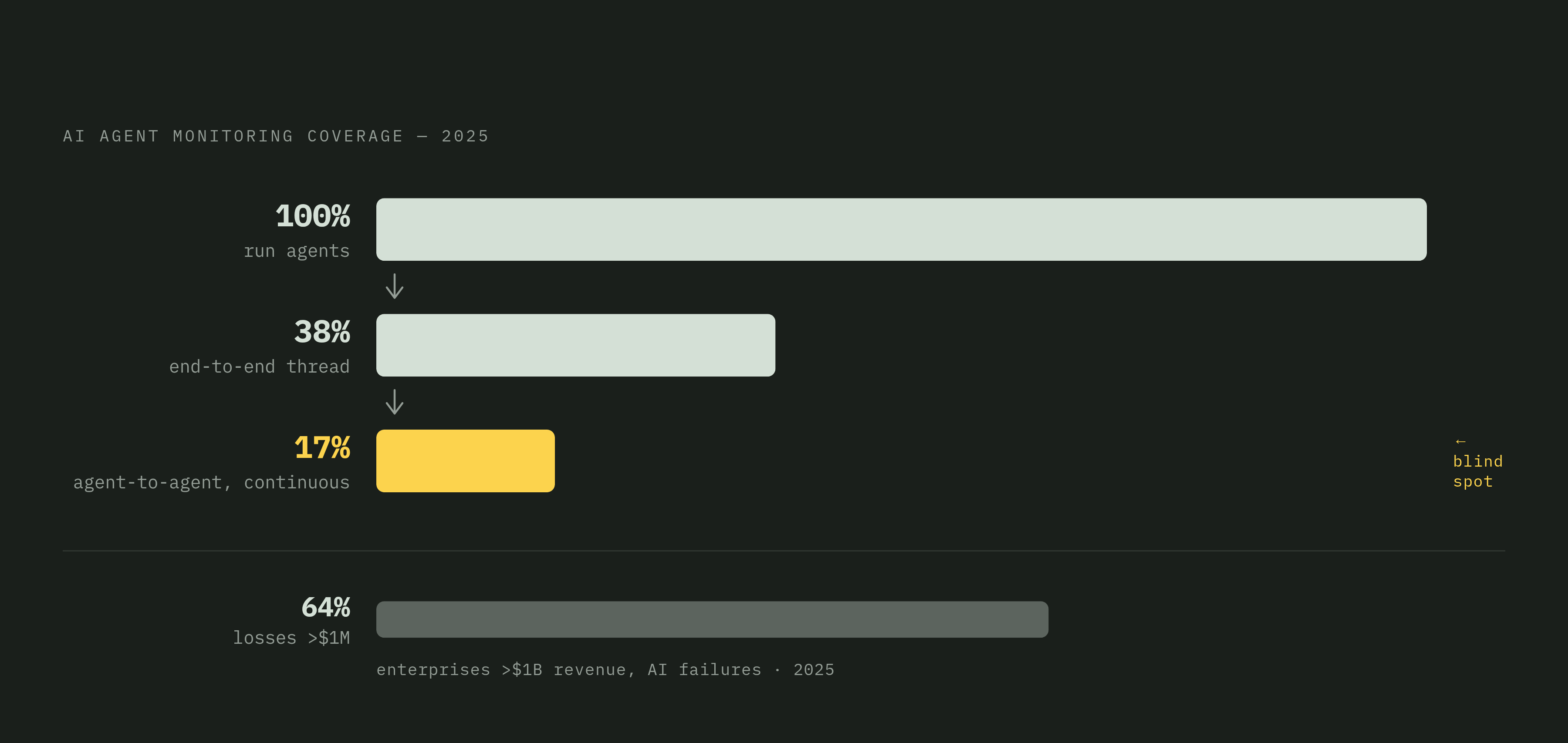
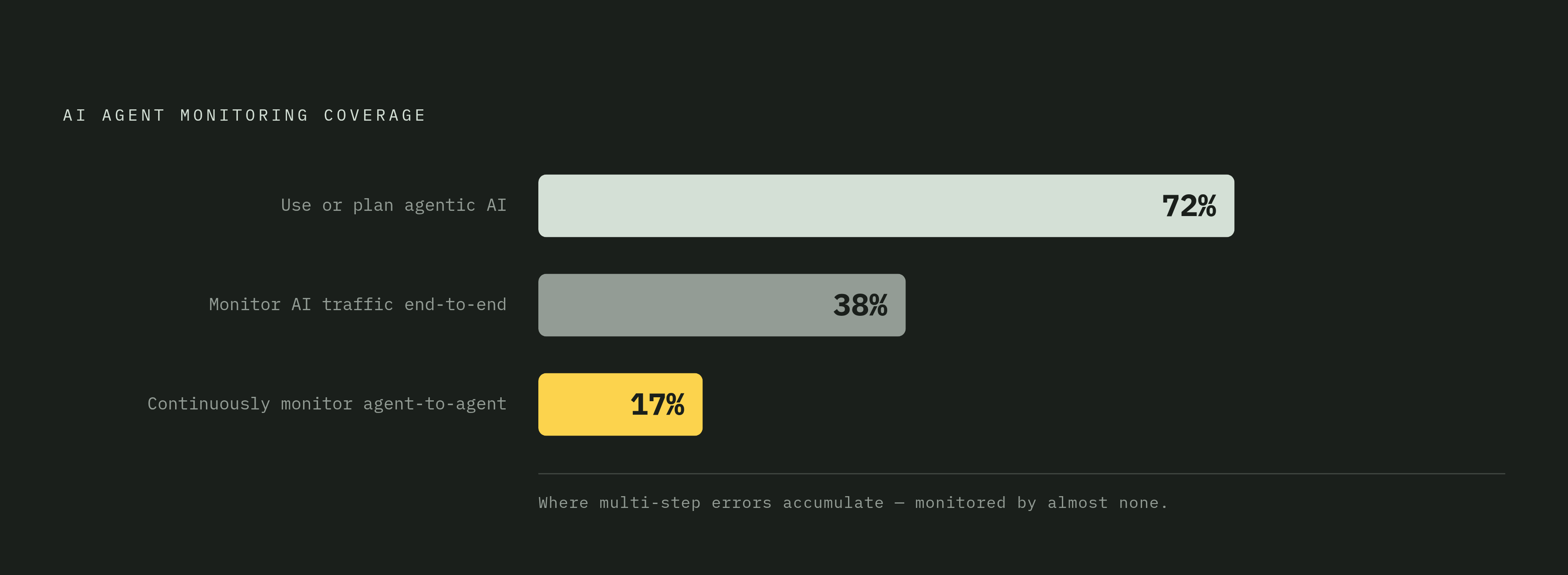
An EY/AIUC-1 Consortium survey found that only 38% of organizations monitor AI traffic end to end, meaning prompts, tool calls, and outputs all tracked as one continuous thread rather than three disconnected buckets. Narrow it further to agent-to-agent interactions, the layer where multi-step errors actually pile up, and only 17% monitor that continuously.
That's a meaningful gap in coverage, concentrated at exactly the altitude where things go wrong.
The same survey found that 64% of companies with revenue above $1 billion reported losses exceeding $1 million tied to AI system failures in 2025. Eighty percent of surveyed organizations had documented risky agent behavior, including unauthorized system access and data exposure, most of which would have surfaced quickly under end-to-end logging. The pattern is consistent enough to call a habit: companies deploy agents first and bolt on observability later, by which point whatever went wrong has already had time to spread. Everything that follows in this piece describes the instrumentation that closes that specific gap.
What regulations now require from AI agent audit logs
The EU AI Act is the clearest mandate on the books for high-risk systems. Article 12 requires that these systems technically support automatic event logging. Article 14 requires that human oversight, including the ability to step in or shut things down, stays intact. Article 19 sets a floor on how long logs must be kept. Penalties run up to €35 million or 7% of global annual turnover for certain violations, which is the kind of number that gets a compliance department's attention fast.
Timing matters here. Recent EU legislative developments have pushed most standalone high-risk deadlines further out, though exact timelines remain subject to ongoing rulemaking. But the transparency obligations for general-purpose AI have been active since August 2025, and AI literacy requirements for employees have been in force since February 2025. A team running agents without baseline training on what those agents do is already out of compliance today, deadline extension or not.
None of this waits around for the EU AI Act to fully phase in, either. HIPAA requires that every access to protected health information, including access made by an AI agent, gets logged with the agent's identity, the data touched, a timestamp, and a purpose, with retention measured in years. SOX and PCI-DSS impose comparable requirements on financial institutions for agent actions touching regulated data. GDPR bakes in purpose-of-access logging as a baseline, and any agent working with personal data inherits that obligation whether or not anyone updated the privacy policy to say so. On the U.S. federal side, CAISI published NIST-2025-0035 in January 2026, openly acknowledging that standard cybersecurity practices don't map cleanly onto autonomous agents, and asking for input on monitoring and incident response.
Strip away the jurisdiction-specific language and one thread runs through all of it: logs need to show who or what acted, on what data, at what time, and why. That last part, the why, is the piece traditional logging systems were never built to capture.
The minimum fields every agent action log entry must contain
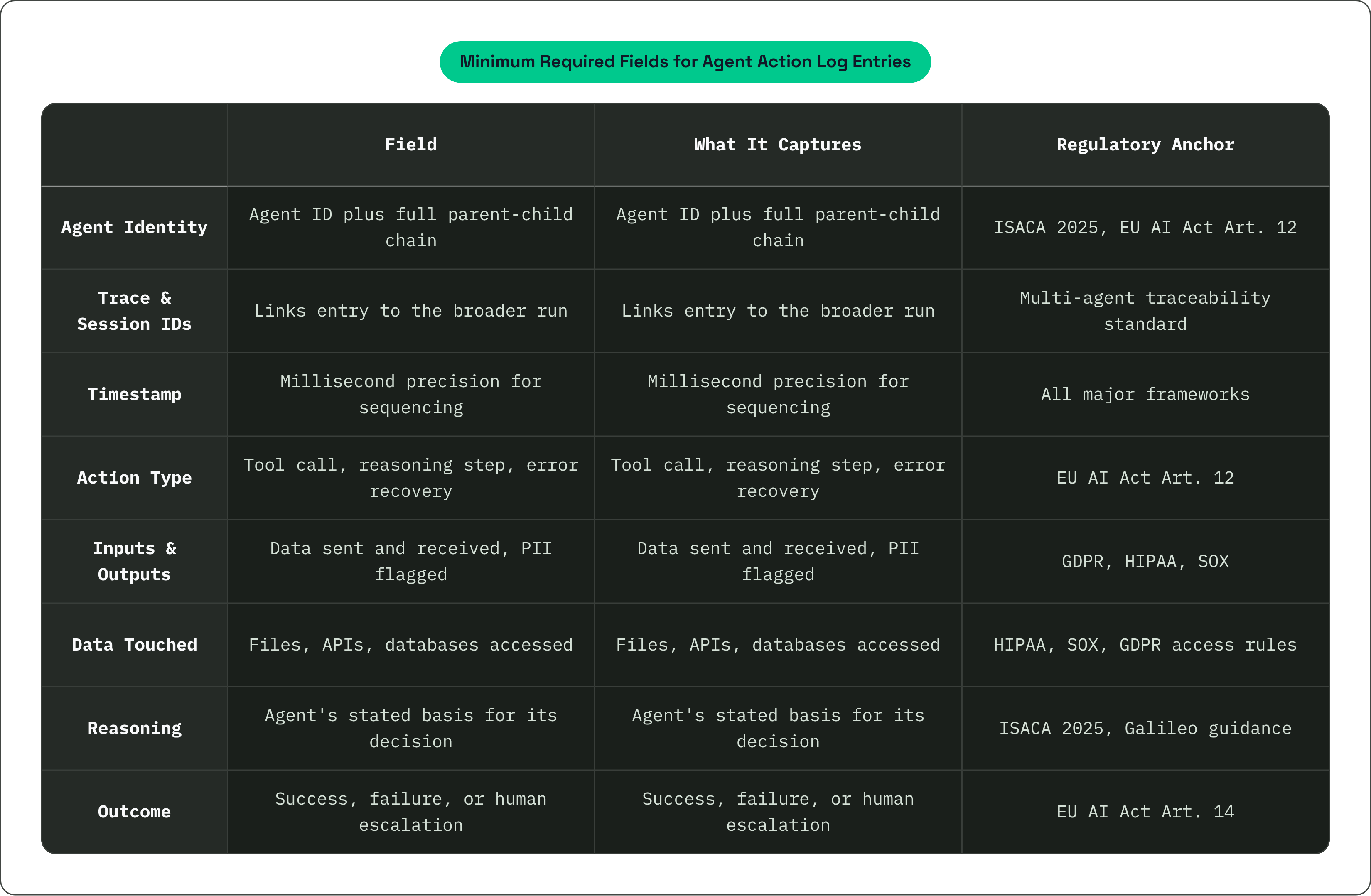
No single body has published a universal schema yet, but regulatory text and practitioner guidance are converging fast on the same list. ISACA's 2025 analysis put it plainly: every action needs a record of who initiated it, whether that's a human, an application, or an agent, along with the reason behind it. Agent identity and purpose function as core parts of the record itself, not incidental context.
A usable log entry needs the agent's identity, including the full parent-child chain in multi-agent setups, plus session and trace identifiers that tie the entry to the larger run it belongs to. It needs a millisecond-precision timestamp, since agents fire off tool calls in rapid succession and sequencing matters. It needs the action type (tool call, reasoning step, model invocation, error recovery), the inputs sent and outputs received, with PII flagged or redacted rather than dropped entirely, and a record of which files, APIs, or databases got touched, which is the piece that maps straight onto HIPAA, SOX, and GDPR access rules. Cost and resource use per step, token counts and latency, matter for operational review and for figuring out how far a failure spread. And every entry needs an outcome: success, failure, partial completion, or escalation to a human.
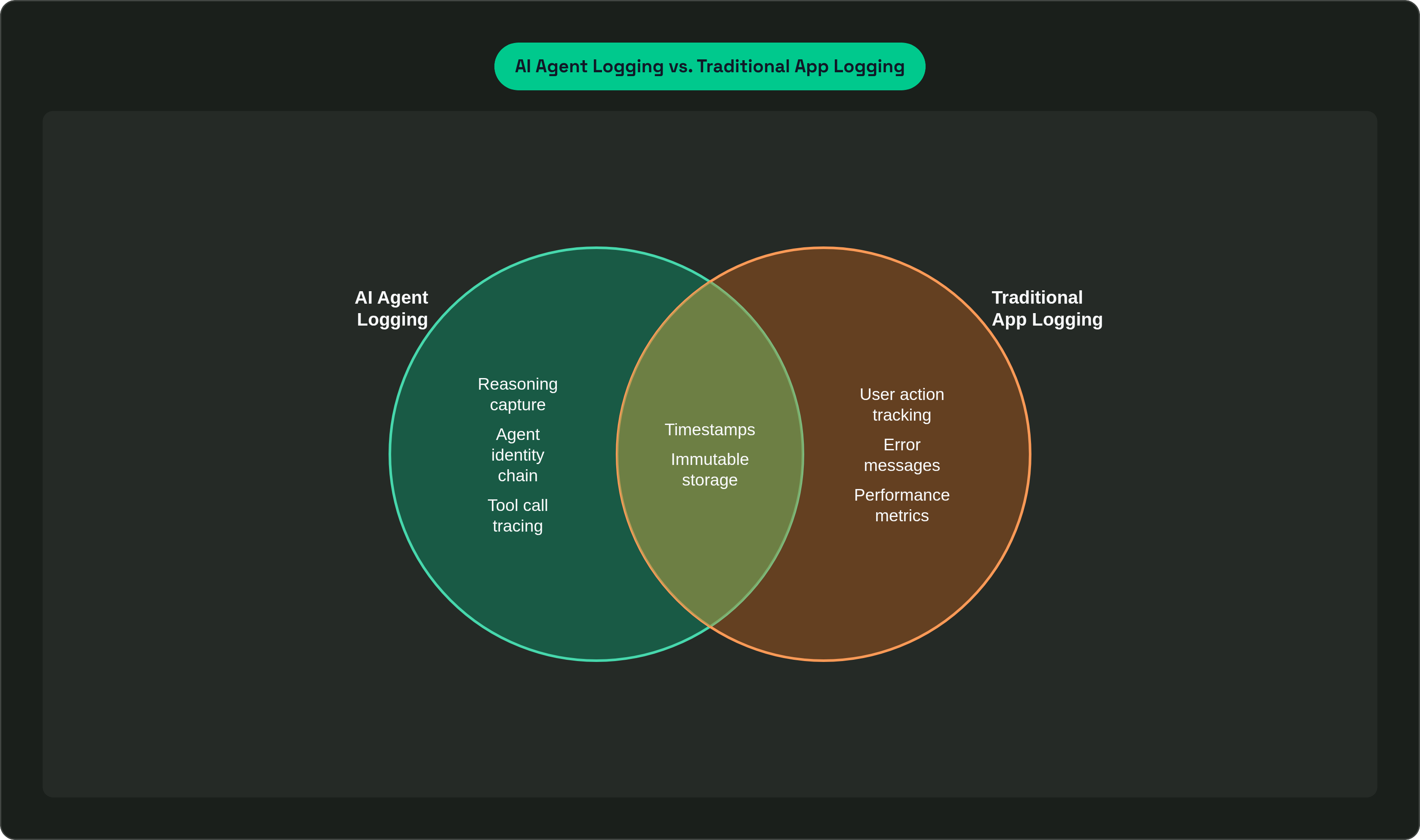
The field that actually separates this from a normal application log is reasoning: the agent's own stated basis for the decision it made. Galileo's compliance guidance walks through a mortgage approval agent as an example. Its log shows the decision to pull a credit score, the reasoning behind classifying the applicant a certain way, the query against the policy database, and the final terms, each one a separate, linked entry, alongside the loan application going in and the approval coming out. That's the difference between knowing what an agent did and knowing whether it should have.
How multi-agent and tool-chaining architectures complicate the trace
Most production agent systems aren't one agent doing one job. They're an orchestrator calling specialized sub-agents, which call tools, which call other APIs, and so on until a single user request has spawned a whole tree of activity. Log each branch of that tree in isolation and you end up with a pile of orphaned records nobody can stitch back together.
Without a unified trace, you can't tell which parent instruction triggered a specific downstream tool call. You can't connect a data access event back to the human request that started the whole chain. And you can't bound the damage when something goes wrong, because you don't know which branches were touched and which stayed clean. Both major agent communication protocols, MCP (Model Context Protocol) and A2A (Agent-to-Agent), treat tracing as a first-class feature rather than an afterthought, which tells you the protocol layer itself is converging on the same conclusion: distributed tracing isn't optional at this scale.
OWASP's Top 10 for LLM Applications 2025 addresses this directly under LLM06, excessive agency, noting that logging and monitoring agent extensions is how you find where bad actions happened and limit the blast radius. Worth saying plainly: logs are detective, telling you what already happened, rather than preventive. The actual guardrails, scope restrictions on what an agent's credentials can touch and human-in-the-loop checkpoints, are a separate control. The logging architecture just needs to mirror the agent architecture: hierarchical, and linked end to end by trace IDs that survive crossing from one agent to another.
OpenTelemetry as the practical instrumentation layer for agent tracing
The tracing layer that's actually won out in production agent systems is OpenTelemetry, extended with semantic conventions built for agent workloads. A properly configured OpenTelemetry setup captures the reasoning chain across steps, the tool inputs and outputs, the agent's state at each point, cost per step in tokens and latency, and PII redaction flags, all at once, all linked together.
The mechanism that makes any of this coherent is the trace ID, propagated across every agent boundary so a sub-agent's log entry can be traced back to the parent request that spawned it. For MCP-based systems specifically, this matters even more: an agent pulling health records or financial data through MCP needs the same field-level logging described above, and it needs to surface through the same pipeline rather than a separate, disconnected one.
State checkpointing pairs naturally with tracing here. Saving the conversation history, tool outputs, current plan, and sub-agent state to durable storage after every step does double duty: it lets a failed agent resume where it left off, and it doubles as an audit record, since an immutable checkpoint is, functionally, a log entry. Idempotent tool calls matter for the same reason. If an agent retries a step after a failure, idempotency keeps the retry from producing a second, different outcome, and it keeps the log honest about what actually happened being a retry, not a mysterious duplicate action.
OpenTelemetry isn't the only way to hit these requirements, and it shouldn't be treated as gospel. It's the dominant open standard right now because it does the job: propagate context across agent boundaries, integrate with durable storage, capture the fields regulators are asking for. Any system that does those three things satisfies the requirement, regardless of what logo is on it.
Structuring logs so they are usable for compliance review, not just stored
Capturing the right fields gets you halfway there. A log an auditor can't query, filter, or read coherently doesn't satisfy anything in practice, no matter how complete it is on disk.
Immutability comes first. HIPAA's Security Rule implies this through its audit control and data integrity requirements, and the standard approaches are write-once storage or cryptographically signed entries, so nobody, including well-meaning engineers, can quietly edit the record after the fact. Retention has to match whichever regulation sets the highest bar; HIPAA's minimums run in years, and Article 19 of the EU AI Act sets its own floor, so the organization's policy needs to satisfy the strictest one that applies, not the average. Searchability is where a lot of otherwise-decent logging setups fall apart: an auditor investigating an incident needs to pull every agent action touching a specific dataset in a specific time window, and if that requires someone manually reconstructing the chain from scattered records, the system has already failed its purpose. Access to the logs themselves needs governing too. Who can read, export, or delete a log entry should be a controlled, auditable decision in its own right; the record of agent behavior needs its own paper trail.
It also helps to keep operational logs (the ones used for debugging and performance) separate from compliance logs, even if they share the same underlying infrastructure. They can live in the same system, but they should be queryable independently, since mixing them just adds noise to a compliance review without adding anything useful. And regulators aren't always engineers: a logging system that can generate a plain-language narrative of an agent's decision chain, alongside the structured trace, saves everyone time when the mortgage approval example above needs explaining to someone who doesn't read JSON for fun. For teams running agents in Kubernetes, standard observability stacks like Prometheus, Grafana, and OpenTelemetry can ingest agent traces right alongside infrastructure metrics, so governance rides on the same rails as everything else already being monitored.
Where network infrastructure sits in an agent logging and governance architecture
Application-level tracing tells you what an agent decided to do. Whether the network traffic matched that decision is a separate question, and one the network layer is well positioned to answer, since agent-to-agent and agent-to-tool traffic all has to physically pass through something on its way from point A to point B.
Globally distributed compute platforms can support agent workloads spanning multiple steps and services. The governance angle sits in how that traffic gets routed. Agent-to-agent, agent-to-API, and agent-to-internal-data traffic can run through a Zero Trust architecture that enforces identity verification beyond the initial perimeter. Network-layer logging can provide a second, independent signal sitting alongside the application-level OpenTelemetry trace rather than depending on it entirely. For MCP-based systems handling regulated data, that independent corroboration matters: if the application log and the network log agree, you've got real confidence in what happened.
A network spanning a large number of locations globally gives broad reach across the internet-connected population within 50 milliseconds, which means agent traffic doesn't need to hairpin back to one centralized logging server somewhere far away. Logs get captured close to where the action actually happened, which helps latency and makes data residency rules easier to satisfy. Usage-based pricing models that charge for what actually gets used, not for an agent sitting idle or waiting on a slow API to respond, mean the governance layer doesn't turn into its own cost center just for existing. For organizations already running WAF, DDoS mitigation, and Zero Trust access on a single platform, agent logging can sit on the same platform with the same identity model, which beats reconciling five different vendor logs with five different definitions of "user."
Building governance policy around the logs, not just the logs themselves
None of the above matters without a policy that says what to do with it. A perfectly instrumented log nobody reviews is just an expensive hard drive. Governance means someone owns the review cadence, someone is accountable when a log shows an agent did something it shouldn't have, and someone has authority to pull an agent's credentials the moment a pattern looks wrong, not after the quarterly audit.
That's the actual dividing line between the 26% of S&P 500 companies with real AI governance and everyone else: whether anyone's job depends on reading the logs, more than whether the logs exist. The instrumentation described in this piece, agent identity, trace propagation, reasoning capture, immutable storage, is the necessary infrastructure. Governance is a separate layer built on top of it: the policy that decides what "acceptable agent behavior" means before the agent acts, and what happens the moment the logs show it didn't. Build the logs first. Build the policy around them second. Skip the second part, and the first part is just a very detailed record of a mistake nobody caught in time.