AI Inference Routing and Model Fallback Strategies
AI systems need routing and fallback layers to survive provider outages without going down.
IsDown's incident tracker logged dozens of outages across major AI providers in a single month in late 2025. Anthropic and OpenAI each racked up over a hundred hours of cumulative impact in that window alone, which is the kind of number that looks abstract until it's your application on the receiving end. AI inference routing is the layer that decides which model handles a given request in real time: cost, latency, whether the primary provider is even reachable right now. Model fallback is the piece that kicks in when something breaks. Most teams skip building either, because the single-provider API call works fine in the demo, and then production traffic shows up, a provider has a bad afternoon, and the application goes down right alongside it.
There's an old story about a junior engineer who proudly demoed an AI feature to the whole company, single provider, single API key, zero fallback logic. It worked beautifully. Someone in the back asked, "What happens when that provider goes down?" The engineer said, "It won't." Three weeks later, it did, live, during a board meeting. That's not a joke, but it should be, because it's the origin story of half the routing architecture in this industry.
What AI inference routing actually means and what it has to solve simultaneously
Routing isn't load balancing. Load balancing spreads requests across identical instances of the same provider; routing decides, per request, which model or provider gets it at all. That decision has to juggle variables that actively fight each other. Think of it like a triage nurse at a busy emergency room: speed matters, cost of treatment matters, and whether the specialist is even in the building matters, all at once, for every single patient walking through the door.
Latency comes first: time to first token, plus total generation time, and in a multi-step agentic workflow those delays stack fast enough to notice. Cost is second, and the gap between a frontier model and a smaller task-specific one isn't subtle, it's orders of magnitude per token. Reliability is the one people misunderstand most. The real question isn't whether the provider you picked usually answers requests. It's whether it's answering them right now, this second, for this call.
Optimize for just one of these and watch the other two fall apart. Route purely on cost and you dump traffic onto cheap models that buckle the moment load increases. Route purely on uptime and you'll cheerfully pick a highly available model slow enough to wreck an agent chain ten steps deep.
Then there's a fourth variable nobody thinks about until it's the only one that matters: governance. Is the model selected at routing time actually on the organization's approved list? Easy question when everything's working fine. Urgent question the second your primary provider goes down and the system needs somewhere else to send traffic, fast. That's the fallback problem in miniature, and it deserves its own design rather than a single line of config that says "try the next one." Fallback is the part of the routing layer most likely to fire during an incident, which makes it the part most likely to be under-designed. Bad combination.
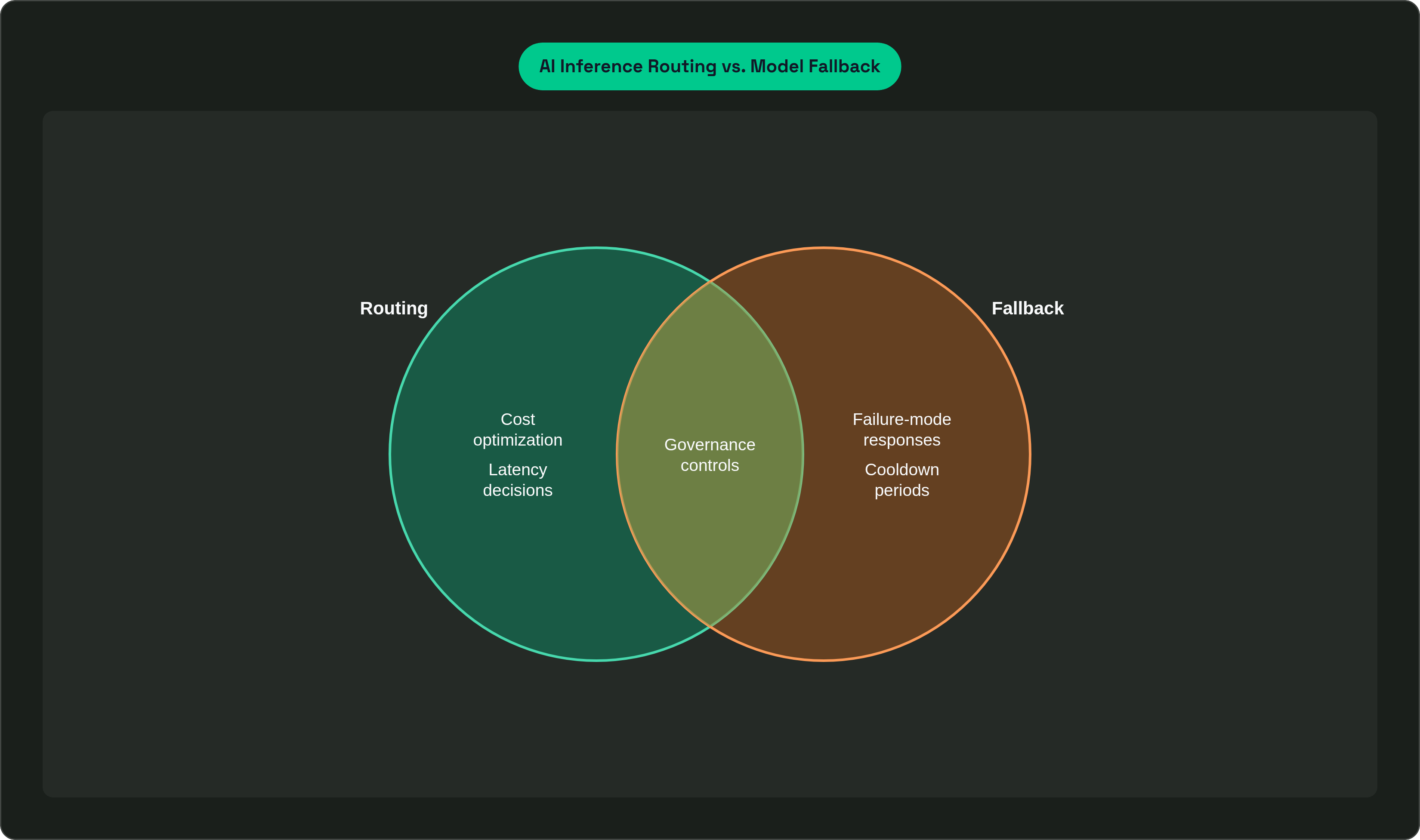
The cost argument for routing: most production traffic does not need the most capable model
Most production AI traffic is boring. Classification, summarization, extraction, reformatting text from one shape into another: none of it needs frontier-level reasoning. Plenty of teams route all of it to the frontier model anyway, because that's the one API key they set up first. This is a bit like hiring a surgeon to put on a Band-Aid: technically qualified, wildly overpriced for the job.
The per-token cost premium on frontier models isn't marginal. It's structural, baked into the pricing tier itself, so routing even a fraction of simple traffic to smaller, task-specialized models produces savings that compound fast. This matters most in agentic workflows, where a single execution might make dozens of model calls and most of those calls are trivial reasoning steps: check a condition, format an output, decide which tool to call next. Multiply a small per-token difference by dozens of calls per run, and a rounding error turns into a real line on the monthly bill.
The standard defense is layered budget controls. A token cap at the workflow level, another at the individual agent step, another at any sub-agent spawned along the way, enforced dynamically as the workflow runs rather than caught in a dashboard three days later. Send capability where it's actually needed and you get a second benefit almost for free: less queue depth on the oversubscribed frontier endpoints everyone else is also hammering.
The main routing patterns and where each one fits
Rule-based routing is the simplest thing on the menu. Route on explicit conditions, task type, token count, user tier, cost threshold; it's deterministic, auditable, cheap to run. It breaks down when the task doesn't classify cleanly, or when the rule set grows faster than anyone can maintain it, which happens sooner than most teams expect.
Embedding-based routing handles the ambiguous cases better: embed the incoming request, match it against a model cluster by semantic similarity, route accordingly. It costs a bit more latency than rule-based routing, though that cost is modest next to typical inference times and rarely becomes the bottleneck.
LLM-based task classification goes further still. A small, fast model looks at the request first and decides where it should go. This is the most flexible of the three, and it handles nuanced task decomposition the other two can't touch, but it's also the slowest of the group, adding more overhead than embedding-based routing even if that overhead is usually a sliver of total end-to-end time.
The newest pattern is KV-cache-aware routing, sometimes paired with consistent hashing, which sends requests to the compute instance most likely to already have relevant context cached, cutting down on redundant prefill work. Research from 2025 found consistent hashing with bounded loads meaningfully reduced time to first token compared to naive round-robin distribution. It matters most in high-throughput deployments with heavy context overlap, and it's the pattern least likely to show up in anyone's first routing implementation.
Picking among these comes down to how heterogeneous your traffic is and how much latency budget you can spare. Rule-based and embedding-based approaches cover most production workloads without much fuss. LLM-based classification earns its cost once task variety gets genuinely high and nobody will miss the extra hundred milliseconds.
How to design a fallback chain that works under the conditions that trigger it
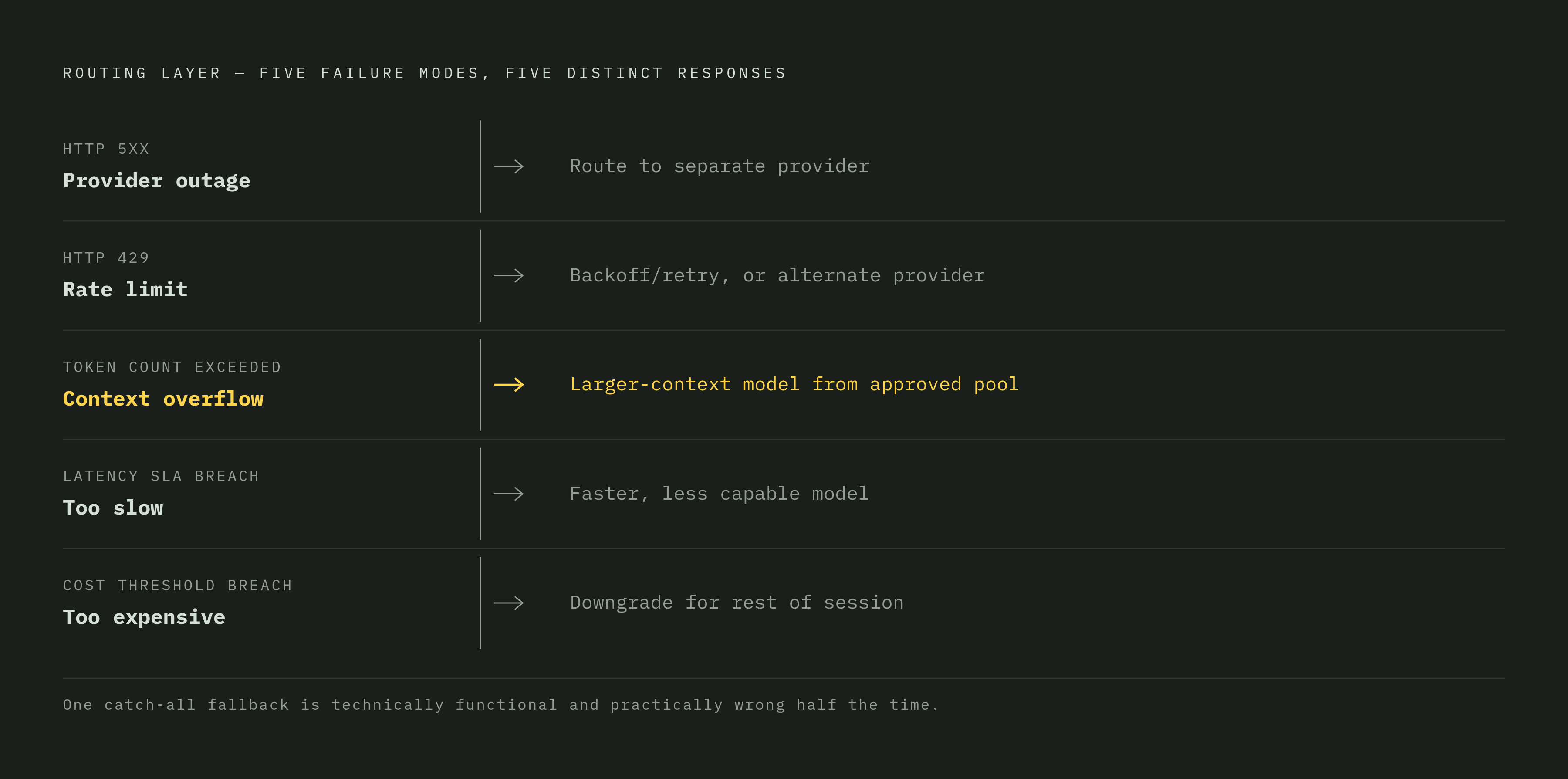
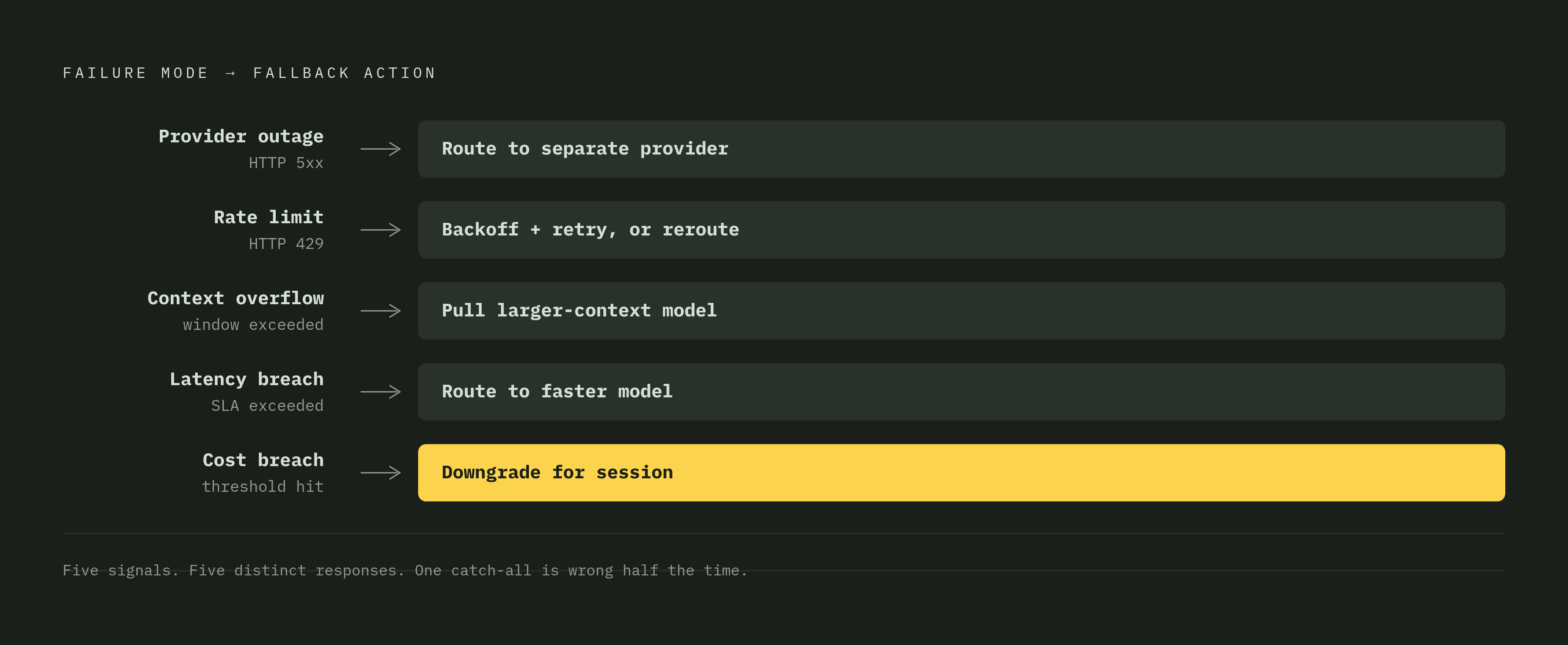
The naive version: try the primary provider, and if it fails, try the next one on the list. This works, technically, but it's also wrong in a way that doesn't show up until it matters, because "try the next one" treats every failure as the same failure. They're not, not even close.
A provider outage, marked by HTTP 5xx errors, calls for routing to a wholly separate provider. A rate limit, HTTP 429, might call for a different provider too, or it might just need a backoff and retry against the same one. A context window overflow needs a model with more headroom pulled from the pre-approved pool, not just "a different model" grabbed off the shelf. A latency SLA breach might mean routing to something faster even if it's measurably less capable, and a cost threshold breach might mean downgrading to something cheaper for the rest of the session rather than treating it as an outage at all.
Collapse those into one fallback rule and you get routing that's technically functional and practically wrong half the time. Each failure mode has a distinct optimal response, and treating them identically doesn't just produce worse outcomes; it buries the signal that would have told you which failure actually happened.
Cooldown periods matter here too. Once a provider fails, mark it degraded for a set window before sending traffic back its way. Skipping this produces a cascade: the failed provider recovers just enough to accept traffic, fails again under the same load, and the fallback chain spends the next hour bouncing between two providers that are both having a bad day. Call it a relationship on-again-off-again with neither party willing to admit it isn't working.
There's a bigger structural risk sitting underneath all of this, and it's not really an AI problem at all. The AWS US-EAST-1 outage in October 2025 took down 70+ AWS services for over 15 hours, triggered by a DNS race condition in DynamoDB that cascaded across the region. Any fallback chain relying on one cloud region for coordination, authentication, or replication inherits that same fragility, no matter how many model providers sit in the pool. Provider diversification without region diversification is half a solution wearing the costume of a whole one.
Governance requirements that fallback design must satisfy before an incident, not during one
Here's the failure mode nobody notices until legal calls: the primary provider goes down, the routing layer scrambles for an alternative, and it lands on a model that's technically available but never went through approval. Nobody decided this, exactly. The system found the fastest path back to "working," and that path happened to run through an unapproved vendor, at the exact moment everyone was too busy fighting the outage to check.
The fix is almost boring. Fallback models get pre-selected from the approved pool at configuration time, not chosen dynamically from whatever's available when things break. Getting a model into that pool means documented data handling agreements with the provider, confirmed geographic data residency, clarity on output licensing, and a security review, all finished before the model is eligible to take a single production request, let alone a fallback one.
Regulated industries don't get a pass here. Healthcare and financial services teams need to show, on demand, that no request was ever processed by an unapproved model, incident or no incident, and that's only possible if the fallback configuration is static and auditable rather than improvised in the moment. IBM's 2025 Cost of a Data Breach Report found organizations running ungoverned AI paid significantly more per breach on average than those that didn't. Ungoverned fallback routing is a specific, nameable slice of that exposure, not a hypothetical someone invented for a slide deck.
None of this is red tape. It's the precondition for the fallback chain still being legally valid at the exact moment it's needed, which tends to be the worst possible moment to discover it isn't.
Making fallback events observable rather than invisible
Without instrumentation, here's what actually happens: a fallback fires, users get a slightly worse answer than usual, and the team finds out through a support ticket or a surprise line item on the invoice, days after the fact. This is a bit like pulling the battery out of the smoke detector and calling it decor.
Every request should carry its own routing metadata: which model handled it, why, meaning the rule or failure condition that triggered the choice, and how long the routing decision itself took. That's the difference between fallback as a silent, after-the-fact discovery and fallback as something a team can act on while it's still happening.
A rising fallback rate toward a specific provider is an early warning that provider is degrading before it fully fails. Audit logs confirm every fallback selection stayed inside the approved pool. Output quality metrics get correlated against which model actually served the request, so a fallback model quietly producing worse downstream results doesn't slip through unnoticed, and cost gets attributed back to specific routing decisions, so "why did the bill spike" has an actual answer instead of a shrug.
OpenTelemetry, with semantic conventions now built out for agentic workloads, is the current standard for this kind of tracing. Routing decisions belong in the same trace view as tool calls and model invocations, not tucked into a separate log nobody opens until something's already on fire.
What to look for in a routing and fallback platform, and where the major options sit
Keep the checklist short: a unified API across providers, so application code doesn't need a different SDK call for every fallback target, and explicit, per-failure-mode fallback configuration instead of one generic retry rule. Add governance controls enforced at the routing layer itself, not bolted onto the application as an afterthought, tracing output that speaks OpenTelemetry natively, and cooldown and retry logic built in rather than hand-rolled for every provider integration.
LiteLLM is the open-source default for a lot of teams: broad provider support behind one API, priority fallback chains, cooldown handling, and a community large enough that most edge cases have already been hit by someone else first. This is a reasonable starting point for teams that want to self-host and keep control, though it starts to strain at high request volumes.
Managed gateways like Portkey sit a layer up, adding hosted observability on top of routing, which cuts the operational burden compared to running LiteLLM yourself. How deep their governance features go is worth checking against your specific compliance needs.
Some gateway options take a different architectural stance, executing routing decisions inside a globally distributed network, close to the user, instead of in one centralized region, and bundling caching, rate limiting, logging, and fallback configuration into a single layer. For teams whose compute already runs on that same network, the routing infrastructure and the compute share it rather than adding an extra hop.
Whichever platform you're evaluating, ask one question first: where does the routing decision actually execute, and what happens to latency when the primary provider, the one that's failing, happens to be the one the gateway itself depends on. A centralized gateway tied to a single region inherits exactly the cascading risk the AWS outage illustrated, just with an AI label stapled on top.
Applying routing design to agentic workflows, where the stakes are highest
Agentic workflows don't invent new routing problems. They take the existing ones and run them through an amplifier. A modest per-call latency delay, harmless on its own, becomes a real tax once it's multiplied across a ten-step chain, and a small per-call cost difference becomes a genuine budget line once an agent is making dozens of calls per execution. That per-run cost turns into a per-day problem the moment the agent starts running continuously instead of on demand.
Failure behaves differently here too. A mid-chain model failure doesn't just drop a single request the way it would in a simple API call; it can leave the agent stuck in an intermediate state that's expensive to recover from, or worse, one that's already triggered a side effect that shouldn't have happened. An agent without routing constraints can also get stuck in loops: re-verifying the same fact, re-querying the same source, spawning sub-tasks that spawn their own sub-tasks, burning tokens and time without making any progress a person would recognize as progress. Call it a budget failure that's borrowed a reasoning problem's outfit for the day, because no amount of prompt tweaking fixes it.
The practical response is to reserve frontier models for the reasoning steps that genuinely need them, and route the simpler intermediate steps to faster, cheaper alternatives. Where correctness is binary, a transaction, a calculation, skip the language model entirely; deterministic code will always be more reliable there, full stop, and routing a deterministic problem to a probabilistic model is just a design error that learned to dress like a routing decision. Layer token budgets across the workflow, the agent, and any sub-agents it spawns, so routing decisions answer to cost policy rather than to whatever's fastest and available in the moment.
Multi-agent systems add one more wrinkle: now you're routing not just which model handles a request, but which agent handles which sub-task. Same underlying principles, bigger configuration surface to get wrong. Gartner projects a large share of agentic AI initiatives will be canceled by 2027, citing cost and unclear value as the leading reasons. Routing and budget architecture sit directly on top of both levers, which makes this less an engineering nicety and more the difference between a pilot that survives contact with production and one that quietly gets shut down in Q3.
The routing and fallback configuration a team should have in place before going to production
Provider and region diversification comes first. The fallback pool needs at least two providers, and for anything critical, no single-region dependency for coordination or authentication, because that's exactly the failure the AWS incident already demonstrated for free. Every failure mode needs its own named trigger and its own fallback action, outage, rate limit, context overflow, latency breach, cost threshold, each with a defined response rather than a shared catch-all pretending they're the same thing.
Every model in the fallback pool clears governance review before deployment, and the routing layer enforces that whitelist itself rather than trusting application code to remember to check. Every request carries its routing metadata, model selected, trigger reason, latency, into the same trace view as the rest of the system, so fallback events register as signal instead of disappearing into a log nobody reads until the postmortem.
Building this before production traffic shows up beats the alternative: building it during an incident, under pressure, with an audience watching the status page refresh.