Agentic Workflow Orchestration Patterns in Production
Five patterns for coordinating concurrent agents without chaos or replay costs.
Parallelism is not coordination. Running five agents concurrently tells you nothing about whether they are operating on consistent state, whether their outputs will be coherent when assembled, or whether the workflow will survive a transient failure at step three. These are different problems, and confusing them is how teams end up rebuilding their architectures every quarter.
Orchestration is the infrastructure layer that turns concurrent agent activity into coordinated, observable output. It handles concerns that raw parallelism ignores entirely: isolation, communication, coordination, observability, and durability.
Isolation ensures agents do not share mutable state by accident. Without it, two agents writing to the same context window simultaneously produce corruption that is difficult to reproduce and nearly impossible to debug after the fact. Communication establishes structured message passing rather than implicit shared context, which is the difference between a system you can reason about and one you can only observe in mounting disbelief. Coordination handles sequencing, gating, and dependency resolution: knowing that agent B cannot run until agent A has succeeded, and enforcing that contract at the infrastructure level rather than hoping the application code remembers to check. Observability means knowing what each agent did, when, and with what result, rather than inferring it from logs. Durability guarantees a workflow runs to completion across failures, restarts, and partial outages.
Durability is the one that surprises even experienced engineers. Long-running agentic workflows span minutes or hours, sometimes days. Standard request/response infrastructure assumes a process lives for the duration of a request. When an orchestration process dies mid-workflow without durable state, recovery means a full replay from scratch, including every expensive LLM call that had already succeeded. That cost is not theoretical; it shows up in the first week of production traffic — and discovering it feels less like a bug report and more like finding out the floor you were standing on was just a very convincing painting of a floor.
The design-time choice that shapes everything downstream is orchestration versus choreography. Centralized orchestration places one coordinator in charge of the plan, delegation, and result assembly. Choreography lets agents react to events with no central coordinator, trading traceability for loose coupling. Both are legitimate. Neither is a default.
DAG-Based Orchestration: Deterministic Control When Execution Order Is Known
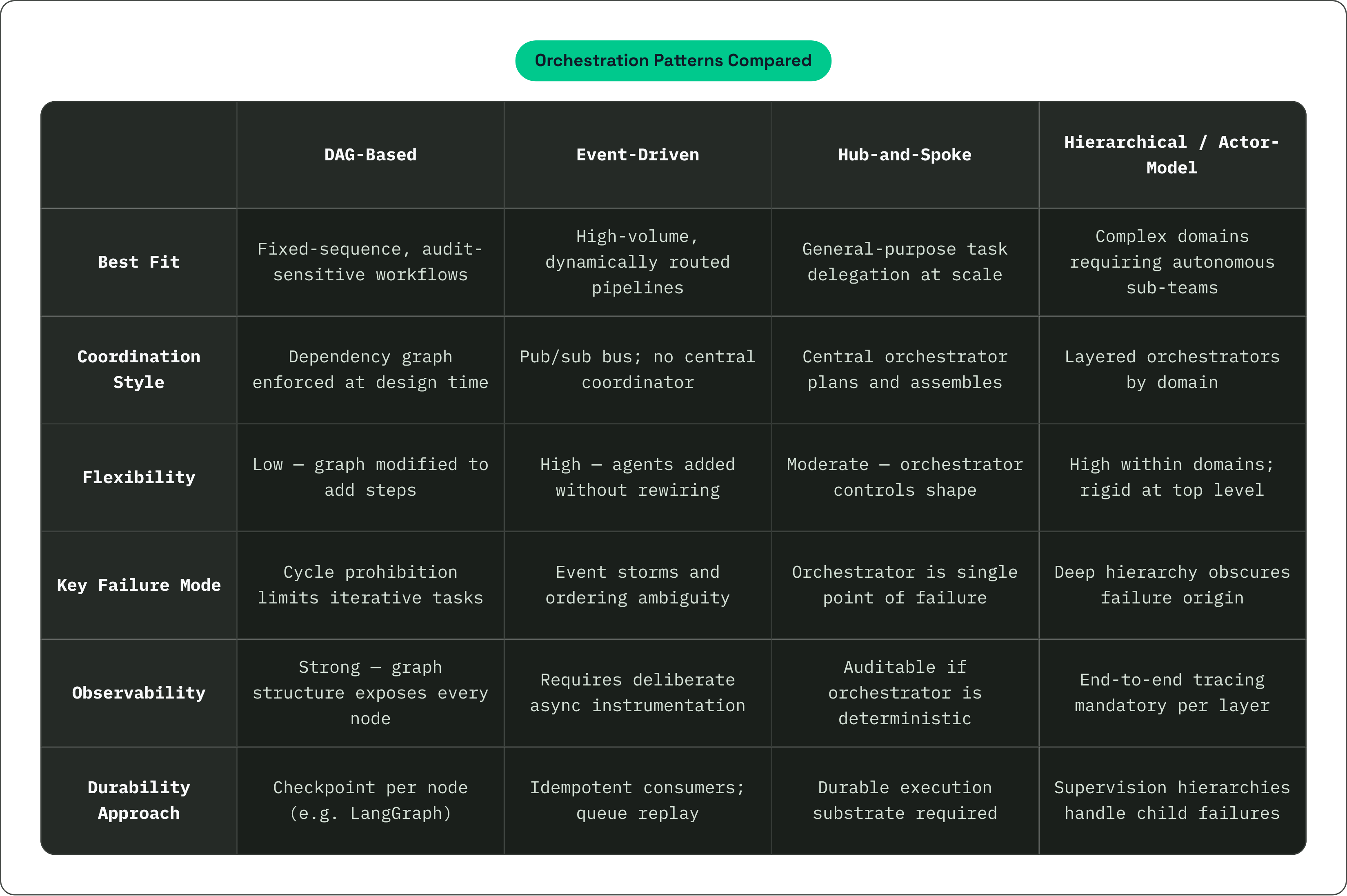
A directed acyclic graph models the workflow as nodes (agent tasks) connected by edges that encode dependencies. The graph determines execution order. Independent branches run concurrently; dependent branches wait. The structure is both the logic and the documentation, which sounds like a minor elegance until you are debugging a production failure at 2 a.m. and the graph tells you exactly where things broke.
What you get is deterministic execution: a given input produces the same traversal path every time. That property is not glamorous, but it is precisely what regulatory, compliance, and audit-sensitive workflows require. Microsoft's Azure Architecture Center documents contract-generation pipelines that follow this pattern, with template selection, clause customization, compliance review, and risk assessment running in a fixed sequence with conditional branches enumerable at design time. ETL pipelines and approval workflows with known conditional paths fit the same mold.
The tradeoffs are real and worth stating plainly. Adding a new agent step requires modifying the graph definition, making DAG-based orchestration a poor fit for workflows that need to reconfigure themselves based on runtime data. The cycle prohibition is a feature for reliability, because cycles in agent graphs produce deadlocks, but it is a genuine constraint for iterative reasoning tasks where an agent needs to loop back. Observability, though, is strong: the graph structure makes it natural to attach status, timing, and output logging to every node.
LangGraph's implementation checkpoints every node execution to a backing store. If the process dies mid-graph, the runtime replays from the last successful checkpoint rather than the beginning, bringing event-sourcing crash safety into the DAG model without requiring teams to build it themselves. Reach for this pattern when reproducibility matters more than flexibility.
Event-Driven Orchestration: Asynchronous Coordination When Workflow Shape Emerges at Runtime
Sometimes the number or identity of downstream steps is unknowable until an upstream result arrives. A classification agent determines that a customer support ticket requires both sentiment analysis and a compliance flag, but that routing decision cannot be encoded in a static graph. Event-driven orchestration handles this by making agents event consumers and producers, with a pub/sub bus or message queue carrying work between them without any central coordinator dictating order.
The architectural benefits are real. Loose coupling means agents can be added, replaced, or retired without rewiring orchestration logic. Queues provide natural backpressure and buffering, absorbing bursts so agents process at sustainable rates. High-volume, heterogeneous pipelines benefit most: customer support routing, monitoring and alerting workflows where anomaly-detection agents fire events that reach remediation agents only when thresholds are crossed.
The failure modes that catch teams by surprise are equally real, and they have a way of arriving simultaneously. Event storms occur when a single upstream output triggers a cascade of downstream events that overwhelm consumers; without rate limiting, this can collapse a pipeline faster than any single agent failure. Ordering ambiguity compounds the problem: events arriving out of sequence cause agents to act on stale context, producing exactly the kind of silent, plausible-looking errors that are hardest to catch. Idempotency becomes mandatory, because any agent step must handle duplicate delivery gracefully, and most teams discover this requirement in the worst possible way. Observability is not free the way a DAG's structure provides it; tracing a request across multiple async hops requires deliberate instrumentation from the beginning, not something you can retrofit after the debugging becomes genuinely painful.
Every Kafka-based microservices event mesh I have seen gives engineers a recognizable mental model, including its debugging costs. That familiarity is an asset. The mistake is assuming prior operational experience transfers completely when LLM outputs introduce non-determinism that message payloads in traditional systems simply do not carry.
The Hub-and-Spoke Pattern and Why It Dominates Production Deployments
The most common pattern in production multi-agent systems is not the most architecturally interesting one. Hub-and-Spoke: one orchestrator agent receives the task, decomposes it into subtasks, delegates each to a specialist worker agent, and assembles the results. It dominates because it works, which is occasionally the most important thing an architecture can do.
The separation of planning from execution is the core insight. The orchestrator reasons about what needs to happen; workers only know how to do one specific thing well. Think of it like a kitchen brigade: the head chef doesn't fry the eggs — they just make sure the eggs, toast, and coffee arrive at the table at the same time. This separation enables a meaningful cost optimization at scale: the orchestrator uses a capable frontier model because it needs broad reasoning, while workers use smaller, cheaper, task-specific models because they only need narrow competence. Per-workflow inference costs can drop substantially when multiplied across thousands of daily executions, though the actual figure depends on model selection and workflow structure.
There is a cost trap embedded in the pattern, though. The orchestrator makes multiple LLM calls per workflow: decomposition, delegation, synthesis, quality check. A workflow that costs fractions of a cent in testing can become materially expensive at production volumes. Every startup I know that failed to model orchestrator call counts before scaling encountered budget surprises that forced architectural rework under pressure, which is the least pleasant time to rethink your architecture.
Reliability requires acknowledging that the orchestrator is a single point of failure. If it crashes mid-decomposition, recovery requires knowing exactly which subtasks completed, which means the durable execution substrate is not optional. Temporal-style checkpointing or LangGraph's checkpoint-to-store model are the standard mitigations. Anthropic's engineering guidance describes a production approach built on a deterministic backbone that controls flow, with LLM intelligence deployed only at specific decision points rather than driving the entire loop. The orchestrator controls; the model advises. That separation is what makes the system auditable when something goes wrong.
Hierarchical and Actor-Model Patterns for Workflows That Need Autonomous Sub-Teams
Hub-and-Spoke reaches its limits when the task decomposition is too complex for a single orchestrator to manage without becoming a bottleneck. A top-level orchestrator that must simultaneously understand legal clause analysis, financial risk modeling, and technical compliance verification is carrying a cognitive load that no coordinating layer should bear alone.
Hierarchical orchestration resolves this through domain partitioning. A top-level orchestrator delegates "legal review" to a legal sub-orchestrator that internally coordinates clause agents, citation agents, and risk agents without surfacing that complexity upward. Each layer understands only its own domain's decomposition logic. The system's reasoning capacity scales without any individual component's responsibility scaling with it.
The actor model provides the formal foundation for this. Each agent is an actor with isolated state, no shared memory, and communication only via message passing. Supervision hierarchies give parent actors defined policies for handling child actor failures: restart, escalate, or fail the subtask cleanly. Failure handling becomes structural rather than ad hoc, which is the difference between a system that degrades gracefully and one that fails in ways you cannot reproduce two days later. Long-lived, stateful agents, like a customer account manager agent persisting context across interactions over days, fit the actor model naturally because isolation and message passing prevent the state corruption that shared-context approaches quietly accumulate over time.
The observability cost of depth is real and worth stating directly. Each additional orchestration layer adds a hop that must be traced. Without end-to-end tracing propagated through the hierarchy, debugging a failure three levels deep becomes an archaeological exercise. OpenAI's Agents SDK ships tracing as a first-class primitive partly because this problem is structurally unavoidable in hierarchical systems; no amount of clever logging after the fact substitutes for instrumenting every handoff from the beginning.
Hierarchy is justified when domains are genuinely independent, carry different failure tolerances, or operate under different SLAs. It is over-engineering when the nesting exists to abstract complexity that a better-designed flat Hub-and-Spoke graph would handle directly. The organizational instinct to mirror org-chart structure in software architecture is a known hazard; Conway's Law is descriptive, not prescriptive, and the distinction matters.
State Management and Durability as the Shared Constraint Across Every Pattern
Every orchestration pattern described above runs into the same constraint: agentic workflows are long-lived and stateful in ways that standard request/response infrastructure was never designed to accommodate. State management is not a per-pattern implementation detail. It is the shared engineering problem that determines whether a system is production-grade or a prototype that works until something mundane breaks it.
Durable execution means a workflow that starts must reach a terminal state, whether success, explicit failure, or human escalation, even if the process hosting it crashes, restarts, or is replaced mid-run. Achieving this requires separating orchestration code, which must be deterministic and defines the workflow logic, from activity code, which is inherently non-deterministic because it makes LLM calls, invokes external APIs, and executes tool operations. The orchestration layer replays event history on recovery; activity code re-executes only steps that had yet to complete. This is event sourcing applied to agent coordination. It is not a new idea, which should be reassuring.
Two implementation approaches dominate production. Temporal.io provides a general-purpose durable execution substrate that any orchestration pattern can sit on. Workflow code is written in standard programming languages and executes as if it were a simple sequential program; the Temporal server handles persistence and replay transparently. LangGraph's checkpoint model is purpose-built for graph-structured agent workflows, checkpointing every node execution to a backing store so replay resumes from the last successful node. Some distributed platform orchestration layers handle durability by persisting execution state across failures and geographic boundaries, allowing long-running workflows to resume from the last checkpoint, which matters when transient infrastructure failures are not exceptional conditions but expected operating reality.
Idempotency flows directly from durability as a requirement, not an optimization. Any activity that might be replayed must be safe to run more than once. LLM calls, writes to external systems, and payment operations all need idempotency keys or deduplication logic. Teams that skip this discover its necessity when a replayed workflow sends a customer two confirmation emails or processes a payment twice.
State scoping deserves explicit treatment as a design decision. Global workflow state, what the orchestrator knows about progress, is distinct from per-agent working memory, what a worker knows for its current subtask, which is distinct from shared knowledge stores such as vector databases and external APIs that multiple agents read. Conflating these three categories produces the state corruption failures described at the outset. The fix is not more careful coding; it is structural separation enforced at the architecture level.
Observability Requirements That Differ From Standard Distributed System Monitoring
Standard distributed tracing is necessary and insufficient. It tells you latency and error rates per hop; it does not tell you why an LLM chose a particular tool, what context it operated on, or whether the output was semantically coherent. Agentic systems require a second observability layer operating at the prompt and decision level alongside the infrastructure trace, and most teams building these systems in 2025 have invested seriously in neither.
A production agentic observability stack needs to capture five things: which agent ran, in what role, and with what input context; which tools or sub-agents were invoked and what they returned; token consumption per step, for cost attribution and anomaly detection, because a sudden spike in token usage at a specific node often precedes a failure mode rather than following it; latency distribution per agent type, to identify where queues are building before they cascade; and guardrail trigger events, meaning which inputs or outputs were blocked or modified, and why.
The practical starting point, before investing in a dedicated observability platform, is structured logging at every agent boundary. Emit a structured record on every handoff, every tool call, and every LLM completion. This costs almost nothing to implement and provides the raw material for every debugging session that follows.
Framework support has improved meaningfully. OpenAI's Agents SDK ships tracing as a first-class primitive. LangGraph's checkpoint store is queryable for post-hoc replay. Microsoft's Azure AI Foundry integration surfaces task-adherence and prompt injection events. The tooling exists. The gap is adoption.
There is a distinction worth preserving here. Observability captures what happened. Evaluation determines whether it was correct. A system that logs every token while producing semantically wrong outputs with high confidence has sophisticated instrumentation and a reliability problem — it is like a surgeon who keeps meticulous notes but keeps operating on the wrong patient. Both layers are necessary, and the evaluation gap is the one that produces silent failures: the kind that are hardest to detect and most expensive to remediate because, by the time you notice, they have been happening for weeks.
Security Controls That Agentic Orchestration Surfaces as New Attack Surface
Agentic orchestration does not merely inherit the security properties of its constituent LLMs and APIs. It creates new attack surface that did not exist in simpler architectures, and most of that surface is structural rather than incidental. You cannot patch your way out of it.
Prompt injection in multi-agent systems is qualitatively different from prompt injection against a single model. When an agent's output becomes another agent's input without sanitization or validation, a malicious payload in an upstream document, API response, or user message can propagate through the orchestration graph, directing downstream agents to take actions no human authorized. The attack surface scales with the number of agents and the number of tool invocations. An orchestrator that trusts its workers' outputs as ground truth is an amplifier for any compromise that enters at the edge.
Tool and API access requires minimal privilege as a design principle, not a hardening step performed after deployment. An agent that can read a customer database, write to it, and invoke billing operations has an enormous blast radius if its instructions are manipulated. Scoping each agent's permissions to exactly what its role requires limits that radius structurally, and this scoping must be enforced at the infrastructure level rather than relying on the agent's own judgment about what it should do. Agents do not have good judgment about their own permissions; that is not what they are for.
Authorization at the orchestration boundary requires explicit design. When a user-initiated workflow spawns worker agents, the workers should operate under the authorization scope of the originating user, rather than under the orchestration system's ambient permissions. Confusion between these two contexts is a common source of privilege escalation in agentic systems, and it is not addressed by standard API security tooling because it is not a standard API security problem.
Human-in-the-loop gates for high-stakes actions are not a usability feature; they are a security control. An orchestration system that can autonomously send emails, execute financial transactions, or modify production databases without confirmation surfaces risk proportional to the value of those operations. Defining which action classes require human confirmation, and enforcing those gates at the orchestration layer rather than within individual agent prompts, is the difference between a system that is auditable and one that is simply hoping the model makes good decisions.
Agentic security is an emerging discipline that is visibly catching up to deployment realities. The OWASP Top 10 for LLM Applications documents the most common vulnerabilities, and most of them are amplified rather than mitigated by multi-agent architectures. Teams shipping these systems into production in 2025 are operating ahead of mature security frameworks. That is not an argument to slow down; it is an argument to make conservative, deliberate design choices at the orchestration layer from the start, because retrofitting security into a running multi-agent system is considerably more unpleasant than building it in.