SASE vs SSE Architecture Decision for Distributed Workforces
Zero Trust compliance deadlines and identity attacks make architecture choice urgent, not optional.
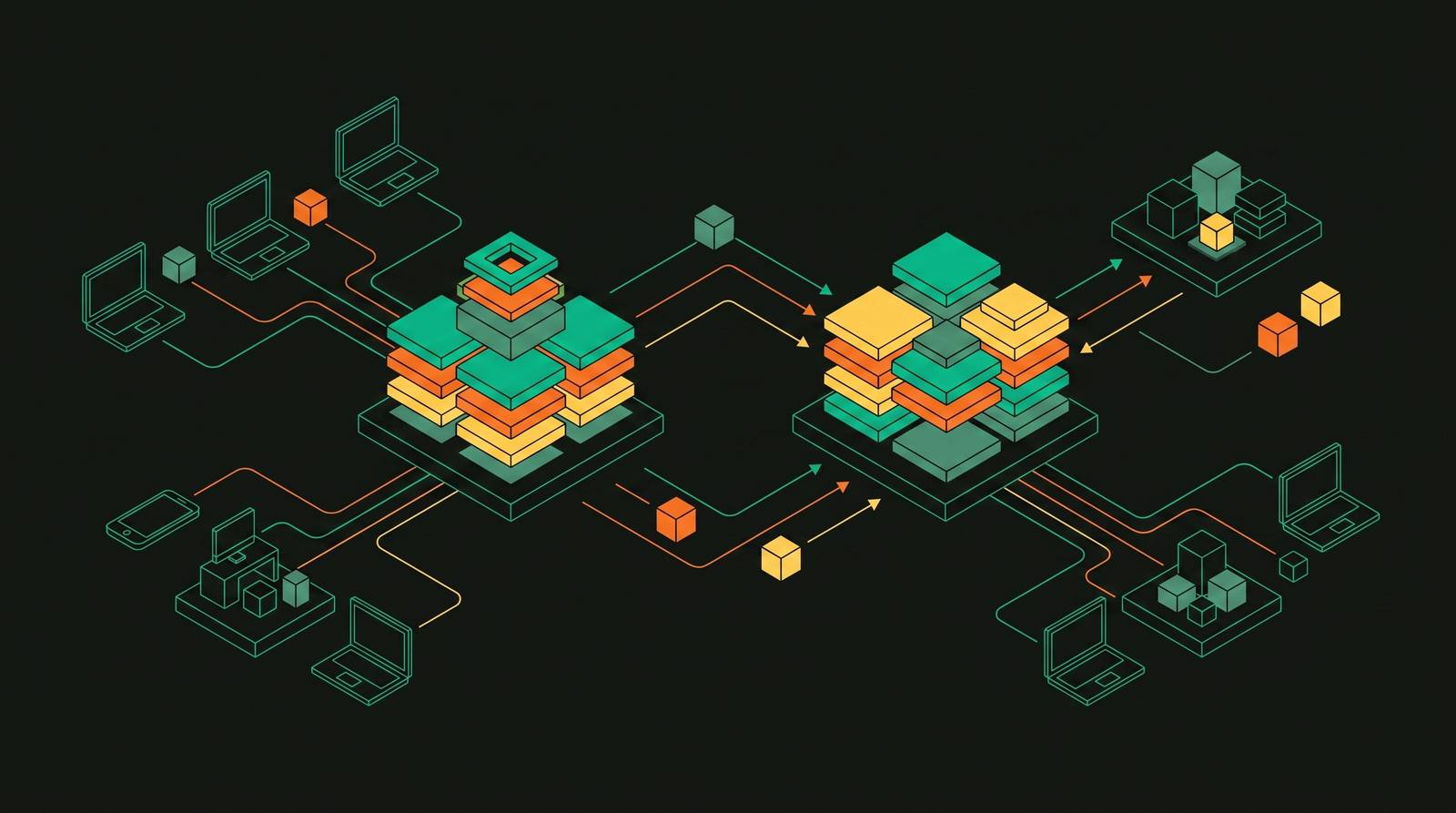
The threat perimeter, as it existed for most of the last two decades, is gone. Branch offices, remote employees, and cloud workloads all operate outside the traditional network boundary, and the castle-and-moat model that legacy VPN and hub-and-spoke WAN architectures were designed to protect is now largely a liability. The architecture assumed users and data lived inside the corporate network. That assumption has not held for years, and at this point, continuing to pretend otherwise is its own security risk.
Regulatory pressure is accelerating what market pressure had already started. Zero Trust has moved from best practice to baseline obligation across many sectors: GDPR compliance has long pushed organizations toward identity-aware access controls, U.S. Department of Defense contractors face a hard deadline of fiscal year 2027 for Target Level Zero Trust, and the White House Executive Order on Zero Trust formalized that trajectory for the federal civilian enterprise. Organizations making the SASE versus SSE decision today are usually doing so under an active compliance calendar. The strategy meeting is not happening in a vacuum; there is a date on the wall behind it.
The threat environment reinforces the urgency. Identity-based attacks surged sharply in the first half of 2025, with password-based attacks dominating daily attack volume against cloud identity providers, according to the Microsoft Digital Defense Report. The attack surface is no longer primarily at the network perimeter. It is at the identity layer, which means access controls are the immediate priority for most security teams, whether or not anyone has gotten around to updating the network diagram.
The scale of market investment reflects this seriousness. The Zero Trust security market was estimated at USD 36.96 billion in 2024 and is projected to reach USD 92.42 billion by 2030, growing at a 16.6% compound annual rate. That is not speculative venture capital chasing a trend. Organizations are treating this transition as infrastructure spend, with the budget cycles, procurement processes, and multi-year contracts to match. The SASE versus SSE decision, for most teams, is being made against a backdrop of contract expirations, fiscal year boundaries, and compliance deadlines. The answer needs to be practical. Ideal is a luxury most organizations do not currently have.
What the workforce distribution variable actually determines
The first question to answer is deceptively simple: where are users connecting from? Fully remote or hybrid workforces with no meaningful branch office footprint present a security transformation problem, not a network transformation problem. SSE addresses that threat surface directly. It delivers Zero Trust network access, secure web gateway, and cloud access security broker capabilities without touching the underlying connectivity layer, because there is no connectivity layer that urgently needs changing.
Organizations with significant branch presence relying on physical WAN circuits face a different problem entirely. Traffic must be backhauled or rerouted through policy enforcement points. Security policy struggles to follow users consistently across sites without a networking layer that can enforce it uniformly. The branch is not just a location; it is an architectural variable that changes what the security platform needs to do.
Mixed environments, some branch footprint and many remote users, are where the decision becomes complex. Applying uniform access controls across branch-connected sites and cloud-connected remote workers requires either a SASE platform that handles both, or a carefully integrated combination of SSE and existing WAN infrastructure. The latter works. It just adds operational overhead that compounds quietly over time. Think of it as patching a quilt versus weaving a new one: both keep you warm for a while, but only one holds together cleanly after a few years of hard use.
The adoption data supports a clear pattern. The ZTNA segment is the fastest-growing component of the broader Zero Trust market, expanding at a 25.5% compound annual rate according to MarketsandMarkets research. That growth reflects how many organizations are entering the Zero Trust journey through VPN replacement and access modernization, not through full WAN transformation. SSE-first is the dominant adoption pattern. Workforce distribution maps directly to network architecture requirements, not just security requirements, and that mapping is what separates the two paths in practice.
Reading the existing WAN investment before committing to a path
The organization's existing WAN state often contains the answer to the architecture question before any strategic framework enters the room. There are three situations that produce meaningfully different conclusions.
If functional SD-WAN is already deployed, SSE is the natural next step. It layers modern security controls on top of existing connectivity without disruption, without redundancy, and without the capital expenditure that new edge hardware requires. The network problem is already solved; the security problem is not.
If the organization is running aging MPLS with contracts approaching expiration, that is the natural SASE window. Replacing transport and security simultaneously avoids running two sequential transformation programs, each with its own procurement cycle, implementation burden, and change management overhead. The timing convergence is the argument, not the technology alone.
If the organization is effectively cloud-native or distributed-first with no meaningful legacy WAN, SASE's SD-WAN component provides limited incremental value. The threat surface is already in the cloud, and SSE typically covers it without requiring branch-edge hardware.
The cost differential matters. Full SASE implementation requires new SD-WAN edge hardware; SSE does not. For organizations whose network is not fundamentally broken, that capital expense is difficult to justify on a security rationale alone. SD-WAN underperformance or reliability problems are a legitimate signal that SASE timing is right; the absence of those problems is an equally legitimate signal to stay with SSE and stop trying to fix things that are working fine.
The practical implication is that teams should audit MPLS contract terms, SD-WAN performance metrics, and planned location expansions before making the architectural commitment. The infrastructure calendar often contains the decision before the strategy meeting begins.
Migration readiness as a constraint on the right architecture
SASE is a larger transformation scope by definition. It requires coordination between networking and security teams, which are frequently separate organizational functions with distinct ownership, tooling, budget cycles, and institutional priorities that did not develop in harmony and will not suddenly begin operating that way because a vendor deck suggested convergence. That coordination overhead is not a minor implementation detail; it is often the primary factor determining whether a SASE program delivers on its timeline or quietly expands into a multi-year commitment nobody originally signed up for.
SSE can be owned entirely by the security team and deployed without touching network infrastructure. For organizations where the networking function is resource-constrained, change-averse, or simply occupied with other priorities, that is a meaningful structural advantage. Framing it as a limitation misreads the operating reality of most security teams.
The staffing and skills gap compounds this constraint. Organizations with small security teams or no dedicated network engineering function face disproportionate operational risk from a SASE rollout. The scope is not just technically larger; it requires skills and headcount that many organizations don't have, and backfilling that gap mid-transformation is expensive and slow.
Single-vendor preference reflects some of this fatigue. Roughly three in five organizations favor a single-vendor SASE or hybrid platform approach over multi-vendor assemblies, per the 2026 Zero Trust Report. That preference is not primarily about technical elegance. It is about the operational exhaustion of managing integration overhead across multiple vendors and policy planes, which anyone who has spent time in a multi-vendor environment during a security incident will recognize immediately.
Migration readiness is not a fixed state. It can be built toward deliberately. But the current state determines whether SASE is a realistic 12-month program or a multi-year commitment that will test the organization's appetite for sustained cross-functional coordination. Being clear about that distinction is the difference between a sound architecture decision and an aspirational one that stalls in implementation.
The decision framework: mapping the three variables to an architecture
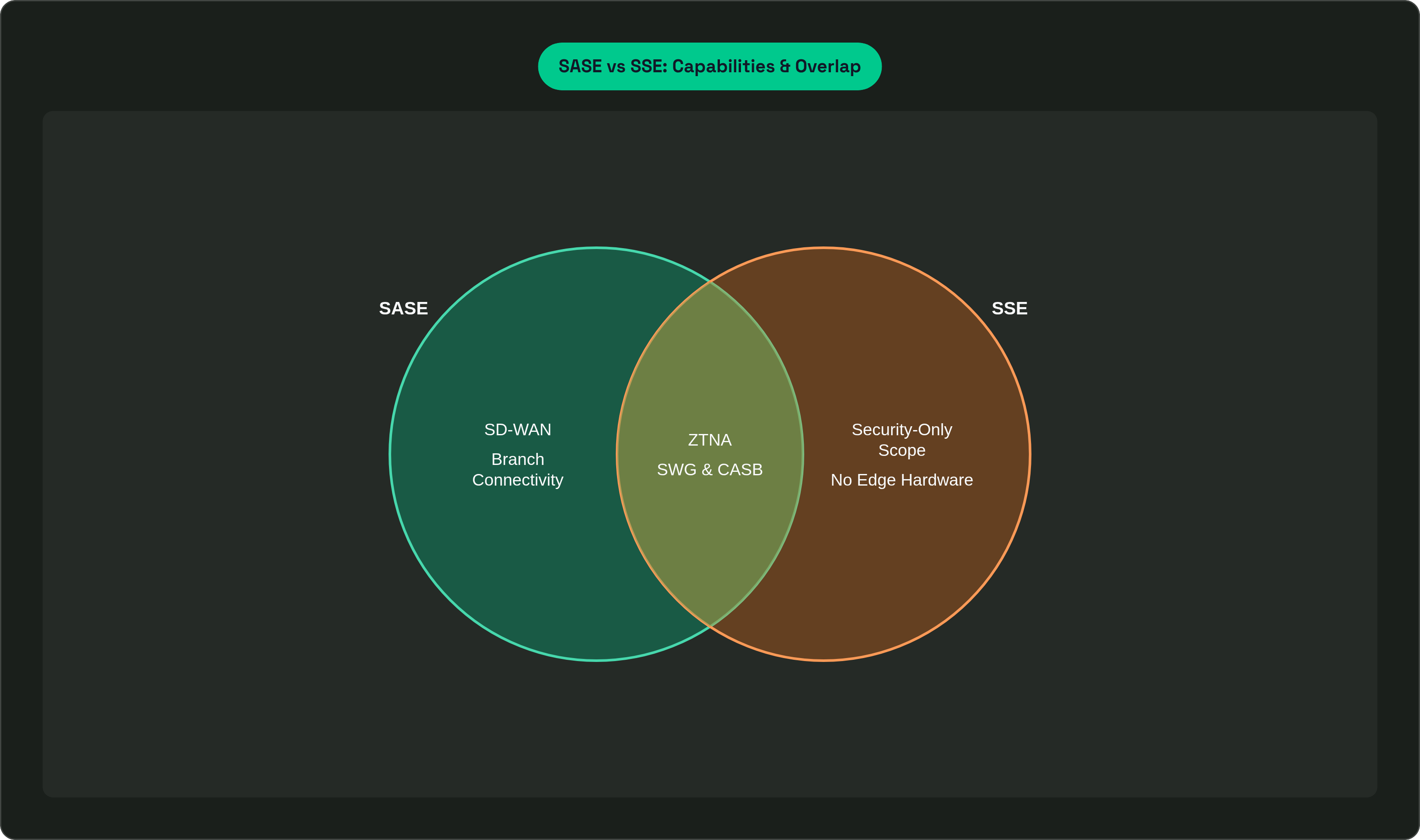
Three variables, mapped honestly, produce the right answer for most organizations.
The first is workforce distribution. Does the organization have significant branch office connectivity requirements, or is the primary challenge securing distributed users who connect directly to cloud resources? The former creates a networking problem that SASE is designed to address. The latter is a security problem that SSE resolves without the added scope.
The second is WAN investment state. Is the existing network functional, making SSE an efficient security overlay? Or is the network at a natural replacement point, making SASE an opportunity to consolidate two transformation programs into one? The answer is almost always visible in the infrastructure calendar, not in the vendor deck.
The third is migration readiness. Does the organization have the team structure, budget alignment, and cross-functional coordination capacity to execute a networking-plus-security transformation simultaneously? Answering yes requires more than intention; it requires an honest assessment of existing bandwidth across both the networking and security functions, the kind of assessment that tends to produce uncomfortable answers in planning meetings.
SSE is the right answer when the WAN is functional, the workforce is primarily remote or cloud-connected, and the organization needs Zero Trust controls without a network overhaul. It delivers the security outcomes without the infrastructure scope, on a timeline that a security team can own independently.
SASE is the right answer when MPLS contracts are expiring, new branch locations are planned, SD-WAN is underperforming, and the organization has the capacity to run a unified networking and security transformation. The combination avoids two sequential programs and their compounded overhead.
The SSE-first, migrate-to-SASE-later path gets unfairly treated as a consolation prize. It is not. SSE's modular components, specifically ZTNA, SWG, and CASB, are the security layer of SASE. An organization that deploys SSE well is not discarding work when it adds SD-WAN later; it is extending the platform. The sequencing is rational. I have watched security teams spend two or three years executing a disciplined SSE rollout, get told they were "just doing SSE" by every SASE vendor who came through the door, and then add SD-WAN at the natural WAN refresh point and realize they had been building the foundation the entire time. The house was not half-finished. The first floor was already load-bearing.
One note on vendor framing: many SASE vendors present full convergence as the default recommendation regardless of WAN state. That recommendation serves vendor interests more reliably than it serves organizational ones.
Where single-vendor platforms change the calculus
A growing number of platforms offer both SSE and SASE capabilities under a single contract, allowing organizations to activate SD-WAN incrementally rather than committing to it at the outset. This changes the risk profile of the SSE-first decision in a meaningful way: if the platform can extend into SASE without a rip-and-replace, the sequencing strategy carries substantially lower switching cost.
The single-vendor preference trend matters here. Managing one policy plane, one management console, and one vendor relationship produces real operational simplification, separate from whether SASE or SSE is the technically correct scope. Integration overhead is real, and reducing it has operational value that belongs in the procurement conversation from the start.
The right evaluation question is whether SD-WAN is integrated into the same policy and management plane as the security components, or whether it arrived via acquisition and remains operationally separate. A unified data plane with consistent policy enforcement across both layers is the actual test of convergence. Platforms that fail that test are selling the label, not the capability, and the distinction becomes obvious quickly once implementation begins.
The risk of premature convergence is also worth naming. Organizations that purchase a SASE platform primarily for its SSE capabilities but never activate SD-WAN are paying for capability they won't use. The framework that drives the architecture decision should inform the procurement conversation with equal rigor.
Network performance is not incidental to this choice. A security platform that routes traffic through a globally distributed network can reduce latency and improve user experience, and the networking value of SASE is not limited to SD-WAN hardware at branch locations; it includes how cloud traffic is handled at the edge. That distinction matters when evaluating platforms against real-world performance requirements rather than specification sheets.
Organizations choosing SSE as a security-first path often layer it on top of existing SD-WAN or cloud connectivity. Some platforms, such as Cloudflare, a global CDN and internet security network that runs Zero Trust access and traffic inspection across more than 330 data centers worldwide, offer unified access controls, including ZTNA, SWG, and CASB, that enforce security policy across branch, remote, and cloud workloads without requiring a parallel WAN transformation, making SSE integration tractable for teams with functional network infrastructure already in place.
How to pressure-test the decision before committing
Four questions, answered honestly, will surface whether the architecture choice is grounded in organizational reality or in vendor collateral.
What percentage of the workforce connects from fixed branch locations versus directly to cloud applications? Every workforce that is predominantly remote or cloud-connected with one or two small branch offices points clearly toward SSE. Every workforce split across a dozen regional branches that generate the majority of application traffic points toward SASE, or at minimum toward a serious conversation about when to revisit the WAN investment question.
When do current MPLS or SD-WAN contracts expire, and are new locations planned in the next 18 to 24 months? Contract timelines and expansion plans are infrastructure facts, not strategic preferences. If MPLS contracts are expiring within the planning horizon, the SASE window is open. If they are mid-cycle, SSE is almost certainly the more rational immediate choice, and treating it otherwise is expensive.
Does the organization have joint ownership between networking and security teams, or does security operate independently? SASE without cross-functional alignment is a program that will encounter friction at every phase. SSE without that alignment is simply a security team doing its job. These are not equivalent problems.
Is the primary security gap in access control, data protection, or traffic inspection? If the gap is entirely in access and data, SSE covers it without SD-WAN. If branch traffic routing and policy enforcement consistency across sites are the actual gap, SASE is addressing the real problem rather than the documented one.
For most organizations, beginning with a ZTNA deployment as a VPN replacement is the lowest-disruption first step that produces immediate security value. It generates telemetry about access patterns, reduces exposure through the highest-risk legacy control, and is architecturally compatible with either SSE or SASE as the end state. Roughly half of organizations are estimated to be midway through their Zero Trust adoption, per the 2026 Zero Trust Report, which means most teams making this decision are not starting from zero. The audit should account for what Zero Trust controls already exist and can be extended rather than replaced. Starting from scratch is rarely necessary and almost never free.