Zero Trust Architecture for Teams Under 50 People
Small teams can adopt Zero Trust principles phased and affordably, starting with identity and MFA.

The principle fits on a sticky note: never trust, always verify. Forrester analyst John Kindervag coined the term in 2009, and the core logic hasn't shifted since. Some degree of compromise will always occur. The architecture assumes it and contains it rather than trying to stop everything at the border.
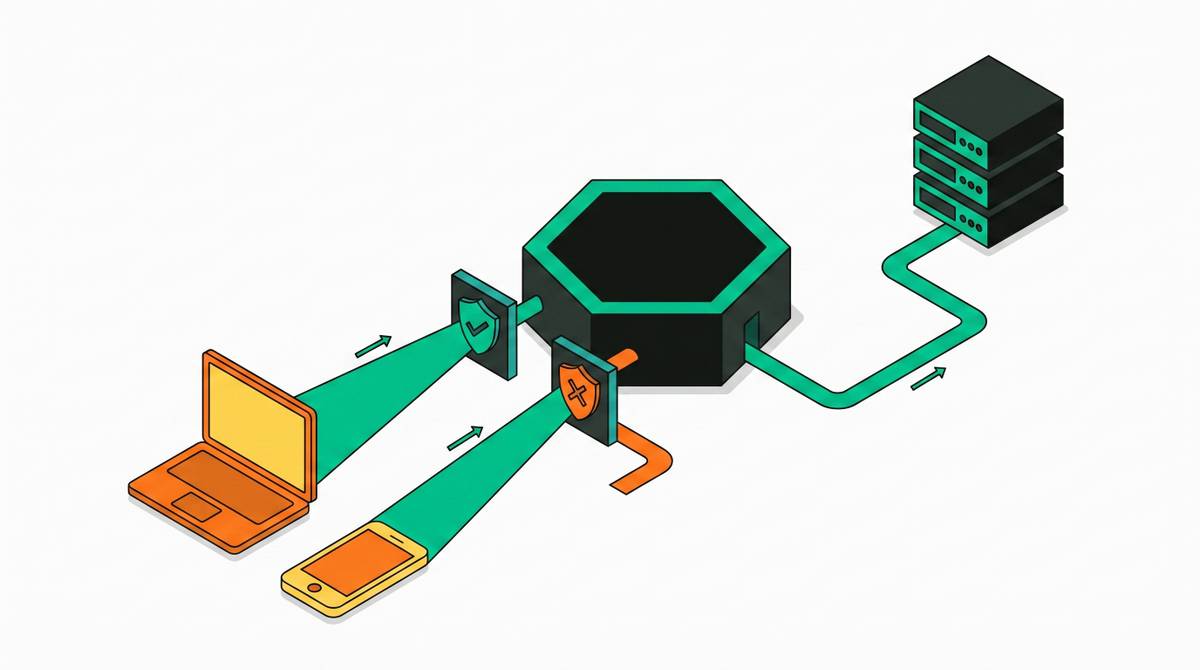
No user, device, or system gets implicit trust based on network location. Every access request is authenticated, authorized, and continuously validated. That's the whole idea, and it stays that simple right up until the vendors show up.
NIST Special Publication 800-207 defines Zero Trust as a set of principles, not a product checklist. That distinction is the most important thing a small team can internalize before evaluating any tool. CISA's Zero Trust Maturity Model organizes those principles into five pillars: Identity, Devices, Networks, Applications and Workloads, and Data. The work is in the sequencing and enforcement logic across those pillars. NIST's NCCoE released updated implementation guidance in SP 1800-35 in late 2024, worth bookmarking.
What This Looks Like for a 30-Person Team
Zero Trust is not a firewall upgrade. It is a different theory of where access decisions get made and on what basis. Identity becomes the operative perimeter: who you are, on what device, from what context determines what you can reach. Least-privilege access means users get to exactly what their role requires, nothing adjacent. Micro-segmentation limits the blast radius when a credential is compromised, so one bad day doesn't become a full-environment exposure.
A few misconceptions are worth killing directly. "Zero Trust means trusting no one" is a catchy misreading; it means trust is earned contextually and continuously, not assumed statically. "It requires ripping out existing infrastructure" is also wrong; phased adoption on top of existing tools is the standard path. The most stubborn myth is that Zero Trust only matters once you have a dedicated security team. The opposite is true. The architecture is explicitly designed to reduce the cognitive and operational load on whoever is handling security, whether that's a full-time CISO or a developer who got handed the role because they once fixed a Wi-Fi router.
The Real Cost of Doing Nothing — and What Zero Trust Actually Saves
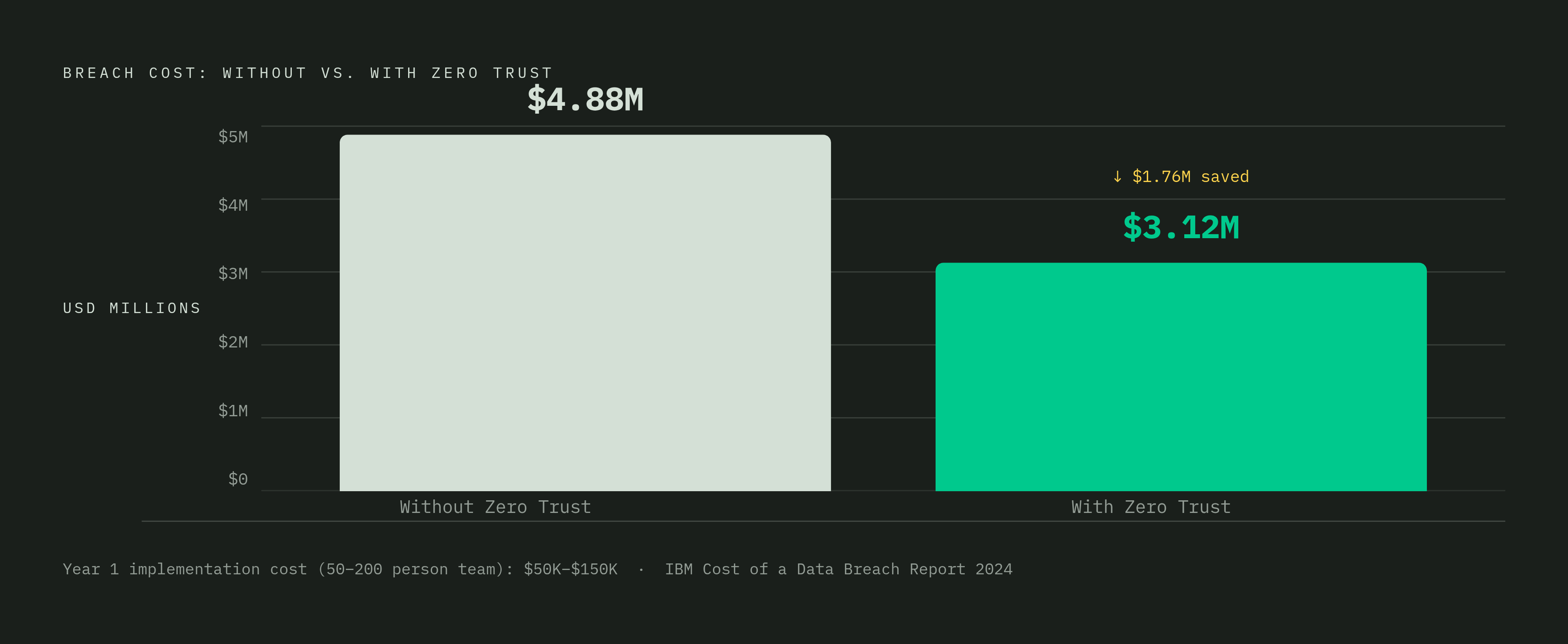
The IBM Cost of a Data Breach Report 2024 puts the average global breach cost at $4.88 million. For a sub-50-person team, a fraction of that figure isn't a setback; it's a liquidation event. The same report found that organizations with Zero Trust principles deployed saved an average of $1.76 million per incident compared to those without. That delta is not abstract. It is the difference between recovering and closing.
Forrester's research on mature Zero Trust implementations shows organizations experiencing roughly half as many breaches as peers without the architecture. These are not marginal improvements at the tail of a distribution; they reflect a fundamentally different exposure profile.
The operational savings compound on top of the risk reduction. ZTNA eliminates VPN infrastructure; organizations typically save 30 to 50 percent on remote access costs after the transition. SSO and self-service credential management reduce authentication-related support load by 40 to 60 percent, per Forrester's 2024 research. Compliance assessments get faster when audit trails and access controls are inherent to the architecture rather than assembled the week before an auditor arrives. Cyber insurers now offer premium discounts of 10 to 25 percent for organizations demonstrating MFA, endpoint detection and response, and Zero Trust principles, which alone offsets a meaningful portion of implementation costs.
For teams in the 50 to 200 employee range, Year 1 investment typically runs $50,000 to $150,000, with $30,000 to $80,000 in annual recurring costs. A phased approach concentrates early spend on the highest-impact controls, so the initial outlay is considerably smaller than those top-line figures suggest.
Why Identity Is the Right Place to Start, Not the Network
If your team uses Google Workspace, Microsoft 365, Slack, GitHub, or any SaaS-first stack, the meaningful security boundary is already the authenticated identity. The network perimeter isn't gone in some philosophical sense; it simply never meaningfully existed for a distributed team running on cloud services. Segmentation starts with who, not where.
The data on credential attacks is hard to look away from. Verizon's 2025 DBIR found that 22 percent of breaches began with credential abuse. Microsoft's Digital Defense Report 2025 documented hundreds of millions of daily identity attacks against Microsoft Entra alone, with password-based attacks accounting for more than 99 percent of them. These are not enterprise-scale attack patterns that politely spare smaller organizations. Credential phishing scales effortlessly, and a 30-person team is beneath no automation's notice.
Phishing-resistant MFA stops more than 99 percent of identity-based attacks even when the attacker already holds valid credentials, per Microsoft's 2025 research. One control, applied universally, is the highest-ROI security action available regardless of team size or budget. Every major Zero Trust framework treats MFA as foundational, and the data explains why.
What an Identity-First Foundation Actually Looks Like
Enforce MFA across all users and all applications, with no exceptions carved out because something feels "internal." Implement SSO to centralize authentication and create one audit surface instead of credential sprawl across a dozen SaaS portals. Define roles and enforce least-privilege access so each user reaches only what their function actually requires. Establish a reliable joiners-movers-leavers process; compromised orphan accounts from departed employees are a recurring gift to attackers, and they are entirely avoidable.
Once identity is solid, the next logical layer is device trust. Is this a managed device? Is the OS current? Does endpoint protection exist and actually run? Even basic device enrollment and health checks dramatically narrow the attack surface for teams with mixed personal and work device usage, which describes nearly every small team operating today.
A Phased Zero Trust Roadmap a Small Team Can Actually Execute
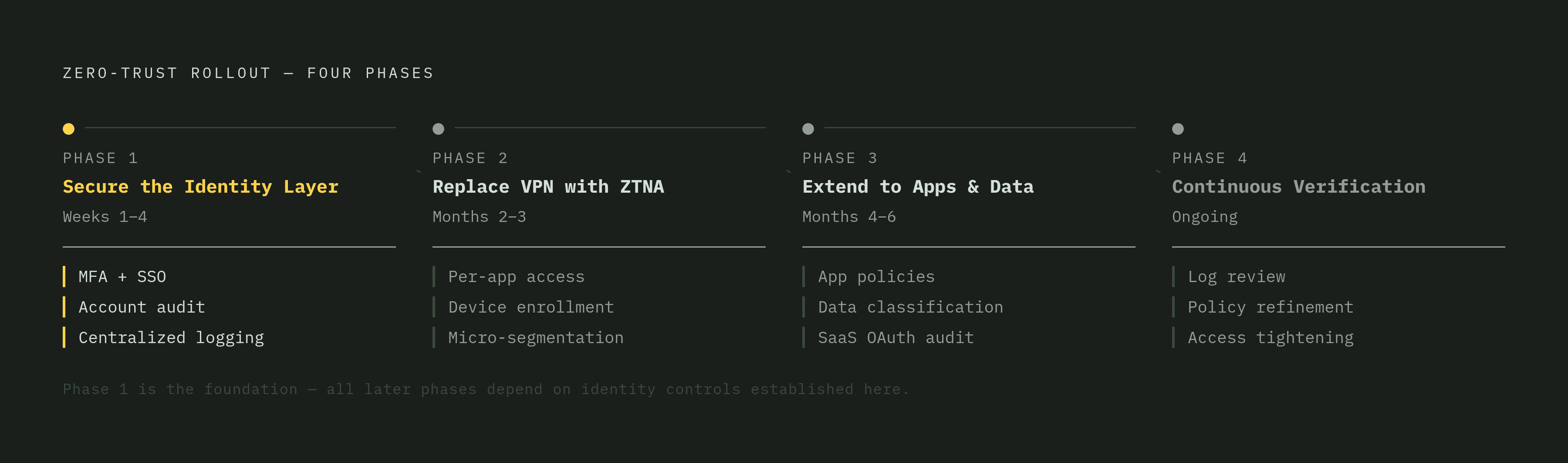
The most common implementation mistake is moving too fast. Lock down every port and require MFA for every action on day one, and employees will route around the controls: personal cloud storage, unapproved messaging apps, shadow IT everywhere. Shadow IT creates more exposure than the friction it was supposed to eliminate. Policy should expand progressively, validated at each step before moving to the next layer.
Phase 1: Secure the Identity Layer (Weeks 1 to 4)
Deploy phishing-resistant MFA for all users across all applications. Implement SSO to centralize identity management. Audit existing accounts; remove unused credentials and enforce least-privilege role assignments. Set up basic logging so access events are visible. The operational principle here is not complicated: you cannot enforce what you cannot see.
Phase 2: Replace VPN with ZTNA and Control Device Access (Months 2 to 3)
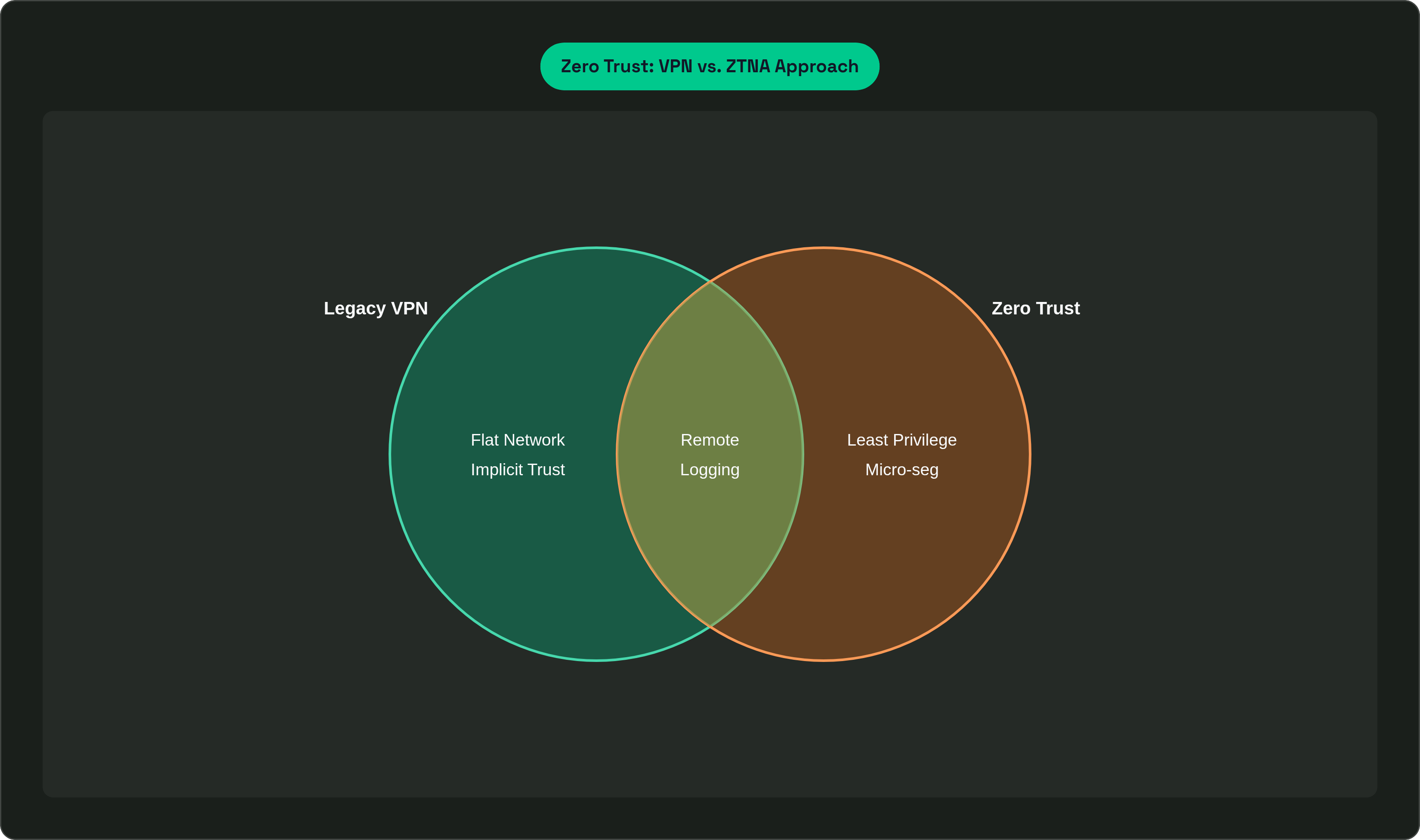
ZTNA grants per-application access based on verified identity and device posture rather than dropping users onto a flat network where lateral movement is trivial. Roughly 46 percent of organizations planning SSE adoption now start with ZTNA, per 2025 industry data, which reflects its emergence as the standard entry point for teams that want meaningful security without rearchitecting everything simultaneously. Enroll managed devices and set minimum posture requirements: OS version, endpoint protection, disk encryption. Begin micro-segmenting internal applications so a compromised credential cannot traverse the entire environment in one move.
Phase 3: Extend Controls to Applications, Data, and Third Parties (Months 4 to 6)
Apply access policies to individual applications and workloads rather than relying on the network boundary as a proxy. Enforce data classification and access controls at the file and application level. Extend Zero Trust policies explicitly to contractors, freelancers, and third-party integrations; these are frequently the preferred entry point for attackers targeting small teams, precisely because small teams often extend access generously and revoke it slowly, if at all. Audit SaaS application permissions. Small teams accumulate OAuth grants at a remarkable rate, and many of those grants provide broad access to tools no one actively uses anymore.
Phase 4: Continuous Verification and Policy Refinement (Ongoing)
Zero Trust is not a project with a completion date. It is an operational posture that requires regular attention, not periodic heroics. Review access logs, adjust policies as roles evolve, re-evaluate device posture thresholds. Each audit cycle is an opportunity to tighten minimum viable access for each role and retire permissions that have outlived their purpose.
Why a Consolidated Platform Serves Small Teams Better Than a Best-of-Breed Stack
A best-of-breed stack may be technically superior in each individual category. For a team with dedicated security engineering resources to tune and integrate those tools, that advantage is real. For a team of 30, where the person managing security is also managing three other things, a fragmented stack becomes shelfware: configured once during a motivated sprint, never actively maintained afterward. Integration labor and tuning overhead scale multiplicatively with each additional vendor, not linearly, and the compounding usually happens quietly until something breaks.
61 percent of organizations now prefer a single-vendor SASE approach over multi-vendor architectures, per 2025 industry survey data, primarily citing enhanced security as the reason. That preference isn't hard to explain. A unified platform means one policy model, one audit log, one vendor relationship to manage when something goes wrong.
SASE (Secure Access Service Edge) converges network security functions, including ZTNA, secure web gateway, cloud access security broker, and firewall-as-a-service, with SD-WAN under a single policy engine. SSE (Security Service Edge) is the security-only subset of SASE and is the practical starting point for teams not yet managing SD-WAN. The global SASE market was estimated at roughly $47.9 billion in 2025, growing at a 23.5 percent compound annual rate through 2032; SSE adoption intent jumped from 69 percent of organizations in 2024 to 79 percent in 2025. The category is consolidating quickly, and pricing is becoming more accessible to smaller buyers as competition increases.
What to Look for in a Platform for a Small Team
Global network reach matters because latency affects adoption: if the security layer visibly slows work down, employees route around it, and you are back where you started, providers like Cloudflare, a CDN and internet security network that routes traffic through 330-plus edge locations worldwide to minimize that latency penalty, exist precisely for this reason. Per-application access policies should not require complex network reconfiguration to implement. Pricing should be transparent and consumption-based so costs do not scale with idle infrastructure. The platform should support the identity providers a team already uses, whether that is Google, Microsoft, or a standalone identity solution, without imposing proprietary lock-in. Visibility should extend to all users and devices, including AI agents and automated workflows, through a single dashboard rather than requiring manual correlation across multiple consoles.
NIST SP 800-207 and CISA's Zero Trust Maturity Model provide the foundational frameworks, but implementing them on a unified global network eliminates the infrastructure fragmentation that most commonly derails small-team adoption.
Where Small Teams Are in Zero Trust Adoption Today — and What the Gap Reveals
61 percent of organizations worldwide have launched a Zero Trust initiative, up from 24 percent in 2021, per the Okta State of Zero Trust Security report. That is meaningful progress on paper. Those same organizations report being only 47 percent of the way through their Zero Trust journey on average, per the 2025 SSE Adoption Report. Gartner's 2025 Strategic Roadmap projects that by end of 2026, only 10 percent of large enterprises will have a mature and measurable program, up from less than 1 percent in 2023. Small teams are typically earlier in that curve than large enterprises. Most are barely started.
Large enterprises currently hold the largest share of Zero Trust market revenue, reflecting their head start and budget scale rather than any inherent architectural advantage. SMEs are projected to represent the fastest growing segment through 2030, per Grand View Research, as tooling, pricing, and operational models converge toward smaller buyers.
External mandates are also compressing the timeline in ways that extend well beyond the federal government. The U.S. federal Zero Trust mandate required all agencies to implement Zero Trust principles by end of fiscal year 2024. The DoD Zero Trust Strategy requires every DoD contractor to achieve Target Level Zero Trust by fiscal year 2027. That requirement does not stop at the enterprise tier; small firms serving the defense supply chain are explicitly included. Similar compliance-driven requirements are spreading through regulated industries at every company size.
The gap between where small teams are and where the threat environment requires them to be is not a technology problem. The tools exist, are accessible, and are increasingly affordable. It is a prioritization problem, and organizations that keep deferring the decision tend to get it made for them, at considerable expense, by whoever finds their credentials first. Starting with identity, executing in phases, and consolidating onto a platform a small team can actually operate without a dedicated engineering function are not aspirational goals. They are the minimum viable response to the current environment.