Object Storage Cost Optimization for High-Request-Rate Workloads
Request charges and egress costs, not storage rates, drive cloud bills at scale.

Storage rate is the most legible dimension of your cloud bill and, at scale, often the least consequential one. The headline per-GB rates across major hyperscalers cluster in a remarkably narrow band. Competing on storage rate alone is, at this point, a distraction from the numbers that actually move.
Request charges are where the math turns treacherous. PUT, COPY, GET, and SELECT operations are each billed per thousand. At modest volume the numbers are trivial. At millions of daily operations across a microservice architecture that polls frequently, generates presigned URLs, runs health checks against bucket metadata, and performs LIST operations to discover object state, the request bill compounds in ways almost no team models upfront. The accounting is also granular in ways that carry real consequences: S3 Bucket Keys, for instance, reduce the number of AWS KMS calls required per object operation, which meaningfully cuts encryption overhead for high-volume workloads. Most cost reviews never reach this layer. That is precisely why it keeps appearing on bills as a line nobody budgeted for, reviewed quarterly with mild collective embarrassment.
Egress is structurally different from both. Storage and request charges scale with what you do inside the provider's network. Egress charges scale with what leaves it, and the per-GB egress cost for a read-heavy workload can substantially exceed the per-GB storage cost for that same dataset. A SaaS platform serving significant content volume monthly can find its egress bill dwarfing its storage cost entirely. This is not an edge case.
The interaction problem is what makes this hard to fix. A team correctly identifies egress as dominant, moves to a CDN, cache-hit rate improves, egress charges fall. Origin request counts climb. Spend shifts rather than shrinks. Each billing dimension runs on its own logic, indifferent to your optimization efforts on the adjacent one. Push down on egress, request costs bulge — it is like squeezing a balloon: flatten one side and another puffs out. Compress request volume, and you will find yourself under-serving access patterns in ways that inflate retrieval fees. The dimensions are not cooperative. That is the central structural problem, and it is worth sitting with before reaching for any tactical solution.
Retrieval Tiers, Lifecycle Transitions, and Versioning as Hidden Cost Amplifiers
Cold and archive tiers look like obvious savings. They are, right up until retrieval happens, at which point the bill can be disorienting.
Glacier-class storage charges per GB retrieved. A workload that occasionally needs archived data can generate retrieval fees that exceed months of accumulated storage savings in a single event. Minimum duration penalties compound this: move an object to a cheaper tier and delete it before the minimum hold period, and you are billed for the unused time regardless. Then there is expedited retrieval, for teams that discover urgently they needed that archive data, which carries an additional premium on top of the retrieval fee. The architecture of these tiers is not designed to make cost surprises easy to avoid.
Lifecycle transition charges are per object, not per GB. This distinction quietly destroys value on small-object, high-object-count buckets. Lifecycle rules pay off on large objects with predictable access patterns. On buckets containing millions of small files, they can easily cost more than they save. This is the kind of thing that looks fine in a napkin calculation and surfaces three months later in a post-mortem.
Versioning is the most invisible amplifier of the group. Every overwrite in a versioned bucket creates a retained non-current version that is stored and billed. In high-write environments this accumulates fast, and the insidious part is that versioning overhead surfaces in cost dashboards as storage, not as its own line item, so it evades scrutiny. The effective policy is to move non-current versions to a cheaper tier after a short window, delete them after a defined retention period. You keep the audit trail without paying for indefinite retention of objects nobody will ever open again.
Incomplete multipart uploads are a separate category of silent waste and the most avoidable one. Failed or abandoned large uploads leave fragments billed as normal storage, indefinitely, invisible in standard object listings. Surfacing them requires explicit lifecycle rules or direct bucket analysis. In environments that have never looked, they accumulate for years.
Conducting a Storage Cost Audit Before Changing Anything
The most common mistake in storage cost optimization is applying lifecycle rules or tier migrations before decomposing the bill. Teams feel productive. The bill gets worse. Run the audit first, without exception.
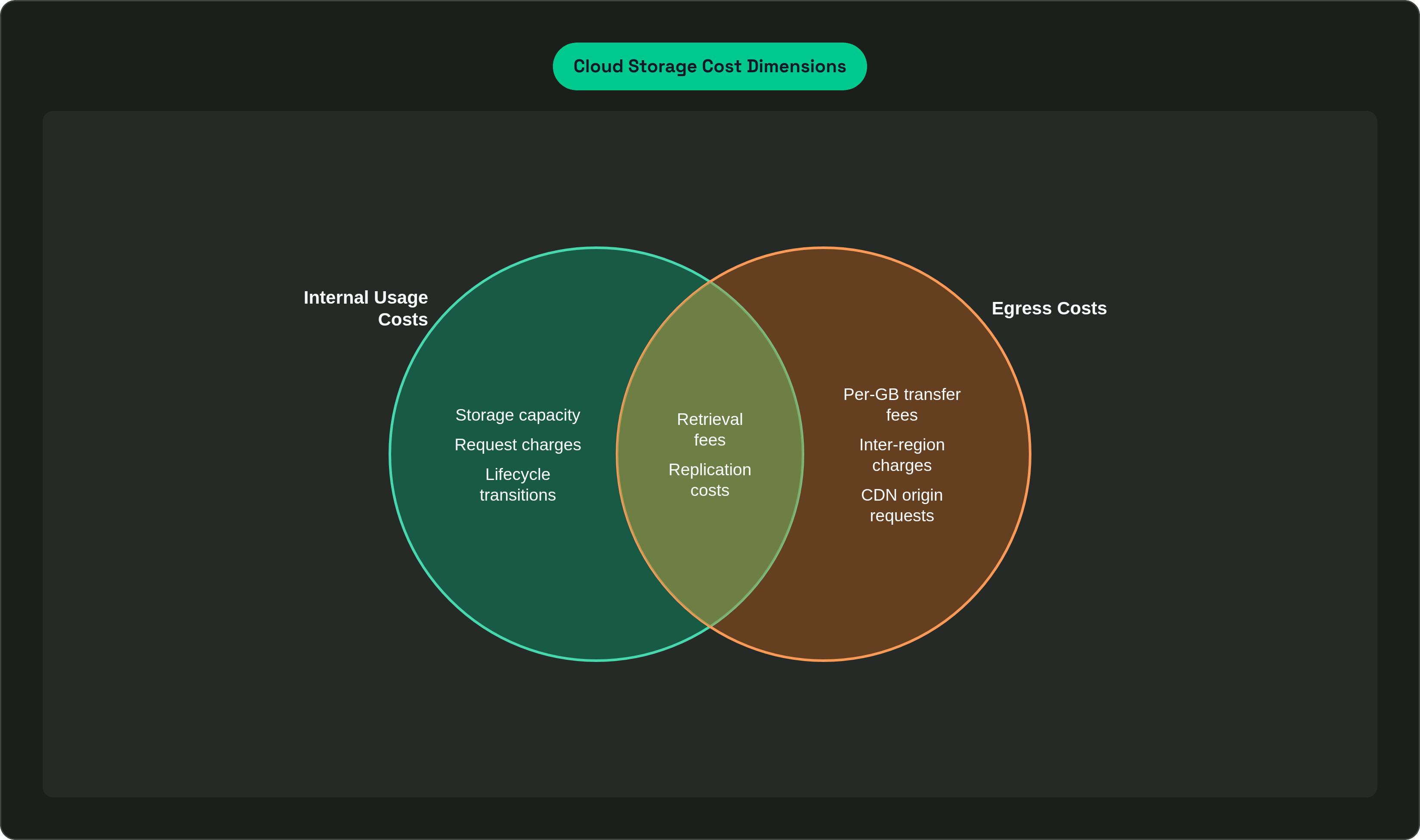
Decompose the bill by dimension. Separate storage capacity charges from request charges, from egress, from retrieval fees, from transition costs, from replication overhead. The goal is identifying which dimension is actually dominant, not which one looks most alarming in the console. Instinct is wrong often enough that skipping this step is expensive, and the instinct-versus-data gap is largest in organizations where the engineers and the finance team are talking past each other.
Profile access patterns per bucket or prefix. Tools like S3 Storage Lens surface GET/PUT ratios, object age distributions, and request patterns at prefix granularity. Without this data, tiering decisions are speculation presented as optimization. The distinction matters more than most teams appreciate until they have made one bad tiering call and had to reverse it.
Identify silent waste before touching active spend. Hunt specifically for incomplete multipart uploads, non-current object accumulation in versioned buckets, zero-byte objects and placeholder keys, and buckets with no read activity over an extended window. These are pure waste with no interaction risk. Clear them first. This is also the most satisfying part of the audit because the savings require no architectural courage whatsoever.
Model interaction effects before making any change. For every proposed lifecycle rule, calculate transition cost at actual object count against projected storage savings. For every proposed tier migration, calculate retrieval fee exposure at realistic retrieval frequency. The realistic retrieval frequency is almost never what the original requester estimates; plan accordingly. Teams move data to an infrequent access tier without modeling the retrieval rate, discover the error several billing cycles later, and reverse the migration at additional cost.
The output of the audit is a ranked list of dimensions by dollar impact, with interaction risks made explicit for each option. Nothing changes before that list exists.
Tiering and Lifecycle Strategies That Actually Reduce the Bill at Scale
The choice between intelligent tiering and manual lifecycle rules turns on one variable: access predictability.
Intelligent tiering automates tier placement based on observed access patterns and charges a monitoring fee per object to do so. That fee earns its cost when access patterns are irregular or distributed across a large, heterogeneous bucket. For predictable workloads, where objects are reliably cold after a certain age, the monitoring overhead is pure waste. Manual lifecycle rules outperform when you already know the pattern. Paying for automation to confirm what you already knew is a real and common error — paying a premium to be told what you already knew, which is less a cloud strategy than a personality trait.
Azure's Smart Tier, which reached general availability in late 2025, automatically shifts capacity to cooler tiers based on last-access time. Real-world deployments at scale show auto-tiering capturing a substantial share of addressable savings when applied to workloads where access patterns are unpredictable. Automation earns its cost when the alternative is humans guessing across thousands of buckets, not when the pattern is already obvious.
Small objects deserve specific attention because they break almost every tiering assumption. Bundling many small objects into archives before upload reduces request overhead and per-object transition costs downstream. For analytical workloads, converting log data from CSV or JSON to Parquet cuts storage footprint and downstream processing spend simultaneously. This is not a minor optimization at scale; it is frequently the highest-leverage structural change available before touching tier configuration at all.
Infrequent Access tiers carry traps. Every major provider's IA or Cool tier carries a minimum duration penalty and, frequently, higher request prices than the standard tier. Storage savings disappear quickly if retrieval frequency is underestimated, which it usually is. Archive tier is appropriate for compliance copies and long-term audit logs where retrieval is rare and latency is acceptable; it is not a cost fix for data that operational processes actually touch.
Replication deserves its own audit line. Cross-region and cross-account replication multiplies both storage and request charges. The productive question is not how to make replication cheaper but which replicas are actually required for availability or compliance versus which ones are vestigial configurations that survived three team rotations without anyone questioning whether they still made sense.
When Egress Is the Dominant Cost Driver and How to Address It Structurally
Egress charges cannot be optimized away at the request level. You can batch requests, cache aggressively, and consolidate access patterns, and you should; the underlying economics remain regardless. Moving data out of a hyperscaler's network carries a per-GB cost that, for read-heavy workloads, dwarfs the storage cost of that same data. The room rate looks reasonable. Taking anything out is where the bill gets creative.
CDN placement is the first structural response. Cache-hit rate determines what fraction of egress charges the CDN absorbs, and long TTLs on immutable assets, versioned static files, compiled bundles, and media assets eliminate repeat egress for the same object. One qualifier that gets missed more than it should: CDN placement only helps for content served to end users. Internal service-to-service reads between cloud services in different regions still incur transfer charges, and those can be significant in ways that CDN metrics never surface.
Zero-egress storage is the more fundamental architectural option. Some storage providers price their service without egress fees, shifting the cost model entirely to storage capacity and operations. This inverts the optimization calculus: rather than minimizing reads to control egress, teams can optimize purely for access patterns and request efficiency. The tradeoff is real. Zero-egress providers tend to have narrower regional footprints, fewer storage classes, or different API surfaces than a hyperscaler. Migration complexity must be modeled honestly.
The workloads where egress-free storage delivers the clearest savings are those where egress already dominates: media delivery, large-file distribution, log exports, ML training data pulls. Workloads deeply embedded in a single cloud's compute ecosystem require more careful modeling before the conclusion is obvious, because the egress savings can be partially offset by losing the integration advantages that made that cloud attractive initially.
Within a single provider, placing compute in the same region as storage eliminates inter-region transfer charges. It is also, reliably, overlooked when teams spin up workloads quickly and geography feels like an administrative detail rather than a billing variable. It is a billing variable.
S3 Express One Zone and High-Performance Storage Tiers: When the Premium Is Justified
S3 Express One Zone delivers single-digit millisecond request latency, materially faster than standard S3, at a substantially higher per-GB storage cost. This tier is not a general-purpose cost optimization. Using it as one is an expensive mistake with a predictable discovery timeline, usually around the second billing cycle when someone runs the numbers.
The April 2025 pricing reductions changed the viability calculus. Storage costs dropped 31%, PUT costs dropped 55%, GET costs dropped 85%. These reductions make Express One Zone a credible option for a broader class of workloads than at launch, particularly read-heavy inference and analytics jobs where GET volume is high and latency sits on the critical path.
The justified use cases are specific. AI inference serving, where model weights or feature data must be loaded repeatedly at low latency, benefits directly. High-frequency analytics queries where storage latency increases compute-hours billed translate storage performance into compute savings elsewhere in the bill. Workloads where improved latency reduces retry rates, timeout errors, or queue depth achieve the same conversion. In each case, the storage premium buys something measurable outside the storage line.
The unjustified cases are equally clear: throughput-bound workloads rather than latency-bound ones, write-heavy logging pipelines, cold archives. The tier also trades multi-AZ durability for performance, which makes it appropriate for reproducible or cacheable data, not for primary copies of records that cannot be reconstructed. That tradeoff is worth stating plainly because it occasionally gets lost in the latency conversation.
Multi-Provider Storage Architecture for Teams That Need to Control All Six Dimensions Simultaneously
No single provider is cheapest across all six dimensions for all workload types. This is not a particularly controversial observation; it is the natural consequence of providers optimizing for different use cases and pricing to reflect those priorities. Pretending otherwise is how teams end up with a single-vendor bill that is expensive in four different directions simultaneously.
A tiered assignment framework, developed from working through these problems at actual scale, looks roughly like this.
Hot user-facing content with high egress belongs in storage architectures that minimize egress cost at the access layer, with compute as close to users as possible. Workloads deeply embedded in a cloud provider's compute ecosystem, Lambda functions, BigQuery jobs, Azure Functions pipelines, benefit from same-provider storage to avoid cross-cloud egress, with optimization happening internally through lifecycle rules and request batching. Long-term compliance and audit archives belong in the deepest archive tier that meets the actual retrieval SLA, not the aspirationally optimistic one. High-IOPS AI inference and analytics workloads justify a performance premium where latency reduction translates to measurable compute savings.
Migration cost is real and must be modeled before the first object moves. Moving data between providers incurs egress charges at the source, a one-time cost that must be recovered by ongoing savings on the other side. S3-compatible APIs reduce re-engineering effort considerably; most tooling works against any S3-compatible endpoint without rewriting application logic. Platforms that combine object storage with a globally distributed edge and security network, Cloudflare's R2 paired with its serverless Workers running across 330+ data centers being one example, can reduce egress-driven spend by shifting retrieval patterns toward nearby points of presence rather than routing through long-haul transfers.
The progressive migration pattern avoids the worst of the upfront cost: new writes go to the target provider, legacy objects migrate as they are accessed, and the egress bill for the migration stays proportional to actual access patterns rather than arriving as a single unpleasant surprise. Teams that skip this and attempt full migrations upfront tend to discover that the egress cost of moving the data partially offsets the first year of savings on the other side. The math on this is not subtle. Model it before you start.