Stateless Application Design Patterns for Kubernetes Workloads
Design stateless Kubernetes apps by separating durable state from replaceable pods.
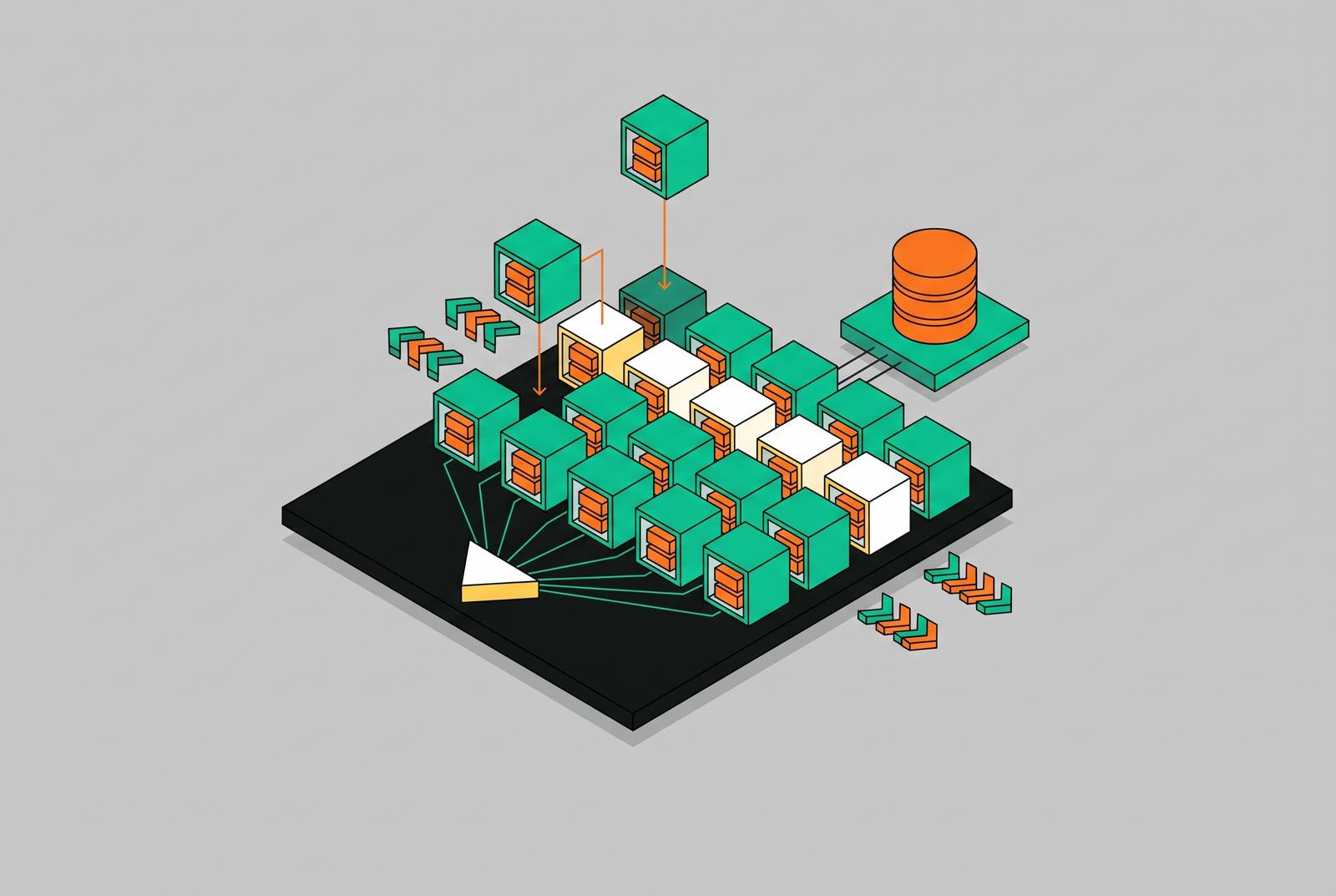
Stateless application design for Kubernetes separates durable business state from disposable instance state, so replacing a pod does not become a business incident. Immutable images, externalized sessions, shared-nothing replicas, and injected configuration enforce that separation. Probes, shutdown behavior, and placement rules then make it work under the conditions Kubernetes creates as it runs.
Why Kubernetes makes pod replacement normal and why application design must start there
Kubernetes restarts, reschedules, upgrades, and scales pods as ordinary operations. An application that depends on one pod’s memory, local disk, or network identity is therefore depending on something the platform treats as replaceable. That mismatch may stay hidden while the service runs undisturbed. A rollout gives it an opportunity to appear. A node failure gives it another chance to appear, usually at a worse time.
The platform orchestrates containers. Local state can disappear when a pod restarts, missing health checks can obstruct recovery, and assumptions about static infrastructure can break when workloads move between nodes. The design constraint follows directly from that behavior. A pod may hold a cache or an in-flight connection, but durable business state must live in a suitable place outside it, and the application must still work correctly when transient instance state is lost as a pod is replaced.
Auditing what a process actually holds before deciding where state belongs
The first design task is to inventory every item the process keeps beyond a single request and classify it as durable, reconstructable, or disposable before moving anything. Login sessions, job ownership, idempotency keys, and generated files all need clear rules for how long to keep them and how to keep them consistent. Their destinations may be a database, object store, or queue. Identify what must remain true after the process that created the state disappears.
Shared ephemeral state needs a different test. Distributed sessions, leases, and rate-limit counters belong in a shared store built for that purpose only when the application needs them to be shared. A reconstructable cache can remain local if starting cold neither harms correctness nor overloads the origin. Local does not automatically mean wrong. Pod-local filesystems, however, should be treated as temporary unless the workload deliberately uses a persistent volume and accepts the operational constraints that come with it.
Session affinity is a useful diagnostic signal here. It can improve cache locality, but it cannot protect state against a restart, rollout, or zone failure. If a user action must reach the same instance to succeed, the service has an availability and scaling constraint that needs to be named.
The inventory must also expose assumptions about ownership. Once several replicas use the same external record, they can race to read, modify, and write it. A local rate limiter or deduplication cache is therefore approximate unless every replica uses the same shared backing store. Moving state changes where concurrency must be controlled.
Choosing the right workload controller and what that choice commits you to
Controller selection turns the state inventory into an operational commitment. A Deployment manages identical, replaceable pods and fits horizontally scalable, restart-tolerant services with no dependency on persistent local storage. Web APIs, frontend services, AI inference endpoints, and microservices commonly fit that description. Their replicas should be interchangeable by design. If an application still has a hidden need for stable instance identity, choosing a Deployment gives it a controller that cannot meet that need.
A StatefulSet serves the other side of that boundary. It gives each replica a stable, unique identity and supports workloads that need to keep their identity and storage. ClickHouse nodes and metadata services are candidates for this model. The workload’s name alone is not decisive, however. Airflow schedulers can use a StatefulSet with LocalExecutor mode and persistence enabled, or a Deployment otherwise, because configuration changes what the scheduler needs from its runtime.
Completion-oriented work occupies a third category. Jobs and CronJobs suit data pipelines, background tasks, and one-time or recurring compute that must finish. dbt runners are Deployment or Job candidates, while Spark driver pods are Job or Pod candidates. A batch process remains a batch process even when it comes in a container image like a live service.
These choices govern how Kubernetes reconciles desired and actual state. Controllers continuously observe, compare, and correct, creating a replacement when a failed node leaves the replica count short. That replacement requires no manual intervention. It does, however, require an application that accepts the identity and storage behavior of its controller. Reconciliation can bring the number of pods back to the requested count, but it cannot keep an instance identity that the chosen controller never promised to keep.
Building an immutable image and a minimal runtime contract that survives replacement
For a Deployment-based service, the next commitment is an immutable image and a small runtime contract. Each replica must bind to its configured port, expose health endpoints, read injected configuration, and emit logs to standard output or a collector. None should need a particular node or public IP. The contract should also exclude a writable application directory and persistent local state surviving a restart. Replacement is simpler when the process asks the runtime for only what the runtime has agreed to provide.
Configuration injection keeps values that are specific to an environment outside the image. ConfigMaps hold settings that are non-sensitive, including Spark tuning parameters, cluster runtime behavior, and environment configuration. Secrets hold credentials, tokens, and sensitive metadata. Both can reach the process through the deployment environment or mounted configuration.
Sensitive configuration also needs a delivery path. HashiCorp Vault supports runtime secret delivery through mechanisms including its Secrets Operator and Agent Sidecar Injector, allowing pods to consume credentials without embedding them in images. The practical pattern is to integrate an external secret manager where that is the production approach. This keeps credentials out of the build artifact. It also preserves the distinction between what the application is and what it is allowed to access.
Resource settings belong in the same contract. Set requests from measured steady-state demand, and use limits to prevent one workload from harming others. CPU limits need care because throttling can lengthen tail latency, so measure before applying them universally. Memory limits provide essential protection. An out-of-memory restart leaves capacity planning unresolved, and leaving resource needs unspecified invites evictions or starvation.
Externalized sessions and shared-nothing architecture as the production separation pattern
Shared-nothing architecture makes replicas independent of their siblings. Each instance reads and writes authoritative state through external systems, so any pod can answer a request correctly without relying on another pod’s private memory. With shared-nothing, systems are shared, but each application instance is free of private pieces of business state that callers would have to find. The shared systems become explicit parts of the architecture instead.
Sessions can live in Redis or a compatible distributed key-value store, with fast reads and expiry after a set duration. Files and generated artifacts belong in S3-compatible object storage, where they are durable, replicated, and accessible from any replica. Business records need a relational or document database with an explicit consistency model. Job coordination belongs in a message queue or database-backed queue with claim-once semantics. Each destination reflects the state’s purpose, rather than the convenience of the process that first produced it.
Those shared systems must arbitrate concurrent access deliberately. Use an optimistic lock, such as a version column or ETag precondition, for read-modify-write updates. Use a database unique constraint for work that must be claimed once. A short-lived, monitored distributed lease is appropriate only when one owner genuinely must hold a task or resource at a time.
Multi-tenant deployments add an access boundary to this design. Namespaces, ResourceQuotas, and RBAC within namespaces provide the Kubernetes-side structure for isolation, resource control, and access permissions, while external state access needs the same separation. Declarative management also makes the arrangement compatible with GitOps. Infrastructure and configuration declarations can be tracked in Git so changes are auditable and reproducible. That records how stateful services are configured, with deployment configuration kept separate from live session contents.
Probe design and graceful shutdown as the operational interface between stateless pods and the cluster
Requests can still be dropped when state is externalized. Probes tell Kubernetes when a process can serve traffic and when replacement is warranted, while shutdown behavior determines what happens to work already underway. These are separate responsibilities. Treating every health failure as a reason to restart erases that distinction. A service can have perfectly separated state and still turn a routine rollout into an interruption.
A startup probe checks whether initialization has finished within its time limit. It holds readiness and liveness inactive until it first succeeds, allowing a slow-booting JVM or cache-warming process to start without a false restart. Readiness asks whether the instance can accept its assigned traffic now. Failure removes it from load-balanced traffic without restarting it. Liveness asks the narrower question of whether the process is unrecoverably stuck and worth replacing.
The expression initialDelaySeconds + (failureThreshold × periodSeconds) gives a rough planning estimate for a liveness failure window. Configure those fields with the application’s startup and failure behavior in mind. Shutdown needs its own bounded window through terminationGracePeriodSeconds. Detection and termination timing must be considered together, without treating the probe interval as a substitute for the time needed to drain work.
Liveness should reflect internal process health independently of the availability of optional downstream dependencies. Otherwise, a downstream outage can make every dependent pod fail its check simultaneously, triggering a restart storm that turns degradation into unavailability. Restarting is not a treatment for someone else’s outage. Readiness should take an instance out of traffic when it cannot serve safely, while circuit breakers and fallbacks protect calls to dependencies. Liveness can then check for faults that a restart might fix.
For graceful termination, fail readiness immediately so new traffic stops being directed to the instance, then stop accepting new connections. Allow in-flight requests a bounded time to finish. Load-balancer draining, pre-stop hook behavior, the application shutdown timeout, and terminationGracePeriodSeconds must work together so they do not cut each other short. Native sidecars refine this sequence and have been stable since Kubernetes 1.33. Declared under initContainers with restartPolicy set to Always, they start before the main container and stop after it, keeping logging, metrics, or proxy functions available during the main container’s drain window.
Spreading replicas across zones and nodes so that replacement does not concentrate risk
Interchangeable replicas still need independent places to run. If all of them land on one node or in one zone, externalized state and healthy probes do not remove that shared failure point. topologySpreadConstraints addresses the placement imbalance directly. Its maxSkew bounds how unevenly pods may be distributed across the values of topologyKey. Setting whenUnsatisfiable to DoNotSchedule makes the rule a requirement.
Pod Disruption Budgets address a narrower operational risk. They limit voluntary disruptions, but they do not guarantee availability. The default unhealthyPodEvictionPolicy of IfHealthyBudget can stall a node drain behind a running pod that will never become ready on its own, because eviction would violate the healthy-instance budget. Set that policy deliberately. A disruption rule should keep the service safe without keeping an instance that cannot serve it.
Sidecars can run logging, monitoring, and security functions outside the application container. Beyond the cluster, multi-cluster deployment uses the same separation pattern for applications that run at global scale, making them more available and cutting latency for users. A globally distributed edge network depends on consistent behavior from the origin replicas behind it. Routing and caching cannot work consistently if the correct answer changes when a request reaches a different replica.
With durable state separated, replicas replaceable, lifecycle behavior explicit, and placement spread across failure domains, a restart stops being an architectural surprise. Kubernetes can then replace a pod as routine infrastructure behavior rather than announce the loss of something the application quietly needed.