Session Persistence Strategies for Stateless HTTP Services
Three session strategies trade off state location, scaling, and operational complexity.

Session persistence for stateless HTTP services is a choice about where memory lives and what happens when it fails. The right strategy depends on scaling needs, acceptable failures, revocation requirements, and the operational complexity a team can afford.
Why HTTP's stateless design forces every web service to choose a persistence strategy
HTTP has no built-in memory across requests. An application that needs to recognize a returning user must add that memory somewhere. Otherwise, a user can authenticate on Server A and have the next request reach Server B, which has no record of the login. The same gap can mean a lost shopping cart or another authentication prompt. The load balancer has distributed the requests correctly, but the application has forgotten who sent them.
Three approaches address this at different layers. Sticky sessions route a client back to one server, distributed stores let servers share session records, and tokens such as JWTs put self-contained state in the client's hands. Each changes who holds the state and which component must remain available.
How sticky sessions work and where load balancer affinity breaks down
Without affinity, a load balancer is free to send requests to any server. With sticky sessions, every request from a particular client goes to the same backend, where its session state lives. Cookie-based persistence achieves this by inserting a tracking cookie such as SERVERID, which the client returns on later requests. The balancer reads it and selects the backend. This is the most reliable affinity method because cookies survive changes to the client's IP address.
IP-based persistence instead hashes the source address to a backend. It needs no cookie, but users behind NAT, corporate proxies, or VPNs may share an address and converge on one server. Application cookie persistence uses an existing application-set cookie rather than inserting another, requiring coordination between application and infrastructure. Each mechanism pins traffic to a node. None makes that node's local state durable.
If the pinned server restarts or leaves rotation, its sessions disappear, forcing re-authentication and losing in-progress work. Adding servers does not redistribute existing sticky clients, so fresh capacity can sit idle while established nodes remain overloaded. Removing a node is disruptive for the same reason.
What distributed session stores fix — and the operational cost they introduce
A shared store such as Redis separates session data from the server handling the request. Any backend can retrieve the record by session ID, so the load balancer no longer needs affinity. Nodes can enter or leave the fleet without taking active sessions with them. The application servers become easier to replace. Availability now depends on the shared store instead.
That store is not merely a login directory. Last-seen timestamps, device state, entitlement changes, and activity flags make session data write-heavy, requiring sustained updates. At high concurrency, database-backed designs can exhaust connections before exhausting storage, particularly where each connection is a backend process. Read replicas take on some of the read traffic, but those writes still go to the main store.
The shared layer also creates a common failure dependency. If it degrades, services across the fleet can suffer together, while provisioning, replication, failover, and cache management remain operational responsibilities even with managed services. Most importantly, each request still requires a network round-trip to fetch session state. Removing that lookup is the attraction of self-contained tokens.
How JWT-based statelessness eliminates server-side storage — and shifts costs to the client
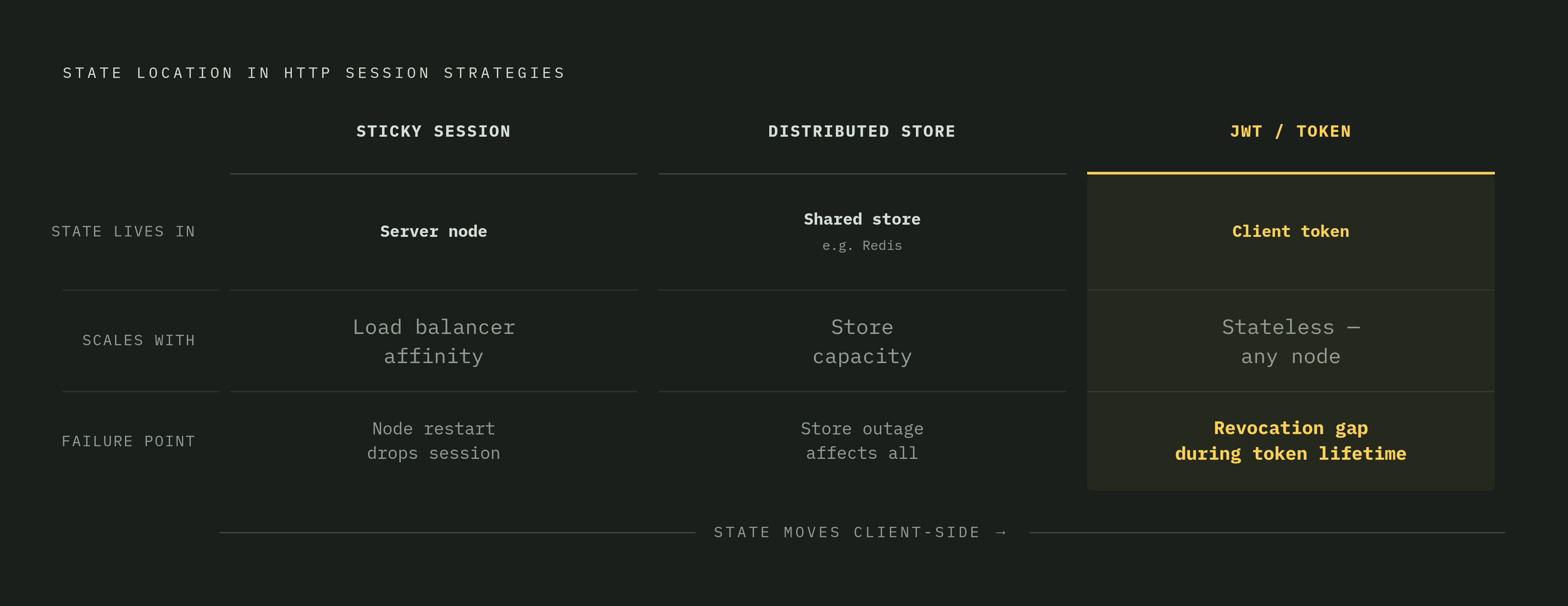
A JWT encodes identity, roles, and expiration in a signed token that the client presents with each request. The server checks the signature locally. Statelessness here has a precise, limited meaning. The server retains no per-user session state between requests, but the system still has state, now held in the token.
This removes a shared lookup from the validation path. Any node can validate a request independently, without affinity rules or a session-cache dependency. Per-request verification does not require a growing pool of session-store connections as the user population expands, although validation still consumes computation. Token contents travel on every request, increasing payload size, and encoding does not encrypt sensitive claims by default.
Netflix's Edge Authentication Services illustrate a related but distinct architecture. They terminate and validate external tokens at the network edge, then propagate a cryptographically signed internal identity object called Passport through the microservices architecture. This is token-agnostic edge authentication. The distinction prevents a useful example of distributed identity from becoming evidence for a stronger claim than it supports.
Why instant session revocation is JWT's hardest unsolved problem
A valid JWT does not learn that circumstances have changed. Blocking a user, terminating an employee, forcing logout, or responding to compromised credentials cannot invalidate the token before expiration through signature checking alone. Immediate revocation requires information outside the token. That requirement breaks pure statelessness.
The gap is most consequential where access must stop immediately, including account suspensions and regulatory obligations. A blocklist can restore control, but consulting it adds server-side state and a lookup to the request path. Short expiration limits the window. The token remains valid during that window.
This is not a defect that more careful token encoding can fix. Distributed validation and immediate revocation are different requirements, and JWTs and server-side sessions serve them differently. No purely stateless implementation avoids the tension between accepting an issued token and responding to a later decision to revoke it. The application's threat model and compliance requirements determine which delay or dependency the design can permit.
The hybrid "JWT plus hot store" pattern that production systems actually use
The production operating point described by these constraints is often a short-lived JWT paired with a small in-memory deny-list. The token supplies identity and claims for local signature validation, while the “hot store” records revoked token IDs. Most session data stays out of the store. Only exceptions go in.
This preserves independent request validation and avoids affinity, while the revocation check restores near-instant control over blocked tokens. The signature check remains I/O-free, but the complete authorization path is not purely stateless when it consults the deny-list. Because the store holds only exception state, it can be much smaller and more read-oriented, providing the hybrid's economic advantage.
Spring Security's SecurityContextRepository abstraction provides a concrete example of configurable authentication storage, including cache or database backends for horizontal scaling. Teams still have to operate token issuance and the deny-list reliably. If the deny-list is unavailable and requests proceed without a successful revocation check, the promised control disappears with it.
How the MCP protocol's 2026 shift to stateless HTTP made session tradeoffs concrete at infrastructure scale
The 2026-07-28 MCP specification release candidate removes protocol-level sessions, including the Mcp-Session-Id header, the initialize/initialized handshake, and the GET/DELETE stream endpoints. The prior stateful Streamable HTTP transport retained client capabilities and in-progress operations under a session ID. Later requests therefore needed the same server instance. A request reaching another pod could receive “Session Not Found.”
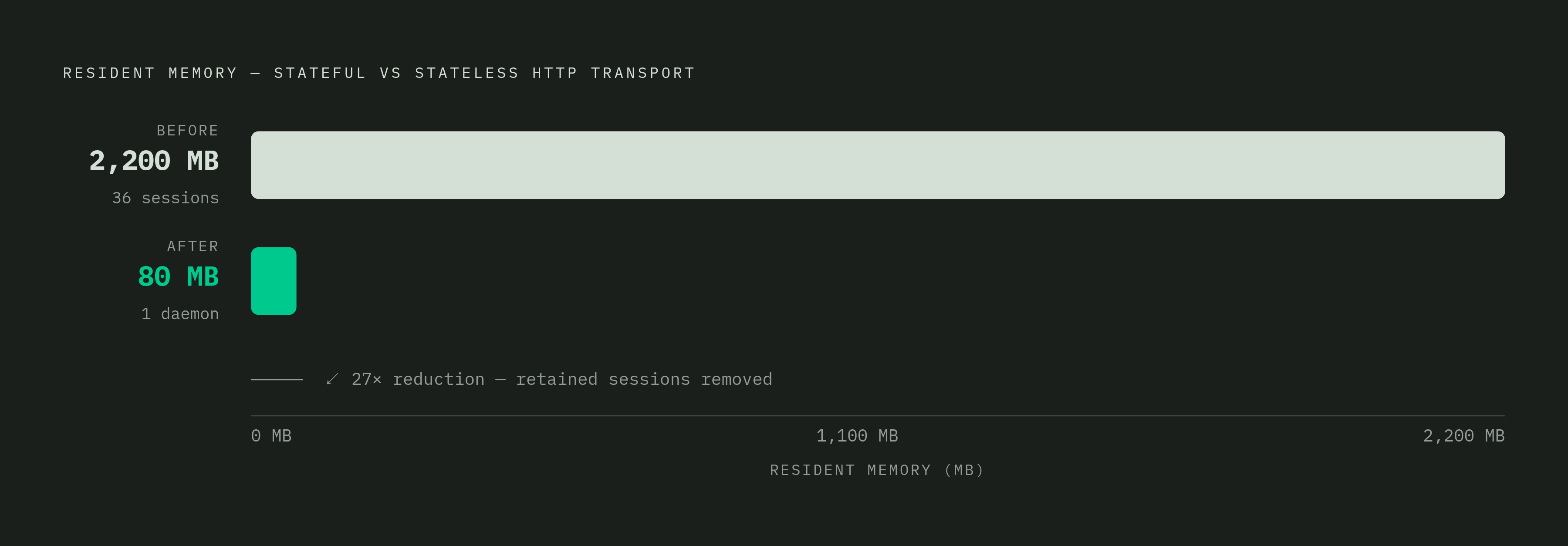
That made ordinary round-robin balancing incompatible with correct operation. Sticky routing prevented even traffic distribution, weakened autoscaling, and left pod restarts able to erase in-flight session state. In an observation limited to the operator's experience, an operator running a token-saving MCP proxy in production reported that moving to stateless transport cut approximately 2.2 GB of resident processes for 36 concurrent sessions down to a single approximately 80 MB daemon. It nevertheless gives the cost of retained sessions a concrete shape.
Removing sessions also changes how interactivity works. Change notifications move to an opt-in subscriptions/listen stream, while request-scoped notifications remain on response streams. Multi Round-Trip Requests, or MRTR, replace the prior approach to mid-call confirmations and sampling. Sampling is deprecated with a 12-month runway. Long-running or human-gated operations can use MRTR for interactivity or the Tasks extension for polling without requiring a held-open connection.
What agentic AI workloads expose about session persistence assumptions that human-user models never stress-tested
Human-oriented session designs assume a recognizable principal authenticates, acts within a session, and retains a reasonably stable scope. Agents strain that model. They authenticate for tasks, cross system boundaries at machine speed, and may disappear when the task ends. What agents do can change while a static session token stays perfectly valid.
The “Agent-Aware Zero Trust” framework, published in Computer Fraud & Security in February 2026, treats agents as first-class identities subject to continuous behavioral verification, policy-bounded autonomy, and probabilistic trust enforcement. Stateless MCP supports this approach because requests supply identity and capability information without requiring reconstruction of a prior session. A standard API gateway can authorize individual tool calls and provide a control point for token scoping, OAuth/OIDC-aligned authentication, and schema validation.
Every agent session should produce an immutable trail of prompts, responses, tool calls, tool results, and model identity. Per-request identity makes attribution easier, though it does not create the audit trail by itself. For principals that act across many systems during one task, request-level identity is a better fit than long-lived trust tied to one server.
How session architecture affects the attack surface for hijacking, bot abuse, and credential stuffing
Sticky sessions and distributed stores often use session IDs that are exposed through cookies or URLs, while in JWT-based systems the attacker targets the token itself. A stolen identifier can let an attacker impersonate an authenticated user. With a JWT, the revocation gap also becomes a window for continued abuse.
Session hijacking belongs within web application firewall defenses, but session abuse is broader than recognizable attack signatures. Credential stuffing, account takeover, and scraping exploit business logic through requests that can look ordinary. Bots can rotate IP addresses and present no signature for a conventional filter to catch. Authentication success is not proof of benign intent.
DataDome's 2026 State of Bot & Agent Security Report found that over 65% of websites were completely unprotected against bots and spoofed AI agents. The defensive response is a combined WAAP layer with behavior-based bot detection, adaptive fingerprinting, and rate controls suited to AI and LLM-driven traffic. Agents give teams another reason to keep watching behavior, since legitimate activity can turn into anomalous queries during a session. The 2026-era SASE approach described for this problem monitors the connection and terminates access or steps up authentication when anomalies appear, rather than trusting the opening exchange indefinitely.
Matching the right strategy to your scaling requirements, failure tolerance, and operational budget
Sticky sessions fit small, stable fleets where state must remain server-local and re-authentication after node failure is tolerable. They are a poor fit when autoscaling, pod recycling, or uneven traffic is common. Distributed stores suit applications that need central control and immediate revocation, as long as the team can handle the write load and keep the shared infrastructure they depend on running.
JWT-based designs fit horizontal scaling when expiration-based revocation windows are acceptable. A minimal hot store can shorten those windows, but guaranteed immediate revocation still depends on an available stateful check. Pure statelessness is therefore the wrong promise where security or regulation demands an immediate stop. For agents, the more useful boundary is each request, with identity enforcement, token scoping, and tool-call validation at the edge reducing per-service session management.
Stanford's Computer Systems Lab established a related recovery principle in its microreboot research presented at OSDI in 2004. Separating important state from application components let those components recover an order of magnitude faster than full reboots in the evaluated system. Persistence architecture thus determines not only how requests scale, but how much software can restart safely. Recovery is part of the choice.
Operational capacity is the final constraint. A hybrid can be architecturally sound and still exceed a team's ability to operate two components reliably. Teams with limited DevOps capacity may be better served by a managed session layer that handles replication, failover, and revocation. The best design is the one whose dependencies and failure modes the team can actually sustain.