Stateless vs Stateful Microservices in Kubernetes Deployments
Deployments suit stateless services while StatefulSets preserve identity for databases.
Choosing between stateless and stateful microservices in Kubernetes means choosing how instances are identified, how storage survives, and what happens when something fails. Deployments and StatefulSets encode different answers to those questions. The right choice follows from each service’s behavior.
What stateless and stateful actually mean at the service level
The distinction starts with where context lives between requests. A stateless service instance keeps no session context between calls, so each request must include everything needed to process it. Any instance can handle the next request. A REST API can follow this pattern, as can an LLM during inference, when its model weights stay fixed across interactions.
A stateful service keeps information that it needs for later interactions, including session history, transaction progress, or cluster membership. An e-commerce cart remembers what was chosen before, while online banking needs the context of earlier transactions. Failure therefore changes the job of recovery. A stateless instance can start afresh, but a stateful service must recover its place in an ongoing process. Storage is part of that design from the outset.
How Kubernetes encodes the distinction into two different primitives
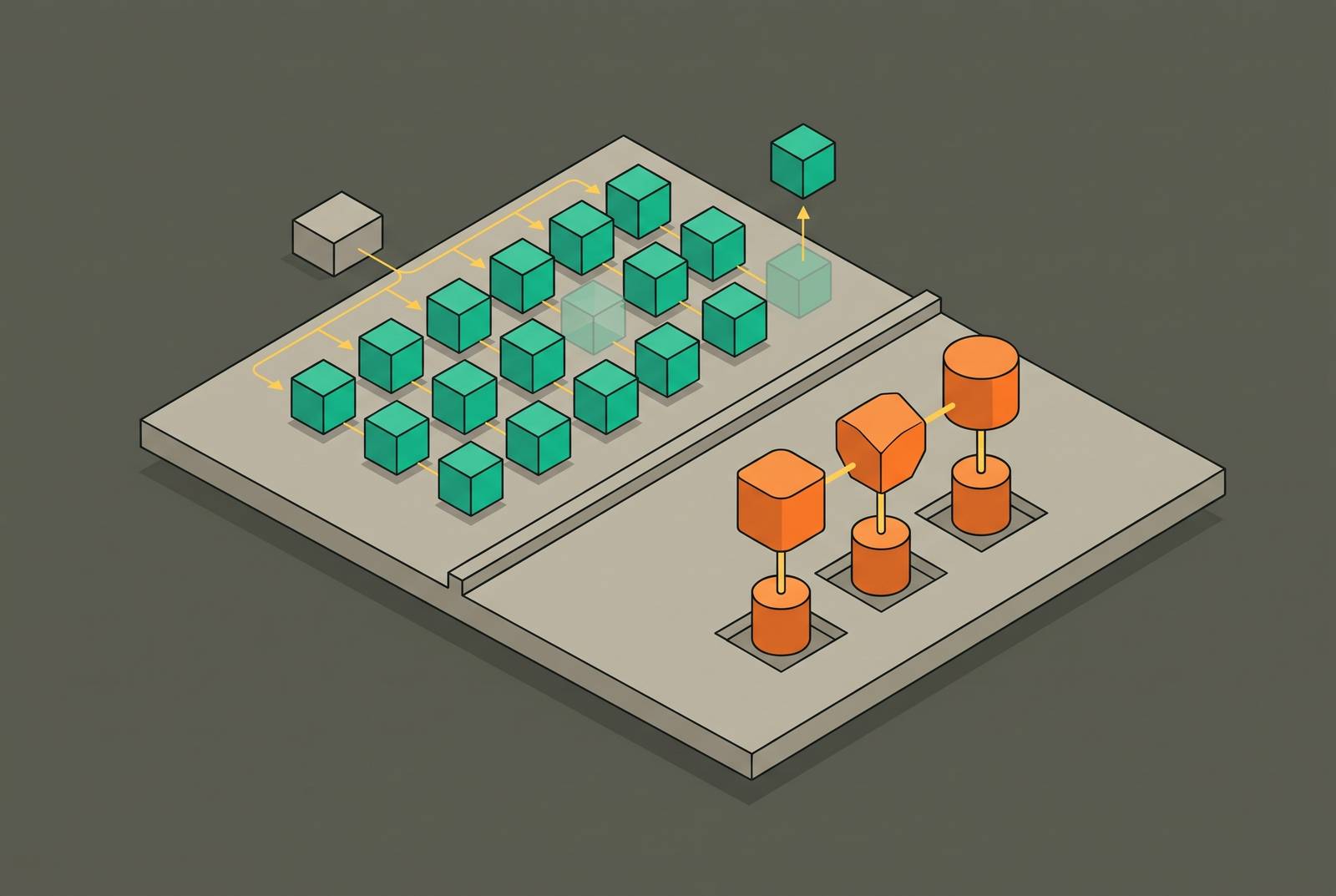
Kubernetes puts this distinction into practice through its controllers, which manage groups of pods based on different assumptions. A Deployment treats its pods as interchangeable instances, with random names, changing IP addresses, and no guaranteed ordering. No particular pod has to come back. Local ephemeral storage resets rather than providing continuity, so the application either keeps nothing locally or retrieves what it needs from an external source. That model fits web servers, APIs, and stateless application logic.
A StatefulSet instead gives each pod a stable, predictable name and network identity across restarts and rescheduling. A MongoDB replica set member, for example, needs a fixed identity so the cluster can recognize it. Its replacement must reclaim a particular role. Persistent Volumes stay tied to that pod identity, while ordered startup and teardown make replicas follow a sequence. Databases, persistent caches, and message queues fit this model when they depend on those guarantees.
Deployments can replace pods without keeping their individual identities or coordinating membership in a cluster that holds data. StatefulSets preserve the identity and storage relationships on which such coordination depends. Kubernetes also supports Operators for lifecycle management of persistent services. Even with predictable naming and persistent storage, the application still needs to keep its data consistent.
How scaling and failure recovery actually differ between the two primitives
For an operator scaling a stateless service, adding replicas means adding interchangeable capacity. A load balancer can route requests to any healthy instance without coordinating session ownership among them. When one pod fails, the others can keep working. Kubernetes replaces the failed pod, and the new pod does the same job without recovering the old pod’s local history. The operator can focus on how much capacity is available, health checks, and performance.
A database may need to synchronize data and adjust cluster membership before the new replica can participate correctly, sometimes with manual steps to preserve consistency. Some stateful systems cannot scale horizontally at all and need larger instances instead. Recovery has the same additional burden. A replacement pod may be running while data consistency checks or manual intervention are still needed, so operators must tell whether just the process is running or the service has recovered.
Stateless rolling updates can replace interchangeable pods without a prescribed sequence, and users typically do not notice. A database update may require updating secondary replicas first, promoting a new primary, and then updating the remaining replicas. Operators must preserve consistency throughout that sequence. The work can take hours and may require temporary downtime, rather than being only a container replacement exercise.
Monitoring and backup plans consequently diverge as well. Stateful operators need to track storage I/O, replication lag, and cluster membership health as well as basic health and performance metrics. They also need comprehensive data backups, point-in-time recovery, and tested restore procedures. Persistent storage is not a recovery plan. For the stateless service itself, backing up code and configuration is sufficient, but that narrower responsibility does not cover any external data store it depends on. Running stateful services therefore takes more specialized skills and costs more.
Why "just make it stateless" breaks down in practice
Most applications move state into a database, distributed cache, or message queue when they adopt stateless services. The application instances become interchangeable, but the system still has something to remember. That is often a useful division of responsibility. It separates horizontally scaled application logic from the services responsible for retaining and synchronizing data, without pretending that those responsibilities have disappeared.
Some interactions resist even that neat division. A WebSocket connection requires the server to remember which client is attached to which socket for the duration of the session. The connection is not reconstructed for each request. More generally, requiring every request to supply all its context becomes awkward as that context accumulates. Statelessness is a constraint on how interactions work.
Retaining context has costs of its own. Stateful applications may need more memory and processing power, an underlying storage solution, and a way to synchronize data between instances. Those demands compound as the service grows. The practical design is often a mix of stateless application logic and a stateful data layer, with each assigned an appropriate controller. AI agents complicate that division further because the executing application itself can have a history, permissions, and unfinished work that must survive.
AI agents as a new category of stateful workload that Kubernetes wasn't originally built for
Red Hat describes LLM inference as technically stateless because model weights do not change between requests. An agent built around the model can be quite different. Conversation history, tool-call permissions, and code execution context add state around that inference step. The model and its wrapper have different needs. Treating the whole agent as an interchangeable request handler misses the context on which its next action depends.
Long-running agents need persistent identity, a secure scratchpad, and a lifecycle that permits suspension and resumption. Those requirements fit neither a Deployment nor a classic StatefulSet cleanly. The shift also reaches beyond scheduling, as agentic workflows increasingly depend on information in the body of a call rather than the HTTP headers around which much cloud-native traffic handling was built. Agents are therefore a stress test of both workload management and the assumptions surrounding it.
Kubernetes SIG Apps responded with Agent Sandbox, an abstraction based on custom resource definitions for singleton, stateful agent workloads. It reached v1.0 in August 2026 with a v1beta1 API, and GKE Agent Sandbox has been generally available since May 2026. Agent Substrate maps many stateful actors onto a smaller pool of ready workers, snapshots an idle actor’s memory and filesystem to object storage, and frees its worker. When another request arrives, it restores the actor onto a free worker to continue where it stopped. Substrate joined the CNCF Sandbox in October 2026.
In production multi-agent systems, agents that keep conversation history or long-term memory should use StatefulSets to get stable network identities and persistent storage. Stateless worker agents should use Deployments instead. For singleton agents, Sandbox adds lifecycle management tailored to the workload, while Substrate addresses suspension and restoration without reserving a worker for every idle session.
Where edge and serverless compute fit into the stateless/stateful decision
The same behavior that determines a controller also helps determine where computation belongs. Stateless, latency-sensitive work distributed around the world is a natural fit for edge serverless runtimes. Each request can be handled in isolation. Red Hat describes serverless architectures as suitable for asynchronous, stateless applications that can start instantaneously, which aligns with services that do not need to retain historical context between calls. REST APIs and LLM inference can fit that pattern.
Persistence-critical, cluster-bound workloads point toward managed Kubernetes with StatefulSets, particularly under sustained load. EKS and GKE provide predictable instance costs, while serverless billing can become volatile at high request volumes. Traffic patterns therefore affect the placement decision. Stateless edge serverless workloads avoid idle compute billing, whereas sustained stateful demand can favor the predictable cost of provisioned instances. The useful comparison is against the full range of actual traffic.
Stateful does not automatically mean confined to a central cluster, however. Session-scoped workloads distributed across regions can use an edge-stateful primitive that retains context where the session runs. This is a separate branch of the decision. The distinction is between state tied to a geographically distributed session and persistence tied to a coordinated cluster, rather than a blanket rule that all state must live in Kubernetes.
Identity and security policy behave differently depending on which primitive you chose
Interchangeability also shapes how workloads identify themselves to other services. Stateless pods in a Deployment can present the same workload identity because they perform the same role under the same policy. Their permissions need not distinguish one replica from another. StatefulSet pods, by contrast, have stable individual identities that can support distinct credentials. A database primary and its secondaries may legitimately need different permissions, so treating every replica identically can obscure a meaningful security boundary.
A Zero Trust model must account for these differences. A service mesh can decouple policy enforcement from application code, while SPIFFE/SPIRE provides cryptographically verifiable workload identities for authentication between services. Identity belongs at every hop. Stable pod naming makes differentiated identity possible, but naming and authorization remain separate concerns. The policy must still express what each workload is allowed to do.
Agents make permission scope particularly consequential. If one agent container is compromised, it can expose inference API keys, log access, storage credentials, and tool-call permissions across several infrastructure domains. Its reach may exceed that of a typical microservice. Least-privilege ServiceAccount scoping is therefore especially important for stateful agents, whose retained context and credentials can span several tools.
Traffic inspection is not a substitute for that model. SASE services sold as Zero Trust move a trust boundary toward the vendor infrastructure that handles the traffic. Deep inspection of TLS-wrapped flows introduces latency and often falls back to metadata analysis, leaving blind spots. Workload identity and narrowly scoped permissions remain distinct requirements, regardless of where inspection occurs.
A decision framework for choosing the right primitive for each service
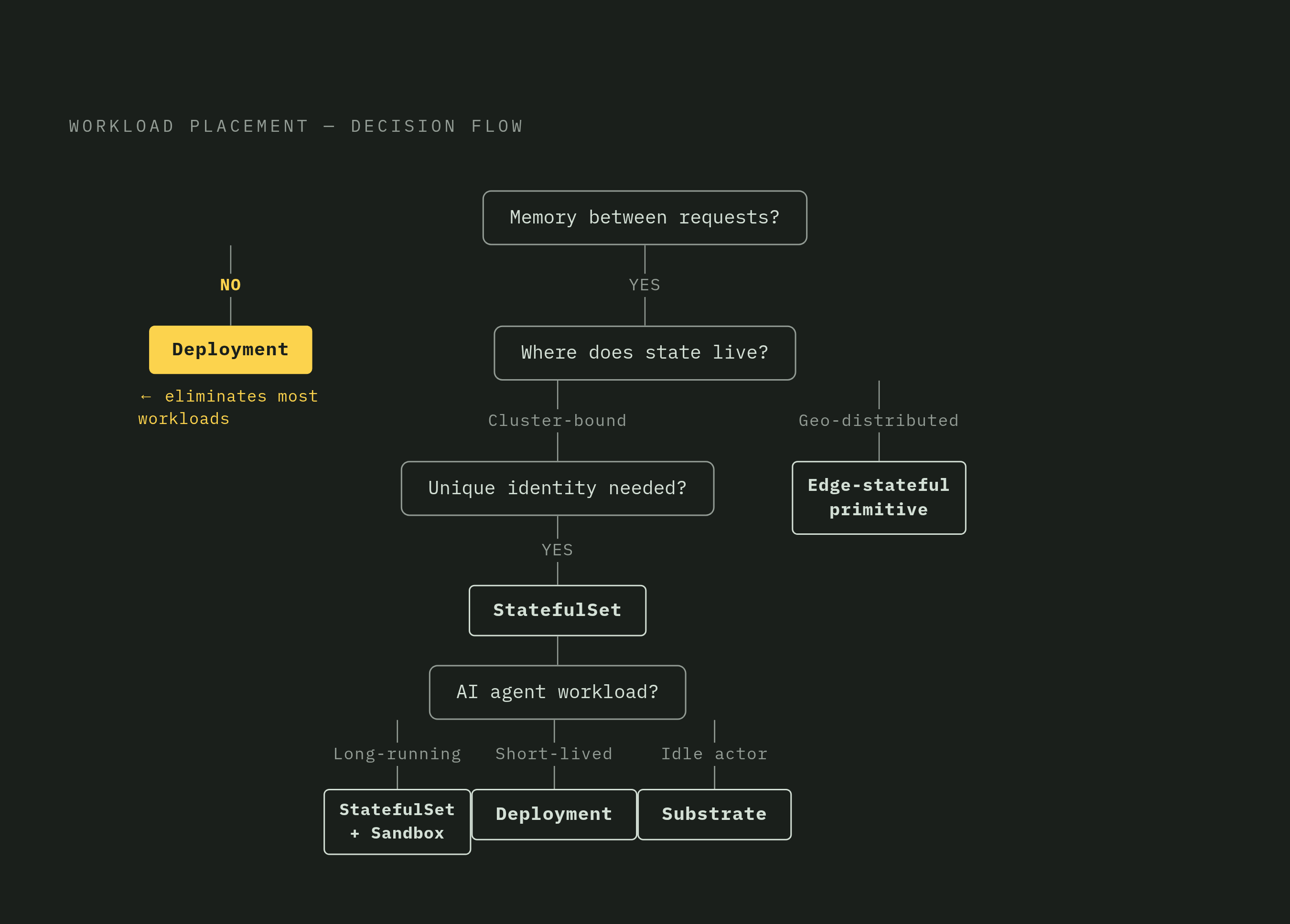
The practical decision starts with four questions about the service itself. Does this instance need to remember anything between requests? If not, a Deployment fits, even when the rest of the system stores data elsewhere. If it does, the next choice is where that state should live. Persistence-critical, cluster-bound state points toward a StatefulSet, while geographically distributed, session-scoped state points toward an edge-stateful primitive.
Does each instance have a unique identity that other services depend on? If any healthy instance can answer, random pod names and interchangeable replicas are acceptable. A Deployment remains the appropriate starting point. If cluster membership, replica coordination, or session affinity depends on predictable identity, a StatefulSet supplies that continuity.
What must happen after an instance fails? Replace-and-retry behavior points toward a Deployment, while the need for data consistency checks and possible manual intervention points toward a StatefulSet. The recovery budget belongs in the decision. A team taking the stateful path should plan for replication monitoring, backups, and tested restores before committing to its operational cost.
Is the workload an AI agent or agentic workflow? Long-running agents with conversation history or long-term memory point toward StatefulSets, with Sandbox worth considering for singleton lifecycle management. Short-lived, stateless worker agents belong in Deployments instead. Session-scoped, geographically distributed agents can use an edge-stateful primitive, while Substrate offers snapshot-and-restore behavior for idle stateful actors.
Assign one ServiceAccount per Deployment or StatefulSet, never share ServiceAccounts across workload types, and grant only the permissions each workload needs. Choose the billing model based on the traffic patterns the service actually has. These decisions are service-level choices that can change as behavior changes.