Global Latency Budgets for AI Inference APIs Served at the Edge
Physics and application type set immutable latency boundaries before architecture choices begin.
Every AI inference deployment inherits a latency budget before anyone writes a line of infrastructure code, and that budget is set by three forces no engineering team controls. Physics sets the floor. A network round-trip to a cloud datacenter adds 20 to 80 milliseconds depending on how close the datacenter sits to the user, and that number holds regardless of how fast the model itself runs. Human perception sets the ceiling for anything interactive: people start noticing delay past a certain point, and for interactive chat that ceiling is under 500 milliseconds. Application type sets the tightest constraint of the three. Voice AI needs the LLM stage to finish in under 150 milliseconds total, or the spoken reply sounds broken to whoever is listening.
These three constraints stack rather than operate independently. For voice and other real-time applications, the network round-trip alone can eat the entire latency budget before the model produces a single token. That is a structural problem, not a tuning problem: no amount of GPU optimization recovers time already spent in transit. A team building a voice assistant that routes every request to a distant cloud region has already spent its full 150-millisecond allowance on the trip there, and the model has not started working yet.
This is why latency budgets belong at the start of the architecture conversation, not somewhere in a post-launch performance review. Treating latency as a metric to improve after the fact is like designing a car around a garage that turns out to be two feet too short. The dimensions were fixed before anyone chose the paint color, and no amount of clever engineering later changes what the garage will physically hold. Latency budgets work the same way: physics and human perception fix the outer limits before any hardware or model gets selected, and application type narrows those limits further depending on what the product actually does.
Latency thresholds by use case: the concrete numbers that govern architecture choices
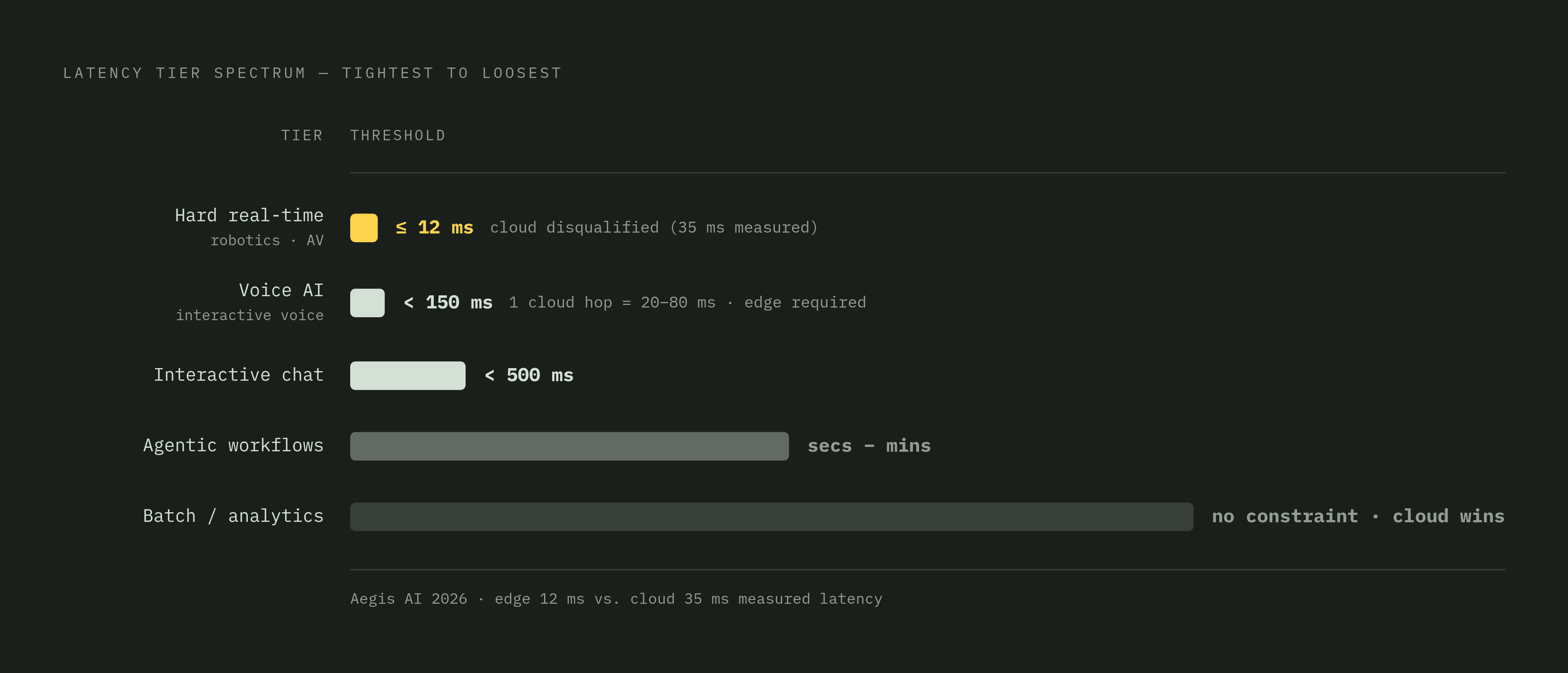
Different applications fall at different points on the latency spectrum, and each point rules certain architectures in or out before cost or convenience enters the discussion.
At the tightest end sits hard real-time control: surgical robotics, autonomous vehicle perception, industrial safety gates. These systems need response times in the single-digit to low-double-digit millisecond range, and a cloud round trip cannot meet that requirement no matter how good the provider is. Cloud GPU inference is architecturally disqualified at this tier, full stop, because the physics from the previous section makes it impossible rather than merely inconvenient. Testing conducted in 2026 by Aegis AI measured a YOLOv8 model running on a Jetson Orin NX at roughly 12 milliseconds per frame, against roughly 35 milliseconds for the same model on a cloud GPU instance once network overhead was included, and that gap widens further whenever the connection degrades.
One notch down sits voice AI and interactive voice interfaces, where the LLM stage needs to complete in under 150 milliseconds total or the spoken response feels broken to the person on the other end. Interactive chat is more forgiving: under 500 milliseconds is acceptable, and users only start noticing delay past that mark. Background agents and multi-step agentic workflows relax further still, tolerating seconds to minutes per task, since no single call in those workflows is facing the user in real time. Batch processing and analytics sit at the loose end of the spectrum entirely, with no real-time constraint at all, where throughput and cost per token are what actually matter.
The practical corollary follows directly from these numbers. Applications that can tolerate 100 to 200 milliseconds or more of end-to-end latency gain little from edge deployment on the latency dimension alone. They should default to cloud GPU inference unless data sovereignty or connectivity requirements apply independently of speed. Edge deployment solves a latency problem. If an application does not have a latency problem, edge deployment is solving nothing, and every dollar spent chasing it on speed grounds is a dollar spent for no operational reason.
Why latency compounds dangerously in multi-step agentic workflows
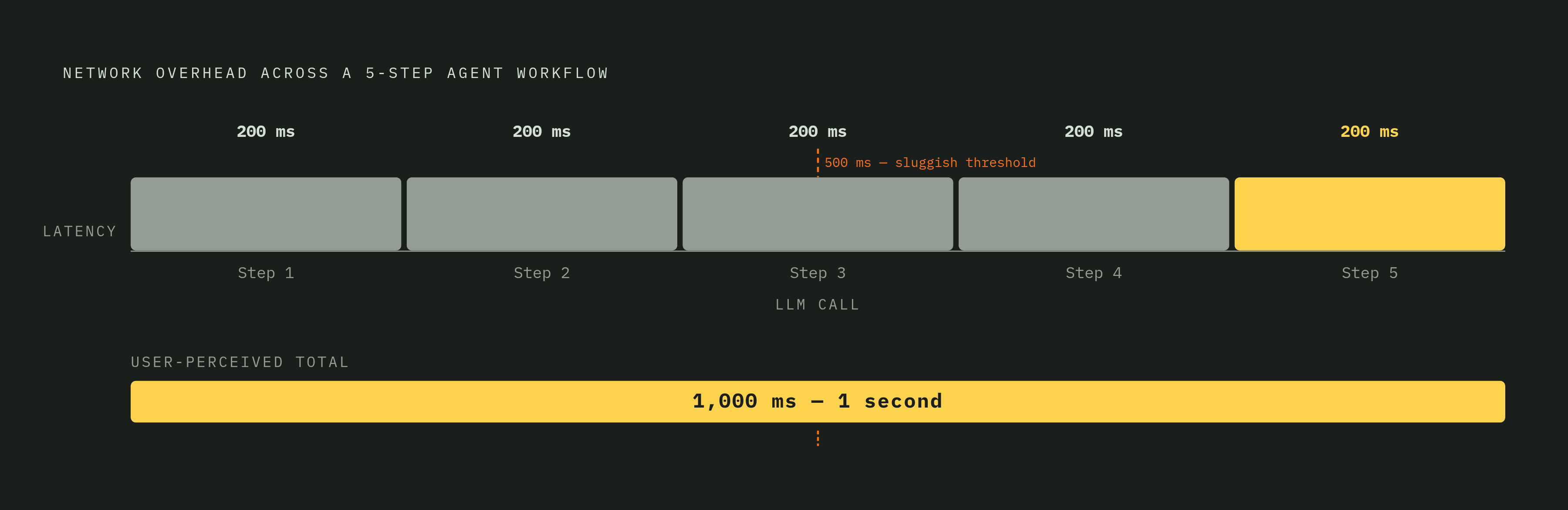
Users of an agentic system experience the total time the workflow takes to finish, not the latency of any individual LLM call inside it, and that distinction changes the math considerably. Small per-step delays that look trivial in isolation stack into a total wait time that feels broken to the person waiting. A workflow built from five sequential LLM calls, each carrying 200 milliseconds of avoidable network overhead, adds a full second of latency that the user perceives as one undifferentiated delay rather than five small, forgivable ones. Nobody experiences a workflow as a sequence of individually-acceptable steps. They experience it as one wait, and one second is well past the point where interactive chat starts to feel sluggish.
The problem gets harder to catch before it ships. Agents waiting on other agents, race conditions inside async pipelines, and cascading failures across a multi-step chain are difficult to reproduce reliably in a staging environment, and the workflow engines most teams already have were not built for this degree of dynamic, model-driven decision-making. Latency now ranks as the second-biggest challenge reported by practitioners deploying agents in production. Practitioners report latency as the second-biggest challenge in deploying agents in production, broadly enough to register as a top operational headache across the field.
The architectural consequence runs against the intuition built in the previous section. An individual step in a workflow might tolerate a cloud round-trip just fine on its own terms. Stack five or ten of those steps together inside a workflow with an overall time budget to hit, and edge placement for at least the latency-sensitive steps becomes necessary even though no single step would have demanded it in isolation. The threshold attached to the whole chain is the one that matters, not the one attached to any individual call. It is the one attached to the whole chain, and that number is almost always tighter than teams expect when they design step by step instead of end to end.
The three constraints that decide where inference runs, in the right order
Teams evaluating edge against cloud inference tend to open with "which is cheaper," but latency, data sovereignty, and connectivity must be settled first before cost can be the deciding factor.
The order that actually governs the decision runs latency first, data sovereignty second, connectivity third. Can the application tolerate the round trip a cloud API call requires, including the variability that real networks introduce? Does regulation, a contract, or internal policy require that data never cross a defined physical or legal boundary? Does the deployment environment guarantee the kind of reliable internet access that cloud inference assumes will always be there? Only a workload that clears all three of those checks, tolerant of latency, unencumbered by data restrictions, and running somewhere with dependable connectivity, gets to treat cost as the primary decision criterion. For workloads that do clear all three, cloud GPU inference wins on cost in most cases.
The growth is concentrated in workloads where the latency or data-sovereignty constraint is already binding on its own, in healthcare imaging, industrial safety monitoring, autonomous systems, and regulated financial workloads, rather than in a broad economic revolt against cloud pricing.
The data sovereignty gate deserves particular attention because it turns what looks like a technical choice into a legal one. A construction site running video through cloud-based object detection in Europe is making a legal decision, not an engineering one. It is creating a GDPR liability, because footage of a workplace is footage of identifiable people, and every frame that leaves the site becomes a data-protection question that a works council can veto. The regulatory environment has tightened to the point that routing user data to a third-party LLM API is a compliance decision rather than a technical one. European regulators have handed down substantial fines for GDPR violations, and the combination of GDPR's data minimization principle, the EU AI Act's transparency requirements, and the growing patchwork of US state privacy laws all add friction to cloud-first deployments touching personal data. Cost cannot be the first question because that friction never appears on a cost-per-token spreadsheet.
What the hardware tiers can deliver against each threshold
Inference hardware has settled into three distinct tiers by 2026, and each tier clears a different slice of the thresholds already laid out.
The first tier covers consumer and workstation GPUs, including the RTX 5090 with 32GB of VRAM and the RTX 4090 with 24GB. These run quantized small models locally at competitive token rates, though larger quantized models force CPU offloading through frameworks like llama.cpp, which drops throughput sharply. This tier suits developer-side inference and small-team deployments rather than high-concurrency production serving.
The second tier is purpose-built edge accelerators: the NVIDIA Jetson AGX Orin with 64GB of unified memory, and Apple's M4 Max with 128GB. Unified memory gives these systems better bandwidth efficiency for smaller models than discrete GPUs offer; Jetson targets industrial and robotics deployments, and Apple Silicon has become increasingly common for developer-side inference. The Jetson AGX Orin and its 2026 successor run quantized models at a capable token rate, with enough unified memory to hold the model, a retrieval index, and a full working context window all at once, which is exactly the combination the safety-gate and robotics thresholds from earlier demand.
NPUs embedded in consumer devices have matured enough to matter as their own category. Qualcomm's Hexagon NPU, Apple's Neural Engine, Intel's NPU in Lunar Lake successors, and AMD's Ryzen AI architecture (using a hybrid XDNA NPU and iGPU approach) all sustain real-time token generation on a 4-bit model at well under the power draw of a laptop CPU. That is fast enough for real-time chat, document summarization, and the tool-use loops that agentic workflows depend on, and it puts serious inference capability into hardware most people already own.
A middle tier sits between on-device hardware and the distant cloud datacenter: multi-access edge computing and telco edge networks. These typically deliver 10 to 30 millisecond latency, bounded only by the local network or regional 5G connection, and they clear the voice AI threshold without requiring any on-device hardware at all. The tiers split along a clean line: cloud GPU wins on raw throughput per dollar when utilization is high, and edge hardware wins on latency and cost when utilization is low or moderate. Neither wins everywhere, and the threshold each application carries is what decides which side of that line it falls on.
Quantization and the edge hardware threshold
Quantization decides whether a model fits on edge hardware, and at what cost to output quality. A quantized small model fits into a few gigabytes of memory and runs at a useful token rate on a modern laptop NPU. Five-bit and six-bit variants trade an extra gigabyte or two of memory for additional quality on top of that baseline.
The quality penalty that used to make quantization a hard tradeoff has narrowed substantially. Calibration-aware quantization methods combined with group-wise scaling let a quantized small model retain the large majority of its full-precision benchmark performance across most tasks. The gap that made quantization a nonstarter for serious production work a few years ago has largely closed. Teams that skip the calibration step and run with default quantization parameters can cut quality by 10 to 15 percent on the edge cases that never appear in aggregate benchmark scores. A model can look fine on a standard test suite and still fail quietly on the specific prompts that matter to a particular deployment, and calibration is what catches that before production does.
Production deployments recommend quantizing to INT4 first, measuring quality against actual production prompts rather than benchmark suites, and moving up to INT5 only if degradation appears on tasks that matter for the product. INT4 is generally sufficient for classification and extraction work. INT8, or FP8 where supported, is the better fit for generative tasks where nuance and phrasing carry more weight.
Quantization is the mechanism that turns the hardware tiers from the previous section into a real answer for a real latency threshold, not a side detail bolted onto the hardware decision. The quantization choice is what decides, case by case, whether a workload can stay on the edge tier it was assigned to or has to escalate back to cloud.
Why the right production architecture in 2026 is hybrid
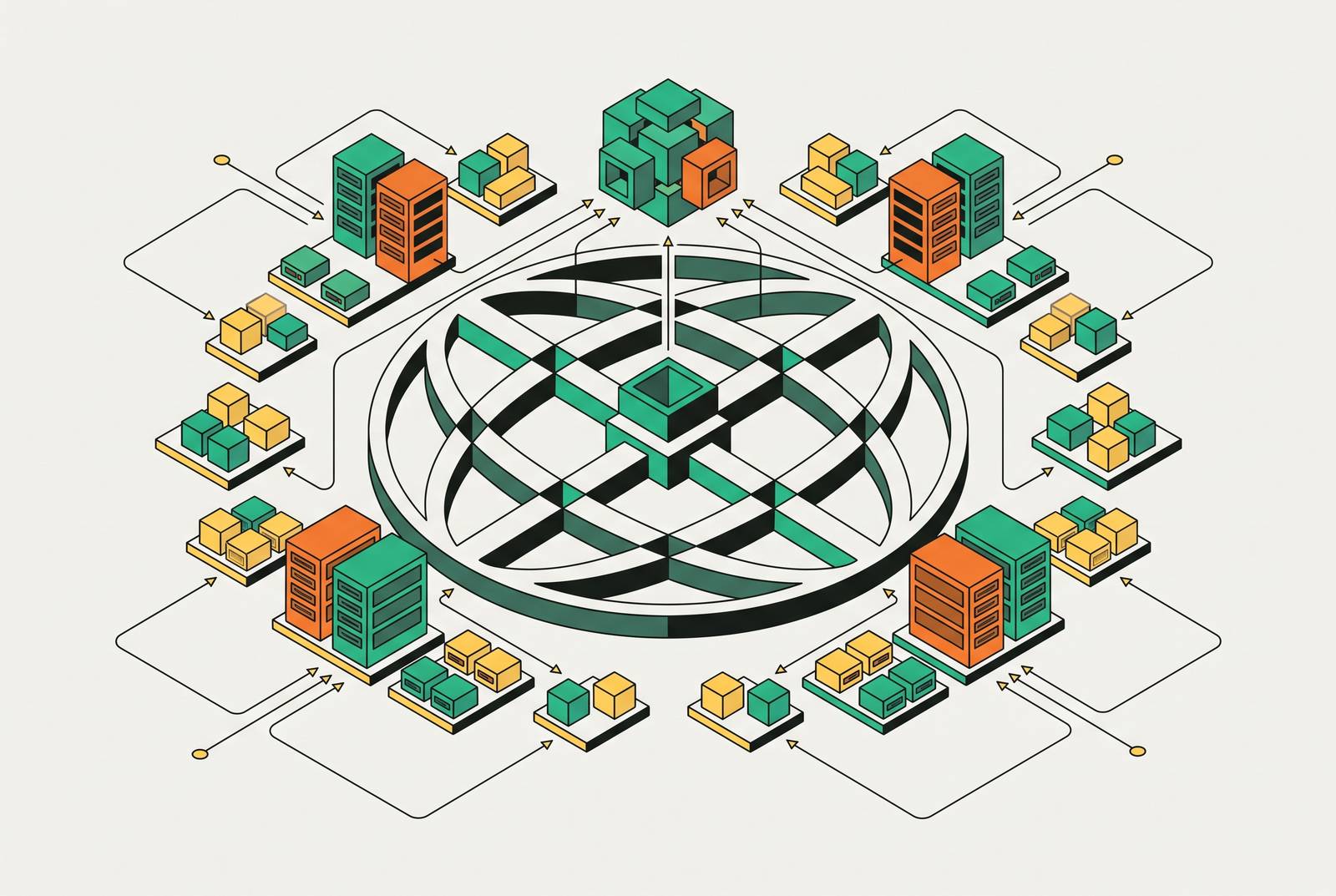
Putting the threshold numbers, the hardware tiers, and the quantization mechanics together points away from picking edge or picking cloud. They point to building a routing layer that sends each request to wherever it clears its own threshold. Edge handles the latency-critical or privacy-sensitive path. Cloud handles the complex reasoning and the burst capacity. A router in between decides, request by request, which constraints actually apply.
Most production deployments already reflect this pattern in practice: edge hardware handles 90 to 95 percent of incoming requests, with cloud serving as the fallback for complex reasoning, batch analytics, or any request that exceeds what the edge model was quantized and sized to handle. That split is the direct consequence of everything established earlier: latency thresholds vary by use case, hardware tiers clear different subsets of those thresholds, and quantization decides case by case whether a given model actually fits the tier it has been assigned. Building around a single deployment target, all edge or all cloud, means either failing the requests that do not fit that target or overpaying for capability the request never needed.
The economics reinforce the same conclusion from a different angle. Where an edge model passes quality evaluation on the majority of incoming queries, routing only the remainder to cloud still saves meaningful compute cost compared to running every request through cloud GPUs. The savings show up because the expensive path is reserved for the requests that actually need it, rather than absorbing every request regardless of complexity. That is the architecture the latency budgets from the opening section were always going to demand: a system built around where each request's constraints actually sit, not around a single infrastructure choice made once and applied to everything that follows.