Cost Modeling for Production AI Agent Workloads
Five cost centers, not model spend alone, determine agent budget reality.

Most teams anchor on model API spend. Inference is one of five distinct cost centers, and the others are frequently larger in aggregate.
The five drivers: token consumption, orchestration compute, memory and retrieval, tool call latency, and infrastructure idle time. Each has a different scaling curve. Some grow linearly with session volume; others grow geometrically with agent complexity. Budget from prototype numbers and you'll be 5 to 15 times under budget within the first quarter of production, which is the kind of surprise that derails roadmaps and makes CFOs ask pointed questions in large rooms.
The mechanism isn't mysterious. Agents don't call a model once and stop; they orchestrate, retry, retrieve, and loop through tools repeatedly, compounding cost at every step. Think of it like a taxi meter that never stops running: every tool call, every retry, every context expansion clicks the fare higher, and you're not even in the cab.
The sharpest real-world illustration is Uber. Between December 2025 and March 2026, Claude Code adoption jumped from 32% to 84% of a 5,000-engineer organization. By April, the entire annual AI budget was gone, with monthly API costs per engineer running $500 to $2,000. That's not a billing anomaly; that's what production agent workloads actually cost when you haven't modeled them properly. Softermii's 2025 research corroborates the pattern: 66.5% of organizations experience AI budget overruns, with first-year overruns typically landing 30 to 40% above initial projections.
How Token Consumption Scales in Agentic Workflows and Why It Bears Little Resemblance to Chatbot Spend
Token prices fell sharply across 2024 and 2025. Absolute spend is rising anyway, because agent workloads generate token volumes that dwarf conversational use cases. Cheaper per-token pricing doesn't protect you when you're consuming orders of magnitude more tokens per task.
Two mechanisms compound this. First, context accumulation: every turn in a long task appends to the context window, so later reasoning steps pay for all prior steps again. An agent twenty turns into a complex task carries the full weight of those nineteen prior exchanges in every subsequent call. Second, multi-agent fan-out: when agents spawn sub-agents, each inter-agent message carries its own context payload, and the orchestration surface grows geometrically. You don't pay linearly for the complexity you're building.
Chroma's 2025 research added a punishing footnote. Every tested frontier model degrades as input length increases, with accuracy dropping meaningfully at mid-window positions. So teams are paying for more tokens and getting worse outputs when they aren't managing context actively. The context window isn't just a capability parameter; it's a cost dial, and leaving it on "set and forget" is like paying first-class fares for a seat that gets progressively more uncomfortable the longer the flight goes on.
Model Selection and Routing as the Highest-Leverage Token Cost Control
Not every agent subtask requires a frontier model. Routing simpler classification or extraction steps to cheaper models, while reserving expensive reasoning-heavy models for genuinely hard problems, is the single highest-leverage budget lever available before you touch infrastructure at all.
Model cascading, the practice of tiering tasks by complexity and matching each tier to an appropriately priced model, reduces per-session token costs by a substantial fraction without meaningful quality loss. The arithmetic is straightforward: a weighted mix across model tiers produces a blended per-million-token cost well below what an all-frontier-model architecture generates. The 2025 narrowing of the MMLU benchmark gap between open-source and proprietary models made this more viable, because open models now constitute a credible routing tier for many subtasks.
Routing decisions rest on four practical criteria: task complexity (does this step require multi-step reasoning, or is it essentially a classification?); latency tolerance (cheaper models frequently carry lower latency, which reduces orchestration idle time downstream); output structure (structured extraction tasks are far less sensitive to model capability than free-form reasoning); and cost-per-error tolerance (some errors are cheap to recover from, others aren't).
Prompt caching compounds the savings further. One developer example from the research showed monthly costs dropping dramatically after caching a large, unchanging system prompt. ProjectDiscovery's documented post-caching reduction reached substantially within ten days. If your system prompt is large and stable, not caching it is a recurring donation to your inference provider.
Routing and caching together recover a significant share of token spend. But they can't fix what happens in the layer beneath the LLM.
Orchestration Compute: The Cost Layer That Runs Whether or Not a Model Is Called
The orchestration layer handles conversation state, request routing, tool dispatch, retry logic, and session management. It runs on traditional compute. It accumulates cost regardless of what the model does, which is the part most teams forget to put in the spreadsheet.
Because engineering leaders anchor on inference spend, the orchestration layer tends to get sized for prototype load and then over-provisioned in production. For moderate workloads in the range of thousands of sessions per day, compute, load balancing, and auto-scaling costs are material monthly line items that rarely appear in the initial budget.
Idle time is structural. Orchestrators that must stay warm to avoid cold-start latency accumulate wall-clock cost even when no agent is running. Billing model choice matters acutely here: per-second or per-minute compute billing charges for idle orchestration time that produces no output, whereas consumption-based billing charges only for actual execution. Those two structures produce substantially different economics for agents with uneven traffic patterns, and almost nobody models both before signing a contract.
Multi-agent systems compound the problem because each agent in a pipeline carries its own orchestration process, and inter-agent communication adds state synchronization overhead. Orchestration costs scale with agent count, not just session count.
The design response is well understood: stateless orchestration where possible, reconstructing state from durable storage rather than holding it in warm memory; horizontally scalable, short-lived workers rather than long-running processes; globally distributed orchestration to reduce latency and avoid geographic bottlenecks that extend session duration. None of these are exotic architectural choices. They're just choices that rarely get made during the prototype phase, when you're optimizing for iteration speed rather than cost structure.
Memory and Retrieval Costs Across Short-Term Context, Long-Term Storage, and Vector Search
Memory in production agents is not a monolithic thing. Short-term context, long-term episodic memory, and retrieval-augmented generation each carry different cost profiles, and conflating them produces a model that mispredicts costs in multiple directions simultaneously.
Short-term context is the cheapest per-query but compounds fastest. Every turn extends the window. "Just keep everything in context" works fine for three-turn demos and fails expensively at scale.
Long-term storage has low per-write cost, but retrieval latency at query time extends the orchestration window. Compute idles while the storage round-trip completes, and that idle time is not free.
Vector search introduces two additional cost centers: embedding generation carries its own per-token cost separate from LLM inference, and vector index infrastructure accrues a recurring monthly cost that scales with corpus size and query volume. Poorly tuned retrieval makes both problems worse. Too many chunks returned, or a low relevance threshold, injects irrelevant tokens into the prompt window, compounding downstream token costs. Bad retrieval is a cost multiplier dressed up as a quality problem, and it's surprisingly easy to misdiagnose.
The feedback loop runs like this: weak retrieval lengthens the prompt, longer prompts increase LLM cost, degraded output quality triggers retries, retries re-invoke retrieval, and the cycle repeats. A single misconfigured retrieval parameter propagates across multiple drivers. The architectural principle that follows is simple: externalize long-term memory to durable, queryable storage rather than expanding context windows. Retrieval is cheaper than token repetition at scale.
Tool Call Latency and the Compute Cost of Waiting
Tool calls are synchronous blocking operations inside the agent loop. While the tool responds, the orchestrator idles, the context window stays open, and compute charges accumulate. Latency is a billing event, not just a user experience problem.
An agent making multiple tool calls per reasoning step, with each call taking several hundred milliseconds, spends more wall-clock time waiting than computing. Multiply by sessions per day, and the idle-compute tax from tool latency becomes a material line item.
Four design decisions govern this: synchronous versus asynchronous dispatch (parallel tool calls reduce total wall-clock time even when individual call latency is unchanged); geographic placement (a tool endpoint crossing continents adds latency that compounds across every invocation in every session); retry behavior (unbounded retries on tool failure are a cost multiplier, not just a reliability mechanism); and output verbosity (tools that return large payloads inject those tokens into the next prompt, bridging tool latency cost directly into token cost).
Running orchestration close to both the user and the tool endpoints is a design goal, not a luxury. Edge deployment of tool endpoints reduces round-trip time and shrinks the idle compute tax per call. Runaway retry loops on slow tools are the worst-case expression of all this; the research documents incidents where agent loops exhausted budgets in minutes. Not hours. Minutes.
Infrastructure Idle Time and the Billing Model Decisions That Determine Baseline Cost
Most production deployments provision compute ahead of demand to avoid cold-start latency. Warm instances, standby orchestrators, and pre-loaded model contexts all accumulate cost before a single user request arrives.
Agents are bursty by nature. Smoothing burstiness requires either over-provisioning or accepting latency spikes, and most teams choose over-provisioning without explicitly deciding to. Per-second and per-minute billing models charge for that warm idle time; consumption-based billing charges only for active execution. For workloads with uneven traffic patterns, the structural difference between those two billing models is significant enough to appear in a cost model as its own variable, not a footnote. Treating it as a footnote is how teams end up with a line item they can't explain in the quarterly review.
Teams that size infrastructure from prototype traffic patterns over-provision for production peaks and underutilize their baseline. In enterprise deployments, a large share of total AI agent cost lands in system integrations and compliance layers rather than in the model itself. Idle integration infrastructure contributes to that share and stays invisible to teams that model cost as API spend plus compute.
Auto-scaling helps but doesn't eliminate the problem. Scale-up events take time, so teams maintain a warm floor, which is a fixed idle cost that must appear in any honest cost model. Globally distributed, short-lived serverless compute, scaled to zero when idle and executing close to users, changes the idle-time equation materially. Infrastructure architecture is a cost modeling input, not merely a deployment detail.
How the Five Drivers Interact: The Compounding Dynamics That Make Agent Costs Non-Linear
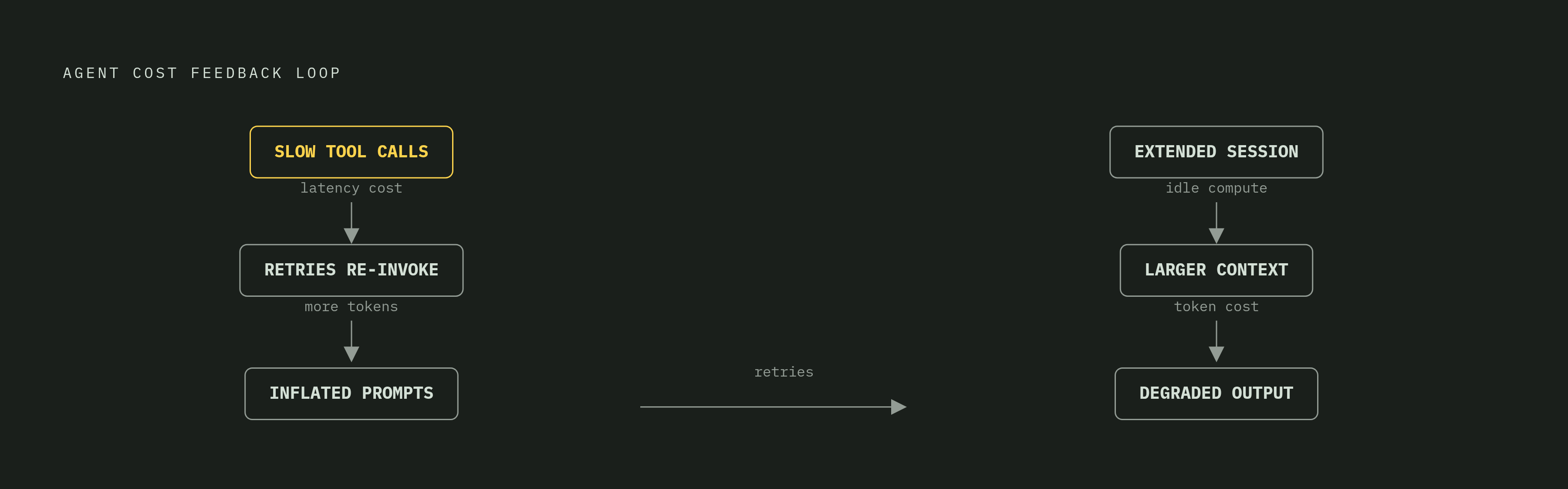
Here is where the model gets uncomfortable for teams accustomed to linear cost projections. Slow tool calls extend session windows, adding idle compute cost; long sessions grow context, adding token cost; large contexts degrade model output, triggering retries; retries re-invoke tools, adding latency; large tool outputs inflate the next prompt, adding more tokens. The loop is self-reinforcing, and it doesn't pause to let you catch up.
Multi-agent systems are where compounding becomes acute. Orchestration costs multiply with agent count, token costs multiply with inter-agent message volume, and observability overhead adds to both. The interaction surface grows faster than any single driver's scaling curve would suggest.
The 40 to 60% figure that emerges from enterprise deployment research is clarifying: in many enterprise deployments, 40 to 60% of total AI agent cost lands in system integrations and compliance layers, not the model. Optimizing inference alone leaves the majority of total cost untouched. I've watched teams spend two weeks shaving their prompt length and then wonder why the bill barely moved.
A complete cost model is a matrix of drivers against their own scaling variables, with interaction terms. A session-count increase doesn't just increase token cost linearly; it increases orchestration compute, retrieval queries, and tool call frequency simultaneously. The practical exercise worth doing before any production launch is to walk through a single agent session and annotate every line item that accrues cost. That exercise consistently reveals that inference is a minority of the session's total cost, and if your cost model doesn't reflect that, your budget won't survive first contact with production.
Governance Mechanisms That Prevent Runaway Costs in Production
Every startup I know learned about runaway costs after the first incident. The research documents the range: small losses in minutes, larger losses compounding over days. The governance mechanisms that prevent this aren't complex, but they require being wired in before production, not retrofitted after the incident debrief.
Hard token budgets, per-session and per-agent, should terminate or escalate a task when the ceiling is hit. A soft warning is insufficient; by the time a human responds to it, the runaway loop has already compounded several times over. Retry caps with exponential backoff on tool calls prevent the specific compounding pattern where a slow or failing tool drives unbounded token and compute spend. Circuit breakers belong in the tool dispatch layer, not just in the model's system prompt.
Cost-per-session alerting should fire at a threshold well below the point of pain, set relative to expected cost rather than absolute dollar amounts. A low-dollar alert on a session expected to cost a fraction of that fires before the problem compounds; a high-dollar alert on the same session fires after it has already compounded many times over.
Observability requirements for cost modeling are specific: per-session token logging with input and output tracked separately, tool call duration and retry count per invocation, retrieval query count and chunk size per agent turn, and orchestration compute time logged independently of model latency. Without those four data streams, you can measure total cost but you can't decompose it across drivers, which means you can't optimize it or predict it.
Governance is ultimately the feedback loop that keeps the cost model honest. Agents in production don't behave like agents in development. The drivers that looked negligible at prototype scale compound into the dominant line items at production scale, and the only way to know which one is causing a budget exceedance is to have had the instrumentation running before it happened.