AI Agent Tool Use and External API Rate Limit Management
Agents now call APIs fast enough to blow through rate limits designed for human speed.
Agents break rate limiting because nobody built rate limiting for what agents actually do. The old contract assumed one request, one response, a human clicking at human speed. Agents chain a dozen calls in three seconds, sit idle for an hour, then burn through a token budget on a single prompt that a request-counter logs as "one call, no big deal." That mismatch is now the thing most likely to take down your agent in production, not model quality. Fixing it takes token-aware limits, per-agent identity, backoff logic, and a queue, built as infrastructure instead of bolted onto application code as an afterthought.
How agent tool-calling got good enough, fast enough, to make this an urgent problem
For a while none of this mattered, because agents couldn't chain enough calls to hit a wall. Function-calling accuracy sat around 70-80% on the benchmarks that track it, so roughly one in five tool calls just failed outright. An agent that stalls every fifth step doesn't generate enough traffic to trip a rate limiter. It generates support tickets instead.
Then the numbers moved. Current frontier models, GPT-4o, Claude Sonnet 4.5, Gemini 2.5, clear 95%+ on the Berkeley Function Calling Leaderboard v3. One bad call in twenty versus one in a hundred looks small on paper. In practice it's the gap between an agent that falls over on step four and one that runs thirty steps without blinking, and thirty uninterrupted steps is exactly the traffic pattern that makes rate limits matter.
Anthropic's Model Context Protocol, out in late 2024, gave that traffic a common shape. MCP standardized how agents find and call external tools, and once tool exposure looked the same across providers, "agent calls fifteen APIs in a row" stopped being an edge case and became the default. Standardizing the interface didn't just make agents easier to build. It made the rate-limit problem everyone's problem, not one provider's quirk.
Teams felt the shipping speed before they felt the risk. An agent that took six weeks to reach production in 2023 now ships in eight to twelve days. Most of that gain comes from better tool-calling and better frameworks. None of it comes from teams getting any better at handling quota, backoff, or cost control. Everyone's shipping the car faster than anyone's building the brakes.
The two-sided rate limit problem agents face in the real world
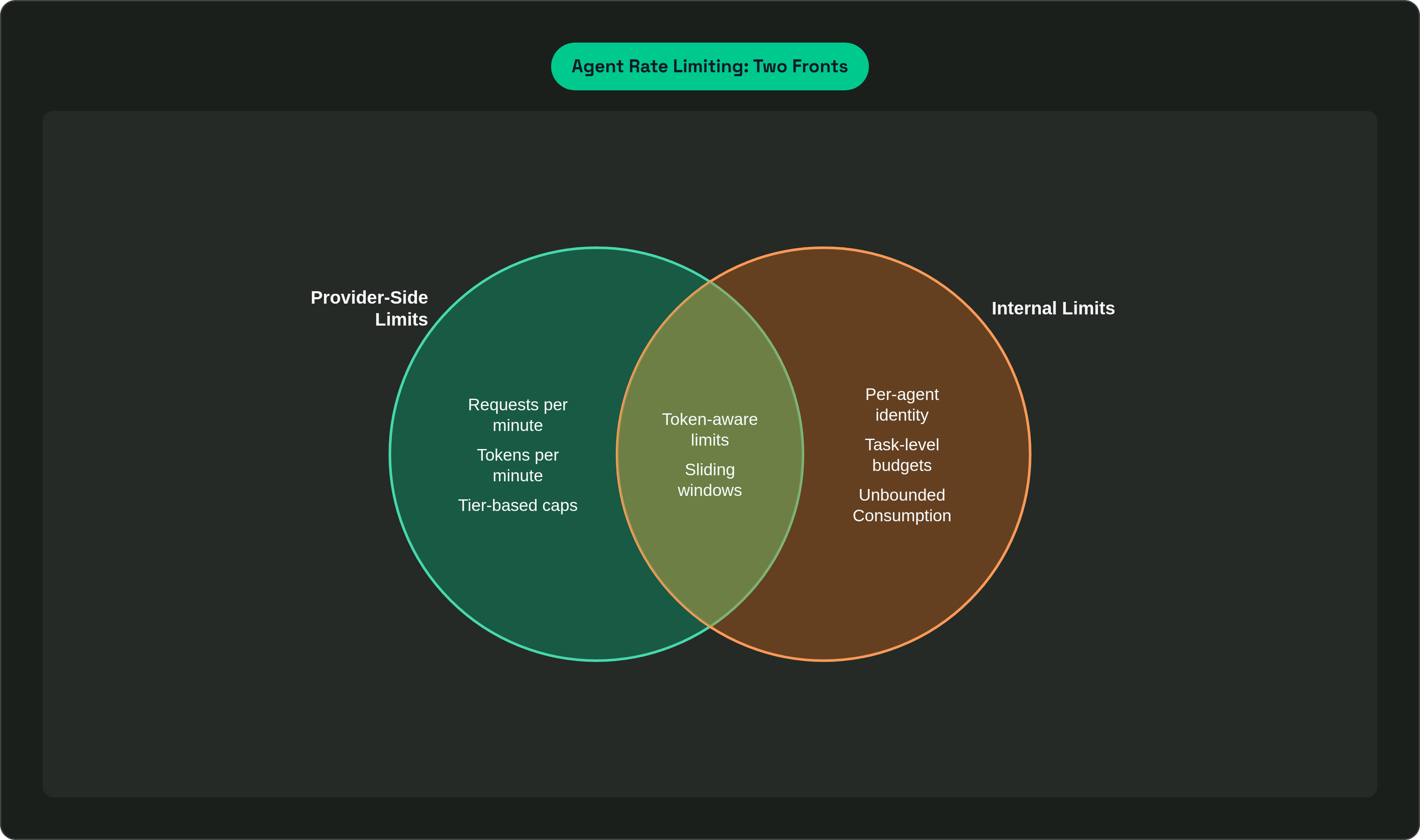
Every agent deployment fights this on two fronts, and losing either one sinks it.
The first front is the provider. OpenAI, Anthropic, and Google all cap you on requests per minute and tokens per minute at once, and the caps shift by account tier, so an agent that runs fine in a sandbox can choke the second it moves to a production key with different limits. Each provider fails differently too: OpenAI throws ratelimitexceeded, Anthropic throws ratelimiterror, Google throws RESOURCE_EXHAUSTED. Retry logic written for one provider's error shape just sits there doing nothing against another's. The IETF has been drafting a standard for rate-limit response headers, RateLimit-Limit, RateLimit-Remaining, RateLimit-Reset, since 2019. Ten revisions in, as of 2025, it's still a draft. You write the translation layer yourself.
The second front is internal. Multiple agents, teams, or customers sharing one API key create contention that has nothing to do with what the provider even allows. One runaway agent eats quota that three other teams were counting on, and OWASP's Top 10 for LLM Applications gave this its own category, Unbounded Consumption, covering denial of service, denial of wallet, and model degradation all at once. Solving the provider side while ignoring this side is putting a good lock on the front door and leaving the garage wide open.
There's a third front most teams skip budgeting for entirely: the SaaS APIs downstream. An agent hitting GitHub, Slack, or Salesforce at agent speed runs into quota limits those integrations were never stress-tested against. No human ever clicked a button fast enough to call Slack's API 200 times in a minute.
I know an engineer who spent an afternoon tracing a production outage back to an agent that was, in effect, DDosing its own company's Slack. It posted a status update after every tool call, twelve times a minute, for six hours straight, before anyone stopped to ask why #deploys had turned into an unreadable wall of text. Nobody built the thing to misbehave. Nobody had imagined anything could type that fast. As the engineer put it afterward: the agent wasn't trying to be chatty, it just never learned when to stop — which, come to think of it, describes most people's group chats too.
Token-aware rate limiting and why request counts alone cannot govern LLM traffic
Here's the part that trips up nearly everyone building their first agent pipeline: counting requests tells you almost nothing about what a call costs you.
Fifty tiny prompts and one massive-token monster can both register as "one request" to a naive limiter, but the cost gap between them is enormous, and a request-count cap gets both wrong. It blocks the harmless burst and waves the expensive one straight through. Counting requests was a fine stand-in for cost back when an API call fetched someone's shopping cart. It's a broken stand-in once the response is a wall of generated text billed by the token.
Token-aware limiting tracks what you're actually paying for: tokens consumed per window instead of, or alongside, requests made, with separate caps on prompt tokens and completion tokens since they cost different amounts. Push further and weight tokens by model, since a completion token from a bigger model costs meaningfully more than one from a lighter model. A cost-weighted limit turns five separate provider quotas into one dollar figure you can actually watch, which is the only thing that makes the two-front war above trackable at all.
One wrinkle, easy to miss until it bites you: fixed time windows have a seam. A consumer can spend their whole budget in the last second of one window, then spend it again in the first second of the next, doubling their effective rate right at the boundary. Sliding windows, which measure usage over a continuously moving stretch of time instead of a hard clock reset, close that gap and actually match the burst-then-idle rhythm agents produce.
Per-agent identity and hierarchical quota assignment
Rate limiting by user or API key assumed one human made one call at a time. Agents blow past that immediately: one engineer kicks off four agents in parallel, each with a different risk profile, and a user-level limit can't tell them apart. It's a bouncer checking one ID at the door while three extra people walk in under the same trench coat.
The fix is a quota hierarchy, three levels deep. At the top, a user-level cap, something like tokens-per-hour, sets the outer boundary and catches the obvious abuse. Below that, agent-level limits get scoped to the job itself: a code-review agent might get a generous token budget but almost no external API access, while a data-fetch agent gets the reverse. At the bottom, task-level budgets attach to one specific workflow and expire when it finishes, so a hung job doesn't sit there quietly draining quota forever.
This isn't just tidiness. A research agent making read-only calls has a small blast radius; an agent with write or delete access to a production system has a large one, and treating both the same under one flat limit is how you end up writing a postmortem. Scoped identity buys you an audit trail too: when a workflow blows its budget, you trace the spend to a specific agent role and task instead of squinting at one aggregate number. In practice this looks like virtual keys or scoped tokens per agent role, with quota tracked in a shared store like Redis, so every instance of that role draws from one shared pool instead of running its own private, unenforceable counter on the side.
Pre-flight quota checks, backoff logic, and queue-based buffering
Checking quota after you've already started a five-step task is like checking your gas gauge after you've merged onto the highway. Pre-flight checks flip that order: confirm there's enough budget for the whole task before the first call goes out, not the third. A workflow that dies on step four after burning steps one through three has wasted that quota and left behind a half-finished mess, usually harder to clean up than it would've been to never start. Pair pre-flight checks with quota reservation, where an agent claims its estimated budget up front and hands back whatever it doesn't use, and the system stays honest on both ends.
Retries need the same discipline. Exponential backoff, where each retry waits longer than the last, is the standard reply to a 429. Backoff alone has its own failure mode: ten agents rate-limited at the same instant, all retrying on the same schedule, all slamming the limit again in perfect unison. A synchronized retry storm is arguably worse than the spike that caused it. Jitter, a small random offset tacked onto each wait, spreads the retries out so most succeed on the first or second try instead of colliding all over again. Skip the jitter and you've got an entire office leaving for lunch at exactly noon, then acting surprised the elevator's full.
Queuing is the last piece, and it changes what a rate limit even means. Instead of rejecting a call that goes over the current limit, you park it and let it through once quota frees up, so excess demand becomes deferred work instead of an error message. Priority queues let a user-facing request cut ahead of a background batch job, and quota reclamation makes sure a reservation held by a stalled or cancelled agent gets returned to the pool instead of sitting there locked up, useless, like a hotel room booked by a guest who never checked in.
Skip any one of these three and the other two won't cover for it. I've heard of a team that watched an agentic workflow burn through $47,000 in API credits before anyone noticed, and the agents weren't malfunctioning. They were doing exactly what they were built to do. Nobody had tested what happens when the reasoning loop doubles in length, or the agent decides fourteen API calls are warranted instead of three. Someone on that team joked afterward that they'd finally found a way to make an AI agent feel like a teenager with the family credit card: technically authorized, spiritually unsupervised.
How AI gateways implement these strategies as infrastructure rather than application code
Writing token counting, backoff, and quota tracking into every agent's application code means writing it again for every new model, every new provider, every new integration you add next quarter. That's not engineering, that's copy-pasting the same liability across your whole codebase. A gateway sits in front of all of it as one layer, so a change to the retry policy or the spend cap rolls out everywhere at once without touching a single agent's code.
Semantic caching belongs right next to rate limiting here, not competing with it. Caching identical or near-identical LLM responses cuts costs 40-60% on workloads with repeated query patterns, and a cached call never touches your rate limit at all, since it never leaves the gateway. Caching shrinks the demand; rate limiting governs whatever's left over.
The gateways on the market split along fairly practical lines. Some managed gateways enforce limits at the edge, near wherever the agent actually runs, instead of routing everything back to one origin server first, and bundle request-level limiting, response caching, retries, and model fallbacks in as defaults instead of things you build yourself. Options in this category have added dollar-denominated spend limits scoped to model, provider, or custom tags like user and team, with fixed or rolling reset windows, which goes straight at the cost problem this piece keeps circling back to. Managed-only products mean teams with strict data-residency or air-gapped requirements have to weigh that going in.
Bifrost, the open-source gateway out of Maxim AI, targets those exact regulated, VPC-isolated, air-gapped environments where a managed-only product is a non-starter. It's written in Go, supports token-aware hierarchical rate limits and multi-key pooling with automatic failover, and runs around 11 microseconds of overhead at high volume, fast enough that it's not what's slowing your pipeline down. It also folds LLM gateway, MCP gateway, and agent gateway into one deployable thing instead of three separate services to babysit.
Kong, at version 3.11, added AI-specific plugins starting at 3.6: token-aware rate limiting, Redis-backed semantic caching, and prompt compression that cuts token count up to 5x while holding onto roughly 80% of the semantic content, layered onto infrastructure a lot of teams already run for general API traffic. If Kong's already your API layer, that's the lower-friction path.
LiteLLM takes a different shape: an open-source proxy with virtual keys, per-key and per-team budgets, RPM and TPM limits, and a Python SDK for teams who'd rather keep routing logic close to the model call than hand it off to a separate service. Budget windows run from seconds to days, and limits apply at the user, team, or key level. Python-native teams tend to gravitate here.
Picking among them comes down to two questions, not a feature checklist: does your compliance posture rule a managed product out, and does your existing infrastructure already point you toward one of these? Whatever you land on, token-aware limits and dollar spend caps aren't optional extras. A gateway that only counts requests is solving a problem nobody has anymore.
What a production-ready rate-limit architecture actually looks like end to end
Put it together and the shape is straightforward. Token-aware, cost-weighted limits on a sliding window sit at the base, because request counts lie about what agent traffic actually costs. Per-agent identity, scoped through virtual keys and enforced through a three-tier hierarchy of user, agent, and task, sits above that, so no single runaway job can spend another team's budget. Pre-flight checks stop a workflow before it starts if the budget isn't there; backoff with jitter handles the inevitable 429s without kicking off a retry storm; a priority queue turns overflow into deferred work instead of dropped work. A gateway, managed or self-hosted depending on what your compliance team will sign off on, enforces all of it centrally, so the logic lives in one place instead of copy-pasted across every agent you ship.
None of this is exotic, honestly. It's the same discipline distributed systems have needed under load for two decades, applied to a workload that happens to bill by the token instead of the millisecond. Gartner expects agents in 40% of enterprise applications by 2026, up from under 5% in 2025. The ones that fail won't fail because the models got worse. They'll fail because somebody shipped the reasoning loop and never got around to checking if there was gas in the tank.