How to Run Stateful AI Agents at the Edge Without a Central Server
Replace central servers with distributed durable objects that sleep between tasks.
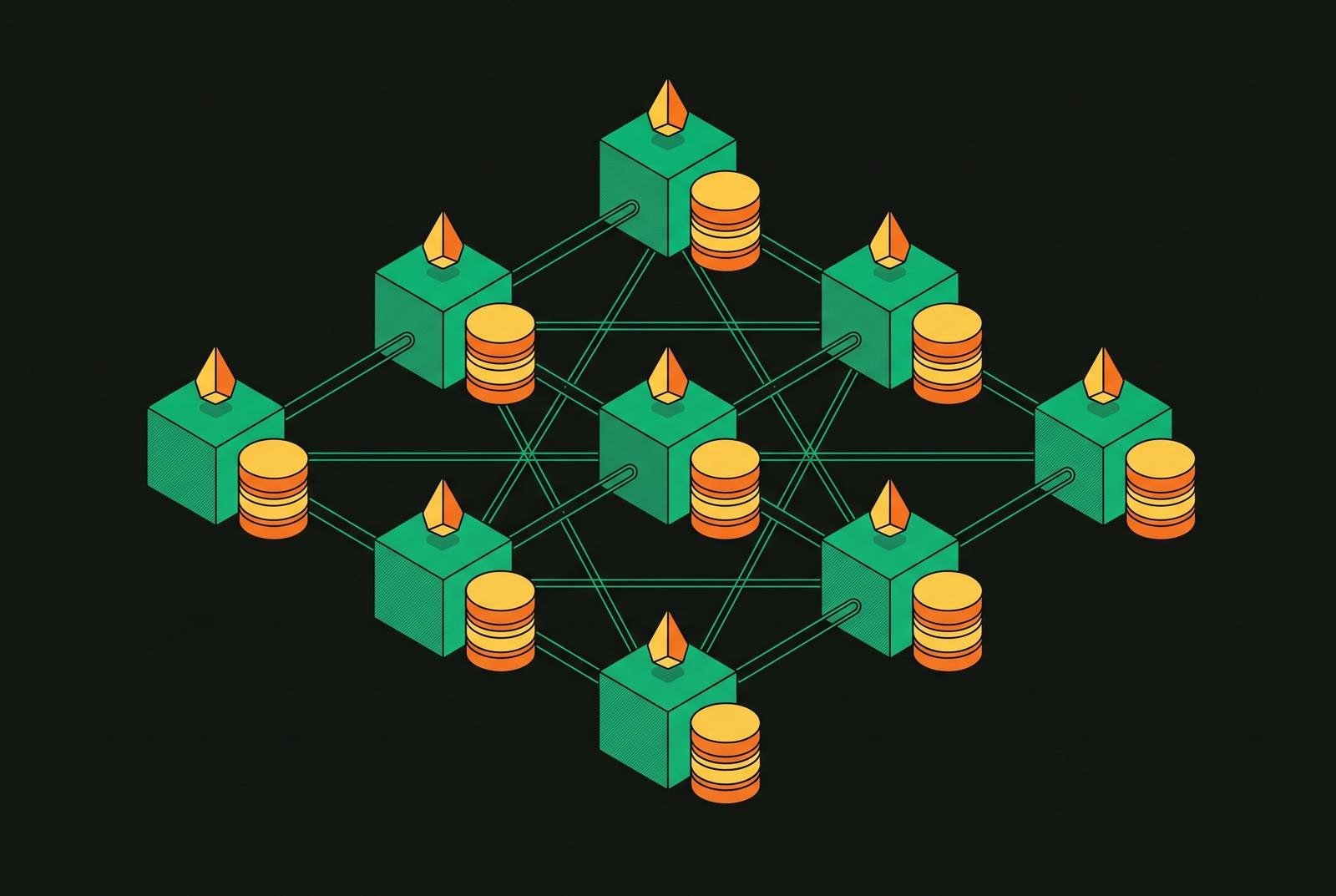
Forget the CDN definition of "edge." Caching a JPEG close to a user is not the problem being solved here. The edge this piece concerns is a globally distributed runtime where each agent instance has a stable, addressable identity, owns storage collocated with its compute, can hibernate between events without losing context, and can receive messages, schedule deferred work, and hold open connections while dormant.
The standard Functions-as-a-Service model terminates the execution environment after each invocation. For a discrete request-response task, that's fine. For an AI agent that depends on continuity across dozens of sequential steps, tool calls, and user turns, it is a structural mismatch: invocation ends, in-memory state evaporates, next invocation starts cold.
The workarounds are tempting but each carries trade-offs. Externalizing state to a central database reintroduces the central server, adds a round-trip on every agent step, and creates a new single point of failure. Keeping a long-running container warm pays for idle compute for the entire duration the agent waits on a human response or a webhook, which is most of the time. Reconstructing context from scratch on each invocation burns token budget and introduces inconsistency when the reconstruction is imperfect.
The real architectural requirement is simple to state: decouple state from compute so that state persists while compute sleeps, resuming only when there is work to do.
Tool calls, LLM responses, and action logs must be written and read in tight loops. A remote database round-trip on every agent step compounds latency across a multi-step workflow quickly. Consistency is also easier to reason about when a single instance owns its data; no distributed lock is needed when there is no contention. There are effectively three layers to the memory problem: ephemeral working memory for the current reasoning step, session-scoped state for task progress within a workflow, and long-term memory for facts and preferences the agent should recall across sessions. A fourth requirement sits beneath all of them: coordination between agent instances must happen without a shared mutable database that merely becomes the new central point of failure under a different name.
The primitives that make durable edge agents possible
The foundational stack for a stateful edge agent rests on three categories of primitive. The interesting part is not what each primitive does in isolation; it's what breaks when you're missing one.
Durable compute units
These are isolated execution environments with a stable address that survive across invocations. The canonical implementation of this primitive is a single-threaded micro-server with its own embedded SQLite database, so state is local to the instance and reads and writes never leave the compute unit. An Agents SDK wraps this model so developers define a class extending Agent and immediately get durable identity, local SQL storage, scheduling, and real-time connections without provisioning anything external. Agents built on this model can scale to tens of millions of concurrent instances.
The single-threaded design reads as a limitation until you work with it. It is actually the correctness guarantee: one instance, one writer, no conflict.
Edge KV and object storage
Globally replicated stores handle state that must be readable from any region: configuration, shared knowledge, artifacts the agent produces for downstream consumption. They are not appropriate for the agent's own mutable working state, because eventual consistency means two concurrent writes can produce conflicts. The durable object's local SQLite handles mutable working state; KV and object storage handle broadly readable outputs. An Artifacts layer, announced in April 2026 and designed for agent-produced outputs at scale, is built explicitly for the latter category.
Workflow coordination
Durable orchestration tracks step completion, handles retries, and resumes after failures without a central coordinator doing the bookkeeping. Cloudflare Workflows v2, part of Cloudflare's serverless edge platform and rearchitected in 2026, supports 50,000 concurrent workflows; each step is checkpointed so a failure restarts from the last successful step rather than from scratch. This replaces the job the central server used to do, without the central server.
Hibernation deserves treatment as a first-class architectural feature. The durable object sleeps when no event is pending; its SQLite state survives on disk. It wakes on an incoming message, a scheduled tick, or a WebSocket event without a perceptible warm-up penalty. Billing stops during hibernation. "Always available but never always running" becomes economically viable precisely because of this property.
What developers can skip: no external Postgres or Redis instance for agent state, no separate cron service for scheduled steps, no session reconstruction logic on each invocation. The primitives handle it, which is the point.
How multi-agent coordination works without a shared server
Multiple agent instances need to hand off tasks, share context, and avoid conflicting actions, all without a central message broker or shared database that becomes the new single point of failure. This is not a new problem. The actor model solved it decades ago; the edge runtime just needs to implement it faithfully.
Direct addressing
One durable object calls another by its stable ID. Each instance has a globally unique name; an orchestrator holds a reference and can call a worker from anywhere in the network. No shared state is required because the callee owns its own state and the caller owns its own. This pattern fits orchestrator-to-worker delegation cleanly, wherever the caller knows the target identity ahead of time.
Message queues at the edge
For fan-out patterns where an orchestrator spawns many workers and cannot wait synchronously, a queue delivers the task; the worker durable object processes it and writes results to its local storage or to a shared artifact. Backpressure and retry are handled by the queue rather than by application code, which is where those concerns belong and where they get lost when you try to manage them yourself.
MCP as the tool-exposure standard
By 2026, the Model Context Protocol is the de facto standard for exposing tools, resources, and prompts to any model. Agents use MCP to call each other's capabilities without tight coupling, which means swapping out an underlying tool implementation doesn't require rewriting the agent that consumes it.
A private networking fabric for agent-to-agent communication, announced in April 2026 and integrated with a Workers VPC, addresses this need. Agents on the same mesh reach each other securely without exposing public endpoints and without manual tunnel configuration.
The consistency trade-off here is specific and worth naming plainly: durable objects give strong consistency within a single instance; cross-instance coordination is eventually consistent unless you route through the owning instance. Route all writes for a shared entity through one named durable object acting as the owner; other agents read from it or send it commands. This is the actor model, not a distributed transaction.
One note on why multi-agent workflows became producible rather than merely theoretically interesting: frontier models reached 95%+ accuracy on standard tool-calling benchmarks by mid-2025, up from 70-80% in earlier generations, according to published benchmark results from that period. At 70-80%, one in five tool calls fails, which stalls a multi-step pipeline at nearly every coordination point. At 95%+, the math changes.
Long-term memory and state that persists across sessions
A durable object's embedded SQLite is excellent for within-session state. It does not automatically surface relevant past context when a new session starts. That gap is the long-term memory problem, and it is the layer most teams underinvest in until their agent starts contradicting itself across conversations.
What long-term memory must do for an agent is specific: store facts, preferences, and past decisions indexed for semantic retrieval; filter so that only memories relevant to the current task are surfaced rather than flooding the context window with everything the agent has ever encountered; and improve over time by weighting memories that proved useful and decaying those that didn't. Building this from scratch means assembling a vector store, a retrieval pipeline, a scoring mechanism, and the integration layer that connects all of them.
A managed persistent memory service, announced in April 2026, is designed for this layer. The developer queries it rather than builds it.
The architecture pattern when using a managed memory layer follows a consistent rhythm. On session start, query the memory service with the current task context, retrieve relevant past facts, inject them into the system prompt or early context. At session checkpoints and on session end, write new facts, decisions, and outcomes back to memory. The durable object orchestrates the flow; the memory service stores it.
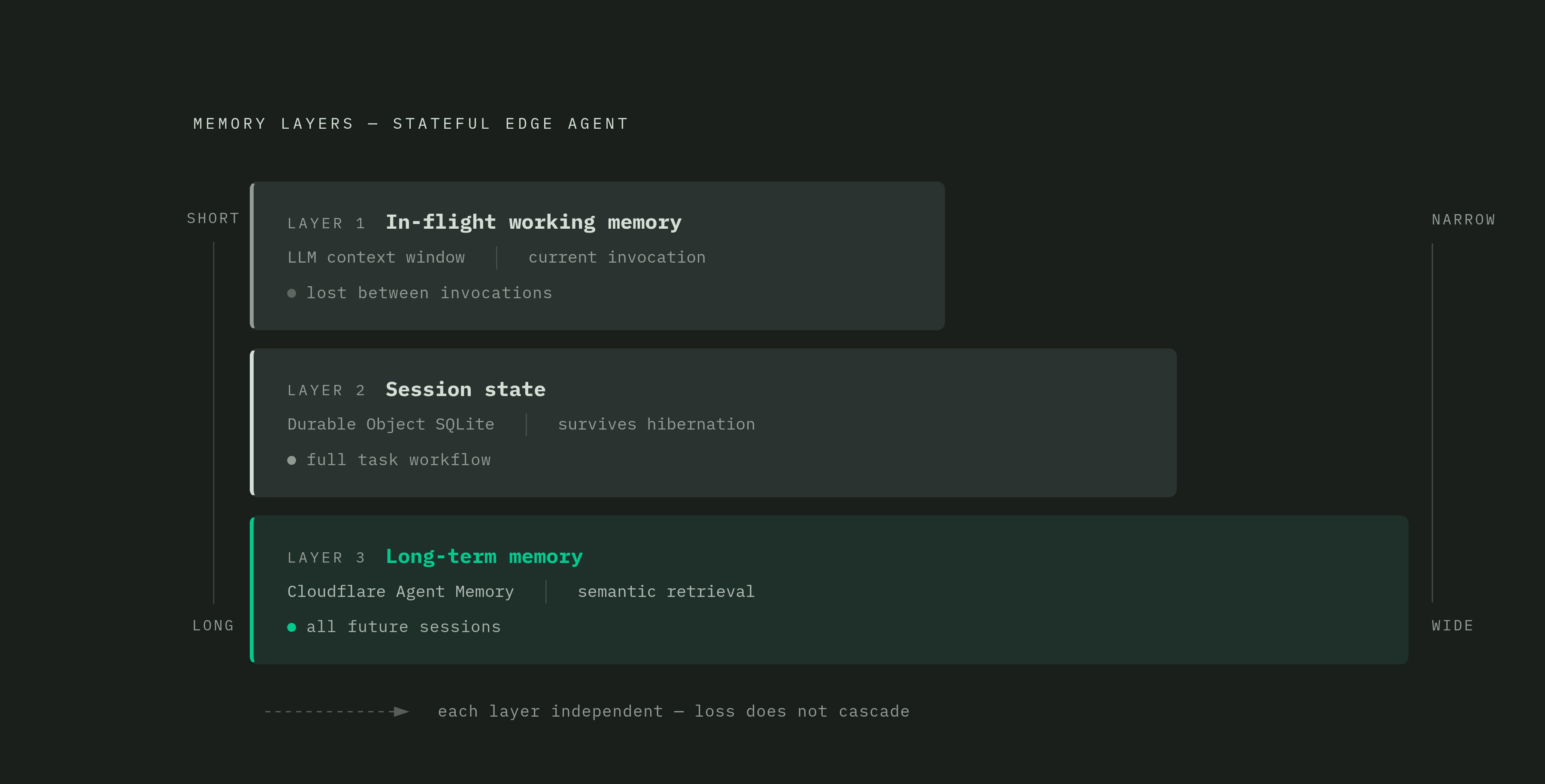
In-flight working memory lives in the LLM context window and the current durable object invocation. Session state persists in the durable object's embedded SQLite and survives hibernation. Long-term memory lives in the managed memory service and is semantically retrieved at session boundaries. Each layer is independent; losing one does not cascade to losing everything. That independence is what makes serverless agents durable rather than merely distributed.
Securing agents that run without a perimeter
There is no perimeter to defend. Agents that span dozens of edge locations, call external tools, and act autonomously cannot be secured by placing them inside a firewall, because there is no inside. The firewall model assumes a boundary between trusted and untrusted networks; edge agents erase that boundary by design.
Zero Trust is the correct model: every agent call, every tool invocation, and every inter-agent message must be authenticated and authorized on its own merits, not trusted by virtue of network location.
The concrete requirements are more specific than the slogan implies. Each agent instance should carry a scoped credential rather than inheriting broad human permissions. The principle of least privilege applies: the agent accesses only the tools and data its current task requires. When an agent is shared across users, its access should reflect the requesting user's permissions rather than the deployer's. The access controls that govern data directly must also govern the agent that touches that data; a separate permission model for agents creates exactly the gap that attackers will find. Tool-call volumes should be baselined so that anomalies, whether a sudden spike or an unexpected data access pattern, trigger alerts rather than silent compliance.
Isolated Linux sandbox environments, generally available in April 2026, provide isolated environments for code execution steps: shell, filesystem, background processes. An egress proxy means the agent never directly touches credentials or makes raw outbound calls; all external access is mediated. The sandbox bills only for CPU cycles used, not for idle time between tool calls.
Post-quantum readiness is not a future consideration for agents handling sensitive data. Harvest-now-decrypt-later attacks allow adversaries to collect encrypted traffic today and decrypt it once quantum computing matures. A Zero Trust connectivity layer that already supports post-quantum cryptography is available for this purpose. Distributing agents across the edge removes the high-value central target; Zero Trust ensures every distributed call is still verified. The two properties reinforce each other, which is the architecture working as intended.
What production deployment actually looks like end-to-end
A demo agent needs a prompt and an API key. A production agent needs durable state, error recovery, observability, cost control, human-in-the-loop capability, tool security, and bounded scope. Those seven requirements are where most proof-of-concept agents stall permanently.
The minimal deployment path on this platform is: npm install agents, define a class extending Agent, run wrangler deploy. From that point, global distribution, instance addressing, SQLite provisioning, hibernation, and wake-on-event handling are managed by the platform. Multi-step orchestration is handled through Workflows v2 with durable checkpointing across 330+ data centers worldwide. Agent Memory handles cross-session recall. Sandboxes handle any step that executes untrusted or model-generated code. The SASE and MCP gateway layer secures agent-to-tool calls.
One internal security review agent built on this architecture processes more than 7 billion tokens per day and caught more than 15 confirmed issues in a single codebase. The economics are also instructive: running an equivalent workload on a mid-tier proprietary model was projected at $2.4 million per year for that single use case before the team optimized model selection.
The central server was never a technical requirement. It was an artifact of infrastructure that didn't yet have better options. Durable compute units with collocated storage, edge-native workflow orchestration, and managed memory layers are generally available now. The agent that still needs a central server to be stateful is the agent that hasn't been rebuilt on primitives that make the central server unnecessary; at this point, that's an architecture decision, not an infrastructure constraint.