Consumption-Based vs Reserved Capacity Pricing for Variable Workloads
Reserved pricing saves money on steady workloads; consumption pricing wins on spiky ones.
Cloud providers bill for the server you asked for, not the server you actually ran. A machine sitting idle at 2am costs the same as one buckling under peak load at 2pm, provided it was provisioned at the same size. That single fact turns the pricing model decision into an engineering question: how much of what you provision will actually get used, and how reliably? If you answer it correctly, you can pay forty percent less or forty percent more for the same workload's identical output. Model APIs now charge by the token rather than by the hour, so cost tracks prompt length and output size instead of a server's clock, which has made the question harder. The same decision that used to govern a web tier now decides the economics of GPU fleets, inference endpoints, and agent pipelines that fire off a dozen model calls per user click, so the cost of getting it wrong has grown with the stakes.
What reserved and consumption pricing measure
Reserved and consumption pricing charge for two different things, and most cloud bill surprises trace back to a team treating them as interchangeable. Provisioned or reserved capacity means picking a server spec, CPU, RAM, disk, and paying for that configuration no matter how much of it gets used. It may be billed by the second, but the economics are no different from renting the whole machine for the term. Commitment-based variants add a time dimension on top: AWS Reserved Instances, Azure reservations, and Google Cloud's Flexible Committed Use Discounts all trade a locked-in term for a lower rate. Google's own migration is a useful marker of how fluid this category has become: as of January 21, 2026, Flexible CUDs bill eligible usage directly at a discounted rate, 28% off for a one-year term and 46% off for three years, rather than issuing separate credits against a reservation. That's a committed tier that behaves more like a consumption rate than a walled-off reservation bucket.
Consumption pricing works on a different principle. The platform meters what the application actually uses, CPU, RAM, execution time, requests, and the bill tracks that footprint rather than whatever headroom got reserved in advance. A further layer of this model, request- and execution-based pricing used by serverless functions and edge compute, charges on meters tied to the application itself: invocations, CPU-milliseconds, tokens. Because the meter can read zero, the bill can too. Token-based AI pricing is the newest member of this family: cost moves with how long a prompt runs, tying spend directly to workload shape. The practical difference to hold onto: a reserved model makes the cost of idle capacity fixed and visible on the invoice every month, while a consumption model lets that cost fall to zero. Which one serves a workload better depends entirely on how much idle time that workload actually carries.
Reading a workload's traffic shape before choosing a model
Before anyone picks a pricing model, you need to diagnose the workload, not guess at it. Three properties do the work: the utilization floor, the peak-to-trough ratio, and how predictable demand is over the length of any commitment. The utilization floor asks a blunt question: how often does this thing actually sit idle? A workload that rarely idles pushes the math toward reserved pricing, because the team is paying for capacity it keeps using anyway. A workload that idles often pushes the opposite direction, since every idle hour under a reserved contract is money spent on nothing.
The peak-to-trough ratio measures the gap between a workload's quietest hour and its busiest one. A service that spikes to ten times its baseline traffic can't be reserved efficiently, because provisioning for the peak means over-provisioning for the other 23 hours of the day. Consumption pricing handles that swing naturally, because the bill tracks average use, not the headroom needed for the worst moment. Reserved pricing, by contrast, rewards workloads that are steady: a team that knows roughly how much CPU and memory it needs, and an app that actually uses most of what got provisioned for it.
The third property is forecasting horizon. Can demand six or twelve months out be predicted with any confidence? Reserved discounts only pay off if the committed capacity gets used, and new AI and agent workloads are some of the hardest things in computing to forecast. Inference traffic is spiky by nature in a way that training jobs aren't, and an agentic pipeline can fire off many model calls behind a single user request, so the cost of that one request swings wildly from one instance to the next. These three properties combine into three workload archetypes: steady-state (high floor, low variance, predictable), spiky (low floor, high variance), and interruptible (tolerant of being paused mid-job). Each one points toward a different pricing strategy, and the next two sections take them in turn.
When reserved capacity wins: the steady-state workload case
A workload with a high utilization floor and predictable demand is the case reserved pricing was built for, and the savings hold when the commitment matches actual steady-state use. The mechanism is simple: Reserved Instances, Savings Plans, and Committed Use Discounts all trade a fixed term for a lower rate, and that trade pays off handsomely when usage is consistent. GPU capacity shows the scale of the discount most clearly. NVIDIA H100 hourly rates run $2.50 to $5.00 on-demand, and long-term reservations of the same hardware can bring that down to $1.00 to $2.00 an hour, a reduction of 40 to 70 percent against the on-demand rate.
That discount only holds if the capacity gets used. A startup that reserves 16 H100s for six months at an attractive rate, then runs them at half utilization, is quietly paying double the rate it thinks it negotiated. The workloads that fit this model cleanly share a profile: always-on APIs or live ML scoring jobs with a known CPU and memory footprint, production inference pipelines running at sustained volume, and anything where the instance size fits the job snugly. The commitment target that matters is the steady-state baseline a team is confident will run continuously, with anything above that handled by on-demand or consumption-priced capacity.
Consumption pricing for spiky, agentic, and AI inference workloads
Flip the conditions, low utilization floor, wide peak-to-trough swings, demand that resists forecasting, and consumption pricing is no longer the alternative; it is the only model that doesn't waste money. This happens to describe most AI inference and agentic work today. Inference is spiky in a way training runs aren't, and GPU utilization across organizations tends to sit well below full capacity, so a reserved GPU fleet built for inference usually carries real idle time baked into its monthly cost. Serverless and edge compute sidestep the problem by billing only for execution that actually happens: no servers to provision ahead of demand, no GPUs sitting warm waiting for a request that might not arrive for another hour.
Agentic pipelines sharpen the unpredictability further. A single user request can trigger a chain of model calls happening behind the scenes, so the cost of one request to the next can differ by orders of magnitude, a simple agent task running a fraction of a cent while a complex multi-step job runs several dollars. Reserving against that kind of swing means guessing at a number that varies wildly depending on what a user happens to type. Token-based pricing, where cost tracks prompt length and output size rather than instance hours, is structurally a consumption model, and most managed model APIs don't offer a reserved alternative at all, so consumption pricing isn't a choice so much as the only option on the table.
Cloudflare Workers is a useful illustration of what consumption pricing looks like applied at global scale: the billing units are requests and CPU-milliseconds, there's no charge for idle time or for egress, and the platform scales to zero between invocations, removing the idle-capacity tax entirely for workloads built to run on it. Workers AI extends the same logic to inference itself: a model gets called the way any other function would be called, the work runs on GPUs distributed globally, and the bill reflects only what got used. AI Gateway sits in front of whatever LLM provider a team is already using and adds caching, cost tracking, fallback, and prompt-injection guardrails without touching client code, and the caching alone cuts spend by avoiding redundant token charges on repeated prompts.
The hybrid case: splitting the workload between reserved and consumption tiers
Few production systems are purely one archetype or the other. Most carry a steady baseline and a variable spike layered on top, and the right move is to reserve for the floor and let consumption pricing absorb the variance, rather than forcing the whole workload into a single model. The logic is simple to state: commit only to the capacity a team is confident will run continuously at high utilization, and let on-demand or consumption pricing handle everything above that line.
GPU workloads make the split concrete. A team running a sustained production inference pipeline gets real savings from reserving GPU access for that baseline, while experimentation traffic, batch fine-tuning runs, and demand spikes are cheaper handled on-demand or through spot and preemptible instances. Spot and preemptible capacity uses a cloud provider's excess inventory at a steep discount and suits any job that can tolerate being interrupted, batch processing, CI/CD pipelines, training runs with checkpointing, where getting paused mid-job costs nothing but a restart.
Google's CUD migration from January 21, 2026 shows a major provider blurring the line on purpose: Flexible CUDs now bill eligible usage at a direct discount rather than issuing offsetting credits, which makes the committed tier behave less like a separate reservation bucket and more like a consumption rate with a discount attached. The risk in running a hybrid setup is calibration. Overestimate the floor and a team recreates the idle waste it was trying to avoid. Underestimate it and discount savings get left on the table. Keeping the split accurate takes continuous right-sizing: you watch actual utilization and adjust commitments as the workload changes, because the floor that was accurate in January rarely stays accurate by summer.
Hidden cost factors that shift the model comparison: egress, bot traffic, and idle waste
The compute line item is not the whole invoice. Egress fees, bot traffic, and forgotten reserved resources routinely flip which pricing model is actually cheaper once you add up the full bill. Egress is the most structural of the three: data leaving the network to the internet on Google Cloud runs $0.08 to $0.23 per GiB depending on destination, with multi-region storage premiums stacked on top, and these charges apply whether the compute underneath is reserved or consumption-priced. For data-heavy workloads, egress alone can dominate the total bill regardless of which compute model got chosen. Platforms that skip a separate egress charge change that math directly. Cloudflare Workers, for instance, carries no bandwidth charge at either its free or paid tier, so one of the largest hidden variables drops out of a high-traffic workload's total cost.
Bot and automated traffic distort consumption bills in a more direct way: every request a bot sends gets metered the same as a request from a paying user, and a traffic spike from bad bots can trigger autoscaling events that inflate the bill further. Block malicious bots before they reach application servers, and compute consumption, database load, and data transfer charges all drop at once. AI agents and LLM crawlers complicate the defense, because they behave more like human visitors than like the bots a standard web application firewall was built to catch, so WAF rules on their own aren't enough. Real-time bot detection layered on top is what keeps bot traffic from quietly distorting the consumption numbers a team thinks it's reading. Cloudflare's DDoS mitigation and bot management are at the network edge for exactly this reason, so they stop malicious traffic before it reaches origin infrastructure and runs up a bill.
The reserved side has its own version of hidden waste: orphaned resources. Idle virtual machines nobody shut down, persistent disks no longer attached to anything, load balancers left running after the service they fronted got retired, IP addresses nobody remembers claiming, all of it keeps generating charges silently. Automated detection and cleanup are the only real defense, because without them a reserved commitment accumulates idle cost the way an untended subscription accumulates monthly charges for a gym nobody visits. Any honest comparison between reserved and consumption pricing has to account for all three factors together: the compute tier, egress, bot-driven amplification, and idle resource drift, not just the headline rate on the invoice.
A decision framework for matching pricing model to workload type
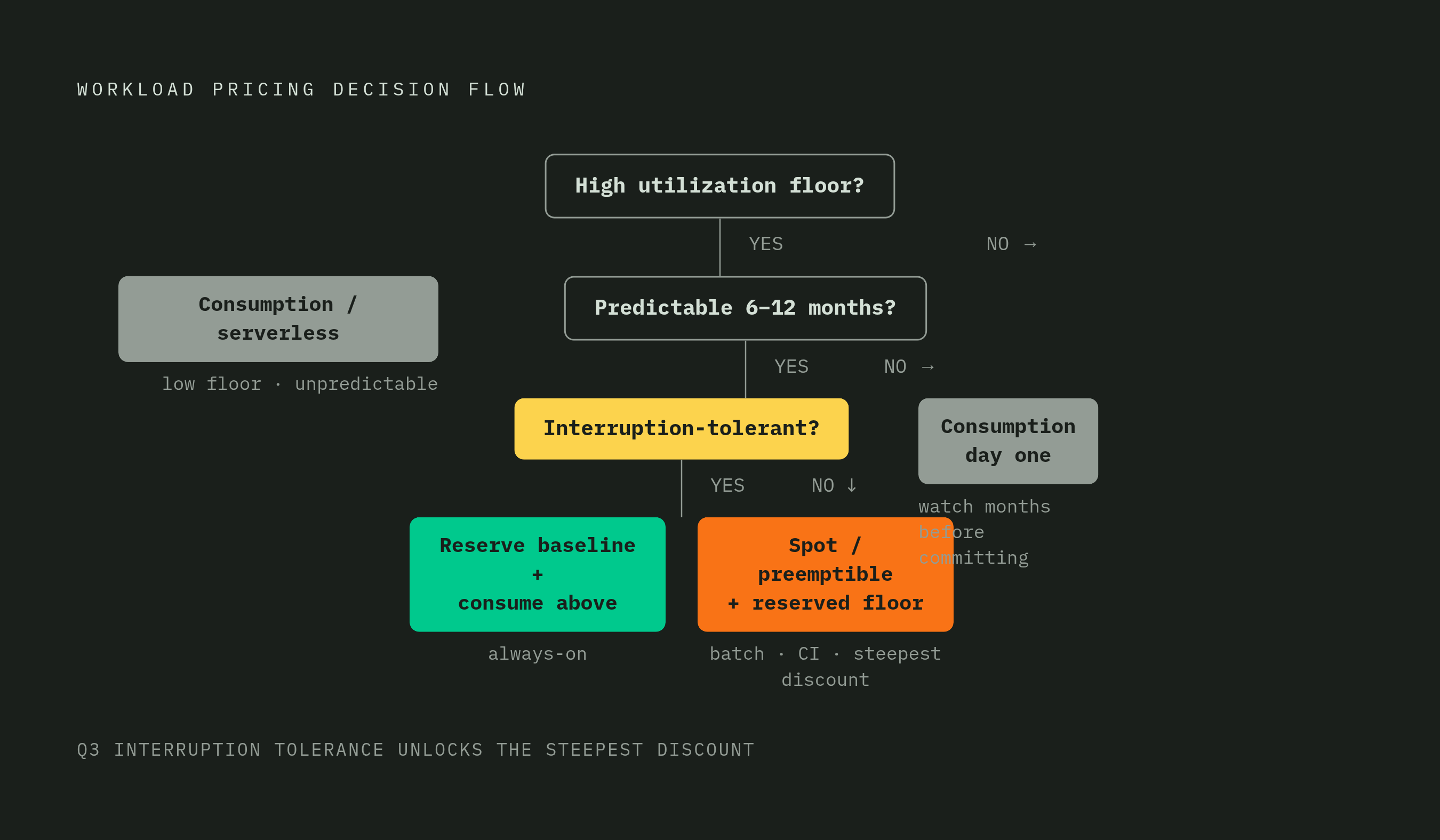
Three questions, asked in order, settle the pricing model question for any given workload.
The utilization floor is the first question: does this workload run continuously at high utilization, or does it idle often enough to make reservation wasteful? High-floor workloads, always-on APIs, live ML scoring, production databases, steady-state backend services, start the evaluation on the reserved side. Low-floor workloads, bursty inference endpoints, event-triggered agent pipelines, batch jobs, scheduled tasks, development environments, start on the consumption side instead.
The second question is forecasting horizon: can the team predict baseline demand six to twelve months out with real confidence? If yes, commitment-based discounts are there to be captured. If the workload is new, growing fast, or structurally resistant to forecasting, which describes most AI inference work, the risk of over-committing outweighs whatever discount the reservation offers. Agentic workloads push this risk further still, since a single request triggering a cascade of model calls makes per-request cost swing too much to justify locking in a reservation against it.
Can the workload survive being interrupted mid-task? Batch processing, CI/CD pipelines, and training runs with checkpointing can survive interruption, and that tolerance makes them candidates for spot or preemptible capacity, which carries the steepest per-hour discount of any pricing model available and ties cost directly to productive work.
Running those three questions produces the output mapping directly. High floor, predictable demand, no tolerance for interruption: reserve the baseline, consume for anything above it. Low floor, unpredictable demand, no tolerance for interruption: consumption-based or serverless, with edge compute where latency matters. Predictable demand and tolerance for interruption, regardless of floor: spot or preemptible for the flexible portion, reserved for whatever minimum is guaranteed. A new or fast-scaling AI workload belongs on consumption pricing from day one, with the team watching several months of real usage before deciding whether any slice of the floor has earned a commitment. Cloudflare Workers and Workers AI are squarely in the low-floor, unpredictable, latency-sensitive box: consumption pricing on requests and CPU-milliseconds, no egress charge, global distribution, and the ability to scale to zero, which removes the idle-capacity cost a reserved model would otherwise force onto that exact workload shape.
None of this gets decided once. A single team typically runs several workload types at once and owes each one its own pass through these three questions, not a single organization-wide verdict. Utilization floors shift as products grow, as traffic patterns change, as agent pipelines get rebuilt, and a commitment that made sense on six months of clean data can turn into dead weight six months later if nobody goes back to check it.