Identifying and Eliminating Idle Compute Waste in Cloud Environments
Structural incentives, not awareness, lock cloud waste in place year after year.

Cloud waste is not a technical problem that better tooling will solve. It is a structural property of how compute is bought, provisioned, and billed. The rate has not moved in any meaningful direction for half a decade, and the reason is not that engineers lack dashboards. The reason is that the people provisioning resources and the people paying for them rarely sit in the same room, and the architecture itself rewards the person who buys too much.
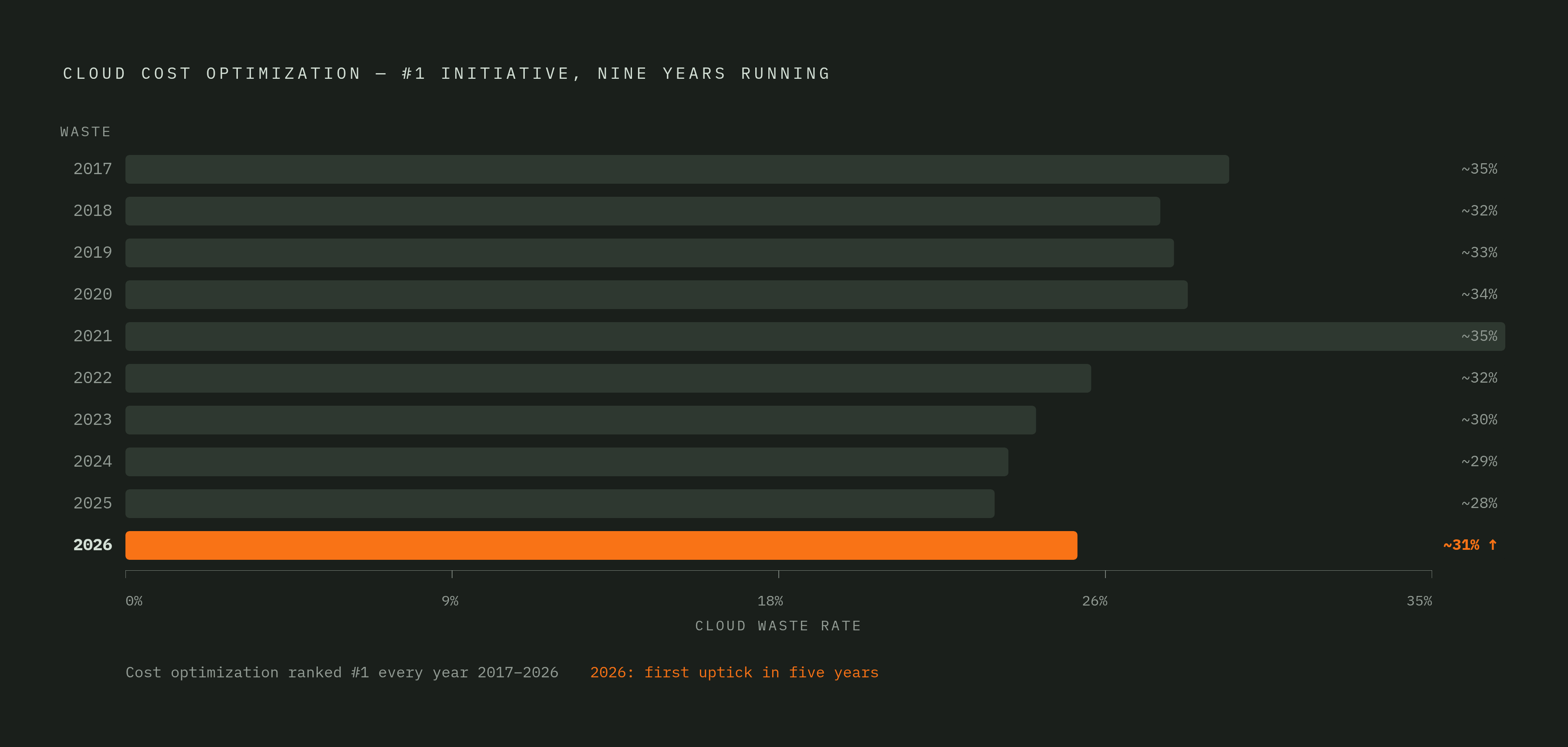
The Flexera State of the Cloud Report has tracked cloud waste for years, and the number refuses to behave like a problem someone is trying to solve. It sits in a consistent band as a substantial share of total spend, declining somewhat from a 2021 peak before ticking back up in 2026. That uptick is notable because it is the first increase in five years. A metric that stays flat while an entire industry claims to be optimizing it is not a coincidence. It is a signal that the forces holding the number in place are not responsive to the interventions being applied.
Here is the part that should give pause: the same survey has shown cloud cost optimization as the top initiative for nine consecutive years. Nine years of stated intent, and the waste rate looks like a plateau with noise around the edges. If awareness and effort were the binding constraints, that number would have moved. The gap between what organizations say they are doing and what the data shows they are achieving points away from behavior and toward structure. The problem is not that teams do not care. The problem is that the environment they operate in makes waste the rational outcome.
How Traditional Provisioning Instincts Survive in Environments That No Longer Require Them
Overprovisioning made sense in the data center era. Buying hardware meant guessing at peak demand three years out, and the penalty for guessing low was a production outage with no quick fix. Nobody got fired for buying the bigger server. The cost of excess capacity was amortized across the life of the machine, and the cost of insufficient capacity was immediate and career-shaping. The rational choice was to build for the worst plausible day and let the rest of the time sort itself out.
Cloud platforms changed the physics of that decision. A virtual machine can be resized in minutes. Storage can be scaled down as easily as up. The capacity buffer that once took months of procurement to correct can now be adjusted in an afternoon. The instinct did not get the memo. Engineers still provision for peak load, still select instance families as if the decision were permanent, still treat development environments as if they were running on hardware that someone already paid for. Memory-optimized instances run CPU-bound workloads. Storage volumes sit provisioned at maximum IOPS while actual throughput stays flat. Development environments run production-grade instance types for work that a laptop could handle. The behavior survives because nothing punishes it. The engineer who provisions too much hears nothing. The engineer who provisions too little hears about it immediately.
The result is a catalog of the quietly forgotten. Dev and staging environments run overnight and through weekends. Deprecated services stay live because nobody wants to own the termination. Batch-processing nodes bill for a full day while doing minutes of work. Demo and sandbox environments reached 94% idle rates in 2025. These are not malicious decisions. They are the natural output of a system where creating resources is frictionless and remembering them is not. The resources are easy to spin up and structurally easy to lose track of. The pattern is the same across every idle category: cheap to create, easy to forget, expensive to carry for months.
Why the Billing Model Makes Overprovisioning the Rational Choice for the Engineer Doing the Provisioning
The turn in this argument is straightforward. When compute is billed by the hour regardless of utilization, overprovisioning is not a mistake. It is the locally optimal decision for anyone who bears the downside of underprovisioning and none of the cost of overprovisioning. The engineer who allocates too much faces no signal that anything went wrong. The bill lands somewhere else. The engineer who allocates too little faces a visible failure, a page at 3 a.m., and a postmortem with their name on it. Given those two outcomes, the choice is not close.
Hour-based billing compounds the distortion. A batch job that runs for ten minutes generates a bill for the full hour. From the provisioner's perspective, idle time and active time cost the same amount. There is no signal in the pricing structure that says idle is expensive, because the meter does not distinguish between the two states. The person making the provisioning decision experiences the cost structure as flat, which means they optimize for safety rather than efficiency. That would be fine if the person paying the bill could push back, but most organizations do not give them the tools to do so.
Cost chargeback remains the exception. Fewer than half of organizations have implemented chargeback or showback in a meaningful way. The person provisioning and the person paying are structurally separated, and the provisioning decision carries no financial consequence for the person who makes it. The cloud provider, for its part, has no incentive to intervene. Larger provisioned footprints mean larger bills, and the seller benefits from the buyer's caution. The incentive misalignment runs in both directions.
The objection that usually arrives here is that Reserved Instances and Savings Plans exist precisely to reward commitment and reduce waste. That is true for predictable, stable workloads. It is not true for the idle tail. Dev environments, abandoned projects, and bursty batch jobs do not commit to anything. They sit there, billed by the hour, immune to the discounts designed for workloads that show up reliably. The commitment mechanisms solve a different problem. The idle compute category, the bulk of the waste, remains untouched by them.
What the Visibility Gap Actually Prevents Teams From Acting On
The visibility argument deserves honest treatment, because the gaps are real. A 2025 study found that only 43% of developers have real-time data on idle resources. A significant share cannot see unused or orphaned resources at all, and many have no visibility into over- or under-provisioned workloads. Waste accumulates before anyone can see it, and by the time it surfaces, the bill has already been generated. The information problem is not imaginary. But it is secondary.
The native billing consoles illustrate the limitation. AWS Cost Explorer, Azure Cost Management, and GCP Billing all report spend. None of them cross-reference utilization with cost in a way that produces a decision-ready signal. They show what was spent. They do not show what should have been spent, or what could be recovered, sorted by dollar impact. The raw data exists. The actionable recommendation does not. AWS Compute Optimizer moved in this direction in 2026, expanding idle resource detection to cover six new resource types, including DynamoDB provisioned tables, ElastiCache, MemoryDB, DocumentDB, WorkSpaces, and SageMaker endpoints. The expansion matters because idle waste has historically been counted only where teams bothered to look, which usually meant EC2 and nothing else. Surfacing more categories is useful. It is not the same as fixing the problem.
The detection-to-action gap remains. Flagging an idle resource still requires a human to decide to terminate it, and in environments without clear ownership tagging, that human may not exist. The resource sits in the report, quietly billing, while the decision about its fate circulates through a message thread that nobody owns. Visibility improvements are necessary. They are not sufficient. Without automated shutdown policies and ownership enforcement, a better dashboard simply produces a more complete inventory of what the organization is failing to act on.
GPU Idle Waste as the Newest and Fastest-Growing Version of the Same Structural Problem
AI workloads are replicating the overprovisioning pattern of general compute, with one meaningful difference: the cost per idle hour. The structural logic is identical. Engineers over-allocate GPU memory to avoid out-of-memory crashes during training runs. The risk asymmetry is the same one that drives CPU overprovisioning, but the hourly rate is higher and the right-sizing tooling is less mature. The outcome is a new category of waste that grows faster than the old one, at a cost that makes the old one look modest by comparison.
AI inference is the sharpest example of the mismatch. Inference traffic is inherently bursty. Requests arrive unpredictably, and processing time varies with input complexity. A static GPU reservation cannot match that shape. The capacity sits idle between bursts, and the idle time is pure waste, billed at GPU rates. The pattern is the same structural story: a provisioning model that assumes steady, predictable demand applied to a workload that is anything but. The consequences are larger because the unit economics are larger. An idle GPU costs more than an idle CPU, and the systems that could right-size GPUs are still being built. The problem is not new. The price of ignoring it is.
What Sequential Optimization Actually Delivers, and Where It Stalls
None of this means conventional FinOps is worthless. It delivers real savings in a predictable sequence, and the sequence is worth understanding. The quick wins come first: terminating idle resources and cleaning up orphaned storage. These actions recover meaningful cost within weeks and carry low execution risk. The medium-effort gains follow: right-sizing overprovisioned instances and improving Reserved Instance coverage. These require utilization data and judgment, but no migration. Non-production environment scheduling sits in this tier, and it is one of the highest-return interventions available without architectural change. Stopping dev and staging environments outside working hours attacks the highest-idle resource class directly.
The problem is that the sequence has an endpoint. Organizations with mature FinOps practices have largely captured the obvious wins. What remains after the orphaned resources are gone and the grossly oversized instances are resized requires real architectural work. The effort-to-savings ratio deteriorates sharply once the low-hanging fruit is picked. Automation of cost governance is now standard for a majority of cloud teams, and the aggregate waste rate still has not moved. That is the tell. Operational maturity without architectural change approaches a floor, not zero. FinOps can get an organization to that floor. It cannot get below it.
How Consumption-Based and Serverless Architectures Change the Incentive Structure, Not Just the Bill
The architectural fix is different in kind, not degree. Serverless and consumption-based models eliminate idle waste by making it impossible to bill for. A resource that is not processing a request accrues no charge. The billing signal and the utilization signal are the same signal, which removes the incentive misalignment that drives overprovisioning in instance-based models. There is nothing to right-size, because there is nothing to size.
The implications extend beyond the bill. Instead of capacity planning for global distribution, deployment covers the logic once and the platform handles geographic scaling. The operational overhead that leads teams to overprovision regional capacity buffers disappears. Serverless deployments delivered a 30% to 40% infrastructure cost reduction compared to traditional multi-region approaches in 2025. For AI inference, the match is structural. You pay only when a request arrives, scaling is immediate, and no idle GPU instance consumes charges between requests. The bursty workload that overprovisioned instances handled poorly is the workload consumption-based models handle precisely.
The objections are real and should not be waved away. Serverless introduces cost unpredictability at peak concurrency. Cold-start latency matters for latency-sensitive agentic workflows. Statelessness constraints require architectural accommodation. These are trade-offs that demand modeling, not assumption. The architectural fix solves the idle problem and introduces a peak-cost and latency problem in its place. Pre-warming policies can minimize cold-start latency while keeping the idle cost footprint near zero, but the design work must be done deliberately. The point is not that serverless is free. The point is that it changes which problems exist, and the new problems are easier to hold someone accountable for.
Governance and Ownership Structures That Make the Architectural Fix Stick
Architecture sets the ceiling. Governance determines whether an organization operates anywhere near it. Consumption-based models eliminate the structural preconditions for idle waste, but they can still be misused without ownership and accountability. The FinOps-engineering disconnect is the root organizational failure. FinOps teams set budgets. Developers provision resources. Without chargeback or tagging enforcement, the two groups operate with different information and different consequences. The architecture changes. The disconnect does not.
Mandatory tagging at resource creation, enforced through policy rather than convention, is the minimum governance layer. It assigns ownership and makes chargeback data meaningful. Monthly cost reviews beat infrequent audits, because optimization that is not continuous reverts to overprovisioning as workloads evolve, engineers move on, and projects are abandoned without cleanup. For AI workloads, inference governance creates the same accountability layer that chargeback creates for general compute: rate limiting, access control per model endpoint, logging of actual consumption. These controls prevent the GPU idle pattern from reproducing itself in the new architecture.
The thread closes here. The waste rate held steady for years not because teams ignored it, but because the provisioning model rewarded excess and the billing model hid the cost from the person creating it. Architectural change removes the structural reward. Governance removes the organizational blindness. Together they do what nine years of optimization initiatives could not: make the rational choice and the efficient choice the same choice.