Deploying AI Agents Globally Without Regional Re-Architecture
State management is the real blocker; solve it and global deployment becomes straightforward.

A stateless API is easy to replicate across regions. No shared memory, no coordination overhead. Copy the container, update the DNS record, done. Agents are categorically different, and the distinction becomes obvious the first time you actually try to operate one across geographies.
Agents accumulate context across multiple turns. That context must be reachable from wherever the next request lands, which is frequently not where the last one came from. Long-lived agentic workflows span minutes or hours, not milliseconds, which means the conventional serverless model, where state disappears between calls and cold starts are an acceptable tax, simply does not apply. Then there is the coordination problem: multi-agent systems, where an orchestrator delegates to sub-agents, require those agents to discover and authenticate each other across network boundaries. None of that is solved by replication alone.
Traditional serverless patterns fracture under these conditions. Containerized or VM-based deployments handle statefulness more gracefully, but they push teams toward region-specific infrastructure management: new VPCs, new state stores, new routing tables, new compliance boundaries, new runbooks. Multiply by four regions and you have a substantial operational burden that has nothing to do with building a better agent. The conventional path to global scale is to replicate the entire stack per region and then construct bespoke synchronization between those replicas. That is a re-architecture project, not a deployment step, and most teams do not realize it until they are already committed.
The state management problem at the center of global agent deployment
State is the variable that anchors the agent. Wherever the state lives, the agent is effectively pinned to that geography, whether the team intended it or not.
The common patterns are familiar and each carries a specific cost. A centralized state store, something like Redis in a single region, is easy to reason about. It is also a round-trip tax on every agent instance anywhere in the world. A replicated database reduces read latency but keeps writes on a primary, and conflict resolution adds coordination overhead that compounds as the agent topology grows. Sharding by user geography routes each user's state to the nearest region but requires routing logic that must already know where state lives before the agent can answer the first question. These patterns redistribute the problem; they do not eliminate it.
The deeper issue is that most agent frameworks treat state as an application concern. The team writes the distributed state logic, resolves the conflicts, maintains the topology as the footprint grows. The infrastructure never absorbs that complexity; it just gives the team a place to put it.
Durable Objects invert this model. State is colocated with compute at the edge, addressed by a consistent identifier regardless of which region a request originates from. The infrastructure routes to the state; the application does not need to know where it lives. That removes an entire category of operational work from the team's backlog. State is the prerequisite for everything else, because routing, orchestration, and compliance all depend on knowing where state lives and how to reach it reliably. Solve state first, and the rest of the architecture becomes tractable.
How a globally distributed network changes the deployment calculus
The conventional model requires teams to choose regions, provision infrastructure in each, and manually wire them together. The alternative treats proximity to users as a property of the platform, not a configuration task someone has to own and defend in postmortems.
Cloudflare Workers instantiates this model in practice. Agent logic deploys once and runs across a network spanning more than 335 cities, according to Cloudflare's published network data. The billing model charges for CPU time only, not wall-clock time. The idle period during an LLM call, which can dominate agent runtime, costs nothing under this model, whereas always-on regional infrastructure charges whether or not the agent is doing anything useful. That economic asymmetry is more consequential than most teams initially expect, particularly at scale.
The operational implication follows directly. A team that would otherwise spend weeks on regional provisioning and routing configuration can instead spend that time on agent logic. Edge functions have matured from experimental curiosities to production-grade infrastructure; sub-millisecond cold starts and global distribution are achievable without managing the underlying network. That maturation is recent enough that every team I talk to is still operating on outdated assumptions about what edge deployment requires.
Routing requests to the right agent instance without writing routing logic
For stateful agents, routing is not simply "find the nearest server." It is "find the server holding this user's state, or create one nearby if none exists." A user in Tokyo starts a session, loses connectivity, and resumes from a different network. The agent must resume from the same state, not a reconstructed approximation of it. The session has to pick up exactly where it left off.
The naive implementation is a routing table the team maintains, mapping session identifiers to regional endpoints. This grows monotonically with geographic footprint and has a reliable tendency to fail in ways nobody anticipated and at hours nobody prefers.
Durable Objects address this by providing a globally unique, consistently addressable object per agent session. Any Worker anywhere in the world can address the same Durable Object by identifier, and the platform routes the request to wherever that object resides. Routing becomes a platform primitive. The session affinity rules, the regional failover logic, the state handoff protocols: none of that lives in application code, because the team did not write any of it.
Multi-agent coordination adds another dimension. When an orchestrator delegates to a sub-agent, it needs to locate and authenticate the sub-agent, and it needs to do that without a centralized registry that becomes a single point of failure. The Agent Card pattern from the A2A specification, a JSON declaration at a known URL, enables discovery without that centralized dependency. Sub-agents are independently addressable and authenticated, no shared internal network required.
Compliance and data residency across regions without per-region deployments
The standard compliance objection to global-by-default architectures is that GDPR, HIPAA, and the EU AI Act impose geographic constraints on where data can be processed and stored. The conventional response is to deploy a separate regional stack for each jurisdiction and maintain divergent configurations indefinitely. This is costly in ways that compound: multiplying regions without a unified policy layer multiplies the permission surface proportionally, and configuration drift between regions is not a theoretical risk, it is an operational certainty over time.
A more tractable model expresses compliance constraints as routing and access policies at the network level, not as separate infrastructure deployments. Data residency requirements are satisfied by routing specific users or data types to edge locations within approved jurisdictions, enforced by the network rather than by a deployment topology someone has to keep consistent across environments. Zero Trust access control is applied to agent endpoints, authenticating callers before execution regardless of origin. Audit logging aggregates centrally from distributed edge locations, without per-region log aggregation pipelines.
The EU AI Act's requirements around human oversight for high-risk AI systems shape agent architecture beyond data storage, and that is worth flagging explicitly, because every team I have worked with treats it as a storage problem and discovers later that it is also a workflow problem. A globally distributed edge network spanning more than 335 cities allows fine-grained control over where compute actually runs, without teams provisioning that infrastructure themselves. Compliance becomes a policy configuration. That shift is conceptual before it is technical, but the technical consequences are real.
Security posture for agents running at the edge of a global network
Agents running at global edge locations face the same DDoS and bot traffic as any public endpoint, but the consequences are amplified: agents take actions, they do not merely return data. That distinction matters when assessing blast radius, and it is frequently underweighted during initial architecture reviews.
OWASP ranks prompt injection as the top vulnerability in production AI deployments, per the OWASP Top 10 for LLM Applications, and agents that process external content such as emails, documents, and web pages are the primary attack surface. Over-permissioning compounds this: when a compromised agent instance in a global deployment carries the full permission set, the blast radius is not bounded by a single region. In multi-agent systems, an orchestrator delegating to a sub-agent must verify the sub-agent's identity; without that verification, impersonation attacks are straightforward to execute and difficult to detect after the fact.
The Zero Trust answer applies to all three failure modes: every agent-to-agent call, every tool invocation, every data pipeline access is authenticated and authorized, with no implicit trust based on network location. WAF, bot management, and DDoS mitigation are present at every edge location by default, not bolted on per region after the fact. MicroVM isolation provides stronger tenant separation than containers for multi-tenant agent platforms, particularly when agents execute LLM-generated or otherwise untrusted code. Security policy does not need to be replicated per region because it is enforced at the network layer, consistently, everywhere the agent runs. The security model scales with the deployment model rather than lagging behind it.
What global-first agent infrastructure looks like in a working stack
The stack is coherent at every layer. Edge compute Workers provide agent compute deployed once and executed at the edge location nearest to the user. Durable Objects provides per-session state, globally addressable by identifier, with no routing table to maintain. Workers AI handles model inference at the edge, reducing the round-trip to a centralized inference endpoint. The Agents SDK supports long-lived workflows, hibernation during I/O waits, and resumability, with no wall-clock billing during LLM calls. WAF, bot management, and Zero Trust access policies are present at every edge location. Observability is achievable through centralized aggregation of logs and traces from distributed execution locations, without per-region log pipeline infrastructure.
What this removes from the team's responsibility: regional VPC provisioning, state synchronization logic, routing table maintenance, per-region security configuration, and always-on infrastructure costs during agent idle time. What the team still owns: agent logic, tool definitions, prompt design, compliance policy configuration, and evaluation pipelines.
Multi-agent coordination in this model works via A2A-compatible patterns. Orchestrator Workers delegate to sub-agent Workers; each sub-agent is independently addressable and authenticated. Every team I know that hand-rolls this stack on regional Kubernetes clusters with self-managed state stores and custom routing takes on infrastructure work that does not differentiate their product and will eventually consume the engineers who built it.
The operational difference between retrofitting global reach and starting with it
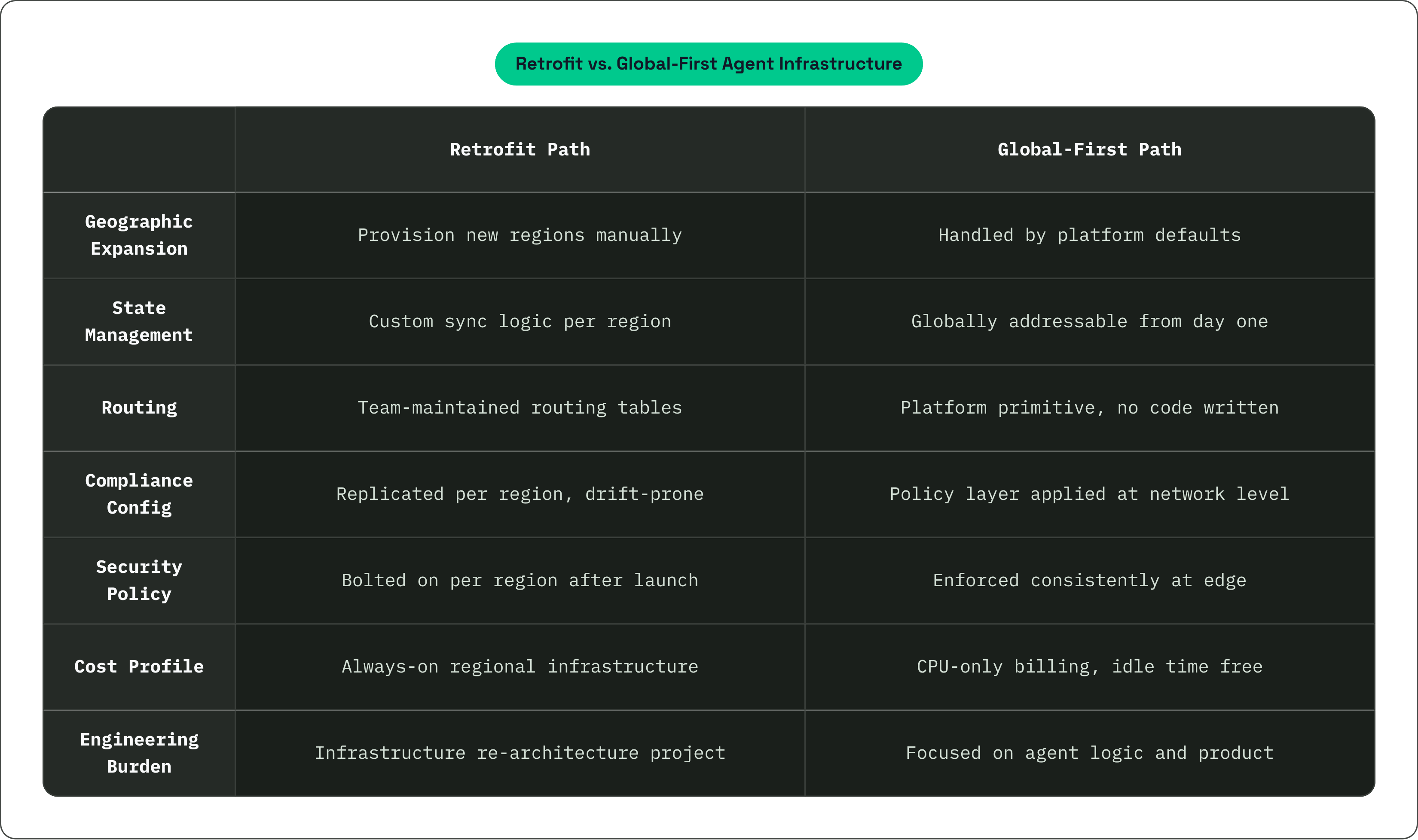
The retrofit path follows a predictable sequence. A team with a working single-region agent that needs to go global must identify which users need lower latency and in which regions; provision infrastructure in new regions; write or adopt state synchronization between those regions and the primary; update routing logic to direct users to the right regional endpoint; replicate compliance configurations, audit logging, and security policies per region; and then maintain divergent deployment pipelines as each region accumulates local configuration drift. It is the kind of project that takes longer than estimated and produces more infrastructure than intended.
Gartner projected in 2024 that more than 40% of agentic AI initiatives will be canceled by 2027, with escalating costs and unclear value as the primary drivers. (Gartner, "Predicts 2025: Agents and AI Will Change How Enterprises Work," 2024.) Regional re-architecture is a reliable cost escalator, and it tends to arrive precisely when the product is showing enough traction to demand attention elsewhere.
The global-first posture is structurally different. Agent logic is written once. Infrastructure handles geographic distribution. State is globally addressable from day one. Global reach is present at launch rather than deferred to a phase-two roadmap that competes with every other priority on the backlog.
This is not an argument for over-engineering early. It is an argument for choosing infrastructure whose defaults match the eventual requirements, so the team never has to call a meeting to discuss a re-architecture project the platform already solved. Every startup I know that treated geographic scale as an infrastructure property rather than an engineering project they would get to eventually reached production faster and stayed there longer. The ones that deferred it generally did not get to it on their own terms.