Eliminating DevOps Overhead for Startups on Serverless Infrastructure
Serverless eliminates infrastructure overhead startups can't afford to hire for.
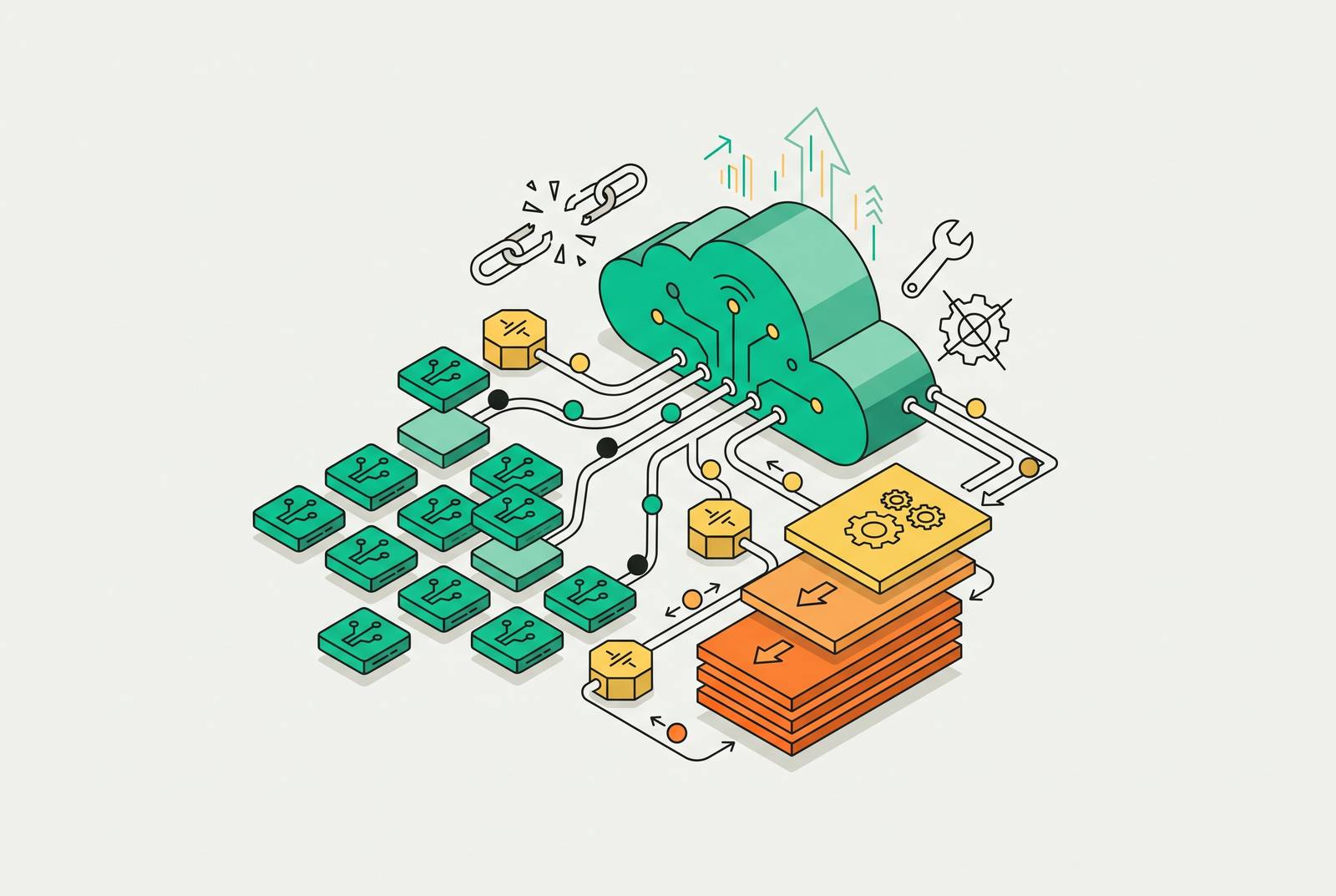
The startup engineering paradox is well-documented, even if rarely acknowledged at the offer letter stage: you hire engineers to build product, and they spend a meaningful fraction of their week keeping the lights on. Server provisioning before you have traffic to plan from. OS patching on a cadence no one owns. On-call rotations for infrastructure that sits idle most of the time. Autoscaling groups configured by intuition and revised after every traffic spike. Deployment pipelines built in-house because the default tooling almost served the team's specific requirements, but not quite.
Serverless infrastructure removes provisioning, OS patching, on-call rotations for idle servers, and in-house deployment pipeline maintenance entirely rather than simply reducing them. The cloud provider owns every one of those operational layers, so a startup's engineers never touch them. Because billing tracks actual invocations rather than reserved capacity, the cost structure also fits unpredictable or near-zero traffic without the penalty a provisioned server charges regardless of load. The net result is that the work a dedicated platform engineer would otherwise handle simply does not exist to be assigned.
The cost structure compounds the problem. Traditional provisioned infrastructure charges for capacity whether or not it is used, which is a direct mismatch for startups with unpredictable, bursty, or essentially nonexistent traffic. The conventional fix is hiring a dedicated platform or infrastructure engineer, a role most companies cannot justify until the problem is already visibly slowing them down.
Serverless's contribution here is not incremental improvement. It is categorical removal. "Reduced burden" and "gone by default" are not synonyms — a server you never provision is like a fire you never have to put out.
What DevOps Work Does Serverless Remove for Early-Stage Startups?
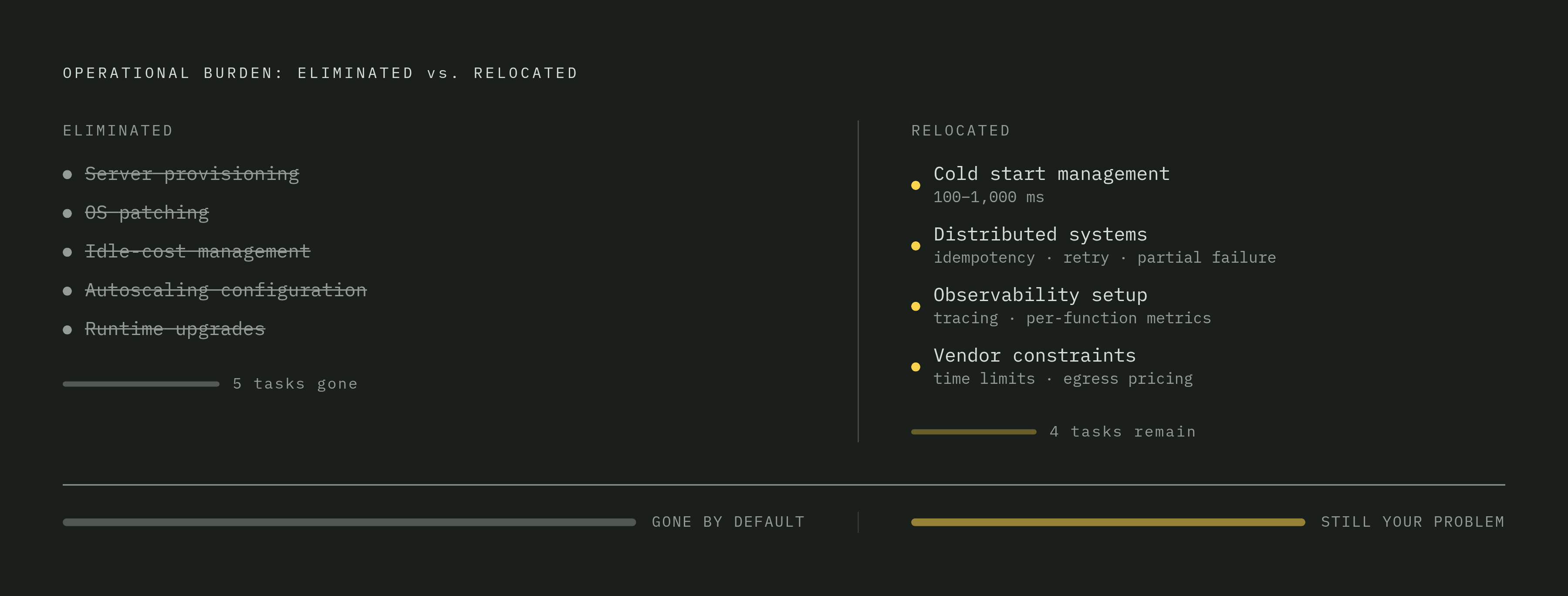
Server provisioning stops entirely. No instances to size, no machine images to maintain, no capacity reservations to negotiate six months in advance. The execution environment is owned and operated by the platform; the team never sees it, which means the team never patches it. OS updates, runtime upgrades, and dependency vulnerability management at the infrastructure layer become someone else's operational obligation by contractual default.
Idle-cost management follows the same logic. Pay-per-execution billing means a function that is not called costs nothing. No reserved instance arithmetic, no warm standby spend, no engineering time allocated to right-sizing what you are paying for. The billing model aligns to actual usage rather than anticipated peak, which matters acutely during pre-product-market-fit stages when "anticipated peak" is largely speculative anyway.
Autoscaling configuration disappears in the same stroke. Scale-to-zero and scale-to-demand are platform behaviors, not tunable parameters requiring engineering judgment. These are not small wins dressed up as large ones. They represent the elimination of multiple job descriptions' worth of operational responsibility.
Adoption here is broadly mainstream. Datadog's 2025 State of Containers and Serverless reports serverless adoption at 65% of AWS customers and 70% of GCP customers. Startups adopting serverless are joining a pattern already validated at scale by enterprises with considerably more to lose from a wrong infrastructure bet.
The Complexity That Doesn't Disappear: It Just Moves
Some things survive the transition, and teams that go in assuming zero complexity end up surprised by the wrong things at the worst times.
Cold starts are the most discussed. When a function has not been invoked recently, initialization latency precedes execution. Lambda cold starts run in the range of 100 to 1,000 milliseconds in documented benchmarks, which is inconsequential for background jobs and genuinely problematic for latency-sensitive, user-facing paths. Workarounds exist, including scheduled warm-up pings and choosing runtimes with lower initialization overhead, but none are free; they reintroduce a modest amount of the operational complexity serverless was supposed to eliminate.
Distributed systems complexity is the less-discussed survivor. Functions that appear simple in isolation become coordination problems at scale — like tributaries that look calm on their own but converge into something turbulent. State management, idempotency, retry logic, and partial failure handling all land on the application developer. The platform removed the server; it did not remove the distributed systems literature.
Observability changes shape rather than simplifying. Centralized server logs are gone. Distributed tracing, per-function metrics, and cost attribution across a sprawling function inventory require deliberate tooling decisions. Tractable for a small team, but not zero work.
Vendor constraints are worth cataloguing early. Execution time limits, memory ceilings, and network egress pricing vary by platform, and architectural decisions made during a fast-moving early stage can become expensive to reverse. Function sprawl, the gradual accumulation of many small functions without a clear organizational strategy, creates its own maintenance burden as the codebase matures.
The categories that vanish are operationally heavier than the categories that relocate. But teams that think clearly about the residual complexity before it surfaces will sleep better than teams that find it at two in the morning.
How Edge-Native Execution Changes the Cold Start and Latency Calculus
The cold start problem has two distinct causes that are frequently conflated. The first is container initialization overhead: the platform must spin up an execution environment before running the function. The second is geographic routing latency: even a perfectly warm function running on distant infrastructure incurs transit time that no amount of code optimization can overcome.
These are separate problems with separate solutions, and conflating them produces architectural decisions that solve the wrong one.
Platforms that run code in V8 isolates rather than containers eliminate the initialization problem at the architecture level. Isolates start in under a millisecond; the initialization penalty is not reduced by tuning, it is removed by changing the execution model entirely. This matters for user-facing paths where cold start variance was the primary argument against serverless.
The routing problem requires a different intervention: executing code geographically close to the user. A user in Singapore connecting to infrastructure in US East encounters over 200 milliseconds of round-trip latency before application code runs. No function-level optimization addresses a routing problem. Running code at hundreds of global edge locations means the execution environment is close to the user by default, which collapses the architectural complexity of multi-region deployment into a platform property rather than a project the team has to own.
For startups, the implication is significant. Global low-latency delivery previously required deliberate multi-region architecture, complex CDN configuration, and ongoing maintenance. On edge-native platforms, it is a default.
Edge and regional serverless are complementary, not competing approaches. Edge handles latency-sensitive, globally distributed request paths; regional serverless handles compute-intensive tasks, complex business logic, and integrations with managed data services. The decision between them should be driven by the workload's characteristics, not by which marketing narrative sounds more appealing.
What Durable Execution Means for Workflows a Startup Actually Needs to Run
Functions are stateless and short-lived by design, which is precisely what makes them tractable to operate. It is also what makes them insufficient for a category of work most startups encounter almost immediately: multi-step processes that span time, wait for external events, or need to resume cleanly after failure.
Traditional workarounds for this gap include message queues, databases used as state stores, and cron-triggered polling. Each reintroduces operational overhead that serverless was meant to remove. The queue needs to be provisioned and monitored. The database-as-state-store needs schema discipline and cleanup logic. The poller needs its own failure handling. The team has, in effect, built a small orchestration layer out of components that were not designed for the purpose.
Durable execution resolves this directly. Each workflow step is independently retryable and replay-safe; failure resumes from the last successful checkpoint rather than restarting the entire job. The implementation details vary by platform, but the operational outcome is consistent: the team does not need to build or maintain a custom orchestration layer.
What This Unlocks in Practice
Multi-step asynchronous processes, including user onboarding sequences, invoice processing pipelines, and data transformation stages, become expressible as code without the scaffolding. Human-in-the-loop gates are tractable: a workflow can pause waiting for an external approval, then resume when it arrives, with no compute cost during the wait. Long-running jobs are no longer constrained by function execution time limits, which removes a ceiling that basic function-based approaches simply cannot clear.
The overhead-elimination angle is concrete. Durable execution removes the need to build and operate a separate job queue, a retry framework, and a state persistence layer. Those are three infrastructure components a startup would otherwise own, maintain, and debug at the worst possible times.
Deploying and Scaling Without a Dedicated Infrastructure Engineer
The staffing constraint is the actual context in which all of this plays out. Most startups cannot hire a platform or site reliability engineer until well past initial scale. Any infrastructure model that requires one is a liability that compounds quietly until it becomes acute.
On a well-chosen serverless platform, a small team realistically owns three things: application code and business logic; deployment configuration, typically a single file or CLI invocation; and observability setup. The last item does not disappear, but it is tractable for one engineer to own part-time without consuming their capacity.
The platform owns the execution environment, scaling behavior, patching, global distribution, uptime guarantees, and baseline DDoS protection. These are infrastructure concerns that would otherwise require dedicated headcount, managed service contracts, and ongoing operational attention.
Git-based deployment workflows and integration with standard CI tooling mean the deployment surface uses instruments engineers already know. No proprietary abstraction to learn before shipping. Time-to-first-deploy on mature serverless platforms is measured in minutes, not days.
The burn rate implication is direct. Pay-per-execution with no charge for idle time reduces infrastructure spend during low-traffic periods in a way that provisioned infrastructure structurally cannot match. Cloud spend aligns to actual usage rather than anticipated peak, which matters when the gap between the two is large and the runway is finite.
What to Look for in a Platform That Makes the Elimination Stick Long-Term
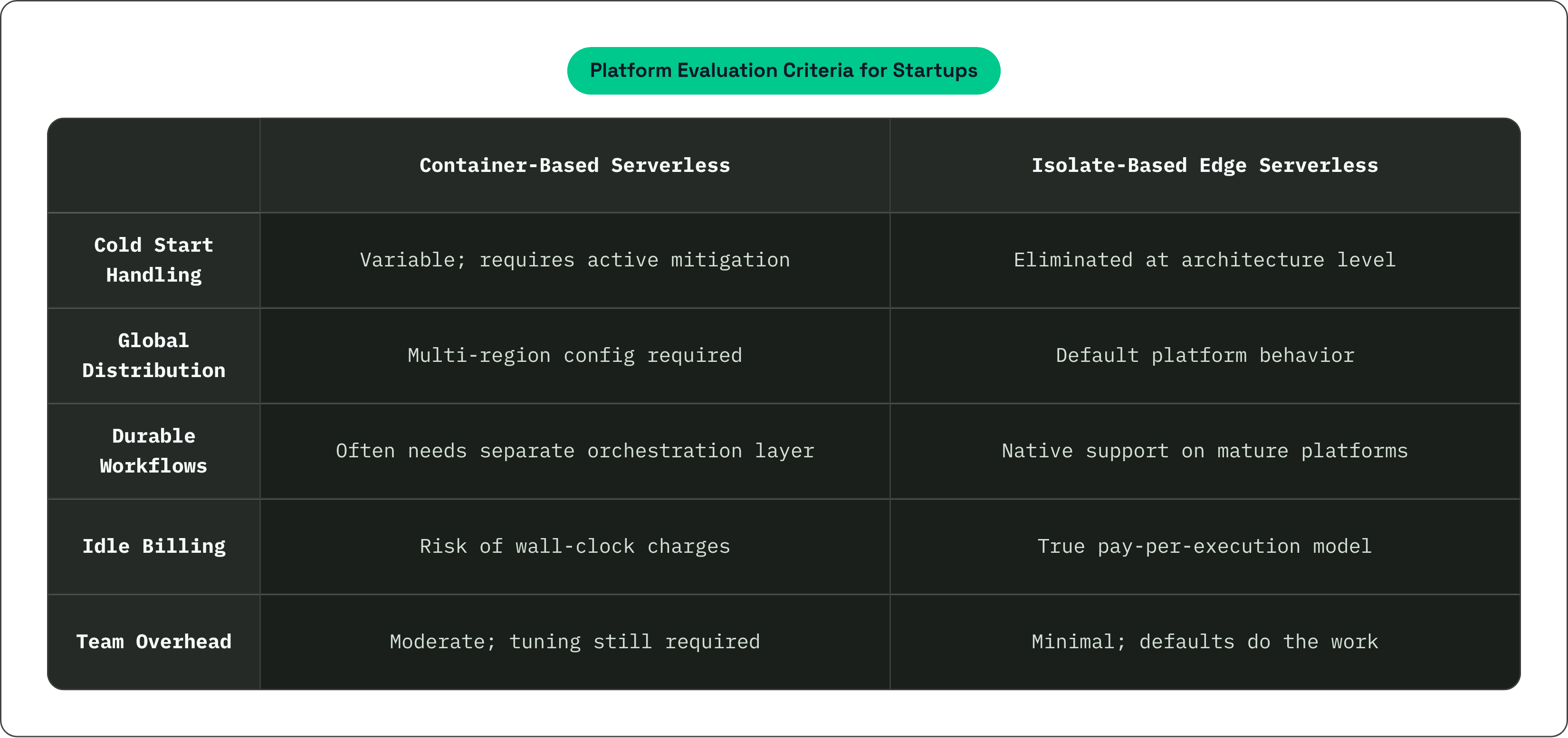
The platform choice determines how much residual complexity lands on the team. Not all serverless platforms eliminate the same things, and the defaults that hold at 100 requests per day must hold at 10 million without requiring a re-architecture the team did not budget for.
Cold start architecture. Container-based platforms produce cold starts that are real, variable, and require active management. Isolate-based platforms eliminate initialization latency at the architecture level. This is a structural difference, not a configuration difference, and it determines whether cold start management is a team responsibility or a solved problem.
Global distribution by default. Low-latency delivery to international users should be a platform default, not a multi-region configuration project. If achieving acceptable latency for users outside the primary region requires engineering work, that work will either happen on deadline or not happen at all.
Billing model honesty. Pay-per-execution should hold for workflows and scheduled jobs, not just simple functions. Platforms that bill for idle time or wall-clock wait during durable workflow pauses negate one of the model's primary advantages for startups.
Durable workflow support. The platform should handle multi-step, stateful processes natively. If the team needs to build and operate a separate orchestration layer, they have inherited infrastructure ownership through a different door.
Observability surface. Per-function logs, traces, and cost attribution should be available without a mandatory third-party integration as a prerequisite. Catching runaway spend early is an operational necessity, not a premium feature.
Lock-in surface. Deployment models that rely on proprietary CLIs, frameworks, or abstractions make migration expensive later. Standard tooling, Git-native workflows, and integration with existing CI pipelines indicate a platform designed for portability rather than retention through friction.
Security defaults. DDoS protection, WAF coverage, and bot management should be present at the pricing tiers a startup can actually afford. Security features gated behind enterprise plans are functionally unavailable to most early-stage companies.
The goal is not a platform with the longest feature list. It is a platform where the defaults actually eliminate what they claim to eliminate, so the team is not quietly rebuilding the infrastructure burden it thought it had left behind.