Infrastructure-as-Code for Global Edge Network Configuration
How codifying network config in version control replaces manual edge deployments.
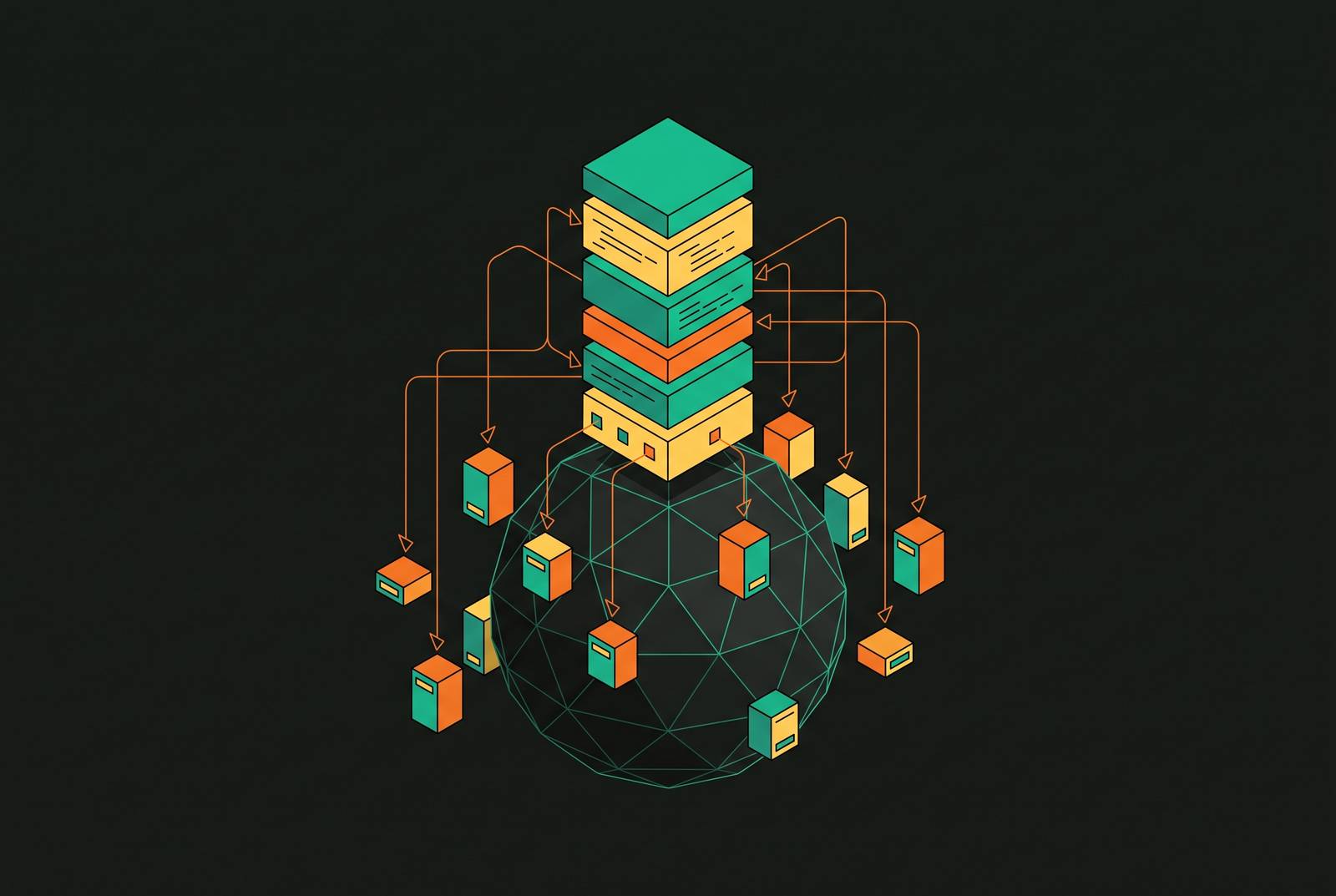
Edge networks used to mean a few dozen data centers and a punch list of manual changes. Now they mean hundreds of points of presence spread across cities, industrial parks, and mobile network edges, and nobody's SSHing into all of them by hand anymore, or at least nobody who wants to keep their job. Infrastructure-as-Code turns that sprawl into something version-controlled and repeatable: config lives in a file, the file lives in a repo, and a tool applies it the same way every time instead of an operator promising to apply it "the same way every time." This piece walks through what that looks like for edge network config specifically, where it splits from the cloud IaC playbook most teams already know, and what breaks if you skip the parts that are boring but load-bearing.
What IaC actually means when applied to network and edge configuration
The cloud version of IaC is familiar to most people reading this: you declare the state you want, a tool checks reality against that declaration, and every change gets tracked in version control instead of tribal memory. Network-as-Code is the same idea aimed at a narrower target. Instead of compute, storage, and networking as one big bucket, NaC applies the declarative model specifically to router config, routing policy, firewall rules, DNS records, and TLS certificates: the stuff a network team actually touches day to day.
At the edge, that distinction mostly collapses. A PoP's "infrastructure" is overwhelmingly its network configuration; there's not much compute sitting there that isn't in service of routing, caching, or filtering traffic. So when edge teams talk about IaC, they're really talking about codifying DNS zones and record sets, load balancing and traffic steering rules, WAF rulesets and rate limits, TLS termination and certificate lifecycle, cache behavior and TTLs per origin, access control and Zero Trust policy, and in some cases anycast routing and BGP policy.
One thing ties all of that together: every one of those objects lives in a file, in a repo, with a commit history. Not in a UI. Not in an admin's memory of "oh yeah, I bumped that rate limit last March because the checkout API was getting hammered." That shift is what unlocks peer review for network changes, CI/CD pipelines that check config before anything gets applied, rollback to any prior known-good state, and audit trails that hold up when a compliance team asks who changed what and why.
Where the main IaC tools stand for edge network use cases in 2025
The tooling market is mature enough now to have real opinions attached to it, not just early-adopter enthusiasm. Terraform remains the default starting point for most teams, largely because of its provider ecosystem: thousands of providers exist, and network and edge vendors tend to publish first-party ones, so Terraform is often the path of least resistance rather than a deliberate choice.
That said, the ground under Terraform shifted. The 2023 license change to BSL forced a lot of teams that had planned around the open-source version indefinitely to rethink that bet. OpenTofu, a CNCF-backed fork, showed up in direct response and is now a legitimate option for teams that need a fully open license and don't want to negotiate that requirement away.
Pulumi sits as the general-purpose alternative for teams that would rather write config in a real programming language than in HCL. It supports Python, TypeScript, Go, and.NET, which matters for teams whose engineers already live in those languages and don't want to learn a domain-specific one just to manage DNS records. Pulumi has also leaned into AI-assisted generation with a feature called Pulumi Neo, letting teams generate config from plain-language descriptions, which lowers the bar for writing edge IaC without deep tooling expertise.
For most teams, though, the practical path is provider-native Terraform integrations, and here's the opinion worth stating plainly: reaching for Pulumi or a general-purpose language before you've outgrown Terraform's provider model is usually solving a problem you don't have yet. Edge platforms that expose full API surfaces for DNS, WAF, load balancing, edge functions, and Zero Trust policy can be managed end-to-end through a single Terraform provider, meaning one plan covers both the compute layer and the network layer instead of splitting the work across two tools and hoping they stay in sync. AI-assisted generation is showing up outside Pulumi too: tools like GitHub Copilot and Cursor can produce reasonably accurate Terraform or OpenTofu config for common edge resources. Generating the config isn't the bottleneck anymore. Checking it before it touches production is.
How edge network IaC differs from cloud IaC in practice
Applying a change to ten cloud regions and applying it to 335-plus PoPs are not the same exercise wearing different clothes. The blast radius of a bad config is wider at the edge, and it takes longer to spread, so the failure mode isn't "one region misbehaves." It's "half your global footprint is running two different rule sets at the same time and you don't know which half yet."
Cloud IaC tends to apply changes in a predictable order. Edge propagation is often asynchronous and only eventually consistent, and IaC tooling has to account for the in-between states that creates: a PoP that's received a new WAF ruleset but not the routing rule it depends on is sitting in a temporarily broken state, and rollout ordering has to be designed around that instead of assumed away.
State management gets messier too. A single Terraform state file designed for one environment turns unwieldy fast across hundreds of edge nodes; teams end up sharding state per region or managing centralized remote state with careful workspace boundaries. Drift detection becomes a continuous job rather than a pre-apply checklist item, because a PoP can drift from its declared state through automatic failover, an emergency manual fix at 2 a.m., or a propagation job that partially failed and nobody noticed.
Idempotency is also just harder at the network layer, and this is where most cloud-trained instincts actively mislead people. Replacing a VM or a storage bucket is low-stakes; replacing a BGP route or a firewall rule can carry ordering dependencies and stateful side effects that make "destroy and recreate" a genuinely bad idea, sometimes a routing black hole rather than a clean swap. Good edge IaC draws a hard line between additive changes that are safe to roll out broadly and stateful, ordering-sensitive changes that need staged rollout and somebody watching. On top of that, edge platforms don't expose uniform APIs: some resources are fully declarative, others need imperative sequences, and the provider abstraction has to paper over the gap, which it does imperfectly. Certificates and secrets add one more wrinkle, since TLS certs, API keys, and origin credentials all have to reach every PoP, and rotation needs to be a first-class operation handled through something like Vault or a cloud KMS, not a manual task someone remembers to do before the cert expires.
Rollout patterns for pushing config changes across hundreds of PoPs safely
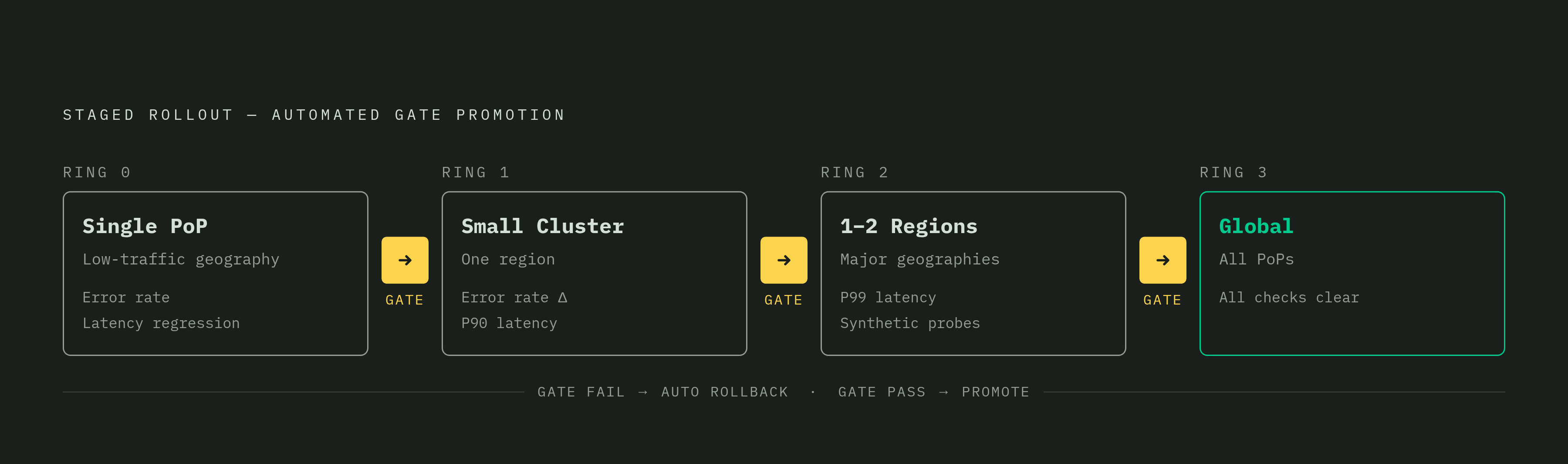
The core rule here is simple: never treat a global edge network as a single apply target. A change that reaches every PoP at once with no check in between isn't a deployment, it's an outage with a deploy log attached.
Ring-based rollout is the standard answer, and skipping it to "move faster" is how a routing tweak becomes a global incident by lunch. Ring 0 is a single PoP in a low-traffic geography, where the change gets applied and watched closely for error rates and latency regression. Ring 1 expands to a small cluster covering one region. Ring 2 covers one or two major geographies. Ring 3 is global, and it only gets reached after automated health checks clear at every prior ring. In Terraform terms, this usually means the same module runs at every ring, set up differently through variable sets or workspaces, rather than maintaining separate codebases per stage.
Between rings, automated gates decide whether promotion happens at all: error rate delta against a pre-change baseline, P90 and P99 latency at the edge compared to origin, and synthetic probe pass rates from outside the PoP. These live in the CI/CD pipeline itself, and a failed gate halts promotion and kicks off rollback without waiting for a human to notice something's wrong.
Blue/green deployment works at the edge too: keep two config versions live on a PoP fleet and shift traffic between them via DNS or load balancer weight, which gives a clean rollback path that doesn't touch the active config at all. Newer edge platforms also support shadow or monitor modes for config objects, letting a WAF rule log without blocking or a rate limit alert without dropping traffic, which separates deployment from enforcement and cuts rollout risk considerably.
Rollback needs to be a first-class operation, not an emergency improvisation. With config in version control, rollback is technically a git revert and an apply, but at edge scale that still has to propagate through the rings, so a bad change doesn't vanish instantly just because someone reverted it. Runbooks should specify a rollback SLO, something like "full global rollback within N minutes," and that SLO should get tested in drills, not discovered for the first time during an actual incident. Treat every checked config snapshot as an artifact you don't touch again: tag it, store it, never edit it in place. It's the same discipline container images get, applied to network config instead.
Integrating edge network IaC into a CI/CD pipeline end-to-end
The pipeline shape is fairly consistent across teams doing this well. A PR gets opened, automated lint and checks run against it (terraform validate, tflint, custom policy checks), and a plan gets generated and posted directly to the PR so the reviewer sees exactly what's changing and at which PoPs before approving anything. Merging to main triggers an automatic apply to Ring 0, and promotion through the rest of the rings only happens as gate checks pass.
Policy-as-code is what makes this safe to open up to more than the network team, and it's the piece teams cut first when they're in a hurry, which is backwards. Tools like Open Policy Agent or Sentinel enforce organizational rules before any apply goes through: no change may disable TLS, WAF rule changes require two reviewers, rate limit thresholds can't drop below a defined floor. That's the governance layer that lets developers open PRs for edge config without needing deep infrastructure expertise, because policy catches the dangerous stuff automatically instead of relying on a reviewer to catch it by hand.
Secrets never belong in the repo. The pipeline should pull credentials from Vault or a cloud KMS at apply time and inject them into the provider config, and that applies equally to API tokens for the edge platform, origin credentials, and certificate private keys. Every successful apply should also post a deployment event to whatever observability platform the team uses, so tying a WAF change to a latency spike becomes a query against a dashboard instead of a multi-day postmortem trying to reconstruct what shipped when.
Branching strategy matters more than people expect. Long-lived environment branches for staging and production, paired with short-lived feature branches for individual config changes, tend to hold up better at scale than anything more elaborate, and trunk-based development with feature flags is generally the better model once the PoP count gets large. Golden path templates for common patterns (a new origin, a new WAF ruleset, a new DNS zone) let application teams provision edge resources through self-service without writing raw Terraform themselves, which is the same idea behind the large deployment-time drops companies like Unity, Snowflake, and Starburst have reported after adopting programming-language-based IaC approaches.
Applying Zero Trust policy at the edge through IaC
Zero Trust Network Access is steadily replacing VPNs for remote access, and that shift moves policy enforcement out of a central perimeter appliance and onto the edge PoPs themselves. That's a real change in where "who can reach what" actually gets decided, and it means edge IaC now has to cover identity and access policy, not just DNS and WAF rules.
According to Okta's State of Zero Trust Security report, 61% of organizations worldwide have already launched a Zero Trust initiative. Most of them are still managing those policies by clicking through admin consoles, which is a strange place to land given how much Zero Trust claims to care about auditability and least privilege. That's the part worth saying plainly: a policy nobody can diff against last month's policy isn't audited, it's just recent, and teams that treat a UI toggle as equivalent to a version-controlled file are fooling themselves about what they can actually prove during an incident review.
Zero Trust policy-as-code at the edge means declaring access policies (which users or groups reach which applications) as Terraform resources, keeping identity provider connector config in version control, defining device posture requirements as config objects instead of UI toggles, and managing gateway policies like DNS filtering and HTTP inspection alongside WAF rules and routing config, in the same repo, under the same review process.
IBM's 2025 Cost of a Data Breach Report found that organizations that have deployed Zero Trust architecture save an average of $1.76 million per breach compared to peers without one. Version-controlled policy is a real part of what makes that maturity demonstrable to an auditor rather than just claimed in a slide deck. The drift problem is especially sharp here: a "temporary" access exception applied manually and never revoked is exactly the kind of thing that sits quietly for eighteen months until someone finds it in an incident review. Automated drift detection closes that gap by treating every unauthorized exception as a bug, not a footnote. And the frontier keeps moving. Identity-centric access control over AI models and agents is shaping up to be the fastest-growing Zero Trust use case heading into 2026, which means the same IaC discipline built for human access policy is about to get applied to machines that never asked for permission in the first place.