Multi-Cloud Vendor Lock-In Risk Assessment for Platform Teams
Platform teams must inventory cloud dependencies to measure and reduce vendor lock-in risk.

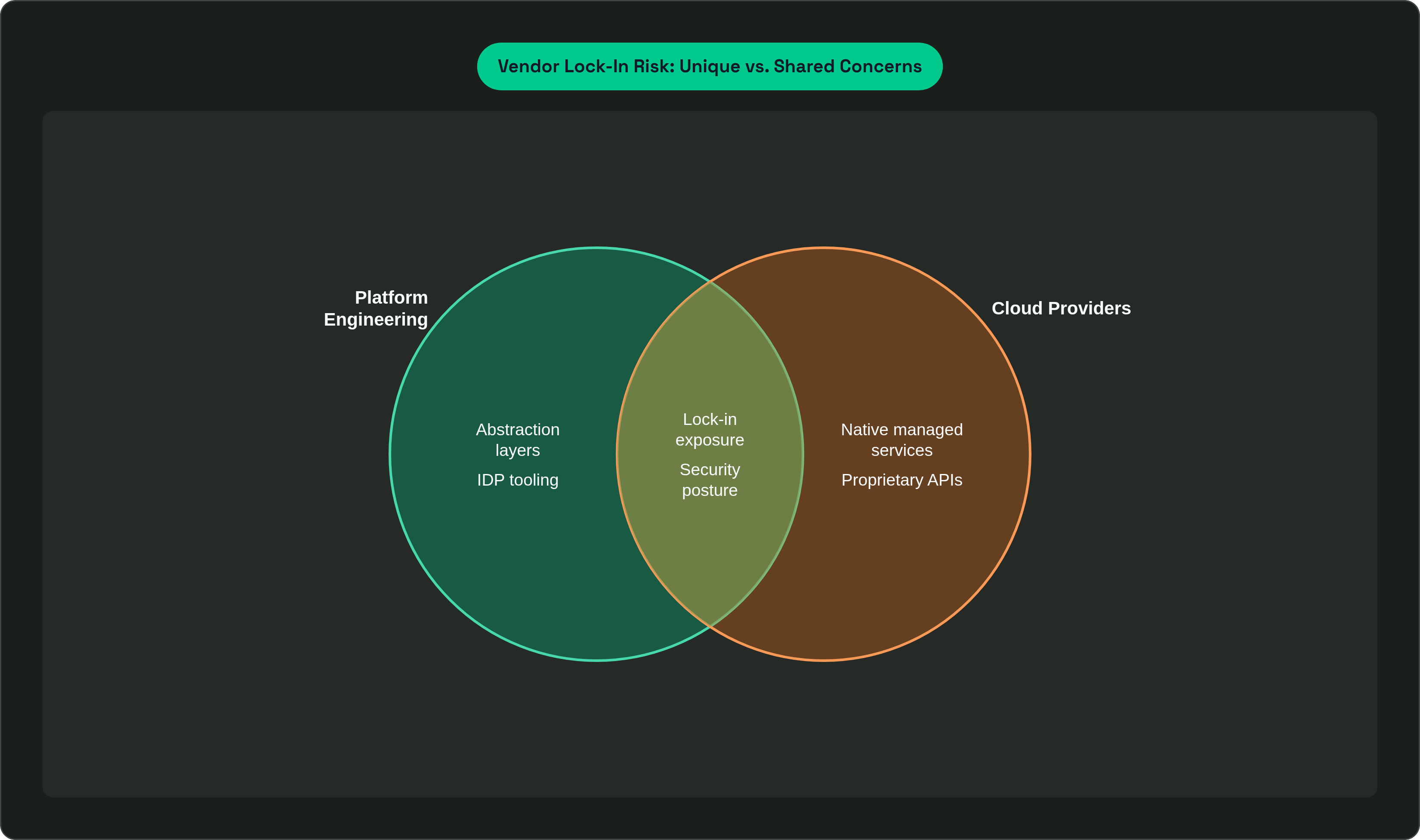
Platform engineering teams are not DevOps with a rebrand. Their explicit mandate is to build abstraction layers that insulate application teams from direct dependency on cloud provider primitives, which makes them the only credible owner of a lock-in risk assessment. No other function has the structural visibility and the cross-cutting authority to do this work at the right level of resolution.
Vendor lock-in doesn't arrive as a single catastrophic decision. It accumulates quietly, one rational choice at a time, until the organization discovers its exit costs have outgrown its migration budget. The mechanism mirrors technical debt almost exactly: the architecture stays internally coherent while the cost of leaving rises invisibly in the background, like a bill accumulating interest in a drawer no one opens. A 2025 survey cited by Techopedia found that 89% of IT leaders believe organizations shouldn't rely on a single cloud provider, yet 45% say lock-in has already constrained their ability to adopt more flexible strategies. Same problem, opposite ends.
A mature platform team's scope already covers the territory where lock-in compounds: internal developer platform tooling and standards, policy-as-code infrastructure enforced consistently across providers, identity integration and access baselines, and network and storage standards decoupled from provider-native constructs. These aren't incidental concerns. They are precisely the dimensions along which dependency accumulates.
The governance mechanism that makes this operational is a Cloud Center of Excellence, which consolidates security, finance, and engineering stakeholders around shared policy. Without it, each team optimizes locally, and every local optimization that reaches for a native service adds another strand to the dependency web. Only about a quarter of businesses report confidence in managing multi-cloud complexity. A CCoE addresses this directly by centralizing decisions that would otherwise be made inconsistently across dozens of teams, each one perfectly reasonable in isolation, collectively expensive in aggregate.
What to Inventory Before You Can Score Anything
A risk assessment without a current-state inventory produces scores that reflect what teams believe they depend on. What they actually depend on is usually more extensive, more deeply coupled, and considerably more expensive to unwind. The delta between perceived and actual dependency depth is where assessments go wrong, and it surfaces in architecture reviews with remarkable consistency.
Here's one that will sound familiar to anyone who has run these reviews: an engineer leans forward, completely confident, and says "we could migrate that in a sprint." They mean it sincerely. They are wrong. The service has seven downstream dependents, two of which nobody documented, and one of which was wired directly to a provider-native event bus eighteen months ago by someone who has since left the company.
The audit covers every service in use across every provider, along five practical dimensions.
Service type: compute, storage, database, networking, AI and ML, observability, and security. Abstraction level: is the service accessed through a proprietary API, an open standard, or a vendor-neutral abstraction layer? That single distinction predicts portability more reliably than any other dimension. Data residency: where does data live, and what would it cost to move it? Egress fees can account for up to 45% of a project's total cloud expenses, which makes this a financial question before it's an architectural one. Integration depth: how many other services or pipelines depend on this one? A service with ten downstream dependents carries dramatically more lock-in risk than an equivalent service sitting at the edge of the dependency graph. Contractual position: active reserved instances, enterprise discount tiers, and committed use agreements with exit penalties are financial lock-in mechanisms that appear nowhere in any architecture diagram.
The output is a dependency map showing not just which services are in use but how deeply each couples to provider-specific behavior. A parallel workload categorization exercise, sorting by risk tolerance, performance requirements, and migration complexity, prevents the team from treating every dependency as equally urgent. Not all of them are.
One operational note worth stating plainly: the inventory phase should consolidate visibility, not justify procuring another dashboard. Dashboard sprawl is, reliably, where this kind of work bogs down.
A Scoring Model for Lock-In Exposure Across Dependency Types
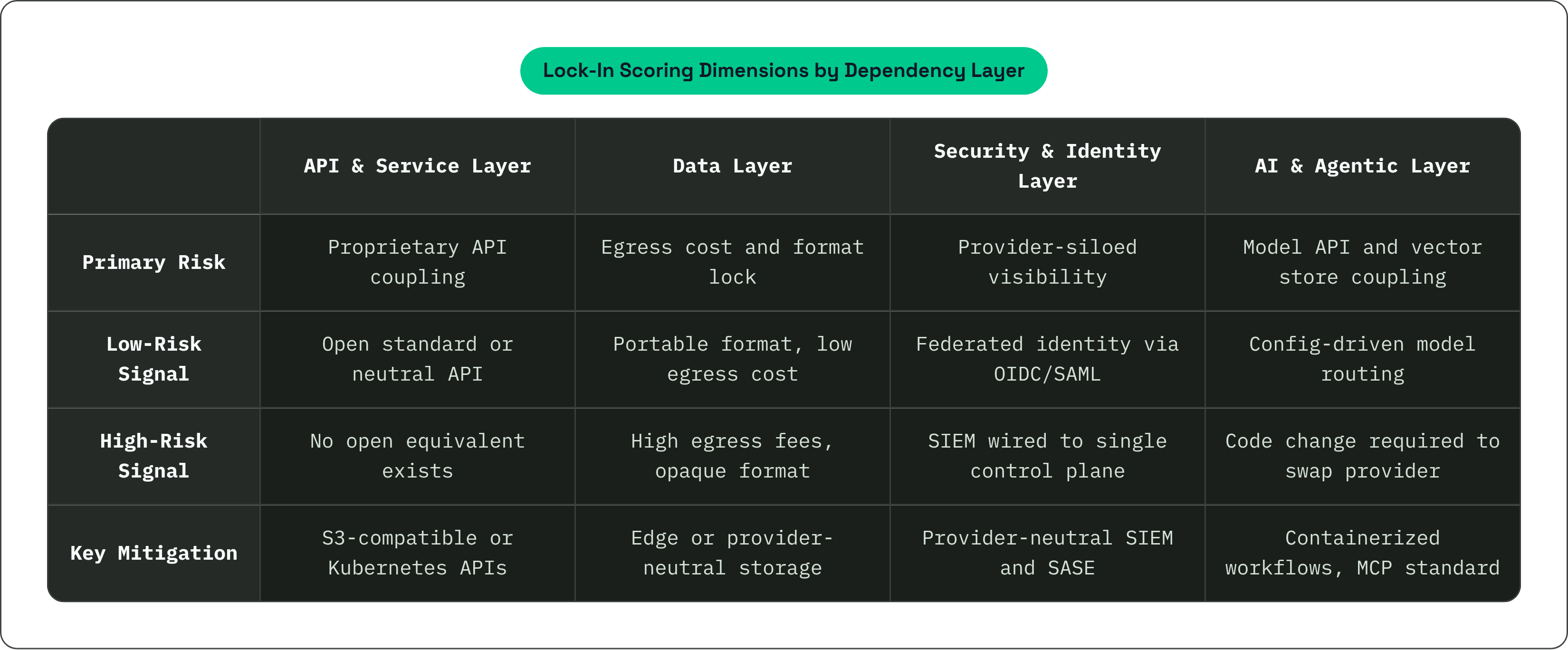
The goal is a number that reflects both the severity of lock-in and the realistic cost of remediation for each dependency. Two axes apply to every entry: portability, meaning how easily the service can be replaced or replicated elsewhere, and impact, meaning what breaks or becomes unavailable if this dependency must migrate.
API and Service Layer
Services accessed via open standards carry low portability risk. S3-compatible object storage, POSIX-compatible file systems, and Kubernetes APIs are interoperable enough that the provider is largely substitutable. Services with no open equivalent sit at the other end: proprietary serverless workflow engines, managed ML pipelines tied to a single provider's SDK, native vector databases without export-compatible formats.
The practical assessment question is whether a competent team could replace the service in under a sprint or under a quarter. Those are different answers, and the difference usually becomes apparent during the scoring conversation in ways that are uncomfortable but useful. Teams tend to discover their most entangled dependencies at exactly this moment.
Data Layer
Score based on data volume, egress cost per gigabyte quantified at actual provider rates, and whether the data format is portable. Egress costs function as a hidden multiplier that transforms a medium-severity architectural dependency into a high-severity financial one — the architectural equivalent of finding out the couch you want to move won't fit through the door, except the door charges you by the gigabyte. Quantify this before scoring, not after.
Security and Identity Layer
This is where teams most consistently underestimate their exposure, and where the underestimation carries the worst downstream consequences. IAM policies, cloud security posture management tooling, and SIEM integrations wired exclusively to one provider's control plane score as high-risk dependencies. Identity federation through OIDC or SAML, which works across providers by design, scores significantly lower.
The risk compounds in a specific way: a multi-cloud organization relying on fragmented, provider-siloed security tooling ends up with a posture that is invisible across its full estate, creating exploitable gaps at exactly the seams between providers. It is a threat visibility problem wearing a vendor lock-in costume.
Billing and Commitment Layer
Score active reserved capacity and committed use against remaining term length and exit penalty. Per-provider discount tiers that reward consolidation deserve particular scrutiny: they are deliberate retention mechanics, engineered to make neutrality expensive. Naming that explicitly in the heat map is useful, because finance stakeholders often don't register these as architectural constraints until someone puts them in a risk register.
The aggregate output is a heat map by service and by provider showing where total lock-in exposure concentrates. The output is not pass/fail. It is a prioritized list of dependencies to address, neutralize, or consciously accept, with documented rationale for each.
Security Tooling Fragmentation as a Distinct Lock-In Risk
Security tooling is almost always the last thing teams think to abstract, and reliably the hardest to migrate when circumstances force the issue.
Each major provider offers native CSPM, logging, threat detection, and policy enforcement that integrates tightly with its own control plane. Adopting these natively is fast and frictionless, which is exactly why teams do it. The resulting security posture is invisible across providers without a separate aggregation layer, leaving platform teams operating multiple consoles with no unified view of cross-cloud exposure. The majority of businesses have experienced at least one cloud security breach; cloud misconfiguration remains the leading cause, and fragmented visibility across provider-siloed tools is a direct contributing factor. The shortcut is also the liability.
The assessment for this layer covers four questions. Is identity and access management federated through an identity provider independent of any single cloud? Is network security policy, including firewall rules, WAF configuration, and DDoS protection, portable or locked to provider-native services? Does security telemetry flow into a provider-neutral SIEM or into a provider's own logging infrastructure? Are Zero Trust controls, including ZTNA, secure web gateway, and CASB, implemented through a single plane spanning all providers, or through separate, uncoordinated provider tools?
A meaningful share of organizations favor consolidating into a single SASE solution that integrates SSE and SD-WAN, and the primary driver is this exact fragmentation problem. A network-level security layer that operates independently of cloud provider control planes removes the security tooling dependency from the lock-in equation entirely.
How AI and Agentic Workloads Introduce a New Class of Lock-In
AI workloads don't fit neatly into the existing dependency scoring model, and the adoption curve is steep enough that the window for proactive assessment is genuinely narrow. Model APIs, vector stores, embedding pipelines, and orchestration frameworks each carry their own portability risk profile. Gartner projects that by 2026, 40% of enterprise applications will include task-specific AI agents, up from less than 5% in 2025. Platform teams that delay assessing AI dependencies will inherit them at scale under considerably less favorable conditions.
Lock-in accumulates across four vectors in this layer. Model API dependency arises when workloads are written directly against a single provider's model API without a routing or abstraction layer; changing providers then requires code changes rather than configuration changes, which is the clearest possible signal that something has been built wrong. Proprietary vector stores and embedding formats create data portability risk, because data stored in a provider-native vector database may be impossible to move without re-embedding the entire corpus, a non-trivial operation at scale. Orchestration frameworks vary substantially in how tightly they couple to a provider's runtime or authentication model. And MCP server infrastructure, following the Model Context Protocol's move under Linux Foundation governance in late 2025, now has a meaningful open standard to assess against; any proprietary extension to that standard is worth flagging explicitly.
Cost functions as a lock-in signal in this layer in a way it doesn't elsewhere. At per-token pricing levels current in early 2025 for frontier models, workloads that cannot route to cheaper models for simpler subtasks are expensive and implicitly constrained to a single pricing tier simultaneously. That combination is rare and unfortunate.
The mitigation is structural: package agentic workflows, tools, and MCP servers in containers with Kubernetes orchestration. The assessment question is concrete: for each AI dependency, can the workload be directed at a different model or inference provider by changing configuration? If the answer requires a code change, that dependency scores high-risk.
Mitigation Strategies That Actually Reduce Exposure
The failure mode to avoid is replacing one form of complexity with another. Multi-cloud management overhead that is itself a new dependency is not a solution to vendor lock-in. It is a vendor lock-in event with a different vendor.
Mitigation tiers should follow the score. High-portability, low-impact dependencies warrant documentation and monitoring, nothing more. Medium lock-in dependencies are candidates for introducing abstraction at the interface level, a provider-neutral SDK or open API standard, without rewiring the underlying service. High lock-in, high-impact dependencies require active remediation: evaluating open alternatives, introducing a secondary provider for the same capability, or negotiating contractual terms that reduce the exit penalty.
The primary lever across all tiers is open standards. Kubernetes for compute portability. Terraform or OpenTofu for infrastructure-as-code that isn't wired to a provider's native tooling. OIDC and SAML for identity federation independent of any single provider's IAM. S3-compatible object storage APIs for data layer portability. Standard developer tooling across the build and delivery pipeline without proprietary runtime abstractions.
For the data gravity problem specifically, the architectural answer is positioning frequently accessed or high-volume data at the network edge or in provider-neutral storage, reducing both the financial and operational friction of moving workloads. Services accessed through vendor-neutral abstraction layers, whether open standards like S3-compatible storage or platforms that operate across multiple cloud providers, carry significantly lower lock-in risk than those tightly coupled to provider SDKs. Cloudflare, a global internet infrastructure and DDoS-protection provider whose CDN, DNS, and security services run across 330+ data centers independent of any single cloud's control plane, is one concrete example of this kind of provider-neutral network layer.
One validation step that every mitigation plan should include: migrate one non-critical workload to the secondary provider as a live test of the abstraction layer's actual portability. A paper architecture and a working migration are different things. That difference surfaces at the most inconvenient moment possible if left untested, which tends to be during an incident or a contract renegotiation.
Making the Assessment Repeatable Rather Than a One-Time Exercise
A risk assessment conducted once is a snapshot. Lock-in exposure grows continuously as new services are adopted, new AI dependencies are introduced, and committed contracts extend further into the future. The snapshot is stale roughly the moment it's finished.
The highest-leverage structural change is embedding a lock-in review into the service adoption process, scoring any new managed service or AI dependency before adoption rather than after. Rescoring existing dependencies on a regular cadence, quarterly or tied to provider contract renewal cycles, keeps the heat map current. Tracking the heat map over time answers the question that actually matters: is total lock-in exposure increasing, stable, or decreasing?
Governance hooks reinforce this. A CCoE that reviews high-risk new dependencies before adoption creates a checkpoint that individual teams cannot accidentally bypass. Policy-as-code that flags services introducing known high-lock-in patterns, adopting a provider-native managed database with no open-compatible API, for instance, as part of CI/CD pipelines makes the assessment ambient rather than periodic.
The organizational payoff extends beyond risk management. Nearly one in three IT leaders believes half of their cloud spending is wasted. A repeatable lock-in assessment also functions as cost hygiene, surfacing unused committed capacity and redundant tooling that would otherwise stay invisible until budget season, at which point it becomes someone's problem to explain in a room full of people who are not pleased.
Maturity here is the ability to answer, at any point, which dependencies are actively managed risks, which are accepted risks with documented rationale, and which are in remediation. Platform teams manage lock-in the same way they manage reliability or security posture: with rigor, with cadence, and with no illusion that the work is ever finished.