Cold Start Elimination Strategies in Serverless Production Systems
Different language choices and platform models create vastly different cold start costs to fix.

Serverless computing sells a simple deal: pay for compute only while it's running, scale to zero when nobody's asking, no idle servers humming away on the company card. The catch sits inside that same pitch. Scale to zero means the execution environment doesn't exist until someone needs it, and building it from nothing takes time. Fixing one layer while ignoring the rest just moves the bottleneck down the stack. This piece works through each layer in order, matches it to a remedy, and gets into why the fix that works for a Java monolith is the wrong fix entirely for a lightweight Node function.
The stakes aren't theoretical. Traditional container-based serverless platforms take two to five seconds to cold start, longer if the image isn't cached on the host, and that cold start can add meaningful latency before the actual work the function was invoked to do even begins. Every 100ms of added latency costs about 7% in conversion for customer-facing apps, so a slow cold start is a business problem wearing an engineering costume. Then in August 2025, a billing change split out INIT phase costs separately, and for some workloads that pushed cold start costs from $0.80 to $17.80 per million invocations. Cold starts got expensive twice: once in the user's patience, once on the invoice.
The lazy fix is "just keep it warm." Ping the function on a schedule, keep a few instances alive, call it done. That trades latency for a standing compute bill, does nothing about the actual causes, and falls apart the moment traffic gets bursty or unpredictable, which is most of the time serverless gets used in the first place. Each layer of the cold start problem has its own fix. Aim the wrong fix at the wrong layer and it's money spent with no latency gained, or latency left on the table nobody bothered to pick up.
How the platform's execution model determines which layers you actually control
Before optimizing anything, it helps to know what's actually optimizable, and that depends entirely on which execution model the platform runs.
Container and microVM platforms, AWS Lambda, Azure Functions, Google Cloud Functions, expose all four layers of the cold start problem. Provisioning the sandbox is usually the dominant cost here, but because the whole stack is visible, developers get the most levers to pull: runtime choice, dependency trimming, startup logic, pre-warming. It's the most work, but also the most control.
Some edge platforms, including Cloudflare's serverless Workers network, use a technique worth understanding even without naming a vendor: eager pre-loading triggered by the TLS handshake itself. The ClientHello message during the handshake carries the hostname before the actual request arrives, and that signal alone is enough to start loading the isolate, in roughly 5 milliseconds, ahead of the request landing. Cold start, from the user's vantage point, effectively disappears.
WebAssembly platforms swap container provisioning for module instantiation, a fundamentally lighter operation. Two recent upstream Wasmtime updates improved instantiation time by roughly 40%. Q1 2026 measurements on these platforms show P50 cold starts between 4.7 milliseconds (Frankfurt) and 12.6 milliseconds (Johannesburg), with P99 staying under 30 milliseconds across every region tested. That's not an incremental gain over containers, it's a different category of problem.
Kubernetes-based edge nodes sit at the other end. Container initialization overhead typically produces cold starts north of 200 milliseconds, and that cost buys full-system isolation and stateful storage, a trade worth making for some workloads and a bad deal for others.
None of this is a footnote. Picking a runtime model is picking how much of the cold start problem gets solved for you versus how much lands on the engineering team. For teams staying on container-based platforms, Lambda being the practical default, the good news is that runtime initialization, dependency loading, and startup logic are all fully within reach. That's where the rest of this piece lives.
Attacking the runtime initialization layer: language choice and AOT compilation
The JVM has a boot tax, and it's steep. A Spring Boot app on a standard Lambda can burn past three seconds of initialization before the handler even sees its first request.
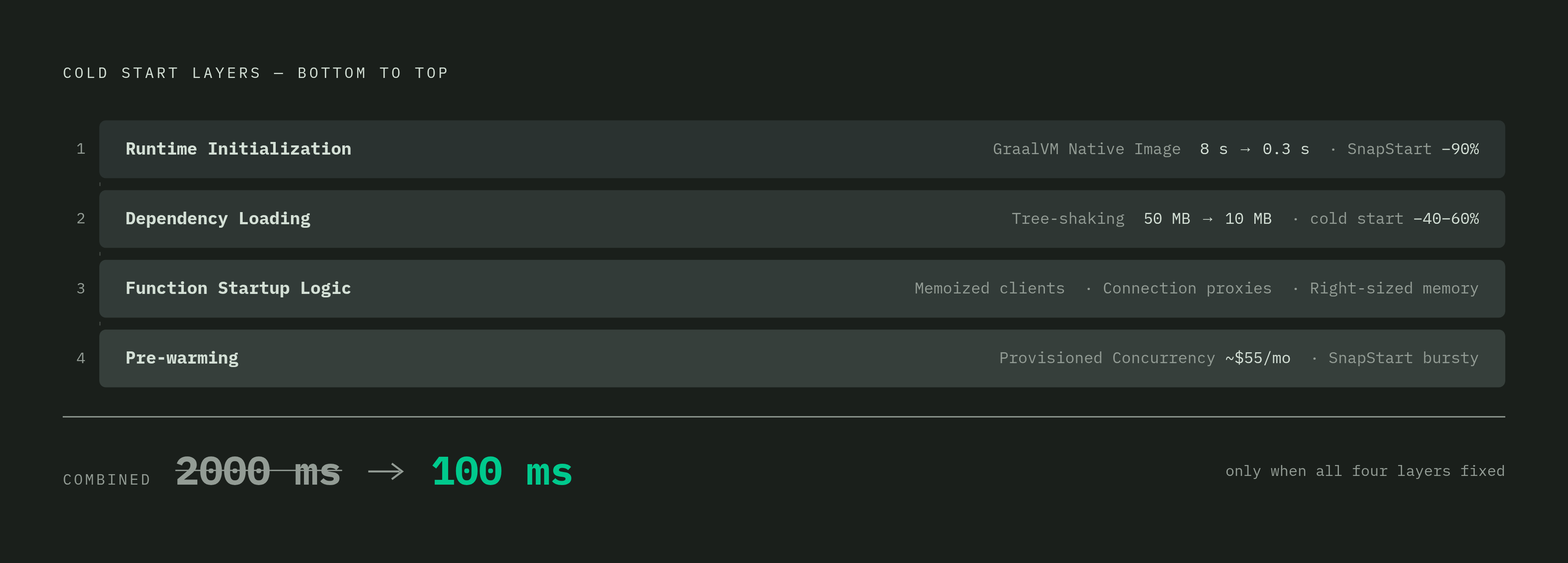
GraalVM Native Image is the most direct answer for Java. It compiles the application to a native binary at build time, so there's no JIT warmup waiting to happen on the first invocation, it's already compiled. Documented results show cold starts dropping from 8 seconds to 0.3 seconds, roughly a 27x improvement. The cost shows up elsewhere: reflection and dynamic class loading need explicit configuration, some frameworks fight the process, and build times get noticeably longer.
AWS Lambda SnapStart takes a different route, and it now covers Java, Python, and.NET. Rather than compiling ahead of time, it initializes the function once at deploy time, takes a snapshot using Coordinated Restore at Checkpoint (CRaC), and restores from that snapshot on every subsequent invocation. AWS's own analysis shows up to 90% cold start reduction. Java support shipped in 2022, Python and.NET followed in late 2024. It comes with real limits though: no Node.js or Ruby support, no compatibility with Provisioned Concurrency, no Amazon EFS, and ephemeral storage capped at 512 MB.
Some wins cost nothing in code changes at all. Switching to ARM64/Graviton2-based Lambda functions shows 13 to 24% faster cold start initialization across every runtime tested. Node.js 20 and Python 3.12 both ship native performance work that trims baseline cold starts by 15 to 20% out of the box.
Choosing between SnapStart and GraalVM comes down to how much pipeline investment is on the table. GraalVM gets the lowest absolute latency but demands a real build-tooling commitment. SnapStart is close to a drop-in for existing Spring Boot applications. And for Go or Node.js workloads, where the JIT tax was never that large to begin with, neither may be worth the engineering hour. Dependency trimming, covered next, tends to return more per hour spent there.
Shrinking the dependency and package layer before the function code ever runs
Everything shipped in the deployment package has to be pulled, verified, and decompressed before a single line of function code runs. Package size isn't a storage concern, it's a latency tax paid on every cold start.
The numbers back this up directly: trimming a deployment package from 50 MB down to 10 MB improves cold starts by 40 to 60%. That's one of the highest-leverage changes available, and it's mostly housekeeping.
The techniques aren't exotic. Tree-shaking and bundling, esbuild or Rollup for Node, stripped binaries for Go, cut out code that never runs. Lazy imports defer the cost of loading heavy modules until the handler actually needs them, instead of paying for every dependency at module load regardless of whether that code path fires. Auditing transitive dependencies and swapping bloated utility libraries for stdlib equivalents removes weight nobody's using. And in.NET and Java particularly, every static variable and static class adds setup cost the moment the container initializes, whether or not the request needs it.
AI and ML workloads push this to the extreme. Bundle a scikit-learn install, pandas, and a vector database client together and it's easy to breach Lambda's 250 MB package limit outright. Model loading during cold start can eat 6 or more seconds on its own, which rules out anything resembling real-time interaction unless the architecture changes. The fix isn't a smaller model, it's separating model hosting from function logic entirely, so loading a model is never something that happens inside the Lambda init path.
Container image deployments raise the ceiling to 10 GB for OCI-compliant images, and lazy loading only pulls the layers needed to start the runtime, streaming the rest in on first read. That reduces the penalty of a large image. It doesn't erase it.
Once the dependency layer is pruned down to what's actually needed, whatever cold start cost remains lives almost entirely in the function's own startup code, which is the next place to look.
Keeping function startup logic from undoing everything else
Database connections, secret fetches, SDK client construction, config parsing: all of it runs before the handler returns its first byte, and all of it is fair game for a rewrite.
The anti-patterns show up constantly. Opening a database socket at module scope means a fresh connection gets established on every new container, not reused across invocations the way it would be on a long-running server. Fetching secrets synchronously in the init path adds a full network round-trip before the handler even starts. Building heavyweight singletons, ORM clients, gRPC stubs, unconditionally at startup means paying that cost even for invocations that never touch that code path.
Connection pooling deserves particular attention because the usual assumptions don't hold. A traditional TCP connection pool is designed for long-running processes, not ephemeral containers, and connection state may not carry over reliably across invocations. The fix is putting the connection state somewhere that survives outside the Lambda execution environment entirely: external connection proxies for relational databases, serverless-compatible drivers, or managed gateways that hold connection state so the function's init cost drops to a lightweight handshake. These proxies hold the connection state so the Lambda function's init cost drops to a lightweight handshake instead of a full connection setup from zero.
Memory allocation is an underused lever here too. On Lambda, memory determines proportional CPU, so an under-provisioned function spends disproportionate time on CPU-bound init work like class loading and JIT compilation, work that would finish in a fraction of the time with more memory assigned.
The general pattern worth adopting: memoize clients and configuration after the first construction, guard the re-use with a null check, and the function pays the init cost exactly once per container lifetime instead of on every invocation. Once startup logic is genuinely lean, the remaining levers aren't in the code anymore, they're platform decisions about whether to pre-warm and how much that's worth paying for.
Provisioned Concurrency and SnapStart as the cost-aware pre-warming layer
Provisioned Concurrency pre-initializes a set number of execution environments and keeps them standing by, ready before the first request ever arrives. It costs $0.0000041667 per GB-second while idle, which works out to roughly $55 a month for a 1 GB function held at 5 provisioned instances, before a single invocation happens. For functions with steady, predictable traffic, that idle cost often beats what repeated cold starts would have added to the billed duration anyway.
It's the right call for user-facing API endpoints where cold start latency lands directly on the user's experience, and where traffic is predictable enough to size the concurrency pool with confidence. It's the wrong call for background jobs, event processors, or anything triggered infrequently: the idle cost accrues whether or not anything ever calls the function.
SnapStart fills the gap for workloads with lumpy, unpredictable traffic. It carries no pre-provisioned instance cost, since there are no standing warm environments to maintain. An app with business-hours-only usage or the occasional marketing-driven traffic spike would leave a Provisioned Concurrency pool sitting mostly unused; SnapStart delivers strong performance during those spikes without paying for the quiet hours in between.
Azure made a structural move on this front in 2024, when the Flex Consumption plan reached general availability. It bundles fast scale-out with integrated VNet support, without requiring the Premium plan, previously avoiding cold start penalties inside a VNet required higher-tier plan options, whether the workload needed everything those plans offered or not.
For low-traffic functions where none of the above pencils out economically, periodic warming pings remain a blunt but workable fallback: invoke on a schedule to keep containers alive, tune the frequency so it doesn't rack up unnecessary cost. Layer all of it together, runtime choice, package discipline, startup logic cleanup, Provisioned Concurrency where it fits, and cold start latency can move from 2000ms down to 100ms. That's a dramatic reduction, and none of the individual pieces alone gets there.
What OS-level research reveals about the remaining cold start floor
The assumption underneath most of this article, that elasticity and low latency trade off against each other, that sub-millisecond cold starts require keeping state resident in memory around the clock, is getting challenged at the operating system level.
MIT CSAIL's Spice system is the clearest example. It co-designs a snapshot and restore engine alongside new OS primitives, restoring kernel state without the expensive replay step that slows down conventional approaches, and adds dedicated primitives specifically for restoring memory mappings efficiently. The result: cold start latency under 5 milliseconds from persistent storage, 14.9 times faster than CRIU-based process systems and 10.6 times faster than VM-based systems like Faasnap. The finding underneath the number matters more than the number itself: the bottleneck was never storage speed, it's OS-level limitations. Existing snapshot and restore systems either restore state piece by piece at high cost, or they capture too much state and end up with unpredictable performance as a result.
If results at Spice's level made it into production platforms, keep-alive policies would stop being necessary altogether. Functions could cold-start from disk and land somewhere close to warm performance, restoring the elasticity serverless was supposed to deliver in the first place. Spice remains a research prototype, and no commercial platform has adopted its primitives yet. Worth sitting with anyway: teams building elaborate warm-pool infrastructure today are optimizing around a limitation that may not last. Nobody should tear down a working warm-pool setup on a research paper's promise, but it's worth knowing the floor is dropping before pouring another quarter into keep-alive tooling.
Agentic workflows as the case where cold starts compound into minutes, not milliseconds
Agentic systems break the single-invocation assumption that most cold start math is built on. An agent doesn't make one function call per interaction, it chains tool calls, sometimes a dozen or more, and each one can trigger its own cold start. The latency doesn't add, it compounds: a 2-second cold start isn't a rounding error when it happens repeatedly inside a single user-facing task, and each layer's overhead rides along.
An agent handling a large repository can lose substantial time to repeated cold starts before it does a single second of actual analysis. That's not container provisioning overhead, that's the dependency-loading layer showing up at a scale nobody designs for when they're benchmarking a single Lambda invocation in isolation. Multiply that by every tool call an agent makes in a typical session, and the four-layer cold start model stops being an engineering curiosity and becomes the difference between a usable product and one that quietly loses its users to a spinner.
Sources
- Serverless Java: AWS Lambda Cold Start Solved in 2025 | by Devrim Ozcay |Production System Engineer | Founder | Javarevisited | Medium
- Taming Serverless Cold Starts Through OS Co-Design
- (PDF) Cold Start Performance in Serverless Computing: A Comprehensive Cross-Provider Analysis of Language-Specific Optimizations and Container-Based Mitigation Strategies
- blog.blazingcdn.com
- AWS Lambda Cold Starts: 7 Fixes + 2026 Benchmarks
- arxiv.org