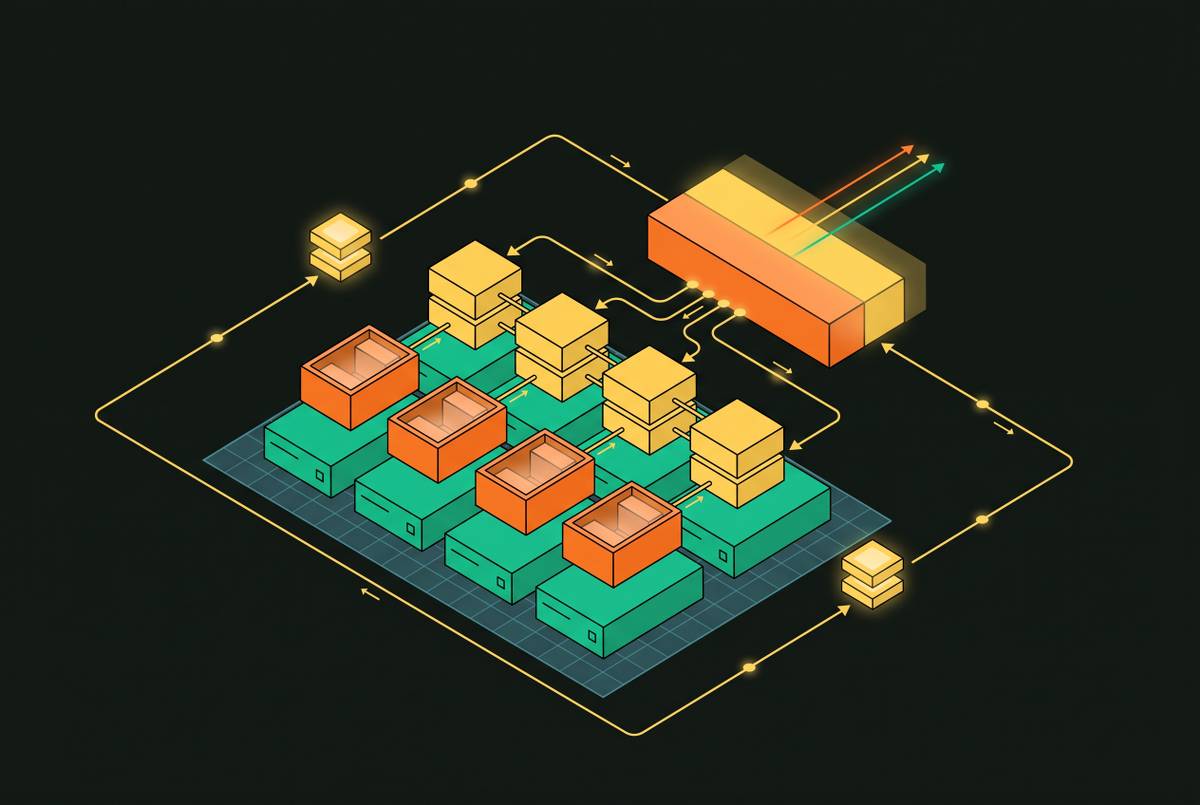
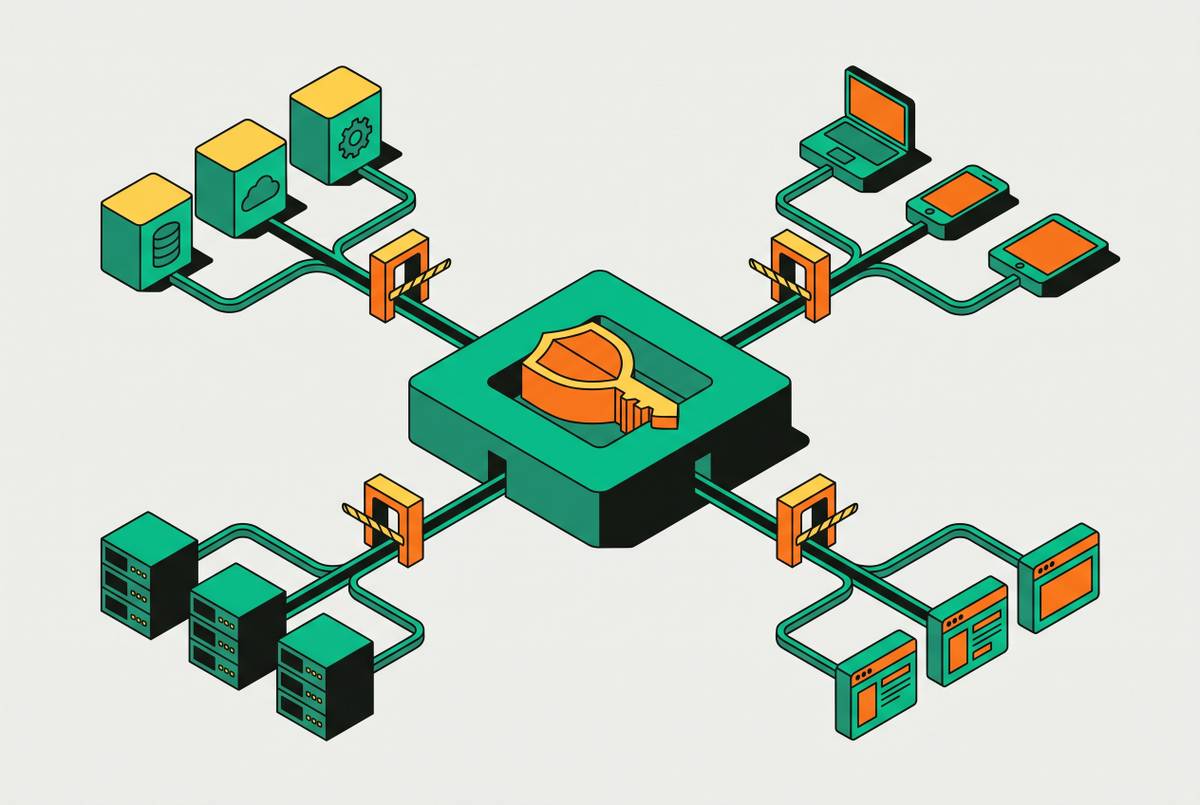
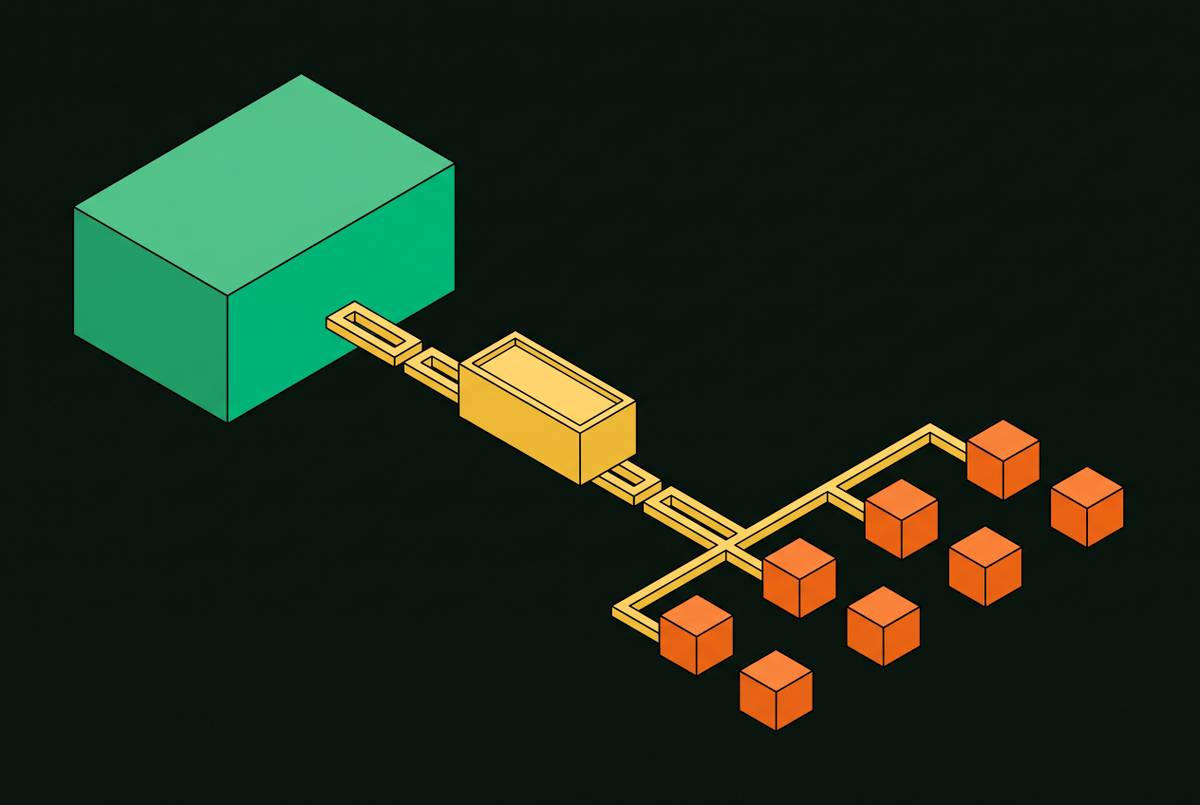
Total Cost of Ownership Comparison for WAF and DDoS Protection Tiers
Hidden costs in bot traffic, bandwidth, and engineering labor often dwarf the advertised plan price.
A large e-commerce retailer found that malicious bot traffic was consuming up to a third of its entire infrastructure capacity. Auto-scaling servers kept spinning up new instances to absorb the load, so the company was paying its cloud provider to serve its own attackers. Engineers were losing roughly two weeks of work per month just to manual bot mitigation. None of that showed up on the invoice for the WAF plan KaBuM! had already purchased. That gap between the quoted price and the real cost is the subject of this piece: the published price of a WAF or DDoS protection plan is rarely the price anyone actually pays, because the real total is assembled at runtime from bandwidth fees, per-mitigation charges, bolt-on modules, and engineering labor that vendors rarely list on the same page as the headline number. Public-cloud WAFs advertise entry prices that look almost nominal, while meaningful DDoS protection is sold as a separate, often expensive line item. Bot management, advanced rate limiting, API protection, and forensic visibility follow the same pattern: features marketed as part of "the platform" that turn out to be add-ons once a buyer reaches the configuration screen. Metered billing compounds the problem by charging the most precisely when a company is under the heaviest attack, and engineering time spent tuning rules and chasing false positives is a cost no vendor bills for but every security team pays anyway.
How WAF and DDoS protection tiers are structured
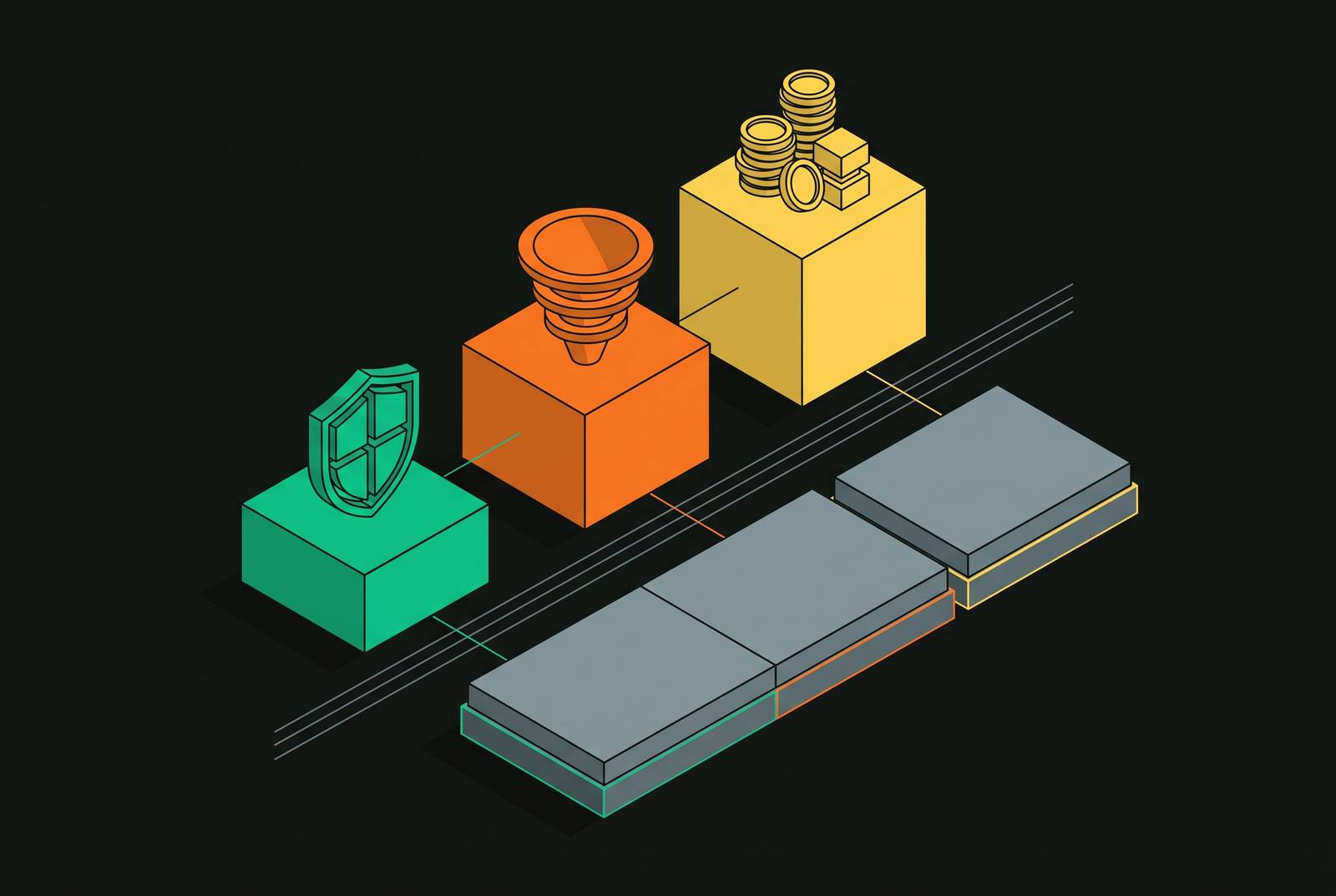
Comparing WAF and DDoS protection on sticker price alone misses the point: tiers differ not just in what they do but in which costs are fixed, which are metered, and which get pushed into a separate add-on purchase. Three broad tier types recur across the market. Free and entry tiers typically cover volumetric attack absorption at the network layer along with basic WAF rule matching, but visibility, forensics, and service-level guarantees are thin or absent. Mid-market tiers add managed rule sets, rate limiting, bot controls, and formal SLAs, but pricing scales per zone or per site, turning a multi-property deployment into a multiplier problem. Enterprise and dedicated tiers bring advanced DDoS scrubbing, API protection, custom rule authoring, managed services, and named account support, almost always sold through a custom quote and a signed contract.
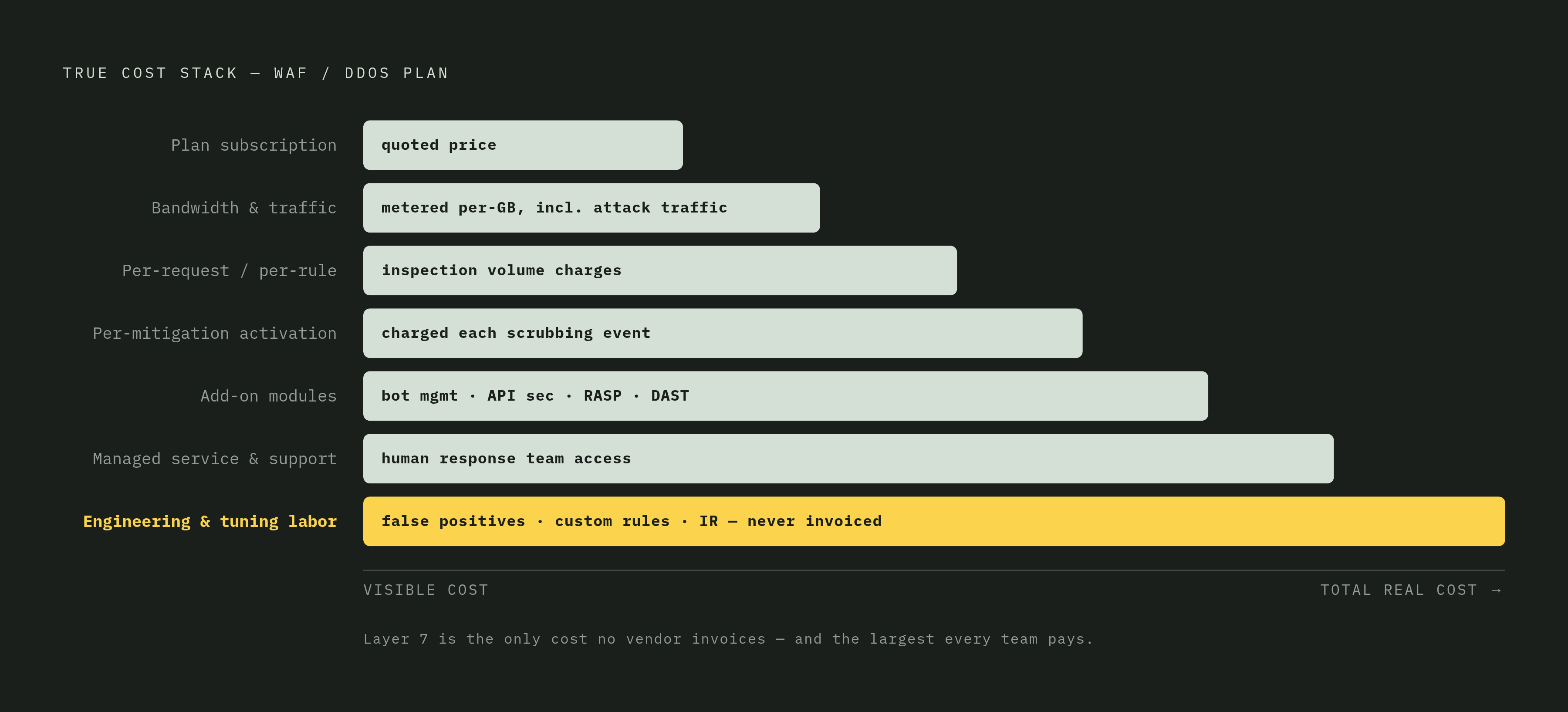
Several cost layers sit beneath those tier labels, appearing in different forms depending on the vendor. Bandwidth and traffic fees are the most consequential: some providers bundle unlimited traffic into the plan price, while others meter every gigabyte in and out, including the traffic generated by an attack itself. Per-request or per-rule fees are common in pay-as-you-go WAF engines, which charge for inspection volume and for each active rule independent of whatever tier a customer is nominally on. In on-demand models, you get charged a separate mitigation or activation fee each time scrubbing switches on. Add-on module fees cover bot management, API security, runtime application self-protection, and dynamic application security testing, frequently sold as standalone products even when marketing materials describe them as part of one platform. Managed service and support fees gate access to a human response team, and that matters enormously during a complex application-layer attack, so it is routinely reserved for premium tiers. Engineering and tuning labor, the cost of managing false positives, writing custom rules, and running incident response, never appears on an invoice at all but scales with how complex the deployment gets.
The category itself has also moved. What used to be sold as a WAF has largely become a WAAP, a web application and API protection platform, and it bundles bot management, API security, and application-layer DDoS mitigation under one name. That consolidation has made "WAF cost" a much bigger question than it was five years ago, because buyers comparing two products with the same label may be comparing fundamentally different bundles of included capability.
Flat-Rate, Traffic-Agnostic Pricing
A monthly price that does not move with traffic volume removes the single most dangerous hidden cost in this market: the bill that spikes in direct correlation with an attack. Cloudflare's pricing illustrates the model well. It charges per zone, meaning per domain, not per gigabyte processed or per DDoS event, so a property serving enormous traffic volumes and one serving a modest trickle pay the same plan price. The verified tier structure runs Free, Pro, Business, and Enterprise, and unlimited CDN bandwidth, DDoS mitigation, and SSL/TLS are included at every one of those tiers, not reserved for the top of the ladder. There are no bandwidth overage charges, no per-request fees layered onto the CDN or security functions, and no scaling charges that kick in once a DDoS event starts.
Separate from that zone-level pricing, Cloudflare's usage-based services, Workers, R2, D1, and KV, carry their own per-unit pricing with generous free tiers attached. Compute and storage billing lives in a different part of the bill from the security layer, and attack traffic does not trigger it. The practical consequence of the zone-pricing model is the sharpest point in its favor: a sustained volumetric attack does not generate an incremental charge, because the cost of absorbing that attack was already priced into the plan before the attack happened. That decouples the moment of maximum operational stress from the moment of maximum financial exposure, which is precisely the opposite of how metered models behave, as the next section shows.
Flat-rate pricing has real boundaries, though, and buyers should know them going in. Advanced bot management is still reserved for the enterprise tier, not the lower rungs. Full API security coverage and dedicated account support are similarly gated to higher tiers. None of that erases the value of flat-rate pricing, but if you are evaluating any flat-rate plan, you still have to check, tier by tier, which of these specific capabilities are actually included before you assume the quoted price covers everything the business needs.
How metered pricing models generate their largest charges during an attack
Pay-as-you-go WAF and DDoS pricing is built so that a successful, sustained attack produces the largest charges a customer will ever see, landing at the exact moment the business has the least capacity to respond to a bill, let alone an incident. AWS Shield Advanced is a useful case study in how this plays out even under a seemingly fixed structure. The subscription itself costs a flat $3,000 a month under a one-year commitment, but data transfer out charges apply on top of that fee, and during a volumetric attack, data transfer out can add materially to the final bill. Shield Advanced does offer a cost protection feature that credits scaling costs incurred during an attack, but that credit is not automatic: customers have to request it through AWS Support, turning a billing problem into a support ticket. WAF inspection, meaning web ACL, rule, and standard request fees, is included in the Shield Advanced subscription for protected resources up to a high request-volume ceiling each month, but add-ons like Bot Control and Fraud Control are billed separately regardless. Once WAF and CloudFront are added to a typical deployment, the realistic all-in cost runs substantially above the base subscription price advertised at the top of the page.
AWS has moved to address part of this. In November 2025, it introduced flat-rate CloudFront pricing plans that bundle CDN, WAF, DDoS protection, Route 53, CloudWatch, serverless edge compute, and monthly S3 storage credits into one price with no overage charges, a real structural shift in how one of the largest cloud providers prices this stack. Shield Advanced still remains the dedicated DDoS product for AWS-native deployments that need it specifically.
The honest counterpoint deserves airtime rather than a dismissal: at low traffic volumes and with no meaningful DDoS exposure, consumption-based pricing genuinely can cost less than a flat per-zone plan, since a customer is paying only for what gets used. That calculation flips once attack traffic becomes sustained and volumetric, because that is exactly the scenario metered pricing was never built to absorb cheaply. A flat-rate global network that folds DDoS absorption into the plan price avoids that flip, and that is the structural argument for choosing one over the other once attack exposure becomes a real possibility.
Enterprise-Tier Dedicated DDoS Scrubbing Costs
When enterprise buyers move past cloud-native WAF pricing into dedicated DDoS scrubbing services, they run into a different version of the same problem. These services are commonly priced on traffic volume. Total cost of ownership scales with the size of the attack rather than with the value of the asset being protected. That is a backwards incentive for the buyer: the largest attacks, which are the most expensive to mitigate technically, also become the most expensive to be charged for. A company getting hit the hardest ends up with the biggest bill, on top of the biggest operational headache.
Architecture compounds the cost. Dedicated scrubbing services typically route traffic through centralized scrubbing centers rather than mitigating at distributed edge nodes, which introduces latency that CDN-integrated architectures generally avoid, and that routing itself carries cost during a sustained event.
The financial stakes of getting this wrong are not abstract. Bandwidth Inc., a communications platform company, disclosed that a DDoS attack reduced its CPaaS revenue by roughly $10 million across the full 2021 fiscal year, driven by lost transaction volume and customer credits issued in the aftermath. That figure has nothing to do with which vendor Bandwidth was using at the time. It is simply what an under-mitigated attack can cost a business in lost revenue, independent of anything on a mitigation invoice.
Pricing at the enterprise tier is also more negotiable than the list suggests. Multi-year commitments are standard, and vendors commonly cut the price substantially off whatever number appears in a published range. Buyers should treat any public enterprise price as a ceiling to negotiate down from, not a floor to budget around.
Bot management as a hidden WAF cost, rarely included at the tier buyers start on
Bot management is the most consistently underestimated line item in WAF total cost of ownership, for a simple reason: its damage is invisible until someone actually measures it, and fixing it almost always requires either a tier upgrade or a separate product purchase made after the fact. Most buyers do not learn they need bot management until bot traffic has already been running up their cloud bill for months.
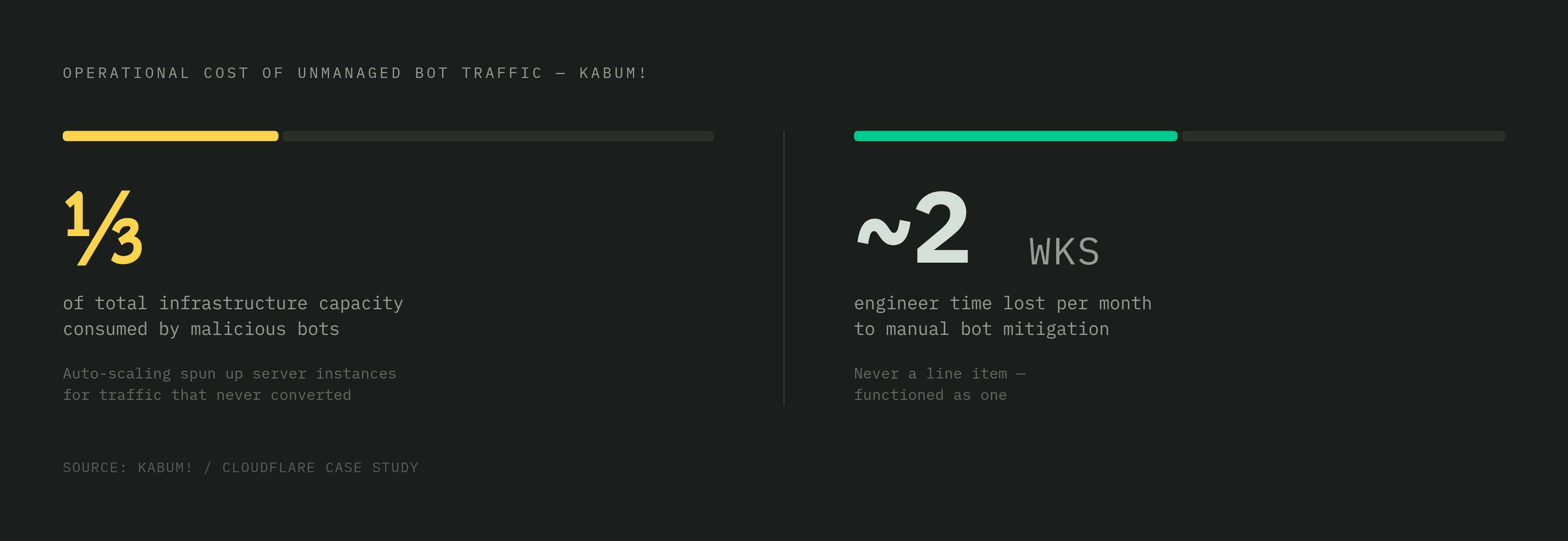
KaBuM! is the clearest illustration available of what that invisible cost looks like once measured. Malicious bot traffic was consuming up to a third of the company's total infrastructure capacity, and because the environment auto-scaled in response to load, new server instances kept spinning up to handle traffic that was never going to convert into a sale. That is cloud compute budget spent entirely in service of attackers. On the operational side, engineers were losing roughly two weeks of work per month to manual bot mitigation, hours that never appear as a bot management line item anywhere in a budget but functioned as one in practice.
There is a second, quieter cost on the other side of the ledger: false positives. Bot controls tuned too aggressively start blocking legitimate customers, producing both a customer experience cost and the engineering time required to re-tune the rules. That tuning gap tends to be worse at lower tiers, so it pushes teams toward managed bot services sooner than their original budget assumed. Platforms built as WAAP from the start, bundling WAF, bot management, API security, and DDoS protection into a single plan price, remove the surprise entirely, since there is no separate bot module to discover after the contract is already signed. KaBuM!'s experience makes the case directly: bot management is an infrastructure cost before it is ever a security line item, and it appears first in the cloud bill, before any breach report.
API protection and the expanding attack surface mid-tier WAF plans were not built for
APIs have become the primary attack surface for web applications, and most mid-tier WAF plans still rely on signature-based inspection that was designed for traditional HTTP traffic, not for API discovery, schema enforcement, or behavioral abuse detection. That leaves a gap that buyers typically discover only after something has already gone wrong, and close at a cost higher than if they had bought the right plan the first time.
Two 2024 incidents make the exposure concrete. In the Dell Partner Portal breach, 49 million customer records got scraped through a partner portal API that had no request-volume limits and no monitoring for unusual behavior, because the WAF configuration stopped at the application layer and never extended to the API itself. The Trello API exposure that same year saw millions of user profiles pulled through an unauthenticated public API endpoint, a reminder that the gap does not require a sophisticated attacker: weak access rules and openly exposed data are sufficient on their own.
Evaluating a modern WAF or WAAP platform means treating three capabilities as mandatory: API discovery, an automated inventory of exposed endpoints; schema enforcement, which rejects requests that deviate from the expected structure of an API call; and abuse detection, which relies on behavioral anomaly analysis. Compliance adds another layer of cost to getting this wrong. PCI DSS, HIPAA, and GDPR all require demonstrable controls over data accessed through APIs, and a WAF that cannot log, monitor, and enforce policy at the API level creates compliance exposure that generates its own remediation costs on top of whatever a breach itself costs.
Buyers who choose a WAF plan based purely on HTTP traffic protection and later discover their API surface was never covered face one of two outcomes: upgrading to a higher tier that includes API security, or buying a separate API security platform to cover the gap. Both options cost more than selecting a plan with API protection included from the outset, which makes API coverage a total-cost-of-ownership decision made at the moment of purchase.