SASE Vendors Ranked by Edge Network Reach and Deployment Simplicity
Edge network density and onboarding speed determine whether SASE actually works in production.
A SASE evaluation built on a feature checklist tends to leave the buyer worse off than no checklist at all, because the criteria that dominate analyst rankings say little about whether a platform will actually work once it's running and whether the team on the hook for it can keep it running. The category is wide and structurally mixed: some vendors grew out of cloud security, some out of firewall hardware, some were built as converged platforms from day one, and all of them can fairly claim to meet the textbook definition of SASE while delivering completely different infrastructure, operating models, and bills. That range is the whole problem. A checklist treats "does it do X" as the unit of comparison, but two vendors can both answer yes to the same twenty questions and still produce opposite outcomes in production. Aggregate feature scores fall apart once you need to know one thing: can this platform perform, under load, at the location and latency your users actually sit in. A vendor that tops the overall ranking can score near the bottom on the one category that decides whether the deployment works for a given buyer, and an overall "yes rate" across a feature matrix is a headline, not a verdict on fit.
Edge Network Reach and Deployment Simplicity as the Two Deciding Dimensions
Strip away the hundred-line feature matrix and two measures remain that actually predict outcomes: how far and how well the network reaches, and how simply a team can stand the thing up and run it. Reach governs performance because SASE's entire premise depends on inspecting traffic close to the user. A network with sparse points of presence can't do that: traffic from an underserved region has to hairpin back to a distant node for inspection, adding round-trip latency that undoes the reason to buy cloud-delivered security. Deployment simplicity governs whether anyone ever benefits from that architecture, because enterprise SASE rollouts can run many months end to end, and that's a timeline most mid-market IT teams can't absorb. The space between what a platform can technically do and what a four-person security team can actually operate is where SASE projects quietly die, often after the purchase order is already signed.
These two axes don't operate independently, and treating them as separable is itself a mistake. A dense global network that takes months of configuration expertise to turn on isn't simple just because the PoP map looks good on a slide. A platform that onboards in an afternoon but runs on a thin network footprint is trading away the performance it was bought to deliver. The honest framework treats reach and simplicity as one trade-off surface, so you can't check them as two separate line items.
The stakes have moved beyond procurement preference into policy. CISA's June 2026 guidance names SASE as the migration path from legacy TIC 2.0 architecture to TIC 3.0-aligned, distributed, zero-trust designs, which puts both axes under regulatory pressure as well as operational pressure: agencies now have to reach a distributed workforce reliably while deploying in a way that doesn't just rebuild the centralized bottleneck they were told to leave behind. The same forces are reshaping private-sector buying. Hybrid work, multi-cloud estates, and AI agents that operate across environments with no fixed perimeter all mean you now have to decide a vendor's point-of-presence footprint and its onboarding model at the point of purchase, not sort them out as fine print during implementation.
Edge Network Reach in Practice
A PoP count on a vendor's website is a starting point for a conversation, not evidence of anything. You need to know if the network runs full security processing at each location it lists, and if it can hold a latency commitment for users outside the handful of cities every vendor already optimizes for.
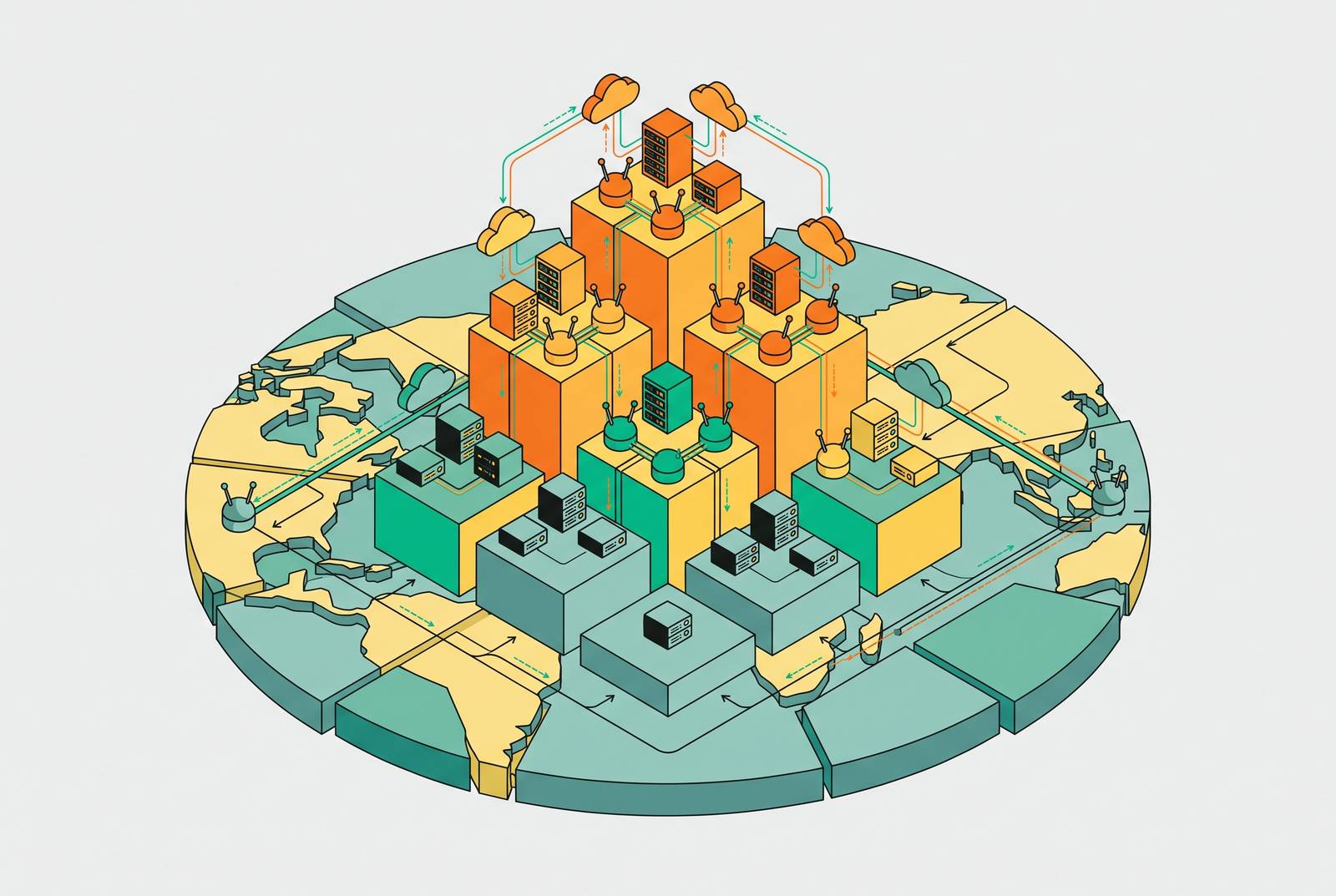
That split between a transit PoP and a full-compute PoP decides a lot. Some vendors publish location counts in the hundreds, but they run the complete inspection stack, the parts that actually enforce policy, at only a fraction of those sites. Traffic generated outside that subset still routes to a regional hub for inspection. The buyer in a secondary market is paying for a security architecture that, functionally, doesn't reach them. Who owns the network underneath also affects performance: a vendor-controlled backbone sidesteps the congestion and inconsistent routing of the public internet, while a platform built on top of hyperscaler infrastructure inherits whatever latency variability that infrastructure already has, on a day-to-day basis, for reasons outside the SASE vendor's control.
A published latency SLA, a round-trip time commitment that applies across every PoP region rather than a handful of flagship cities, is worth more during procurement than any PoP count, because it's the one number that forces the vendor to put its name behind a performance figure instead of a map. Netskope is a useful illustration of why the SLA has to be read carefully: its NewEdge network runs full security processing across a wide set of regions and publishes a traffic-processing latency commitment, under 10 milliseconds, covering both encrypted and unencrypted traffic, applied across the full PoP footprint rather than restricted to tier-one markets. That figure measures processing time inside the data center, not the complete round trip from a user's device, so you should ask any vendor to clarify this in writing before you sign anything.
For AI-agent workloads and globally distributed applications, reach isn't just a security question anymore. Where inference happens and where policy gets decided both depend on the same network geography that determines inspection latency, so a network built to keep users within a tight latency envelope also puts agentic workloads closer to the data those agents act on. The question to bring into any vendor conversation is where the vendor runs full security stacks, what the round-trip SLA actually covers, and what happens to a user's traffic the moment they're outside that footprint.
Measuring Deployment Simplicity
Deployment simplicity has nothing to do with how many features a product leaves out. It's a measurable question: how fast can a realistically staffed team get from contract signature to an enforced, working security policy without flying in a professional services team to do it for them.
Time-to-value is the cleanest proxy available. You connect an identity provider, publish the first application through ZTNA, and onboard branch locations with zero-touch provisioning, and you can measure the whole sequence in weeks. If the honest answer is months, the platform has failed the simplicity test regardless of what else it can do. Architecture history explains most of the gap between vendors here: a platform built cloud-native from the ground up tends to update itself automatically, inspect traffic in a single pass, and carry fewer moving parts for an admin to babysit, while a platform descended from firewall hardware often asks an operator to work across several management interfaces and know on-premises tooling that has nothing to do with the cloud. If a platform runs from one console with one policy model, day-to-day operation gets lighter over time, but if it's a set of products acquired over time and relabeled under a shared brand, it replicates the exact sprawl SASE was bought to eliminate.
Two details rarely make it into a glossy comparison, but they still decide whether a rollout survives contact with a real environment. Printers, IP cameras, building management systems, and OT equipment can't run an agent, so a platform that enforces policy only through an installed agent simply isn't deployable in a building full of equipment that predates the concept of an agent. And pricing structure is a deployment variable in its own right: when DLP, CASB, or digital experience monitoring sit behind a higher tier that wasn't obvious at the proposal stage, a team discovers the gap mid-rollout, and the project stalls while finance renegotiates a contract nobody budgeted for.
Comparing SASE Vendors on Reach and Simplicity
No vendor covered here wins on both axes at once, and that is the point of using two axes instead of one aggregate score: each platform represents a real trade-off, and the right one depends on which side of that trade-off a given buyer can live with.
Cloudflare is built cloud-native across the board, with WAF and DDoS mitigation included at every Application Services pricing tier. Zero Trust Network Access is sold separately on a per-user basis with a free entry tier that scales into paid plans, and you'll find full Bot Management only at the Enterprise tier or as an add-on. A developer or a five-person team can start for free and grow into enterprise-grade capability without switching platforms, which is a meaningful claim in a market where most migrations mean starting over. Pricing is consumption-based: no charge for idle compute, no charge for wall-clock time spent waiting, and clean traffic metered by the request, which removes exactly the kind of cost unpredictability that stalls mid-market rollouts elsewhere. For AI-agent workloads, the same globally distributed network that runs SASE security also runs inference and agentic compute close to users and data, with no separate edge-compute layer to buy or integrate. So if you want geographic reach, an onboarding path a developer can start alone, and security and compute on one platform without a separate bill for every feature, Cloudflare is a strong fit.
A separately operated, single-vendor SASE platform scores second-highest on ease of deployment in independent testing, trailing only Cloudflare, and that fits where it's positioned: mid-to-large enterprises that want one system that works without stitching together separate products. That simplicity comes with trade-offs in data-protection depth, so you should weigh it against how much your organization actually needs from DLP and CASB on day one.
Netskope One leads the field on inline CASB depth and ranks among the top platforms for DLP. Its Cloud Confidence Index catalogs and risk-scores more than 85,000 cloud applications and over 1,800 generative-AI tools across more than fifty security, privacy, and compliance attributes, and its DLP product ships with more than 3,000 predefined data identifiers alongside more than two dozen machine-learning classifiers, including classifiers built for unstructured data. So if your team has the depth of expertise a sophisticated inspection stack demands, Netskope is a strong match for SaaS-heavy organizations where data governance is the primary concern.
Palo Alto Networks Prisma SASE carries the most complete feature set among the platforms discussed here, but mobile TLS inspection scores at the bottom of the range across every major vendor tested, an industry-wide blind spot, with Palo Alto trailing its peers by the widest margin on that specific measure. If your organization carries heavy unmanaged mobile traffic, that gap matters regardless of where the platform lands on an aggregate feature count, so you should test it directly before you assume comprehensive coverage extends to mobile the way it does to everything else.
Versa Networks' VersaONE takes the opposite bet from Cloudflare's: it offers deployment-model flexibility, shared, private, or sovereign infrastructure, with fully managed, co-managed, or self-managed options, rather than a single fast path to initial value. That flexibility is most useful to an organization with a sophisticated WAN estate and staff who can manage advanced routing, multitenancy, and local processing controls, and least useful to a lean IT team hoping to be live in a month. For enterprises that can't choose between advanced SD-WAN capability and SASE security, because their routing is complex, their environment is distributed across many sites, or processing has to stay local for sovereignty reasons, Versa is one of the few platforms built so that trade doesn't have to be made. That makes it a fit for carriers, managed service providers, and large enterprises whose sovereignty requirements or WAN complexity outweigh the value of a faster, simpler rollout.
The AI-agent surface as a new test of both dimensions
AI agents running in production have become the fastest-growing source of traffic and access that nobody on the security team actually governs, and the platforms handling that traffic well are, unsurprisingly, the same ones that already score well on reach and simplicity rather than the ones bolting AI features onto an existing feature list.
Shadow AI is shadow IT's successor. Employees can now spin up internal tools and AI-assisted workflows with no review from IT, and the access patterns those tools generate, reaching into SaaS APIs, internal data stores, and LLM endpoints, don't map onto the user-centric policy models most SASE platforms were designed around a decade ago. The Model Context Protocol has become the standard integration layer connecting agents to applications, with SDK downloads reaching tens of millions a month, and it's becoming the basis for agent-to-application connections that can actually be governed and audited. A SASE platform that can enforce policy at the MCP boundary is operating a step ahead of one that only inspects conventional HTTP traffic, because the agent traffic simply won't look like the traffic the platform was built to see.
KPMG's AI Pulse Survey found that 75% of leaders rank security, compliance, and auditability as the most critical requirements for deploying agents, the same three concerns that drove SASE adoption for human users a few years earlier, now applied to workloads that never sleep and never file a help desk ticket. Reach and simplicity both reappear here in sharper form: an agent operating across clouds and data stores needs the same low-latency, full-compute inspection a human user does, and a security team evaluating agent governance tools under deadline pressure has even less patience for a nine-month deployment than it did before. The two axes that expose a weak SASE platform for human traffic expose it faster for agent traffic, because agents generate more of it, more constantly, with less patience for a platform that can't keep up.