Identity Provider Integration in Zero Trust Deployments
Proper IdP integration is where Zero Trust enforcement actually happens.

Zero Trust lives or dies on one question: who's asking, and can you prove it? The identity provider is where that question gets answered, which makes it the load-bearing wall of the whole architecture. It's not a login box you configure once and forget about. Get the IdP integration wrong and you've built a system that talks like Zero Trust but still behaves like the old walled garden, just with better branding and a bigger marketing budget.
The old model assumed anything inside the network perimeter could be trusted. That premise held up fine when employees sat in an office, on a company laptop, plugged into a company switch. Remote work broke it, and SaaS adoption broke it further. Cloud migration finished the job. CISA's Zero Trust Maturity Model puts identity as the first pillar for a reason: access decisions get checked continuously, not assumed from wherever the request happens to originate. The old question was "is this device on our network?" The real question now is "who is this, what do they want, and does the context support saying yes right now?" Okta says 91% of organizations already believe identity sits at the center of their Zero Trust strategy. Belief is cheap, though, and most of that group still hasn't built the plumbing to back it up.
What an identity provider actually does inside a Zero Trust deployment
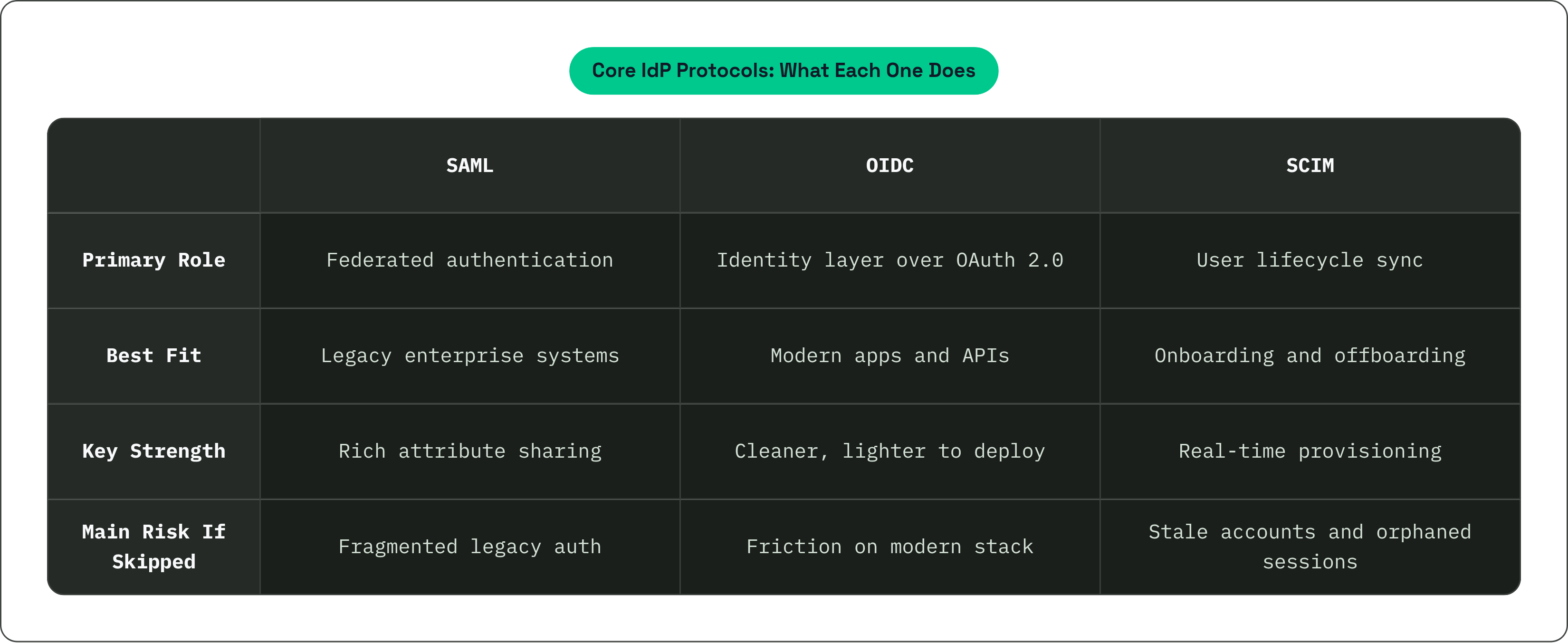
Strip away the marketing and an IdP does three things. It authenticates a person or a service, it issues a signed token, and it hands off attributes, group membership, role, auth method, device state, that a policy engine downstream is going to chew on and make a call with.
SAML is the old workhorse: XML-based, heavy to configure, but still running the show in large enterprises that need detailed attribute sharing across legacy systems nobody's touched since 2014. OIDC sits on top of OAuth 2.0 and gives you a cleaner way to move identity data around, and it's usually less work to stand up for a modern app. Given a choice, pick OIDC over the alternative. SCIM handles the piece everyone forgets about until it breaks: lifecycle. It syncs users and groups between the IdP and every downstream app in close to real time, so onboarding and offboarding actually happen instead of living in a spreadsheet somebody updates every other Friday.
That lifecycle piece matters more than it sounds like it should. When SCIM works, access disappears the moment someone's status changes in the IdP: no stale accounts, no orphaned sessions sitting around waiting for an auditor, or worse, an attacker, to stumble on them. Put SAML or OIDC together with SCIM and you get one authoritative record for identity, access, and lifecycle, instead of three half-synced systems pretending to be one. An organization running something like 106 SaaS apps on average doesn't get to skip this step. Without a central IdP, each of those 106 apps is running its own login logic, its own session rules, its own gaps.
How the IdP connects to the policy enforcement layer
The IdP doesn't enforce anything on its own. It hands a signal to a policy engine, and the policy engine decides whether the door opens. Microsoft Entra Conditional Access is the clean example here: it checks identity, device health, and risk score at the moment of every access request, not once at login and never again.
The policy engine wants a few specific things from the IdP. What auth method got used, password versus phishing-resistant MFA is a meaningful gap. What groups and roles the user sits in. Session risk signals, a login from a country the user's never touched at 3 a.m. is a flag, not a coincidence. And device compliance, usually relayed through the IdP from an MDM or EDR tool. Single sign-on is really just the visible side effect of doing all this correctly: the same guardrails apply everywhere without re-prompting the user every five minutes, which cuts MFA fatigue and stops people from scattering passwords across a dozen apps because logging in was a hassle everywhere else.
The chain runs like this: IdP authenticates, issues the assertion, a policy proxy checks it, the resource opens or it doesn't, and the whole thing gets logged somewhere. Skip a link and the Zero Trust label is just a sticker on the box. Enforcement only holds if every route to every resource passes through a check reading live IdP signals, not a decision cached from an hour ago and reused because nobody bothered to refresh it.
Why running multiple IAM systems defeats the purpose of Zero Trust
Mergers, acquisitions, plain organic sprawl: a lot of companies end up running two IAM systems side by side and call it a migration in progress. Microsoft's own guidance doesn't hedge on this. Multiple IAM platforms dilute the signal the IdP sees, hand attackers a gap to work in between the two engines, degrade the user experience, and chip away at how much partners trust your security posture.
The gap shows up in specific, boring ways. An identity that exists in system A but not system B can get compromised and nobody notices, because nobody's watching both at once. A policy exception granted in one system is invisible in the other, so least privilege gets enforced depending on which door someone happens to walk through that day. Offboarding in one system leaves live credentials sitting active in the other, quietly, for months sometimes.
Here's the logic underneath all of it. Zero Trust needs exactly one authoritative source of identity truth, and splitting that authority in two quietly reintroduces the old perimeter assumption, that some identities are already trusted by default just because they live in whichever system you're not watching as closely this quarter. It's no surprise, then, that the 2025 SSE Adoption Report found 61% of organizations now prefer a single-vendor SASE approach over stitching several vendors together. That's not just an integration-headache problem. It's a quiet admission that fragmented signals produce fragmented enforcement, every single time.
Connecting the IdP to a Zero Trust Network Access layer
ZTNA replaced the VPN, and the reason is worth spelling out. A VPN authenticates you once and hands you the keys to the whole building. ZTNA grants access per app, per session, contingent on identity that gets re-checked continuously rather than assumed for the rest of the day. The IdP sits upstream of all of it: ZTNA has nothing to evaluate without a live, verified assertion from the IdP at every single session, not just the first one.
Gartner's numbers on the shift are stark. Less than 10% of new remote access deployments used ZTNA at the end of 2021; the projection was that at least 70% would by 2025. That's not a trend anymore, since the market has already moved on while some teams are still debating pilot programs.
Federated identity is what stretches this beyond your own org chart. A partner's employees authenticate against their own IdP, a trust relationship between the two IdPs lets your ZTNA layer accept that assertion, and you apply the right policy without ever provisioning that partner inside your own directory. Supply chain relationships and academic collaborations run on exactly this pattern: resource access without dissolving the organizational boundary that's supposed to still be there. Some ZTNA platforms integrate with essentially every SAML and OIDC provider and most OAuth providers, and their access policies bind straight to IdP group membership, so a change in the directory updates the ZTNA policy automatically with no manual reconciliation. One test worth running before trusting any of this: revoke an account in the IdP and check that every active ZTNA session tied to it dies immediately, not that new sessions just get blocked going forward.
The credential attack surface that makes IdP hygiene non-negotiable
The Verizon 2025 Data Breach Investigations Report put credential abuse at the start of 22% of breaches that year. That number settles the argument about whether the IdP deserves extra scrutiny on its own. It's the single highest-value target in the stack, because it's the trust anchor everything else leans on.
Microsoft's Digital Defense Report 2025 adds the scale most people don't picture. Password-based attacks make up more than 99% of the roughly 600 million daily identity attacks Microsoft tracks against Entra, Microsoft blocks around 7,000 password attacks per second, and identity-based attacks overall rose 32% in the first half of 2025. Translate that into configuration terms and the takeaway is blunt: MFA at the IdP isn't optional, and phishing-resistant MFA specifically stops the overwhelming majority of these attempts even after the password's already stolen. Any app connected to the IdP that still accepts password-only login is a weak spot against the entire chain, not just against itself. Conditional access has to flag odd sign-in behavior the moment it happens, not in next week's audit report that nobody reads until the incident's already three weeks old.
There's a dollar figure attached to getting this right. IBM's 2025 Cost of a Data Breach Report found organizations with a deployed Zero Trust architecture save an average of $1.76 million per breach compared to those without one. A well-run IdP stops being just a security posture at that point; it becomes a line item you can defend in a budget meeting without flinching. On the human side, MFA fatigue, the trick where attackers spam push notifications until an exhausted user finally taps approve just to make the buzzing stop, gets a lot less effective once SSO with sane session policies cuts down how often people get prompted in the first place.
Non-human identities: the gap most Zero Trust deployments leave open
Nearly every Zero Trust rollout points its attention at humans: MFA, SSO, conditional access, the full kit. Meanwhile service-to-service calls and workload-to-resource traffic run almost entirely ungoverned in the background. It's an odd place to leave a hole, given how much of modern infrastructure is machines talking to other machines all day without a person watching.
Services run across multiple clouds now. Containers spin up and vanish inside seconds, and AI agents call APIs across company boundaries with no human anywhere in the loop. The perimeter isn't just weak here, it's gone, and what's standing in its place is the identity of the workload itself. AI agents make this harder by acting like digital employees: they need their own identities (service accounts, Kubernetes pod identities, cloud workload identities), tight least-privilege scopes, and some mechanism stopping them from quietly escalating their own privileges over time.
The governance numbers are rough. Okta's AI at Work 2025 report found 91% of organizations already using AI agents, yet 44% have no governance framework covering them at all. Only 10% report a mature strategy for managing non-human identities, which is the baseline you need before governing agent access at any real scale. Cisco's State of AI Security 2026 report found only 29% of organizations feel ready to secure agentic AI applications, meaning 71% are running agents they can't properly monitor, audit, or respond to when something breaks. Gartner projects 40% of enterprise applications will embed task-specific AI agents by the end of 2026, up from under 5% in 2025. Deployment speed and governance maturity are moving in opposite directions, fast, and that's the whole problem in one sentence.
SPIFFE/SPIRE, the CNCF frameworks, are becoming the answer for workloads the way OIDC answered it for humans: they issue, check, and federate cryptographic identities for services, and AWS, Azure, and GCP have all started building workload identity federation in natively. This isn't a hypothetical risk sitting on a slide somewhere either. IBM's 2025 report found organizations dealing with ungoverned shadow AI paid roughly $670,000 more per breach on average. The bill for skipping non-human identity is already itemized and sitting on someone's desk.
What production-grade IdP integration looks like across the major platforms
Microsoft Entra ID makes sense for organizations already living inside the Microsoft ecosystem. Conditional Access is the native policy engine, and Entra Workload Identity stretches that same framework to service principals and managed identities, closing part of the non-human gap directly instead of bolting on a separate tool.
Okta covers broad SAML/OIDC support across thousands of pre-built app integrations, plus strong lifecycle management through SCIM. It's a common upstream pick for organizations running their ZTNA layer through a separate vendor. Ping Identity moved into AI agent governance in 2025 with PingOne Privilege, worth a look for anyone who'd rather have one vendor covering workforce identity, privileged access, and agent identity than juggle three.
Whatever you pick, the vendor name matters less than what it actually does under pressure. Does the IdP hand your policy engine attributes rich enough, device compliance, auth method, group data, to make a real decision? Does SCIM push revocations in real time, or on some overnight batch job from 1998? Can the identity model stretch to cover non-human workloads without a second product and a second budget line? Does enforcement live in one control plane, or are you stitching two or three policy engines together and hoping they agree?
Common integration failures that let perimeter thinking persist inside a Zero Trust label
Treating IdP integration like a project with an end date is the first one. SCIM syncs drift, conditional access policies go stale, and group mappings rot as the org restructures around them. This needs ongoing upkeep, not a cutover date and a champagne toast in the conference room.
Leaving one legacy auth path alive somewhere is the second, and it's sneakier than it sounds. One app that still accepts password-only login, or routes around the IdP through some old connector nobody remembers building, is a hole in the entire chain, not just a flaw in that one app.
Gating access on network location instead of identity is the third. VPN split-tunneling, IP allowlists, the "office IP gets a pass" exception someone added during an outage three years ago and never removed: all of it drags the perimeter-era assumption back in through the side door and breaks least privilege on the way through.
Importing Active Directory groups wholesale into the new IdP without cleaning them up first is the fourth, and probably the most common. An old, over-permissioned group structure doesn't become appropriate just because it moved to a shinier system. Least privilege is something you design on purpose, never something you inherit by accident.