Device Posture Checks in a Zero Trust Policy Engine
Continuous device health checks close the identity-only gap in Zero Trust.
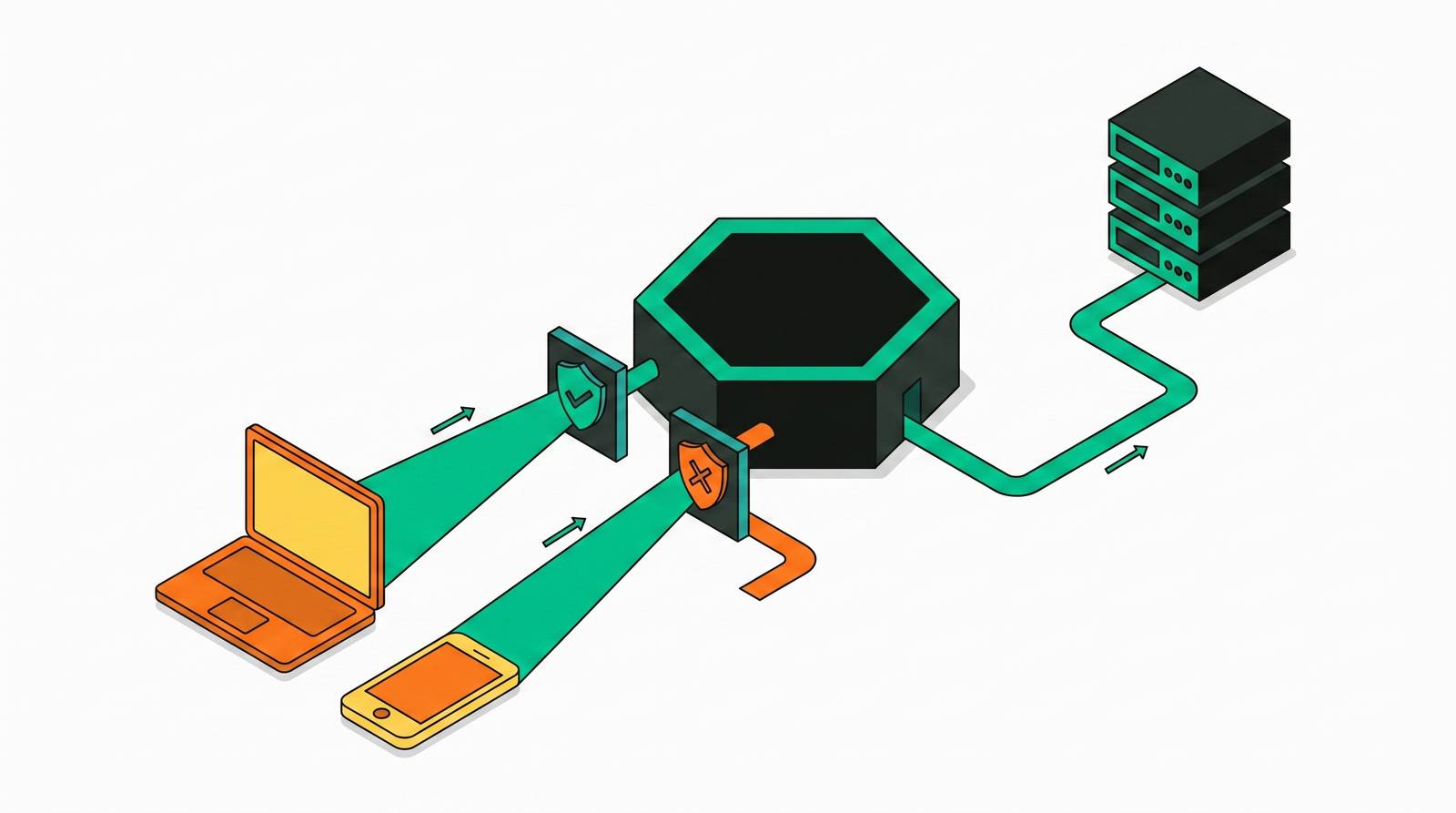
Zero Trust says trust nothing by default: not the user, not the device, not the network segment it's sitting on. Most organizations have taken that premise and applied it to one thing: identity. MFA, single sign-on, conditional access based on who's logging in. What they haven't done is apply the same suspicion to the device the credentials are typed into, which means a user can sail through MFA on a laptop that hasn't been patched since the last kernel exploit made headlines. Device posture checks are the piece that closes that gap: real-time signals about the endpoint's health, fed into a policy engine that decides access on a continuous basis instead of a one-time login gate. Without them, Zero Trust is a slogan on a slide deck.
What device posture actually means as a policy input
Posture is the security state of an endpoint at a given moment, translated into signals a policy engine can actually read and act on. Not a vibe, not a checkbox someone filled in during onboarding. A snapshot, refreshed constantly.
There's a real difference between knowing a device is out of compliance and doing something about it. Compliance monitoring tells you "this laptop hasn't been patched in ninety days." Conditional access takes that same fact and denies or restricts the connection. The first is a dashboard. The second is governance. Plenty of organizations have built the dashboard and stopped there, which is a bit like installing a smoke detector and removing the battery because the beeping was annoying.
Signals get collected one of two ways: a lightweight agent sitting on the endpoint, pulling telemetry directly, or an integration that pulls from an MDM or EDR platform the organization already runs. Either way, the access broker takes those signals, checks them against policy, and decides whether the connection happens. Posture isn't pass or fail. It's a set of dimensions, weighted differently depending on what the device is trying to reach. A device missing one minor check might be fine for the intranet wiki and completely unacceptable for the payroll system.
The signal set a policy engine evaluates and why each one earns its place
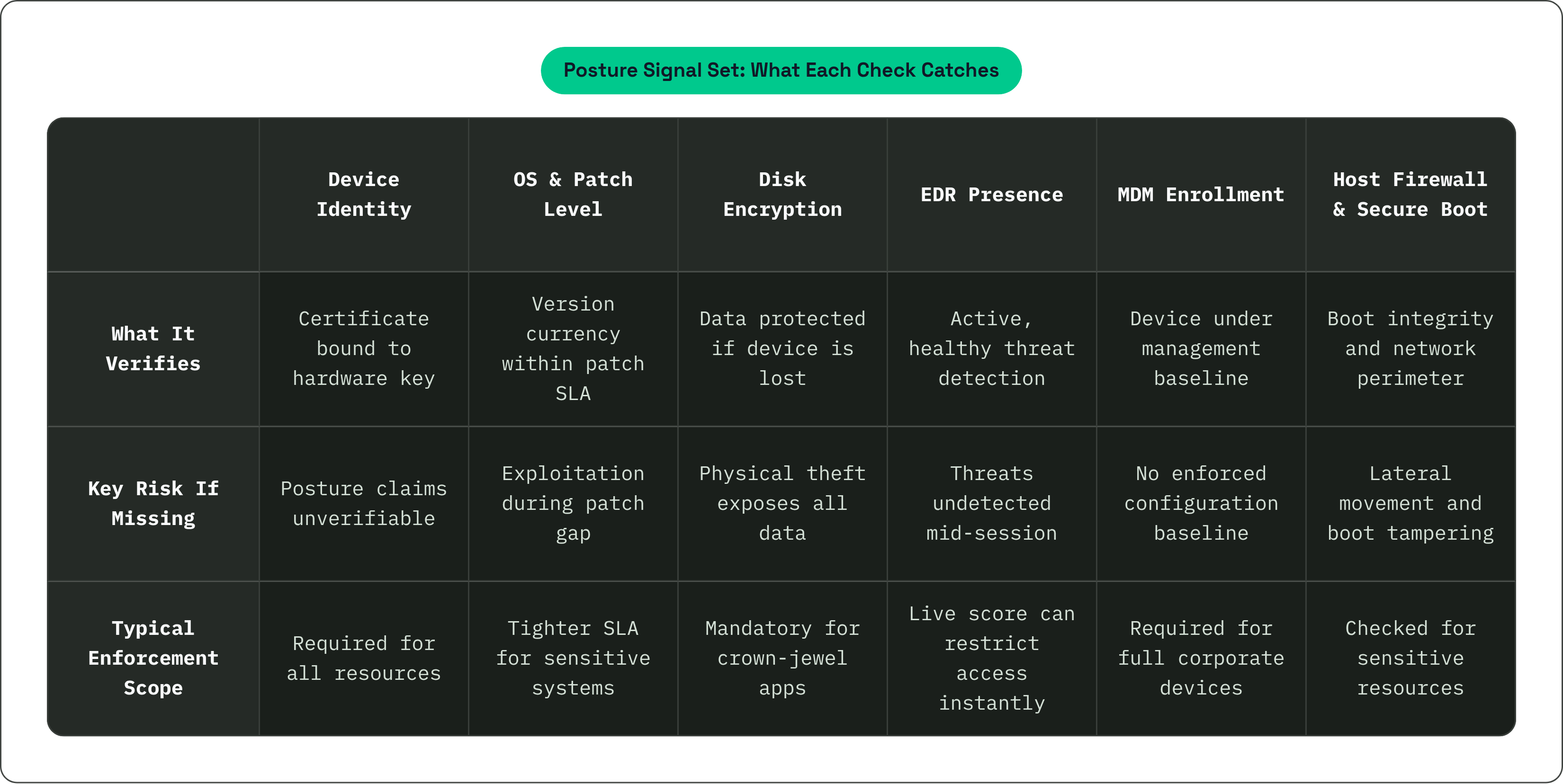
Start with device identity, because nothing else on this list matters without it. The device needs to hold a certificate issued by corporate PKI, bound to a hardware key that never leaves the machine. If you can't verify which device is sending the signals, every other posture claim is just a device telling you about itself, and devices lie, or rather, malware on them does. Hardware attestation through a TPM or Secure Enclave signs the posture measurements cryptographically, so even malware running with admin rights can't fake a clean bill of health.
OS version and patch level come next. A machine on macOS 14.3 with January patches looks fine until February's critical kernel fix drops and it's suddenly a month behind. The window between a critical patch dropping and its broad deployment is exactly where attackers operate. Organizations serious about this set a tighter SLA, under two weeks for critical patches, and the gap between that target and the industry average is where posture enforcement earns its keep.
Disk encryption, BitLocker on Windows, FileVault on Mac, protects data at rest. Lose the laptop without it and every access control you built upstream is irrelevant, because someone just pulled the drive. EDR presence matters too, and not just installed, but running and healthy; some policy engines go further and ingest the EDR's live threat score as its own signal, so an active detection can tighten access before a human even looks at the alert. MDM enrollment confirms the device sits under a management baseline. Round the list out with host firewall status, Secure Boot, and MFA enrollment, and you've got the canonical signal set most mature policy engines check against. Different resources warrant different subsets: nobody needs Secure Boot verification to read the cafeteria menu.
How continuous evaluation differs from a login-time check
A device that's compliant at 9 a.m. can stop being compliant at 9:15, the moment someone disables a firewall, installs something they shouldn't, or an EDR agent flags a live threat. A login-time check has no idea any of that happened. It already stamped the session approved and moved on.
Continuous verification runs the check again, and then again, on a polling loop through the life of the session. Most systems land somewhere between five and fifteen minutes per cycle, quick enough to catch drift mid-session, slow enough not to hammer the endpoint or the network with constant checks. When a device fails one of these mid-session polls, access steps down or gets pulled without anyone needing to intervene manually. The session doesn't get grandfathered in just because the login succeeded an hour ago.
Worth being honest about the limits here: real-time evaluation of every single request is expensive, so most policy engines keep a local posture cache. That means there's a lag, usually short, between the moment a device actually falls out of compliance and the moment enforcement catches up. Continuous posture isn't instant revocation. It's near-real-time adaptation, which is a considerable upgrade over a check that only runs once, but it's not magic and nobody should sell it as such.
Collection mechanisms and their trade-offs: agent, agentless, MDM, and EDR integrations
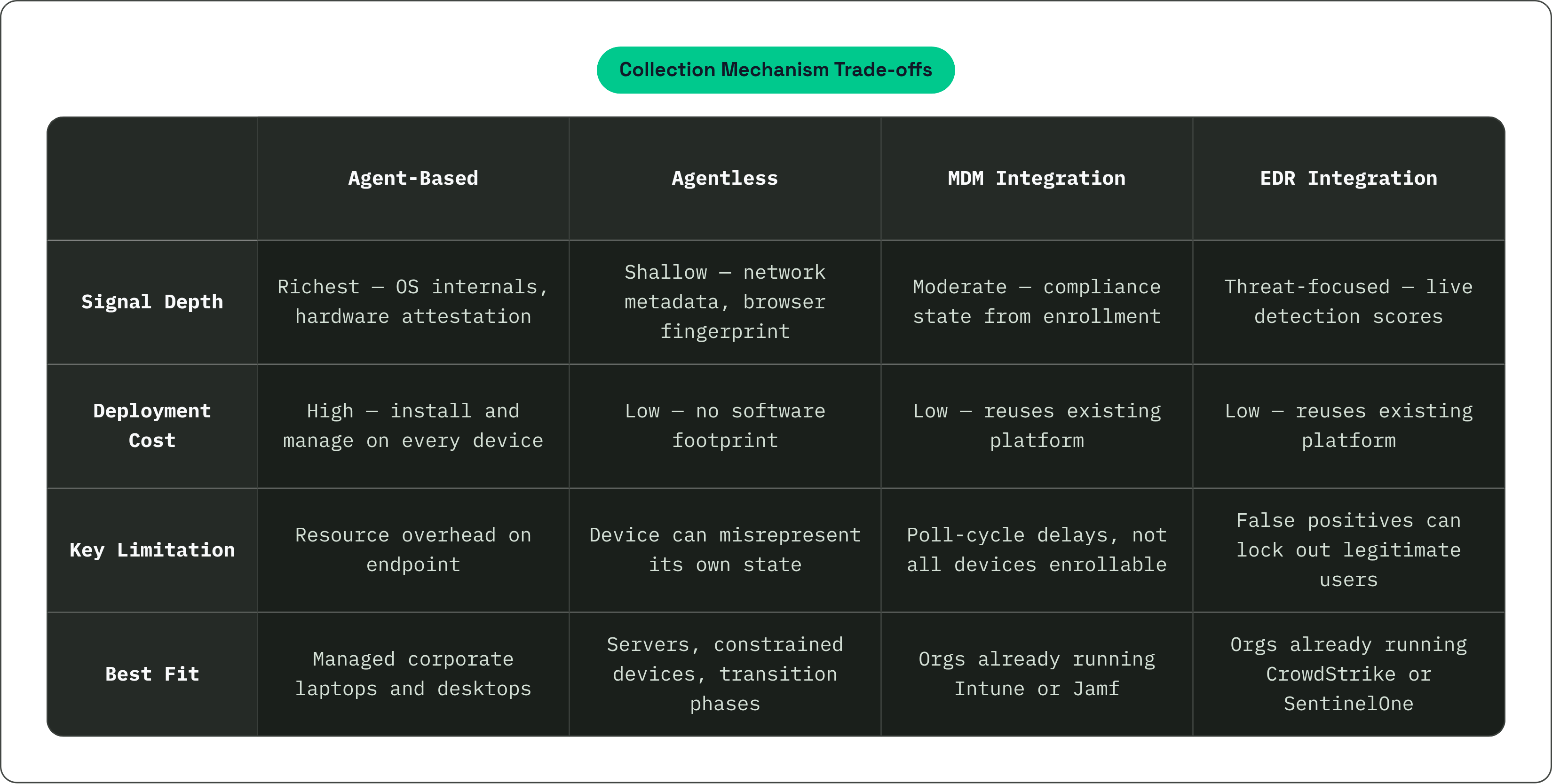
Agent-based collection gets you the richest signal: OS internals, hardware attestation, process state, the works. The cost is that someone has to install and manage that agent on every device, and the agent itself eats resources on the endpoint. This fits corporate-managed laptops and desktops where IT already owns the lifecycle.
Agentless collection pulls from network metadata, browser fingerprinting, or MDM APIs, no software footprint on the device. The trade-off is trust: without an agent watching from inside, a device can misrepresent its own state more easily. This fits constrained devices, servers where installing an agent isn't practical, or a transition phase before a full agent rollout finishes.
MDM integration means leaning on what's already there. Platforms like Microsoft Intune or Jamf already track compliance state for enrolled devices, so a ZTNA platform that reads from MDM instead of duplicating the work saves everyone a headache. The catch: not every device class can enroll in MDM, and MDM signals tend to update on a poll cycle rather than instantly.
EDR integration, through tools like CrowdStrike or SentinelOne, layers threat intelligence on top of configuration checks. An active detection can trigger immediate restriction, which sounds great until a noisy false positive locks someone out of their own work for no good reason.
Then there's BYOD, the honest problem child. You cannot achieve full posture visibility on a personal phone or laptop, full stop. The workable answer is tiered access: a personal device might reach lower-sensitivity resources with reduced posture requirements, but crown-jewel applications stay off-limits regardless of how clean the device looks. A policy engine has to support graduated access here, not a single gate that swings one way or the other.
How a posture-aware policy engine connects signals to access decisions
The access broker sits in the middle, between the user and device on one side and the resource on the other. It takes identity claims and posture signals together, checks them against policy, and issues or denies access. A typical rule blends three things: who the user is, what state the device is in, and context like time, location, or how sensitive the resource happens to be. Something like: allow access to the finance app only if the user's in the finance group, disk encryption is on, the EDR agent is healthy, and the OS is inside its patch window.
Outcomes don't have to be binary. A device missing one non-critical check might get read-only access instead of full access. A partially compliant device might get bumped to step-up authentication. A device that fails something critical gets redirected to a remediation portal instead of just told no.
Programmable policy engines, the OPA-style frameworks, turn these decisions into code: version-controlled, testable, auditable. That beats a GUI setting nobody remembers changing six months ago. Enforcement also splits across layers: some signals block traffic at the network level before it ever reaches an application, others let the connection through but restrict what the user can do inside the app. A mature setup uses both. And posture rarely lives in a vacuum: platforms like Entra ID and Okta build conditional access policies that consume these signals directly, meaning the policy engine is often a joint effort between the ZTNA platform and the identity layer, not one product doing everything alone.
Where organizations actually stand on Zero Trust deployment in 2025
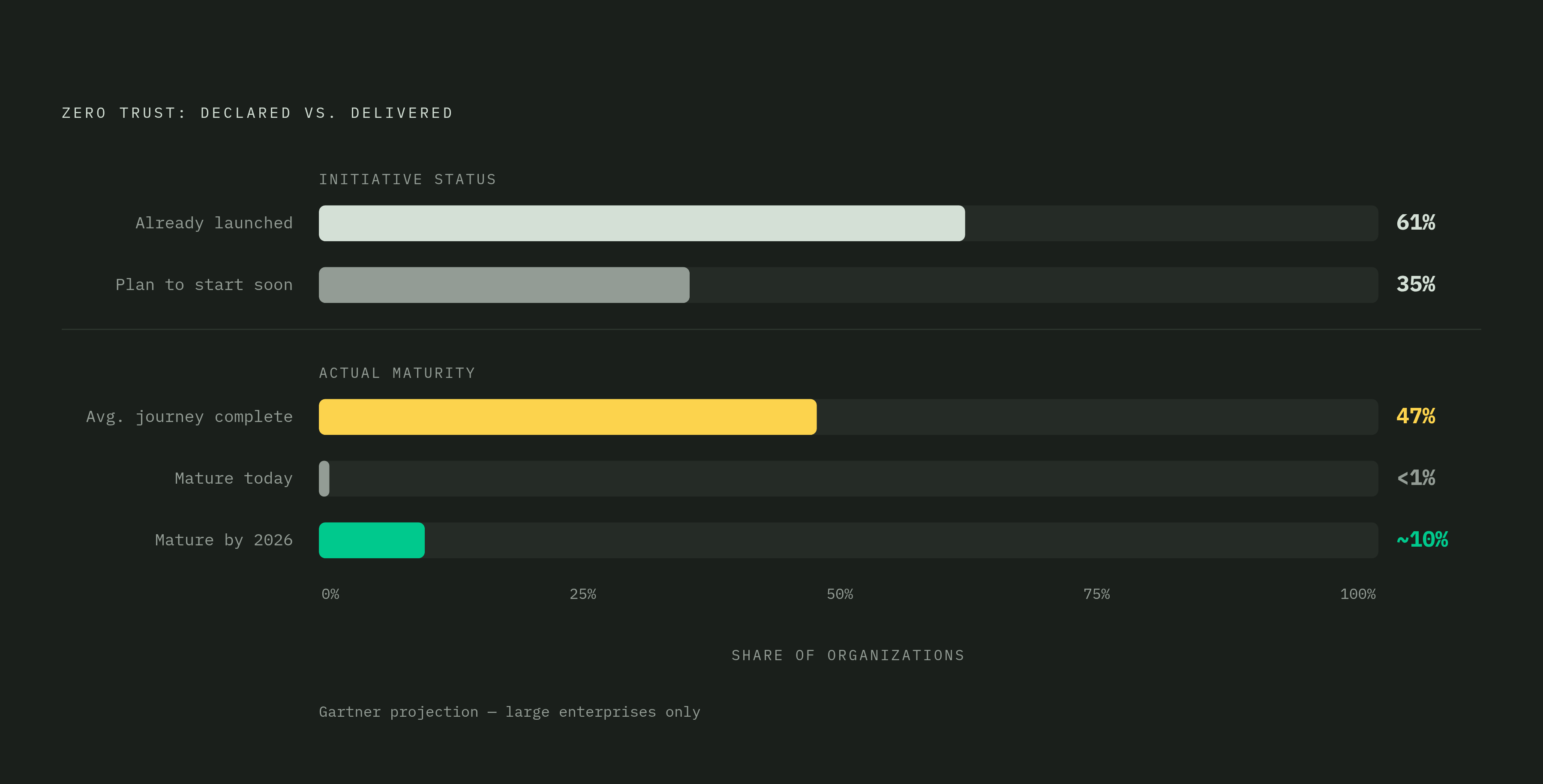
The intent is there. Per Okta, 61% of organizations have already launched Zero Trust initiatives, and another 35% plan to start soon. That's close to universal buy-in on paper. But the SSE Adoption Report 2025 puts the average organization at only 47% of the way through its Zero Trust journey, which tells you the strategy slide got approved a long time before the enforcement actually landed.
That gap has a shape to it. Identity gets prioritized first, because MFA and SSO are relatively easy to bolt on and show up well in an audit. Posture enforcement, the harder, more operationally demanding half, gets pushed to later phases that sometimes never arrive.
There's a related shift worth noting: 61% of organizations now say they'd rather run a single, unified SASE platform than stitch together tools from multiple vendors, according to Cybersecurity Insiders. That matters specifically for posture. When identity, network access, and posture signals live in one platform, the policy engine can act on all three coherently. Fragmented stacks force custom integrations between tools that were never designed to talk to each other, and that's exactly where lag and blind spots creep in.
Gartner's numbers put the maturity gap in sharper relief: fewer than 1% of large enterprises had a measurable, mature Zero Trust program in recent years, with a projection of roughly 10% by 2026. That's a real jump, tenfold, but it still leaves the overwhelming majority of large enterprises building this out in real time rather than operating it at full maturity. Regulation is pulling some of them along faster than they'd move on their own, with government mandates placing defense suppliers and their commercial partners onto fixed enforcement timelines whether they feel ready or not.
Implementing posture checks in practice: staged rollout and common failure modes
Flip on full enforcement, day one, fleet-wide, and you'll lock out half the sales team before lunch. That's not a security win, that's a helpdesk fire. The goal is enforcement without triggering a revolt, and that means staging it.
Phase one is observation: deploy the agent or MDM integration in reporting mode only, and just watch. Build a baseline of where the fleet actually stands without denying anyone anything yet. Phase two is remediation: take that baseline and go close the biggest gaps first, unencrypted disks, ancient OS versions, before enforcement flips on. Phase three enforces on the highest-sensitivity resources first, the crown jewels, leaving lower-stakes systems for later. Phase four expands enforcement across the whole fleet and introduces graduated tiers for BYOD and contractor devices that were never going to hit full compliance anyway.
The failures tend to repeat across organizations. Some treat posture as a one-time setup instead of an ongoing operation, forgetting that devices drift, OS versions age, and EDR agents go stale without anyone noticing. Some collect the signals faithfully and never wire them into an actual access decision, which produces a very pretty dashboard and zero additional security. Some apply the same posture bar to every device class regardless of what it can realistically support, treating a contractor's personal laptop the same as a fully managed corporate machine. And some skip the remediation path entirely: a user's device fails a check, nobody tells them why or how to fix it, and IT drowns in tickets from confused employees who just want to get back to work.
A posture-only mode, where the client reports without blocking, is a reasonable way to start collecting the dataset needed to write sane policy before flipping the enforcement switch.
How platforms implement posture enforcement and where they differ
The architecture looks similar everywhere: an agent or MDM integration feeds signals to a broker, the broker checks policy on every session or request. Where platforms actually diverge is in the details underneath that shared shape.
Signal depth varies, some platforms check a wide set of attributes natively, others need a third-party integration to fill the gaps. Polling frequency and cache behavior differ too, which changes how fast a mid-session compliance drop actually turns into an enforcement action. Some platforms support an agentless fallback for devices that can't run software locally; others don't, and simply exclude those devices from full enforcement. Integration with existing EDR and MDM tools varies as well, some platforms happily ingest signals from whatever the organization already runs, others push their own agent stack regardless. Policy expressiveness is maybe the biggest differentiator: whether posture rules can get composed into fine-grained, per-resource logic, or whether the platform only supports one fleet-wide threshold applied everywhere.
Okta's Advanced Posture Checks fold customizable device requirements into IAM-layer conditional access, with macOS-specific controls added in 2025. Citrix's Device Posture Service runs as a cloud-based scan across Citrix DaaS and Secure Private Access resources, covering SaaS, web, and TCP/UDP apps, checking endpoints both before and during the session. A unified ZTNA and SASE platform that also handles DNS and HTTP filtering can apply posture signals across multiple layers at once, network and application, instead of forcing separate tools to coordinate after the fact. That is the problem siloed stacks were never designed to solve. The differences aren't cosmetic. They determine how fast a compromised device actually gets cut off, and how much custom glue an organization has to build to make the pieces talk.