Securing Third-Party Contractor Access Without VPN Accounts
Zero Trust Network Access grants contractors scoped app access without network exposure.

Contractor access is where security architecture goes to die quietly. The typical engagement begins with IT scrambling to provision a VPN account and ends with no one remembering to delete it. Zero Trust Network Access fixes this not by adding controls to the existing model but by replacing the model itself: instead of putting contractors on the network and hoping for the best, ZTNA grants verified, scoped, time-limited access to specific applications and nothing else. The mechanism is architectural, not procedural, which is why it actually works. Think of it like a bouncer who doesn't just check your ID at the door — he walks you to your specific table, stands there the whole time, and escorts you out the moment your reservation ends.
Contractor Credentials Are a Bigger Liability Than the Network Realizes
VPNs operate on a binary assumption: you authenticated, therefore you belong here. For a full-time employee on an IT-managed laptop with a background check, years of tenure, and a clear offboarding process, that assumption is defensible, if imperfect. Contractors invert every variable simultaneously: unmanaged devices, short engagements, rotating personnel, no IT enrollment, and access requirements scoped to one project rather than the whole environment.
The friction of VPN onboarding for contractors is underappreciated as a cost center. Someone has to provision an Active Directory account, configure split tunneling, and arrange for software installation on a device IT has never touched. Then, when the engagement ends, someone has to remember to undo all of it. That last step is where the model structurally fails. Fifty-four percent of organizations lack a complete inventory of which external parties hold active credentials, and 63% lack visibility into what permissions those credentials carry. The orphaned account is not a procedural failure; it is the predictable output of a system that requires a human to initiate offboarding every single time.
The carrying cost is substantial. Organizations spend an average of 134 hours per week managing vendor access, according to research from Imprivata and the Ponemon Institute published in February 2025. That figure rarely surfaces in VPN budget conversations, but it belongs there.
Broad Network Access Turns Contractor Credentials Into an Outsized Liability
Third-party involvement in breaches doubled to 30% in the Verizon 2025 Data Breach Investigations Report. This is no longer a marginal risk category; it is a primary threat vector. Nearly half of security professionals identify third-party remote access as their weakest attack surface, and the mechanism that makes it dangerous is straightforward: a compromised contractor credential on a VPN does not yield access to one application. It yields access to a network segment, enabling lateral movement toward higher-value targets.
The VPN perimeter itself has become a target independent of the credentials it protects. Exploitation of edge devices and VPN appliances rose 34% year-over-year in the Verizon 2025 DBIR. In January 2025, the Belsen Group leak exposed VPN configurations for 15,000 Fortinet firewall devices: credentials, certificates, and firewall rules published publicly. The scale of that exposure made clear that VPN infrastructure is targeted systematically, not opportunistically.
The attack chain here is not any single element in isolation. It is the combination: an unmanaged device, broad network access upon authentication, and an offboarding process that depends entirely on human memory. The blast radius of a contractor credential compromise is determined at provisioning time, when the VPN account is created and the network segment becomes reachable. By the time an incident occurs, the structural decision has already been made.
What Zero Trust Network Access Actually Does Differently at the Architectural Level
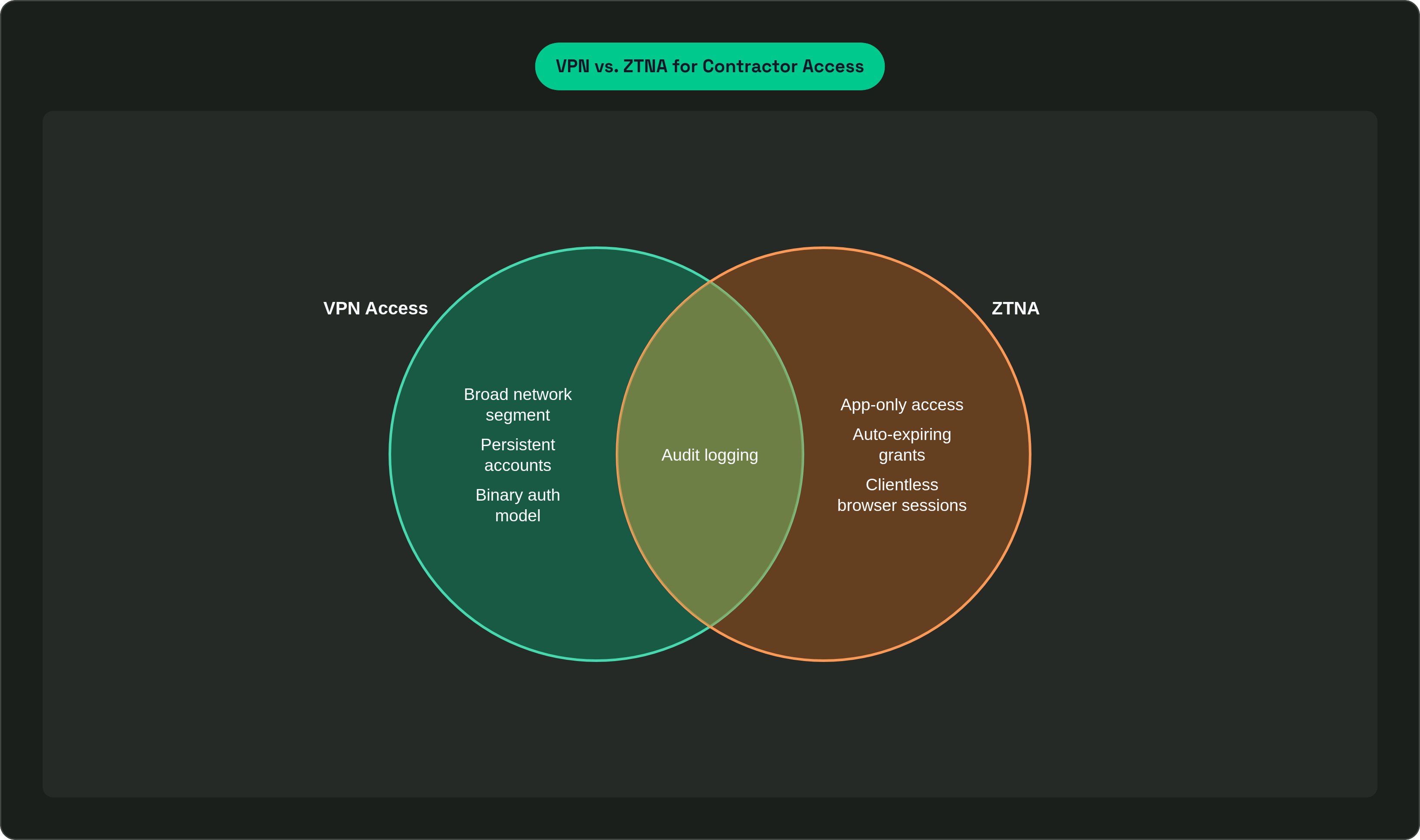
ZTNA's core move is deceptively simple: it severs the connection between "authenticated" and "able to reach anything on the network." Instead of opening a tunnel into the network, ZTNA creates a policy-enforced proxy. Identity is verified, the specific application is resolved, and a session is opened to that application only. The contractor's device never receives a routable IP on the corporate segment. They reach an application surface, not a network surface.
This distinction matters more than it sounds. A contractor accessing a staging environment through ZTNA cannot pivot to the internal file server, because there is no network path to traverse — not because a firewall rule blocks them. The architecture forecloses lateral movement by design, not by configuration.
Continuous verification compounds this advantage. Trust in a ZTNA model is not an event that occurs at login and then persists until the session ends. It is a per-request or per-session evaluation that incorporates device posture, identity signals, and behavioral context. The policy engine is running continuously. This operationalizes the "never trust, always verify" principle as a technical control rather than a philosophical aspiration, and it limits blast radius at the structural level regardless of what happens at the credential level.
Clientless ZTNA and Why It Matters Specifically for External Contractors
Agent-based ZTNA is workable for managed devices. For contractors operating on personal hardware or employer-owned equipment that IT has never enrolled, installing a client before day one is a barrier that often kills the rollout before it starts.
Clientless ZTNA resolves this. The entire session runs inside the browser; no client installation, no device enrollment, no IT touchpoint required at onboarding. RDP, SSH, and internal web applications are rendered inside an isolated browser session. The application is never transmitting content directly to the contractor's device. Malware on that device cannot reach the application because there is no network path; the session is a rendered view, not a connection.
Remote Browser Isolation adds another layer: the application renders in a headless browser on the network side, and administrators can restrict downloads, clipboard access, and printing. The contractor can work; they cannot exfiltrate. This capability enables a tiered access model that replaces the blunt "everyone gets a VPN account" default:
- View-only: the contractor can observe outputs without interacting with sensitive data or systems.
- Single-application: full interaction limited to one designated application and nothing adjacent to it.
- Time-boxed just-in-time access: elevated permissions granted for a defined window, automatically revoked at expiry, with no manual step required.
A tiered model of this kind can typically replace the default VPN-account provisioning workflow within a 60-to-90-day rollout window for the contractor population specifically, without touching employee access at all.
Identity Federation Without Provisioning Corporate Accounts
The traditional contractor access path is a liability loop: contractor needs access, IT creates an Active Directory account, the account persists indefinitely, and offboarding depends on someone remembering to initiate a deletion. ZTNA decouples identity verification from corporate identity provisioning entirely. The organization does not need to own the contractor's identity to verify it.
Multi-IdP support makes this practical. Contractors authenticate through identity providers they already possess, whether that is Google, GitHub, or another supported provider, without IT creating a new credential to manage. For contractors who lack a supported IdP, a one-time password delivered to a verified email address provides assurance equivalent to multi-factor authentication without requiring account creation on either side.
The policy layer then maps that externally-verified identity to exactly the applications and permissions the contract scope requires. Identity federation is not open access; it is scoped access anchored to an identity the organization did not have to build.
The contrast with VDI as an alternative is instructive. VDI achieves application isolation, but the carrying cost can exceed a thousand dollars per user per year in licensing, infrastructure, and operational overhead. Clientless ZTNA delivers comparable isolation without the infrastructure footprint, which is a meaningful difference when contractor headcount fluctuates with project cycles.
Building Access Policies That Expire With the Contract
The structural failure of VPN-based contractor access is that persistence is the default. An account exists until someone deletes it. ZTNA inverts that default: access expires unless explicitly renewed.
Time-bound sessions attach an explicit expiry to the access grant at provisioning. The contractor's access ends on a date set during onboarding, not when someone remembers to revoke it. Trigger-based revocation extends this further: access can be tied to external signals, including contract closure in a ticketing system, project completion in a CMDB, or an inactivity threshold, so offboarding is event-driven rather than reliant on a manual step.
Approval workflows at provisioning create accountability before access is granted rather than after an incident prompts a review. A named approver scopes the permission, sets the expiry, and generates an audit trail. Session logging, a default capability rather than an add-on, records which user accessed which application and what actions occurred without requiring the contractor to install monitoring software.
The lifecycle that replaces the VPN checklist looks like this:
- Map: identify which applications the contractor actually needs, not which network segment their role historically touched.
- Scope: define the minimum permission within each application, distinguishing read-only, write, and administrative access.
- Provision: issue a time-bound, IdP-federated access grant tied to the specific applications.
- Monitor: correlate session logs with expected behavior and surface anomalies without waiting for a support ticket.
- Revoke: automatic at contract end; manual revocation available at any point without IT involvement.
This lifecycle closes the orphaned-account gap structurally because there is no persistent credential to forget to delete. The account does not outlive the engagement by design.
Where ZTNA Fits Within a Broader SASE or SSE Deployment
ZTNA is the fastest-growing segment of the zero trust market, projected to grow from $1.34 billion in 2025 to $4.18 billion by 2030 at a 25.5% CAGR, well above the broader zero trust market's growth rate, according to MarketsandMarkets. Forty-six percent of organizations now name ZTNA as their starting point for SSE adoption, per the Cybersecurity Insiders SSE Adoption Report from 2025, meaning the contractor access problem is frequently the practical on-ramp to a wider program rather than a sidecar project.
The reason ZTNA works as an entry point is that contractor access is a tractable, bounded problem: defined user population, defined applications, measurable outcome. Sixty-one percent of organizations prefer a single-vendor SASE approach over assembling point solutions, according to the same Cybersecurity Insiders research, and a successful ZTNA deployment for contractors builds the organizational and technical foundation that reinforces that consolidation preference over time.
The operational case is concrete. ZTNA reduces remote access support tickets substantially compared to VPN, freeing IT resources that were previously consumed by provisioning, troubleshooting, and deprovisioning contractor accounts. At the program level, organizations that have deployed zero trust architecture save an average of $1.76 million per breach compared to peers that operating without it, according to the IBM 2025 Cost of a Data Breach Report.
What a Practical Rollout Looks Like for a Team Starting From VPN
Most organizations are mid-journey: the majority have implemented zero trust partially, but implementation depth varies widely, and a complete program remains elusive. Starting with contractor access is a realistic, scoped entry point, not a prerequisite for having everything else figured out.
The rollout sequence is more straightforward than the organizational conversation usually implies.
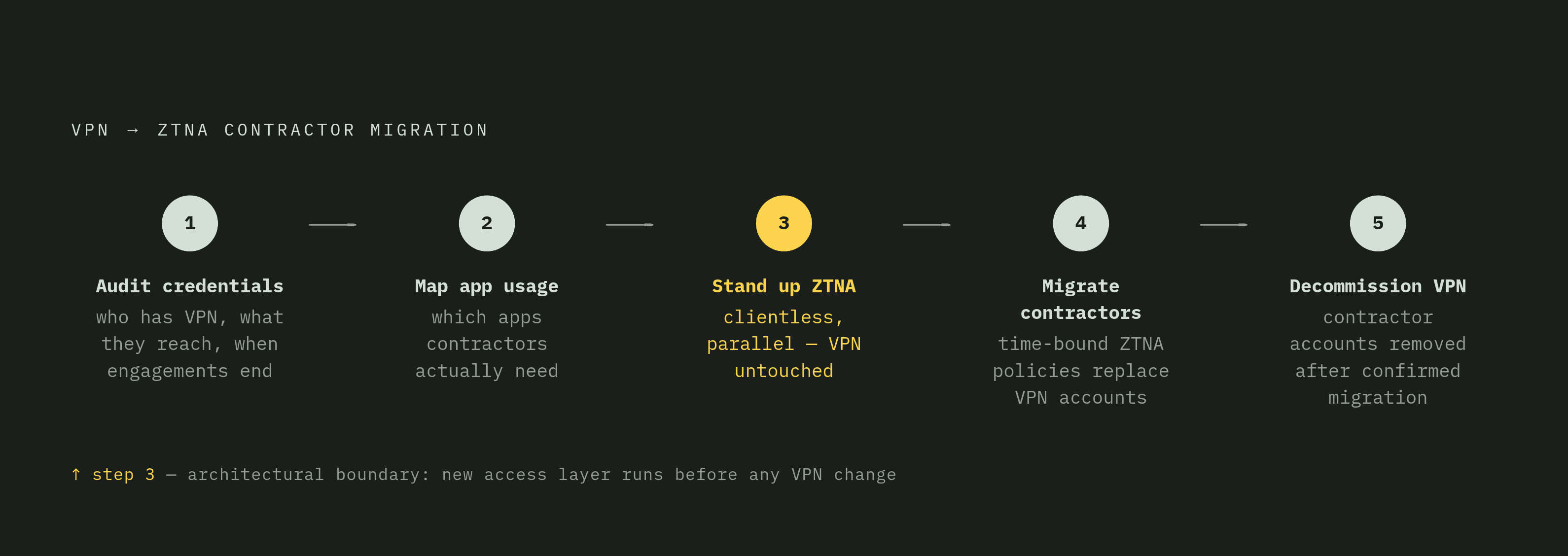
Step one is an audit of active external credentials. Who has VPN accounts, what those accounts can reach, and when each engagement ends. This audit alone resolves the visibility gap that makes orphaned accounts endemic, and it requires no new tooling.
Step two is identifying the applications contractors actually use. Every contractor engagement I've seen collapses to a small set of specific tools: a project management platform, a staging environment, an SSH endpoint. The network segment they can currently reach is almost always larger than the applications they actually need.
Step three is standing up clientless ZTNA for those specific applications before touching VPN infrastructure. Contractors get the new access path; existing employees are entirely unaffected. This is the key to keeping the project scoped and avoiding the organizational resistance that accompanies anything framed as a "full migration."
Step four is migrating contractors off VPN accounts as access is reprovisioned through ZTNA policies with explicit expiry dates. The new policy becomes the canonical access grant; the VPN account becomes redundant.
Step five is decommissioning the VPN accounts for the contractor population once migration is confirmed. Leaving both paths open defeats the purpose and perpetuates the blast-radius problem.
What does not need to happen first: replacing employee VPN, completing a comprehensive zero trust assessment, deploying endpoint agents across the fleet. The contractor use case is separable and deployable independently.
The measurement signal that confirms the rollout is working is simple: track orphaned accounts at 30, 60, and 90 days post-rollout. A well-configured ZTNA policy should reduce that count to near zero without a manual review cycle. If it falls short, the expiry logic needs adjustment, not more headcount.
The organizational argument that clears fastest frames this as "contractor access management" rather than "security overhaul." It has a defined scope, a defined population, and a before/after metric the business can read without a security background. That combination is rarer than it should be in this domain, which is precisely why it succeeds.