AI-Assisted SOC Triage and Alert Fatigue
AI screening work can move from advice to execution if policies and feedback guide it.
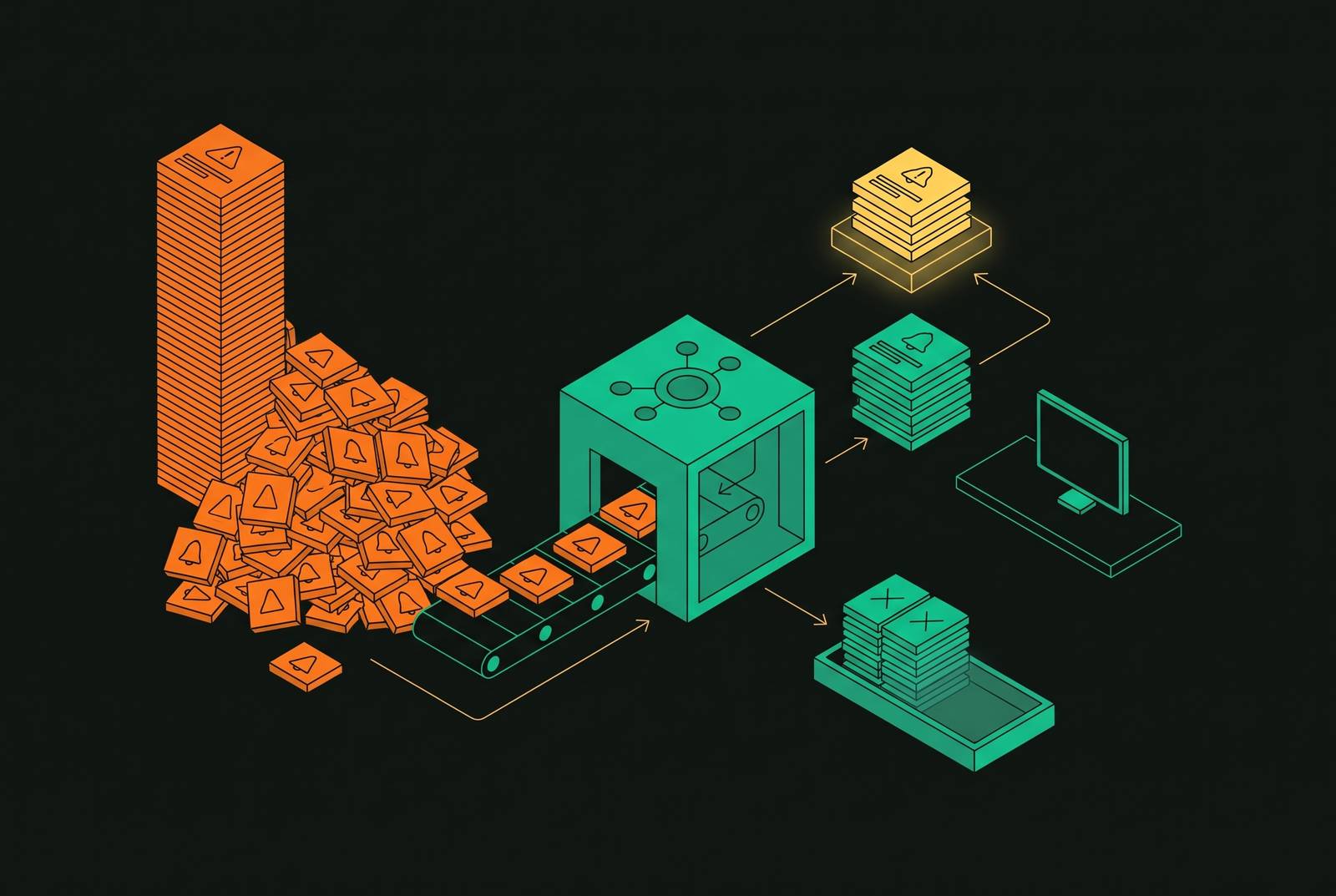
AI-assisted SOC triage addresses a problem that faster dashboards cannot solve. Security operations centers face a structural mismatch between human attention and growing telemetry. AI can help screen that telemetry, but people still have to process every case. Agentic AI can take on delegated work if sound policy, analyst feedback, and results that can be measured support its autonomy.
Why alert fatigue resists conventional fixes
“Alarm fatigue” comes from healthcare, where repeated low-value alarms desensitize the people expected to respond. Fewer alarms alone will not bring back people's attention if they still have little reason to trust the alarms that remain.
Security analysts face the same psychological trap. The National Institute of Information and Communications Technology and Kobe University survey links sustained low-signal alert streams to blanket suppression, severity-based skimming, and over-reliance on tool severity scores. These coping behaviors create blind spots that sophisticated adversaries can exploit. The underlying constraint is fixed human cognitive bandwidth facing telemetry that grows exponentially as attack surfaces expand. Better tuning can relieve pressure without changing that relationship.
Vectra AI’s 2026 data shows that the number of daily alerts fell year over year, but the gap in unaddressed alerts remained. Signal quality is the operative variable. The same data shows a majority of teams using ten or more detection tools, each with its own stream, console, and severity scale. Analysts must work through those differences before deciding which alerts to investigate. The NICT/Kobe survey links overload that lasts for a long time to longer breach dwell times, while false negatives may come to light only after an incident.
How the four-stage screening pipeline becomes the bottleneck
The NICT/Kobe survey divides downstream alert screening into filtering, triage, correlation, and generative augmentation. Filtering takes noise out before alerts reach the analyst queue. Triage prioritizes the alerts that remain by their likely urgency and impact. Correlation connects separate alerts into incident hypotheses, while generative augmentation supplies context and explanations for investigation. Each stage can become its own bottleneck.
Detection sits upstream of this screening workflow. A system can spot suspicious activity quickly but still leave the alert it creates untouched. Darktrace reports that only a quarter of initial alerts are triaged, even after detection engineering and tuning have already suppressed many signals. Some genuine threats are therefore disabled before reaching human eyes. An orderly queue is not necessarily a safe one.
Darktrace identifies Mean Time to Analysis, or MTTA, as the relevant metric here because detection latency is declining while investigation latency is not. The distinction changes what counts as progress. Finding another suspicious event sooner does little for an analyst who cannot start looking into it. Screening performance depends on moving evidence toward a defensible decision.
What AI-assisted triage actually does at each stage of the pipeline
The NICT/Kobe survey describes filtering models trained on past alert data to spot false-positive patterns. These models suppress low-fidelity signals before they reach the analyst queue. Unlike static suppression rules, the filtering is adaptive. Its contribution is not simply a smaller inbox, but the transfer of repetitive screening work from people to machines.
Intezer describes triage models that use past data, user behavior, and environmental context to judge severity and the impact a threat could have. They assign risk scores so that critical threats surface first. Context changes the order of work. Analyst feedback then refines prioritization, allowing the model to learn from decisions made in the organization’s own environment.
Intezer describes AI aggregating endpoint, network, cloud, and application data to identify multi-stage attack patterns. Dozens of alerts spread across security information and event management systems and endpoint detection and response platforms can be brought together as one incident hypothesis.
Generative augmentation makes that evidence easier to examine through summaries, contextual explanations, and suggested next steps. This is useful work, but it has a boundary. D3 Security distinguishes summarizing an alert from investigating it across network, email, endpoint, identity, and cloud evidence. A readable account of the starting point is not the same as following the trail.
Why copilot assistance is a ceiling, not a solution
Copilots make analysts more efficient by enriching alerts, summarizing context, and suggesting what to do next. That is a genuine improvement over manual assembly. Yet the analyst still decides what to investigate, pulls the threads, reviews the result, and closes the loop.
The limit becomes clearest at the response layer. A copilot that cannot contain, isolate, or remediate must hand every confirmed threat back to a person for action. That dependency adds latency precisely when speed becomes most consequential. The machine has prepared the paperwork, but someone still has to leave the desk.
The critique therefore concerns workflow. Assistance increases the amount of work an analyst can complete, but it leaves throughput tied to the availability of analysts. To change the structural mismatch, the system must take responsibility for delegated work.
How agentic AI changes the equation by taking delegated action
Agentic operation moves from advice to execution. The NICT/Kobe survey describes agents that pull context, choose the next investigative step, and execute parts of an investigation without human prompting at every checkpoint. Across the alert lifecycle, this can connect detection, triage, correlation, and response. Delegation removes the requirement that every transition wait for a person.
Intezer describes the Tier-1 shift from manual triage taking roughly 45 minutes per alert to agent triage taking under two minutes, with only confirmed threats escalated. These figures describe a reported workflow change. The organizational consequence is equally important. L1 analysts move from repeating the same screening steps toward supervising AI.
Microsoft reports that its agents automate a substantial share of phishing and malware investigations. Google Security Operations provides another example through an alert triage agent that analyzes context, gathers relevant information, and renders a verdict on behalf of users. Google launched its public preview in November 2025.
Google’s SecOps Labs pilots extend delegation into related workflows. One autonomously converts threat reports into detection rules and generates synthetic data for testing, while a separate pilot recommends and generates response playbooks for new alerts. These are distinct capabilities. Their shared mechanism is the execution of work that would otherwise require a human handoff.
AgentSOC, presented at the 2026 IEEE 5th International Conference on AI in Cybersecurity, combines perception, anticipatory reasoning, and risk-aware action planning in one operational loop. It normalizes alerts, enriches context, generates hypotheses, and executes policy-compliant responses. The NICT/Kobe survey also describes reinforcement learning from analyst feedback that adapts prioritization over time. Autonomy and learning serve different purposes, with one advancing the investigation and the other improving future decisions.
What production deployment of agentic SOC platforms looks like today
The AI SOC category is moving into production, but the label says little about autonomy depth. D3 Security distinguishes investigation that traces threats east-west across tools and north-south through time from systems that stop at triage. It also distinguishes contextual playbooks generated at runtime from static templates requiring SOAR architects to build and maintain them. Static playbooks fail when new threats do not fit the paths they lay out.
Integration maintenance is another operational dividing line. D3 Security identifies self-healing integrations as a way to detect and repair API drift that would otherwise create blind spots as vendors update their systems. Its evaluation criteria also include the share of the full lifecycle handled without human intervention and the staffing still required. A platform dependent on dedicated SOAR architects has a different total cost of ownership from one that removes that dependency.
D3 Security describes Morpheus as combining a Cybersecurity Triage Reasoning Graph, an integrated SOAR engine, and Attack Path Discovery with runtime playbook generation and self-healing integrations. It also provides native multi-tenancy for managed security service providers. Torq’s Socrates automates a high share of Tier-1 tasks without human involvement and delivers substantially faster response times on Google Cloud and AWS infrastructure. These examples establish capability.
Explainability remains a condition of enterprise deployment. D3 Security identifies the need to show what data a system analyzed, how it reached its conclusion, and why it escalated or closed a case. Shared network infrastructure can also reduce integration latency by placing correlated telemetry at the point of inspection. When detection, traffic analysis, and response share a globally distributed network, agents have fewer separate vendor stacks to reconcile.
The analyst role after agentic automation — and what the reskilling gap costs if ignored
L1 roles evolve toward more agile L2 positions, moving between triage and deeper investigation with AI support. That transition requires deliberate training investment. Treating it as an automatic promotion confuses access to better tools with the judgment needed to supervise them.
Darktrace describes senior analysts recovering capacity for threat hunting, recovery activities, and proactive risk reduction when AI handles enrichment, indicator-of-compromise correlation, and cross-tool pivoting. Both the claim that AI simply “takes jobs” and the claim that it requires no reskilling miss this transition. Either can leave organizations underinvesting in the people needed to capture the promised efficiency gains.
Experienced judgment also remains a backstop for unfamiliar attacks. The NICT/Kobe survey identifies weaknesses in adversarial robustness and cross-environment generalization, especially when models encounter patterns outside their training distribution. Analysts need to know when to take a closer look at the system’s conclusions. Intezer describes analyst decisions feeding back into prioritization models, making high-quality human feedback essential to the system’s continuing accuracy.
Why tool sprawl and fragmented policy enforcement undermine agentic SOC before it starts
That feedback loop needs a coherent policy environment. An agent reasoning across separate systems must reconcile their signals before acting, while inconsistent access rules complicate what it is permitted to do. Automation gives fragmentation a faster participant.
The 2026 Zero Trust Report from Cybersecurity Insiders and HPE identifies tool and vendor sprawl as the largest barrier to advancing Zero Trust and SASE, cited by more than a quarter of organizations. This is directly relevant to autonomous triage. The same fragmented infrastructure that obstructs consistent secure access also obstructs an agent’s correlated view of an incident.
Over-privilege makes the action side more hazardous. A majority of organizations cite employee over-privilege as the leading contributor to unauthorized access, and agents inherit the risks of operating in that environment. An autonomous action taken with excessive permissions can compound those risks. Delegated work needs policy enforcement that is consistent as well as broad access to data.
A unified platform model brings security, connectivity, and compute under one control plane, supplying correlated telemetry and consistent policy. Nearly three in ten organizations surveyed say adopting a unified platform would do the most to speed up their Zero Trust journey. For agentic SOC, consolidation is an operational prerequisite. It reduces the conflicting signals and policies the agent must resolve before its decision loop can deliver useful speed.
The open problems that production deployments have not yet solved
The NICT/Kobe survey identifies four persistent gaps, namely adversarial robustness, cross-environment generalization, evaluation practice, and operational validation. Strong benchmark results can degrade on novel attacks or fail to transfer between environments. Research metrics also do not reliably map to operational SOC metrics. Field evidence from Tier-1 production remains thin relative to benchmark-based claims.
Adversarial robustness is a deeper challenge than routine tuning. Attackers can make inputs that take advantage of blind spots in prioritization models, including getting the models to ignore particular attack signatures. Explainable AI tools exist, but their deployment is inconsistent, and standard explainability requirements for SOC use have not converged.
Mature, validated autonomous deployments remain a minority, with most organizations still at early or proof-of-concept stages. That limits claims about widespread results without invalidating delegated action itself. Microsoft, Google, and Torq provide evidence of the mechanism in operational use, though their capabilities and deployment stages differ. The remaining task is to establish what works reliably in a particular environment.
For teams evaluating platforms, the practical response is measurable proof-of-value rather than confidence borrowed from vendor benchmarks. D3 Security recommends evaluation using false-positive reduction rate, mean time to triage, and analyst escalation rate. Those measures test whether the system makes accurate decisions on delegated work and leaves less for people to handle.