Cache Hit Rate Optimization for Dynamic and Personalized Content
Move dynamic data to the end of prompts to unlock cache efficiency.

Low cache hit rate on dynamic content happens upstream of the cache layer, baked into how the request got built before it ever asked to be cached. It is not a TTL you forgot to bump, or a purge rule you got backwards. The failure happens upstream of the cache layer entirely, baked into how the request got built before it ever asked to be cached. Treating dynamic, session-aware, or user-specific content as automatically uncacheable made sense once, back when that kind of traffic was a rounding error against the mass of static assets sitting quietly at the edge. That assumption has not aged well, mostly because the traffic mix flipped underneath it without anyone updating the rulebook.
Policy controls what gets stored and for how long, while architecture controls whether two requests carrying the same meaning end up with the same cache key. No amount of policy tuning fixes a key that was broken at construction. You can raise the TTL to a week, and you can whitelist every header you can think of, but none of it matters if the request itself was built to be unique every single time. That is the reframe. Everything downstream, the KV cache mechanics, the ProjectDiscovery numbers, the CDN parallels, is a variation on this one idea: fix the key, or stop pretending the cache was ever going to help.
Prompt and request structure silently destroying cache hit rates in LLM and API workloads
In LLM API workloads, caching runs through the KV cache, the stored intermediate computation from processing a prompt's tokens. Providers reuse that computation only when a new request opens with a token prefix identical to one already seen; change a single token near the front, and the whole thing misses. Not degrades, not partially reuses. Misses completely. That all-or-nothing behavior makes prompt structure unforgiving, and teams who think they've "mostly" got caching right are usually getting nothing.
The failure modes here are not exotic engineering mistakes, they're mundane habits that seemed harmless at the time. A timestamp dropped into the system prompt for logging purposes turns every request into a unique prefix, and cache hit rate falls to zero without anyone touching a config file. Tool schema reordering does the same damage through a subtler path: dynamically constructed tool lists, or a JSON serializer that doesn't guarantee key order, will produce schemas that are structurally identical but hash differently, and on a large agent prompt that single quirk invalidates the entire cached computation. User-specific data injected too early is the third culprit, and arguably the most common: placing a user ID or account tier near the start of the system prompt makes every user's prompt unique, when the cacheable prefix is supposed to hold only what's identical across every request, regardless of who's asking. Whitespace inconsistency rounds out the list, quietly, through prompts that pass through Jinja templates, Markdown renderers, and string sanitizers that each normalize whitespace a little differently, turning semantically identical content into different token sequences.
None of these appear in a code review as "this will break caching." They appear as reasonable, defensible engineering decisions, each one independently fine, that together add up to a cache that never fires. The web has the same disease under a different name: session tokens, user identifiers, or personalization context stuffed into the URL, the query string, or early request headers manufacture a unique cache key for content that's otherwise shared across thousands of users. Edge-Side Includes exist specifically to solve this, by splitting a page into cacheable and non-cacheable segments so the header and footer get cached while only the personalized block gets fetched fresh.
Cost differential of incorrect versus correct prompt structure
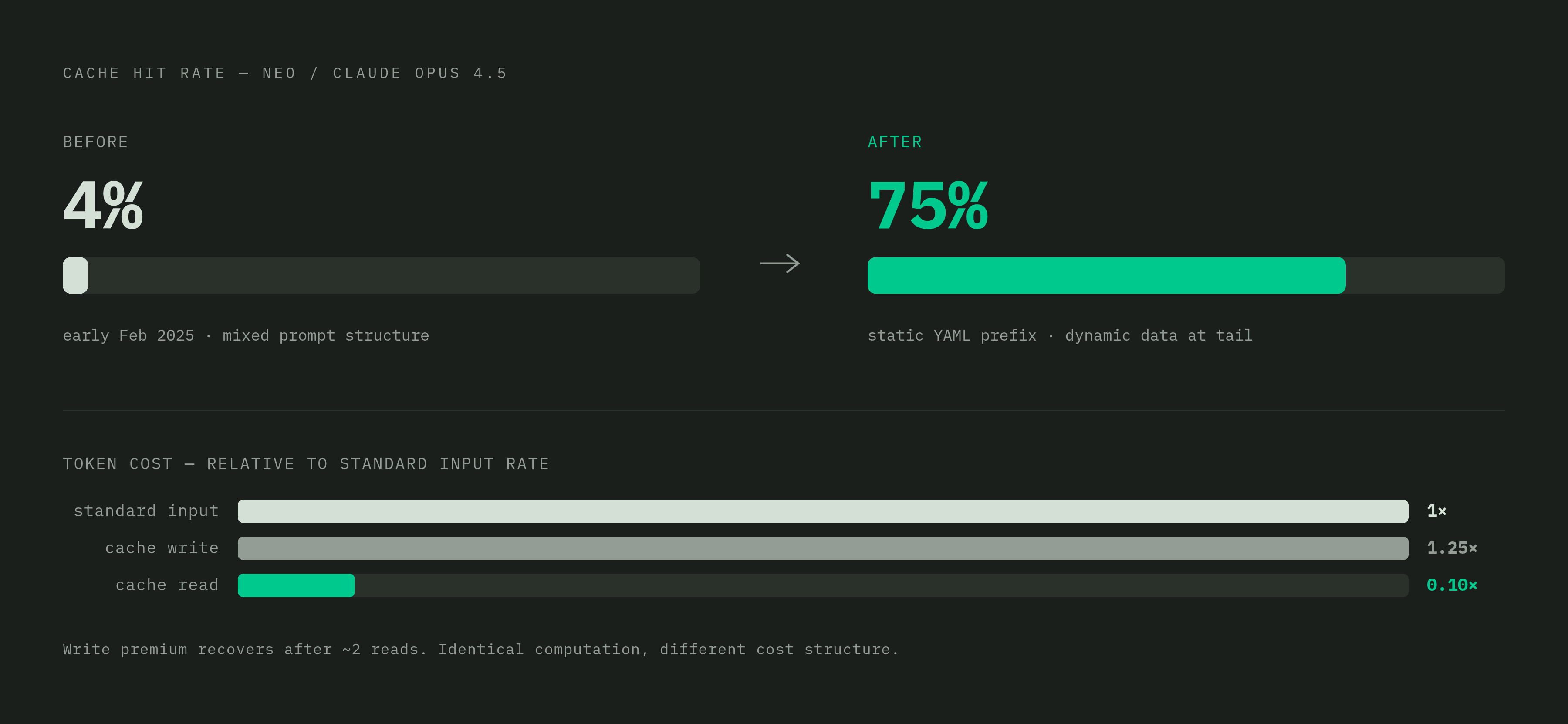
Neo is an agentic task runner built on Claude Opus 4.5, with substantial system prompt length per agent. In early February 2025, its cache hit rate sat at roughly four percent. Four percent means the system was recomputing almost the entire prompt on almost every request: the cache hit rate in early February 2025 was roughly four percent.
The fix was structural: pull working memory, runtime context, and session-specific data out of the cacheable prefix entirely, move it to the tail of the user message, and keep a static YAML system prompt with an explicit cache breakpoint marking where the stable part ends. That one change moved cache rates from low single digits into the mid-seventies, with the gains holding up in the most recent measurements. That is not a tuning improvement. That is a different cost structure for identical computation, and it maps directly onto the provider economics, since cached tokens on Anthropic's API run at a small fraction of the standard input rate, the write premium breaks even after only a couple of reads, and a prompt that hits repeatedly ends up costing a fraction of what an uncached version costs.
Before this reads as "cache everything, always," a January 2026 study on prompt caching for agentic tasks complicates the picture. Testing across more than five hundred agent sessions on multiple major models running PhD-level research tasks, the study found savings ranging from a solid minority of spend to most of it, but the distribution was uneven, and the best-performing strategy on every single model was caching the system prompt only, not the full context. Full-context caching, it turns out, is not free insurance. Volatile tool results sitting in the middle of context create mismatches that add overhead instead of removing it. The cost curve here is not linear, and "more caching" is not automatically the right instinct. ProjectDiscovery's case, as reported by the DEV Community, illustrates what the cost differential looks like when prompt structure is wrong versus right.
The structural prompt architecture that makes high cache hit rates repeatable
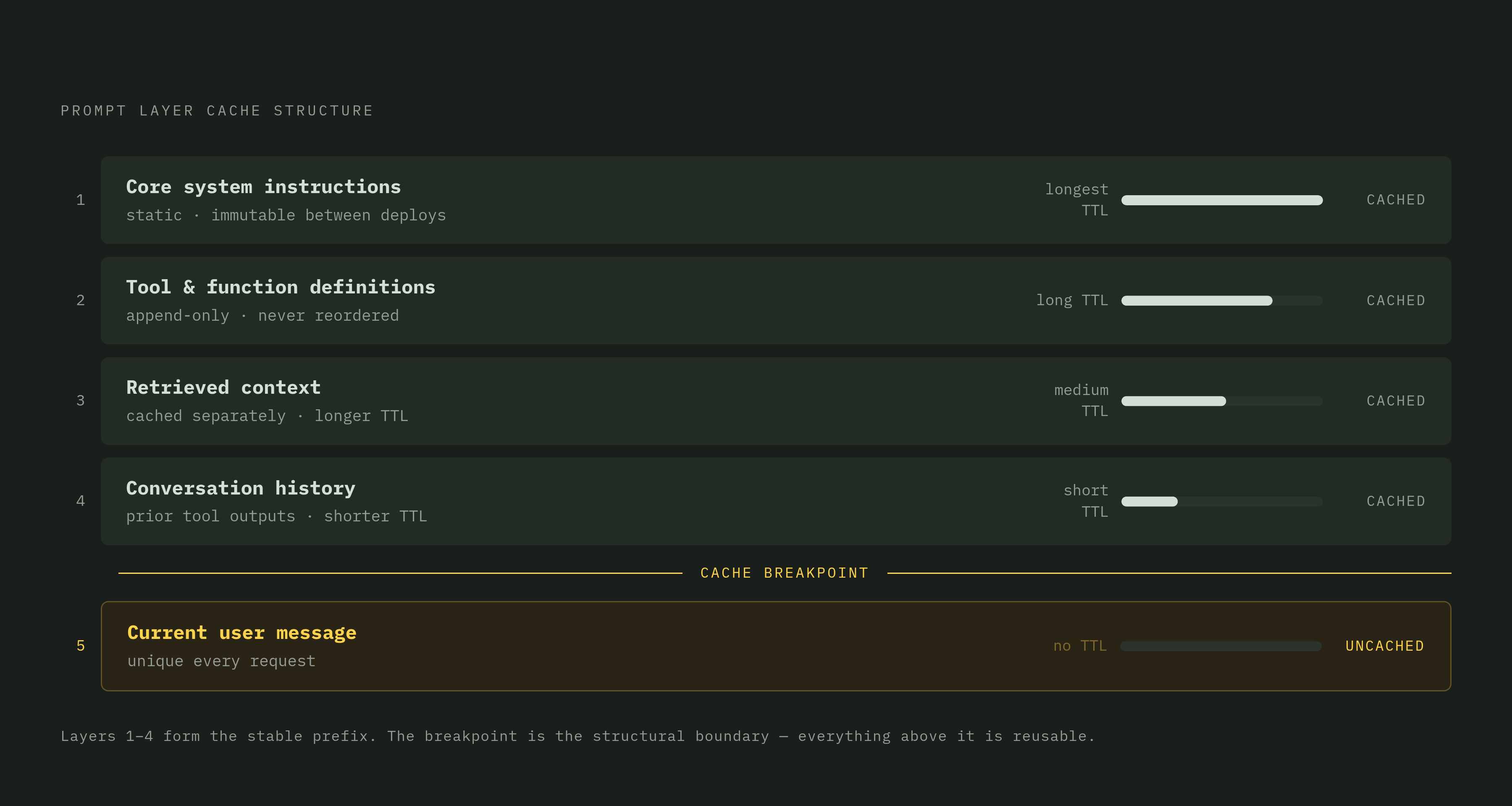
Static content first, dynamic content last, is the principle underlying all of this, and it demands treating the system prompt like a policy document instead of a dumping ground for personalization. A policy document doesn't change every time a new user shows up. Neither should the front of your prompt.
Building that ordering is a sequence. Core system instructions and behavioral rules, the largest and most static block, come first and are ideally immutable between deploys. Next come tool and function definitions, which should be append-only: never reorder them, never mutate an existing entry, because reordering invalidates the cached computation described earlier. After that sits retrieved context and reference material, cached separately with a longer TTL since documents don't change on every request. Then conversation history and prior tool outputs, cached with a shorter TTL because they're tied to the session. Only at the very end does the current user message appear, uncached, because it is the one part of the request that is genuinely unique every time.
Tool definitions deserve their own discipline separate from the ordering logic: sort names alphabetically, pin the key order, and use a serializer that produces deterministic output every time, because a JSON library that shuffles keys "for efficiency" is quietly sabotaging the whole structure. Prompt changes should be treated as events, not edits, with a warmup expected to produce a temporary dip in hit rate before recovery. And the cache breakpoint itself, the explicit marker for where the stable prefix ends, is not decoration. Without it, the provider has no clean signal for where cacheable content stops and dynamic content begins.
Cache hit rate as a production metric that must be monitored continuously, not set once
Architecture that's correct on deploy day does not stay correct by default. The most common production arc looks the same across teams: caching gets enabled, costs drop, everyone moves on to the next problem, and months later the hit rate that started strong has quietly fallen to a fraction of its peak because of a slow accumulation of small edits that each seemed harmless on its own. Nobody breaks the cache on purpose. It erodes.
The fix is instrumentation. Anthropic's API reports cache read token counts directly in the usage field of a response, or in the message_start event for streaming requests, and logging cache_read_input_tokens alongside standard token counts is the baseline requirement for actually seeing what's happening. Once that's in place, the thresholds are fairly blunt. A hit rate above seventy percent is achievable on workloads with a stable prompt. Rates above eighty percent have shown up in production under disciplined architecture. And a rate below thirty percent on a workload that has a fixed system prompt is a structural problem, full stop. Cache hit rate belongs on the same dashboard as token spend per workflow step, watched with the same seriousness as latency or error rate, not filed away as a deployment checkbox that gets ticked once and forgotten. According to the TianPan.co analysis, certain thresholds indicate a structural problem in cache hit rate as a production metric. The same monitoring discipline applies at the CDN layer for web workloads: cache hit ratio is a reported metric on any production CDN, and sustained drops in hit ratio on content that has not changed signal either a key structure problem or a purging issue.
The static-first principle applied to web CDN caching for personalized pages
Personalized web content gets written off as uncacheable more often than it deserves to be. The actual problem isn't personalization, it's where the personalized data gets fused into the response. Inject session state, a user identifier, or account-tier data into the URL or into early request headers, and the cache key manufactures uniqueness out of a response that was largely identical across users. That is the same mistake as caching responses keyed on an LLM prefix that varies by user, wearing a different outfit.
Edge-Side Includes solve it the same way at the web layer: decompose the page so the header, footer, navigation, and product listings cache at the edge, and only the genuinely personal block, an account balance, a recommendation list, gets fetched fresh from origin. Modern CDNs have made this an operational feature rather than a theoretical one, pairing ESI with advanced purging so the decomposition actually holds up under real traffic. Granular cache rules, by path, by device type, by geography, combined with real-time purging when the underlying content actually changes, give teams a way to cache dynamic-but-stable content without guessing, and this level of control is now table stakes on production CDNs rather than a specialty feature. Cache key construction is the web equivalent of token prefix ordering: a cache key that includes a session cookie or user ID in its hash will never produce a hit for any other user, even if ninety-five percent of the response is identical.
Multi-layer caching architecture for workloads that mix static, dynamic, and agent-generated content
Real production traffic doesn't sit neatly in one category, so no single cache layer is going to cover it. The workable model has three layers, each tuned to how volatile and how shareable its content actually is. Beneath that sits an intermediate reverse-proxy or application-layer cache, handling content that's dynamic but stable, product catalogs, permission sets, shared tool definitions, with a medium TTL keyed on whatever dimensions of the request are actually stable. Closest to the application sits an in-memory data cache like Redis, covering hot data paths inside a session with a short TTL, functioning as the application-layer equivalent of the KV cache.
For agentic workloads, TrueFoundry's AI Gateway centralizes model access, routing, fallback handling, authentication, caching, and tool orchestration, a design pattern increasingly adopted by healthcare, finance, and government or other regulated industries requiring governance. The gateway acts as an intermediate cache layer for model calls, the same architectural role a reverse proxy plays for HTTP responses.
Where compute gets placed affects end-to-end latency, particularly when the bottleneck isn't network distance to the user but the time it takes to reach backend data. Smart Placement for edge compute puts the compute near the data instead of near the user, which cuts end-to-end latency specifically for data-dependent responses. That's a different lever than caching, but it's solving an adjacent problem, and teams optimizing hit rate without looking at where compute physically sits are leaving a second source of latency on the table. The research brief recommends a three-layer model for multi-layer caching architecture. CDN edge cache handles static assets and popular pages, using a long TTL and keying on path and content hash, never on session state.
Security enforcement that runs on the same layer as caching, not after it
The objection to all of this usually arrives fast: cache more aggressively and eventually someone serves the wrong content to the wrong user. It's a fair worry, and it's also the reason security checks can't be bolted on after the caching decision has already been made. If authorization happens downstream of the cache, in a separate service, behind a separate vendor, the cache has already decided what to serve before anyone checked whether the requester was allowed to see it. That ordering is backwards.
The fix is running enforcement on the same execution plane as the cache itself, so the check happens as part of serving the request, not as a follow-up audit. A globally distributed edge network that handles security enforcement, caching, and compute together removes the round-trip that occurs when those three functions live with different vendors and have to hand off to each other in sequence. Every one of those handoffs is a place where the cache serves before the security check finishes, or where a cache key gets built without knowledge of the authorization context that should have shaped it. Collapse the layers, and the cache key can actually reflect who's allowed to see what, instead of trusting a downstream service to catch the mistake after the response has already gone out.