TLS Handshake Performance and Protocol Optimization at Scale
TLS 1.3 and careful cipher selection cut handshake latency by a third at scale.
TLS Handshake Performance and Protocol Optimization at Scale.
TLS handshake latency as a first-order infrastructure problem
Every secure connection on the internet starts the same way: a key exchange, an authentication step, and a negotiation over which cipher to use, all before a single byte of the actual request goes anywhere. That setup work is the handshake, and it is easy to treat as plumbing, something a config file handles once and nobody revisits. That's a mistake at scale. A few tens of milliseconds of handshake overhead, multiplied across millions of concurrent sessions, becomes a measurable drag on throughput for anyone running global infrastructure. The handshake also isn't one event with one latency number attached to it. It breaks into distinct phases, TCP setup, TLS negotiation, certificate validation, and key exchange, each with its own budget and its own place to fail slow. What makes the timing unusually pointed right now is that two pressures are converging at once: the ordinary push to shave milliseconds off every connection, and the looming, mandated shift to post-quantum key exchange. Together they make protocol choice more consequential than it has been at any point before. The Telefonica/Keysight/Carlos III layered decomposition methodology (arXiv:2603.11006, March 2026) offers a framework the rest of the piece will draw on: five protocol phases from TCP through application response, each attributable separately.
TLS 1.3 handshake changes and latency numbers
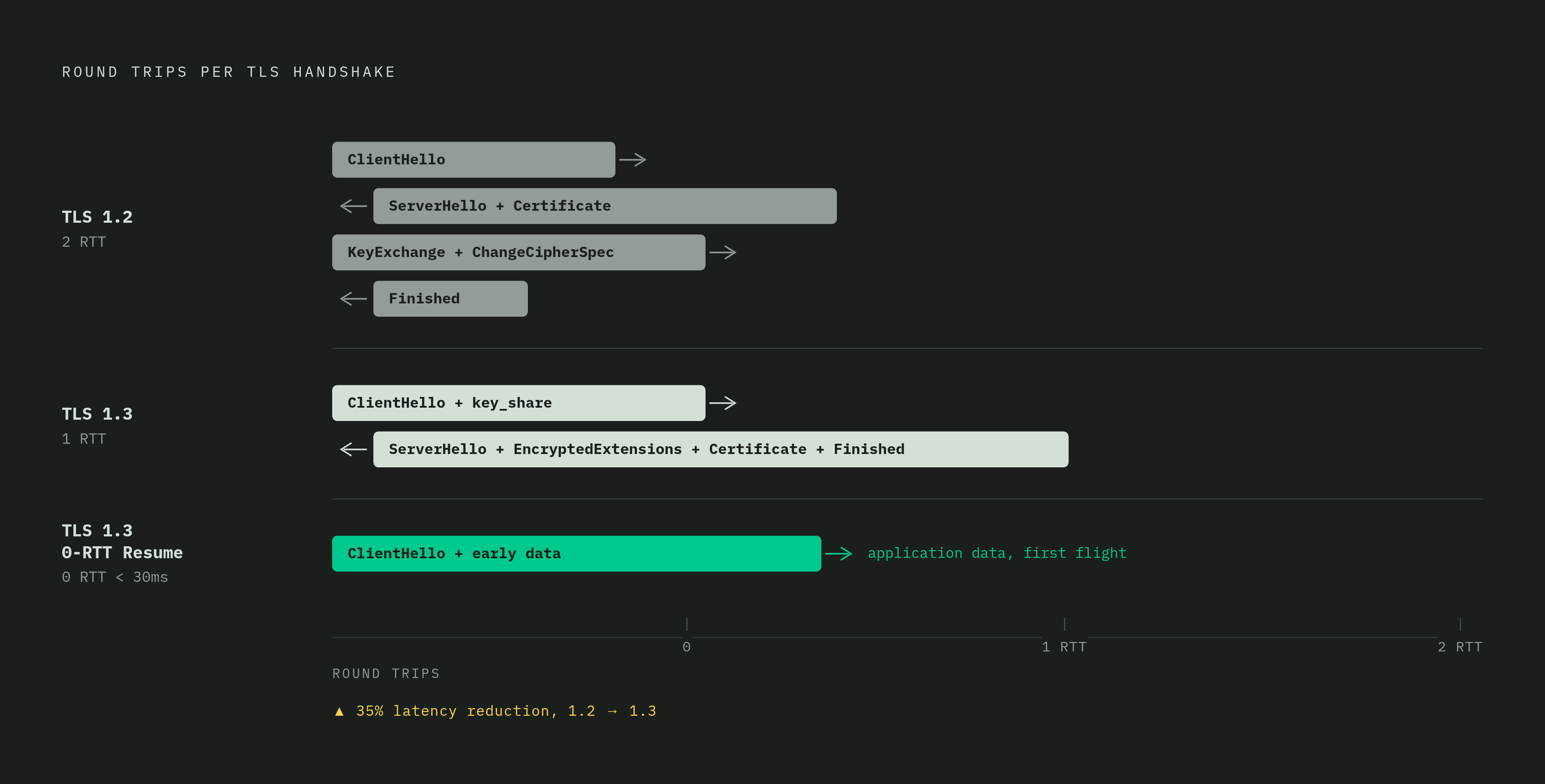
TLS 1.2 asks for two full round trips before any application data moves: ClientHello, then ServerHello plus certificate, then key exchange, then Finished. TLS 1.3 collapses the handshake to 1-RTT: the ClientHello carries the key_share extension, and the server responds with ServerHello, EncryptedExtensions, Certificate, CertificateVerify, and Finished in a single flight. The ClientHello now carries a key_share extension up front, and the server answers with ServerHello, EncryptedExtensions, Certificate, CertificateVerify, and Finished all in one flight, one round trip, done.
A 2025 study running 100 globally distributed cloud servers against RSA-2048, ECDHE-RSA, and ECDHE-ECDSA configurations found TLS 1.3 cuts handshake latency by roughly 35% compared to TLS 1.2 ijccts.org. That number matters more in some places than others. At high connection volumes the aggregate savings pile up fast, and at the edge, where geography already stretches round-trip time, cutting a round trip out of the handshake counts for more than almost any other optimization available ijccts.org. The industry is treating this as settled business. None of that means TLS 1.2 disappears tomorrow: plenty of legacy systems still need it, so the sane posture is TLS 1.3 as the default, TLS 1.2 held as a fallback, and TLS 1.0 and 1.1 switched off entirely. Over a hundred cipher suite combinations from TLS 1.2 were replaced with only AEAD suites (fewer options means faster negotiation and no weak-algorithm paths). will begin marking TLS 1.2 connections as "Bad" starting 2026-12-14, signaling an industry direction in which TLS 1.3 is treated as the required baseline. NIST, as of January 2024, requires government agencies to support TLS 1.3, per LogicMonitor's analysis.
Session resumption and 0-RTT: how returning connections sidestep the full handshake
TLS 1.3 gives returning connections two ways to skip the full negotiation. Session tickets are the simpler one: the server hands the client a NewSessionTicket after the first handshake, and the client presents it on the next connection to resume without renegotiating from scratch. QUIC carries the same idea but moves the delivery mechanism, packaging NewSessionTicket messages inside CRYPTO frames after the handshake wraps up.
0-RTT, or early data, goes further and cuts latency to almost nothing for the first request itself: the client sends actual application data, an HTTP GET, say, in that very first flight, before the server has said anything back.
It comes with a catch that doesn't get enough airtime: replay. A network adversary who captures that first flight can retransmit it, and the server, having no proof it's seeing a fresh request, may process it twice. Read-only GETs, static asset fetches, idempotent API calls: fine. There's also a quieter operational lever here, session ticket rotation frequency, that a lot of teams under-think: rotate too slowly and stale tickets sit around as exposure, rotate too aggressively and the resumption benefit evaporates before it can pay for itself. It makes it a decision that has to be made deliberately, at the application layer, not flipped on as a global default and forgotten. Teams that turn it on everywhere accept replay risk they haven't measured; teams that ban it everywhere are leaving real latency on the table for no reason. Research (ijccts.org) shows session ticket reuse and 0-RTT together achieve sub-30ms negotiation times, making them the mechanism of choice for latency-sensitive applications and edge delivery. Which request types are safe for 0-RTT:. Unsafe without replay protection: state-changing POSTs, payment flows, authentication submissions.
Cipher suite selection and the certificate chain's hidden role in handshake cost
TLS 1.3's cipher suite list is short by design, AEAD-only, which narrows the negotiation surface considerably. But the signature algorithm sitting on the certificate side is a separate decision, and it still moves the needle. Lab testing across Intel x86 and Raspberry Pi 4 hardware in 2026 found ED25519 and ED448 signatures consistently posting the highest handshake throughput of the classical elliptic-curve options.
Certificate chain length is easy to overlook because it does not appear in any cipher benchmark. Every additional intermediate certificate is another parse-and-verify step, and the JISIS 2025 analysis of SSL/TLS handshake latency flagged chain length as a real, independent source of delay, separate from whatever cipher is running underneath it. OCSP stapling closes a related gap: without it, the client has to make its own live revocation check against an external OCSP responder, which can tack a full extra round trip onto the handshake. Encrypted Client Hello, now running in production at multiple major providers as of 2025, closes a different hole, the SNI field, which used to be plaintext and hand any on-path observer the server name being requested even inside an encrypted session. ECH costs a small increase in handshake size and buys a real privacy improvement in return.
None of these are one-time settings. Cipher choice, chain length, stapling, and ECH interact with each other, and the costs compound if they're not looked at together. ECDHE with P-256 or X25519 offers fast key generation and small key sizes; X25519 is increasingly preferred for performance and implementation safety. Cipher suite selection and certificate configuration are not set-once decisions, they interact with key exchange overhead and certificate validation paths in ways that compound; the optimized stack chooses small, fast elliptic-curve signatures, short chains, stapled OCSP, and ECH together.
Post-quantum key exchange: what the performance data shows layer by layer
NIST finalized its first post-quantum cryptography standards in August 2024: FIPS 203 for ML-KEM, FIPS 204 for ML-DSA, FIPS 205 for SLH-DSA. Network vendors and major platforms have been integrating them since. Running classical elliptic-curve key exchange, a hybrid combining that classical approach with a post-quantum key encapsulation mechanism, and a pure post-quantum key encapsulation configuration at 100 transactions per second across more than 30 experiments and roughly a million total requests, the finding is almost anticlimactic: the TLS handshake layer itself barely cares which key exchange algorithm it's running.
The cost, where it exists, is visible elsewhere. Hybrid configurations pairing X25519 with ML-KEM-768 posted the lowest handshake throughput across every signature algorithm tested, and that penalty traces back to bigger handshake messages and extra cryptographic operations, not to anything about TLS itself. There's a real optimization lever available here too: switching to CPA-secure KEMs delivered up to a 44.8% improvement at the key-exchange layer specifically, and close to 9% faster full TLS 1.3 handshakes, with the added benefit of a smaller attack surface since re-encryption gets eliminated entirely ncbi.nlm.nih.gov. QUIC complicates the picture further.
Put together, the migration math is more forgiving than most teams assume. The handshake latency tax from hybrid PQC is small. The actual engineering headache is message size growth, which bites hardest on networks with tight MTUs or higher packet loss, not on raw handshake speed. All three configurations show negligible effect sizes (Glass's Δ. PQC overhead is detectable but small in absolute terms: 0.37–0.48ms, stable across configurations, independent of backend response size. ScienceDirect Computer Networks notes that QUIC's tight coupling of transport and cryptography means PQC changes to the handshake have unresolved implications for congestion control, connection migration, and 0-RTT resumption; these interactions have received limited formal analysis.
Why organizations are migrating to post-quantum now
The migration is driven by "harvest now, decrypt later" (HNDL): adversaries collect encrypted traffic today and hold it until a cryptographically relevant quantum computer exists to decrypt it, meaning traffic with long-term sensitivity is already at risk. Anything with a long confidentiality shelf life, financial records, health data, government communication, is exposed under that model whether or not the decryption capability has arrived yet.
Regulators are treating this as a deadline problem. The NSA's CNSA 2.0 guidance requires networking equipment and firmware signing to run exclusively on quantum-resistant algorithms, including ML-KEM-1024 for key establishment, by 2030, with web, cloud, OS, and application categories following by 2033 ijccts.org. On the industry side, Google and several major network infrastructure providers have set 2029 as their internal target for finishing a full post-quantum migration across their entire encryption stack, not just TLS, citing the pace of quantum hardware progress and improved error correction alongside the HNDL threat as the reasons for moving now. Given that the previous section found the handshake performance cost of PQC to be modest, the real obstacle to migration is the surrounding certificate ecosystem. It's whether the surrounding certificate ecosystem is ready to support it. ENISA and UK NCSC have recommended adopting PQC protections now for long-sensitivity data.
The certificate infrastructure gap blocking full post-quantum deployment
Two specific things stand between where PQC is today and full public deployment. First, the CA/Browser Forum has to update its Baseline Requirements before ML-DSA can appear in publicly trusted certificates at all, and as of mid-2026 that ballot was still in draft, not merged. Both pieces are expected to land sometime in 2026 or 2027.
Private and internal PKI is a different story, and it's available right now. ML-DSA certificates can be tested today through DigiCert Private CA, through AWS Private CA (generally available since November 2025), and through open-source tooling, OpenSSL 3.5 and later supports it natively without needing the OQS provider layered on top. That makes internal services, service-to-service mTLS, and zero trust internal certificate authorities the realistic place to start migrating before the public ecosystem catches up. Hybrid key exchange, classical algorithms running alongside PQC ones, is the sensible posture for the interim: it neutralizes the harvest-now threat while staying interoperable with clients that don't yet speak pure PQC.
Audit the current cipher suite and certificate setup, turn on hybrid key exchange across TLS 1.3 endpoints, start migrating internal PKI to ML-DSA for services that don't touch the public internet, and keep an eye on the CA/Browser Forum and IETF timelines so the public rollout isn't a surprise. For organizations running PQC at real volume, DPU offloading scales throughput close to linearly under multi-threaded load, beats host-based throughput by a wide margin once load gets heavy, and cuts latency variance to under 0.1%, against host-based variance that can exceed 34% under the same load. The throughput number gets the attention, but the variance number is arguably the more important one. Predictable latency is what lets an infrastructure team make promises they can actually keep. IETF must finalize remaining OID and encoding standards for composite/hybrid PQC in X.509, though core ML-DSA and ML-KEM X.509 standards were already published as RFC 9881 and RFC 9935, kunalganglani.com reports.
Network topology and edge proximity's effect on protocol optimizations
None of the protocol work above escapes physics. Round-trip time is bounded by the speed of light over distance, full stop, and that means cutting round trips through TLS 1.3 or 0-RTT only pays off if the endpoint is actually close to the client. A 1-RTT handshake to a server on the other side of the planet can still lose to a 2-RTT handshake against something nearby. Distance beats round-trip count every time it's tested.
Here, edge architecture carries more weight than a footnote, becoming the factor that decides whether any of the earlier optimizations matter. A CDN sitting at the edge can terminate TLS 1.3 for modern clients while still bridging back to an origin server that hasn't upgraded yet. End users get the benefits of TLS 1.3 before the origin infrastructure catches up at all. Anycast routing does something similar for geography: every request lands on the nearest healthy server, so certificate validation, key exchange, and cipher negotiation all happen at the shortest possible distance. Cold start is a related, less obvious tax. If a compute node has to spin up before it can even terminate a TLS connection, that startup delay gets folded into what the user experiences as handshake time, and edge platforms that hit sub-5-millisecond initialization eliminate that category of cost outright. Raw network capacity is the cause: infrastructure spread across 330-plus locations in more than 120 countries, carrying over 200 Tbps, sets the performance floor that every TLS optimization discussed above is built on top of. Get the protocol layer right and skip the topology work, and the gains mostly evaporate before they reach anyone.
Sources
- Layered Performance Analysis of TLS 1.3 Handshakes: Classical, Hybrid, and Pure Post-Quantum Key Exchange
- Comparative analysis of post-quantum handshake performance in QUIC and TLS protocols - ScienceDirect
- TLS 1.2 vs. 1.3—Handshake, Performance, and Other Improvements
- jisis.org
- On the Security and Efficiency of TLS 1.3 Handshake with Hybrid Key Exchange from CPA-Secure KEMs
- ijccts.org
- Layered Performance Analysis of TLS 1.3 Handshakes: Classical, Hybrid, and Pure Post-Quantum Key Exchange