Edge Compute for Real-Time Personalization Without Backend Round-Trips
Moving personalization logic to the edge eliminates the latency that kills user experience.
Personalization does not fail because the recommendation engine picked the wrong banner. It fails because the correct decision arrived too late to matter. The user has already scrolled past, already bounced, already formed an opinion of the page before the "personalized" version finishes assembling. The fix isn't smarter logic or fresher data, it's simpler infrastructure: move the decision itself off the round-trip entirely.
What edge compute actually does differently from a CDN or a faster origin
Start with what a CDN actually does: cache static files and serve them from a location near the user. A CDN is a filing cabinet with branches in every city. It does not think. It cannot check a user's session, weigh a feature flag, or decide which of six hero images to show a returning shopper in a distant city, because personalized UI isn't static by definition. The moment a page needs a decision instead of a lookup, the CDN hands the problem back to the origin.
A faster origin server doesn't fix this either. It just makes the same trip a little quicker. If a user in one city hits a server in a distant region, the request has to physically cross an ocean, bounce through routers, and come back. No amount of server-side tuning changes the distance the signal has to travel. That's the speed of light doing exactly what it's supposed to do, which happens to be inconvenient for anyone building a real-time product.
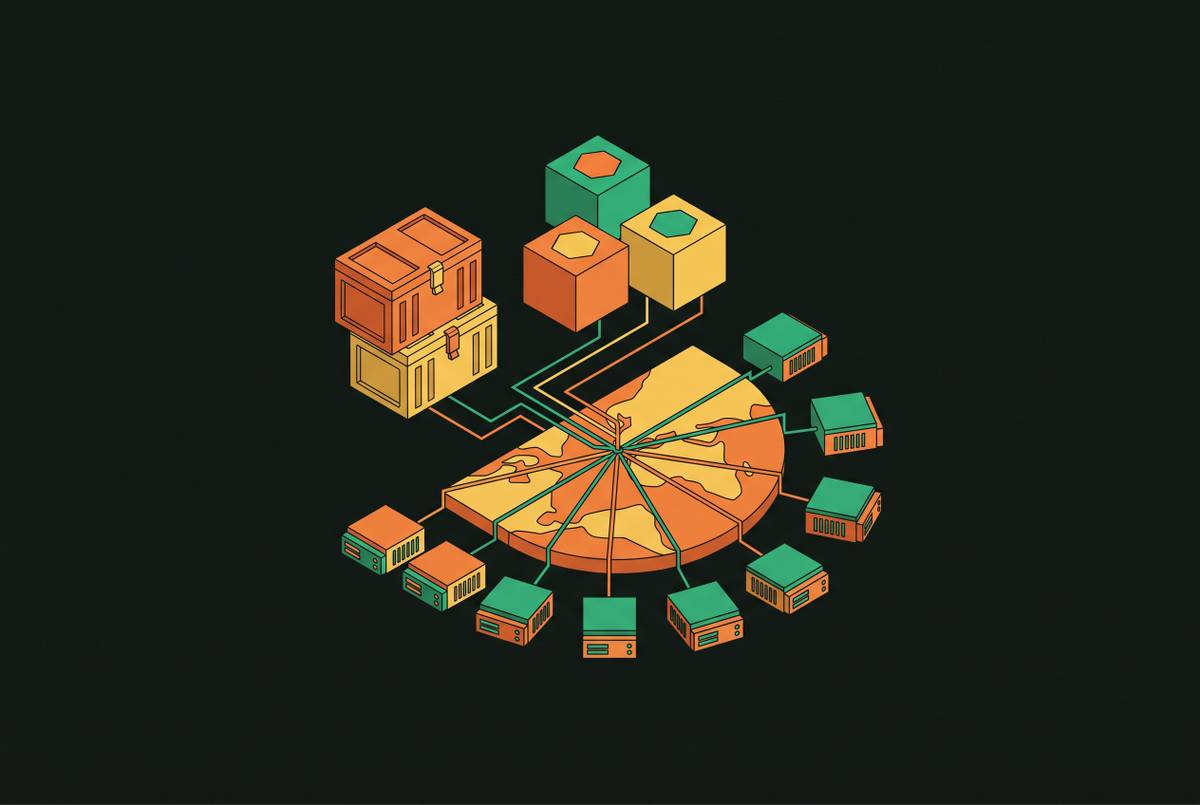
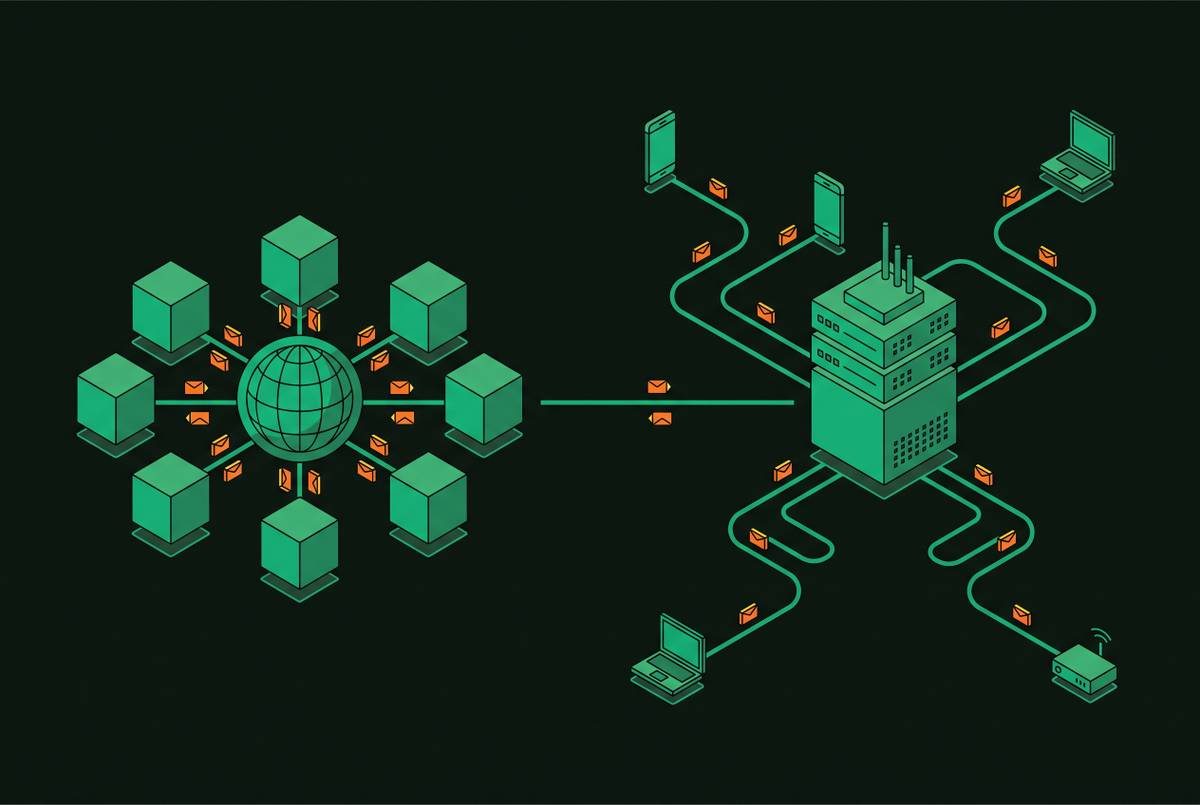
Edge compute is a third thing, separate from both. Instead of one centralized backend, application code runs on distributed points of presence, the same network layer a CDN uses for cached files, except now it's running logic instead of just serving bytes. A request from Tokyo gets handled by a node in Tokyo. Mumbai gets handled near Mumbai. The personalization call, which variant, which content block, which flag is on, gets made at that nearby node before a response is even assembled, and origin never sees the request in the common case.
One more thing worth knowing: these edge runtimes start up for almost nothing. Edge functions built on V8 isolates, the same isolation model that runs a browser tab, spin up extremely quickly. The latency savings aren't coming from some clever trick that avoids spinning up a server. They come from geography, plain and simple. The server was already close enough that spinning up barely costs anything. Once that's true, personalization stops being a bolt-on step applied after the page loads and becomes part of how the response gets built in the first place.
Eight patterns for moving personalization decisions to the edge
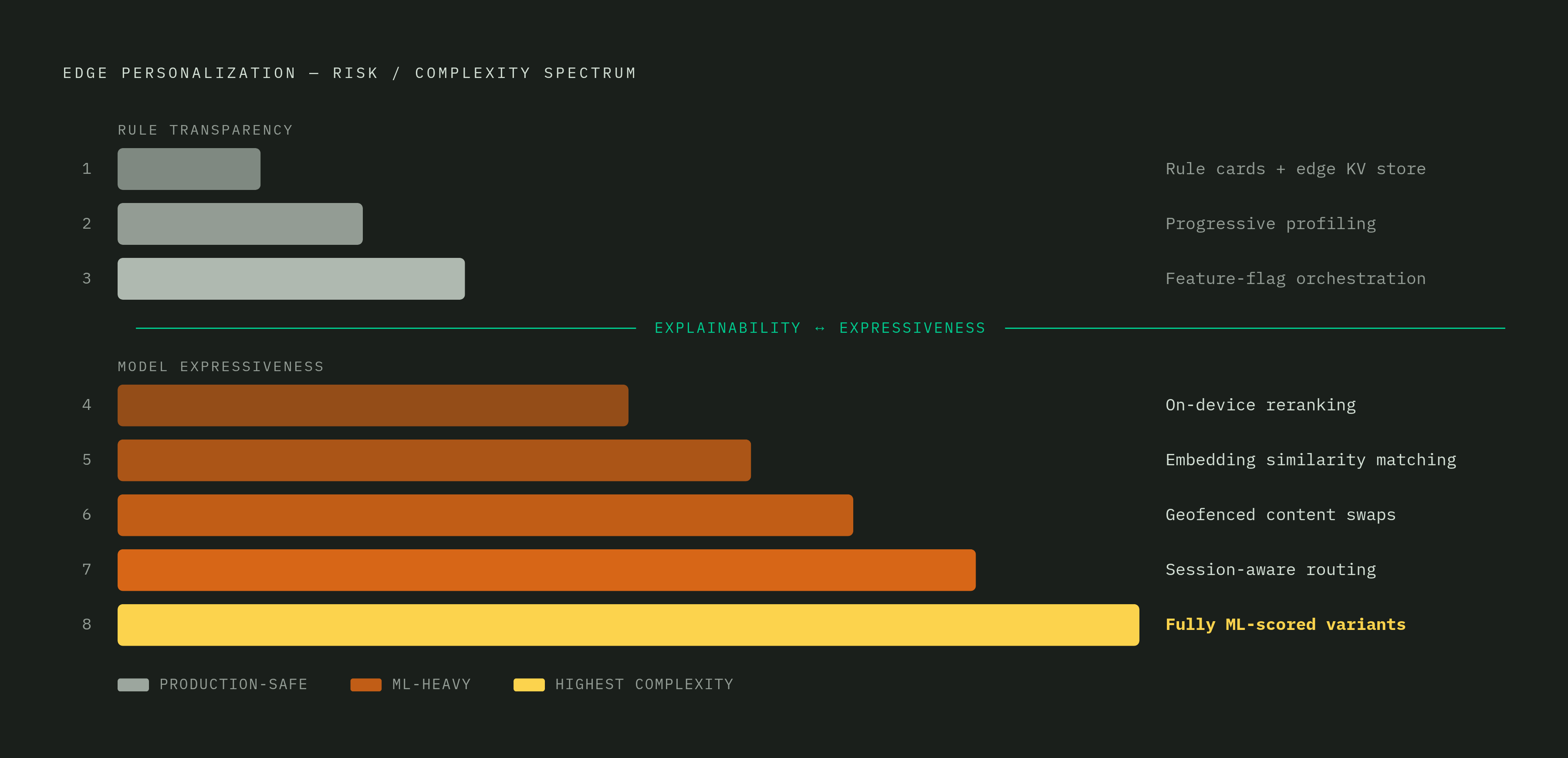
Eight recurring blueprints show up across practitioner writeups on edge personalization. Not an exhaustive list, but a working menu of what teams actually build. The first three are the ones worth trusting. The last five are where the risk piles up.
Rule cards backed by edge key-value stores. Fetch a lightweight user profile from an edge KV store, apply a deterministic JSON rule card, done. Zero origin calls for the common case, and because the rules are just JSON, they're easy to read and easy to A/B test. This covers hero banners, feature flags, locale switching, new-versus-returning-user flows. Delivery lands well within the range that makes a page feel instant instead of loaded.
Progressive profiling at the edge. Each request adds a small, derived fact to the user's profile (device class, rough geography, time-of-day bucket) and stashes it back into KV. Personalization gets sharper request by request, without a heavy client SDK or a nightly retraining job. Expire these micro-facts on a short cycle, days to weeks, and keep raw personal data out of it entirely. Store the derived trait, not the person.
Edge feature-flag orchestration. Flags get evaluated using KV context plus request signals (country, device, referrer), and impression events fire asynchronously so nothing blocks the response. This kills the "wait for analytics" round-trip and keeps decisions consistent whether the request came through a single-page app, server-side rendering, or a raw API call. Pricing tests, ranking experiments, layout trials all run through the same mechanism.
Blueprints four through eight get progressively heavier on machine learning: on-device reranking, embedding-based similarity matching, geofenced content swaps, session-aware routing, fully ML-scored variants. Each one trades rule transparency for more model expressiveness, and that trade is exactly where things get shaky. A tiny reranking model can reorder a candidate list at the edge without an origin call and without a GPU cluster behind it. Embeddings let the system match a user's context to a content cluster by similarity instead of hand-written rules. But stack enough of these five on top of each other and it gets hard to explain why a given user saw a given variant, and "we don't know why the model did that" does not survive a postmortem.
The thread running through all eight: origin gets consulted only for data the edge doesn't already have, never for every decision. Keep the models small and the rules crisp. Edge compute is cheap when the logic fits comfortably inside the runtime's memory and CPU budget, and expensive the moment it doesn't. Middleware at the edge also absorbs the bulk of global traffic, and the resulting personalized responses can still get cached at the CDN layer, so a large share of traffic can be served without touching origin.
Where edge inference fits, and where it runs into real constraints
Machine-learning inference at the edge deserves more skepticism than it usually gets, not less. For something like real-time content moderation or personalization scoring, moving inference out of a centralized data center and onto the edge network can shave hundreds of milliseconds off response time compared to calling a centralized model endpoint. That part's real.
Cloudflare's Workers AI is a workable example. It runs inference directly on the same global network as the edge functions, no GPU provisioning, no separate endpoint to manage, no second billing relationship to chase down, since usage rolls into the existing Workers plan through per-neuron pricing. The model catalogue spans small open-source models up through frontier options like Moonshot AI's Kimi K2.6. It's general-purpose inference infrastructure that happens to live at the edge.
Here's the part that gets glossed over in most pitches for this stuff. The V8 isolate starts in low single-digit milliseconds, but the GPU call behind an inference request is a different animal entirely. If a model has to spin up cold on a backend node, that first call adds real, noticeable latency, a different profile from a pure rule-based decision running in KV. Ignoring that constraint is how a demo looks great and a production system falls over under load.
The fix is a cache-aside layer sitting in front of the model, not a bare function calling inference on every single request. Common contexts get served from a cached result in KV, and the model path gets reserved for inputs the system genuinely hasn't seen before. Pair that with edge-resident structured storage, something like D1 running SQLite at the edge, to hold preferences and session state without a round-trip to a database somewhere else. Treat any benchmark here as perishable, too: a number measured six months ago on a platform like this may already be stale, because the underlying infrastructure keeps shipping improvements underneath it.
Keeping personalization state consistent across edge nodes without rebuilding infrastructure
The obvious objection: edge compute is stateless by default, and personalization runs on state, user history, session context, preference signals. So how does any of this reconcile?
The answer splits into two tiers, and the split matters more than either tier does alone. Lightweight, frequently-read state (profile snapshots, rule sets, flag assignments) lives in edge KV stores, where reads are fast and the data doesn't need to be perfectly real-time. It needs to be close enough and quick enough, nothing more. Structured, session-scoped state, the kind that needs strong consistency for one user's active session, belongs in something like Durable Objects, where each session gets its own addressable micro-server with storage built in, placed physically near wherever that session first showed up.
Durable Objects fold compute and storage into one serverless unit with no infrastructure for the team to manage. Each object is its own address, the model scales to millions of instances, addressable per session, and each one is placed near where that session first originated. That's a genuinely different shape than a stateless function reaching out to a shared database on every call.
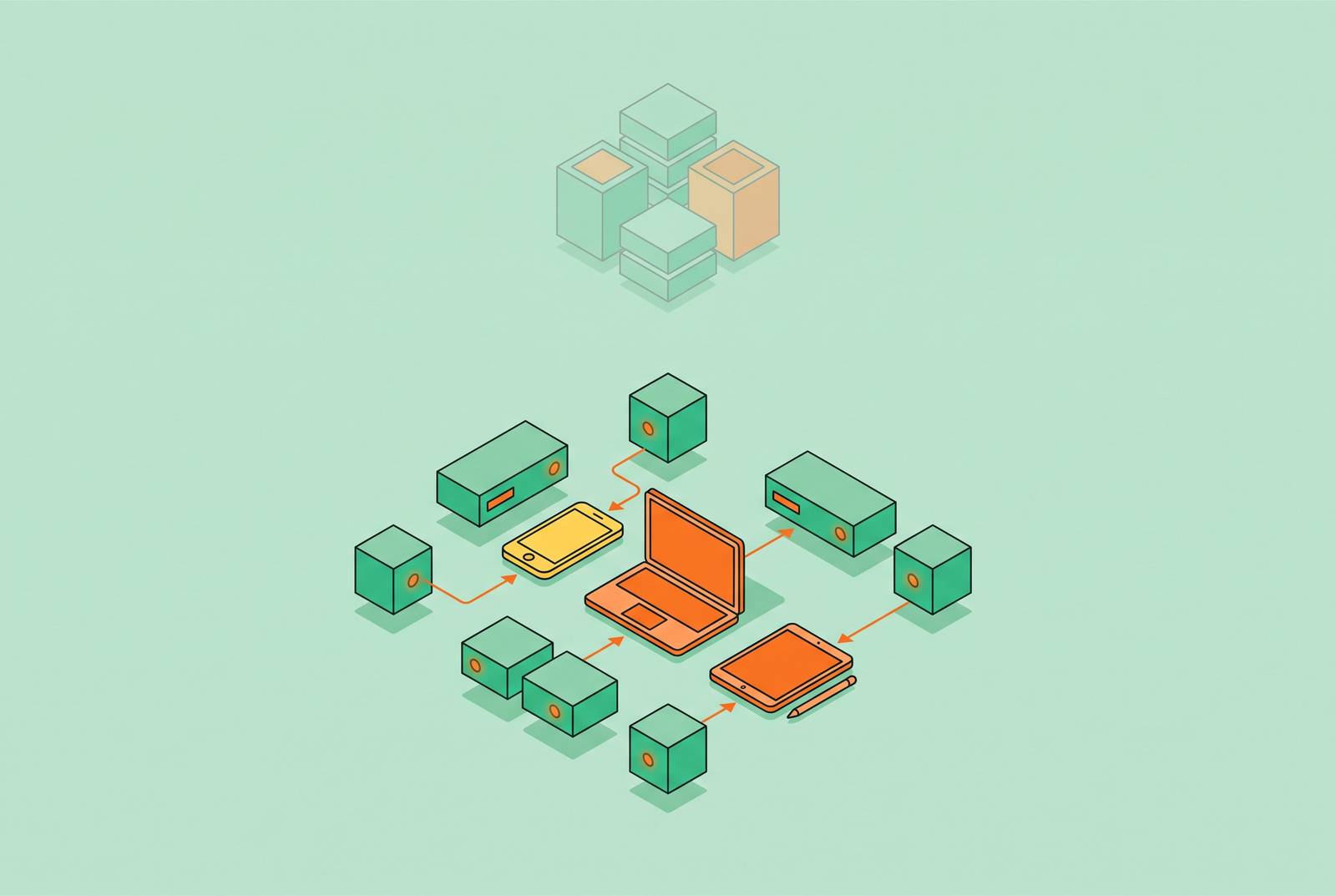
The real design question is whether the edge can hold state. It's which slice of that state actually needs to live there, and which can stay put at origin. Most personalization decisions run on a small, fast-expiring slice of context, not the full behavioral record. Keep the snapshot at the edge, keep the full history at origin, and let the edge function read the snapshot, make its call, and optionally write a derived fact back. It never needs the whole database, and reaching for the whole database is exactly the mistake that turns a 20-millisecond decision into a 400-millisecond one.
For AI-driven personalization specifically, the inference call at the edge works off that same local snapshot. Origin gets consulted to refresh the snapshot on a schedule, maybe every few hours, maybe daily, not on every single request a user makes.
What the enterprise adoption curve reveals about where edge personalization is heading
Enterprise infrastructure priorities have been drifting toward performance as a first-order concern, and that maps directly onto the latency argument running through this piece. The business case and the architectural case turn out to be the same case, argued from two different angles.
The clearest signal shows up in e-commerce, where edge functions handling server-side personalization and A/B routing have gained significant traction in e-commerce, where checkout latency translates directly into abandoned carts. A broader shift is visible underneath this: a growing majority of enterprise-generated data is increasingly created and processed outside traditional data centers or centralized cloud, and edge personalization is one piece of that larger migration.
Not every edge-adjacent trend deserves the same confidence, though, and this is the part to say clearly: agentic AI is riding the same hype wave as edge personalization, but it hasn't earned the same trust. Industry forecasts suggest a substantial share of agentic AI projects will be scrapped within the next few years, citing runaway costs, murky value, and thin risk controls. Edge personalization, rule cards, KV lookups, cached inference, is a solved and measurable problem today. Agentic AI layered on top of it is a much younger, much less governed idea, and treating the two as equally mature is the mistake to avoid.
A quieter pressure is building underneath all of this too: infrastructure sprawl. Once edge personalization stops being an experiment and becomes the default, a team running it across five different vendors, one CDN, one inference API, one KV store, one feature-flag service, and whatever else got bolted on along the way, accumulates operational overhead that has nothing to do with the personalization logic and everything to do with managing five billing dashboards and five points of failure. At that point, the case for a single unified platform stops being architectural taste and becomes a straightforward cost-and-complexity argument.
What a production-ready edge personalization stack actually requires
A demo skips most of this. Production doesn't get the choice.
Durable state has to live somewhere sensible: profile snapshots in edge KV, session state in a co-located stateful primitive like Durable Objects. Inference has to run without GPU provisioning or capacity planning on the team's part, with a model catalogue spanning lightweight scoring models up through frontier-class LLMs depending on how complex the decision actually is. A cache-aside layer needs to sit in front of that inference call so common contexts get served from cache and the model only runs on genuinely new inputs. Skip that layer and cost scales linearly with traffic, and nobody enjoys that invoice.
Observability can't block the response path: impression events, variant assignments, and inference calls all need to log asynchronously. The rule-card and feature-flag patterns need real A/B testing with consistent variant assignment, so a user doesn't see three different versions of a banner across three page loads. Billing needs to be consumption-based, charging for actual inference calls and actual KV reads, not for idle capacity sitting around waiting for traffic. And for anything AI-driven, a governance layer has to exist, something like a protocol-based boundary that scopes exactly what the inference function is allowed to touch, so the system doesn't quietly gain access to data nobody meant to expose.
Here's the actual cost of skipping all that: a team running this stack across five separate vendors is managing five billing relationships, five network hops between components, and five places where one bad config push breaks personalization for every user at once. A platform where compute, KV, stateful objects, inference, and observability sit on the same network, reachable through a binding instead of an external API call, removes that failure mode by design instead of by discipline. Workers AI, Workers KV, Durable Objects, D1, and AI Gateway sitting together is one working version of that idea: same network, same consumption billing, same latency budget, no separate service for the decision to detour through.
Once the decision point sits at the edge, personalization latency becomes a property of geography and network design, something a team can measure and improve on purpose, rather than a number that depends on how many services a single request happens to bounce through before anyone gets an answer.