HTTP/3 and QUIC Adoption Impact on Application Performance
Real gains appear on mobile and lossy networks, not lab conditions.

HTTP/3 and QUIC are no longer experiments running in a handful of Google data centers HTTP/3 and QUIC — The Next-Generation Network Protocol Accelerating the Web in 2026 | AnhTu.dev QUIC vs. TCP: Which Performs Better in Lossy Networks? – Design Gatew… QUIC Cloud CDN Performance Tests on HTTP 3 Workloads HTTP/3 and QUIC in Production: A Practical Deployment Guide for 2026 - DEV Community Google research during QUIC development. The gains are large and well-documented on lossy, mobile, and high-latency networks, and nearly invisible on the clean wired connections most engineering teams test on. That gap between measured benefit and assumed benefit is where most deployments quietly go wrong.
Why the transport layer is the right level to fix HTTP/3 and QUIC
QUIC started as a Google project in 2012 and spent nearly a decade in the wild before the IETF standardized it as RFC 9000 in May 2021, with HTTP/3 following as RFC 9114 in June 2022. Both are stable specifications now, not drafts sitting in a working group's backlog.
The problem QUIC exists to solve is a bit of an inherited mess. HTTP/2 fixed head-of-line blocking at the application layer by letting multiple requests multiplex over one connection, but it pushed the same problem down a layer, because TCP has no concept of "streams," only a single ordered byte stream. Drop one packet, and every request sharing that connection stalls until the retransmission arrives, regardless of which logical stream actually needed that packet. On a network with 2% packet loss, this is bad enough that HTTP/2's single TCP connection can lose to HTTP/1.1's clunky old habit of opening several parallel TCP connections at once. The multiplexing advantage, the entire reason HTTP/2 existed, inverts under loss.
QUIC runs on UDP and reimplements reliability per-stream, so a lost packet on stream A does not block streams B, C, or D. It's a different transport, not a smarter congestion-control algorithm bolted onto the same transport. It's a different transport, built specifically so that loss on one logical stream doesn't hold the others hostage.
Three other structural choices matter for everything that follows. Third, encryption isn't optional. TLS 1.3 is baked into the transport itself, and there's no plaintext QUIC mode to fall back to. Security here is architecture. QUIC identifies connections by Connection ID rather than by the four-tuple of source IP/port and destination IP/port, so a network switch such as WiFi to cellular does not break the session.
Where the protocol's gains are genuine and large
Those are measured numbers from real traffic patterns and real geography, not a synthetic loss simulator. They're measured across real traffic patterns and real geography, and the geographic spread is the actual story.
That's not a coincidence of measurement. Multi-round-trip TCP handshakes hurt worst exactly where baseline latency is already high, and those three regions happen to be among the fastest-growing internet markets on the planet HTTP/3 and QUIC — The Next-Generation Network Protocol Accelerating the Web in 2026 | AnhTu.dev. The protocol's biggest structural advantage lands precisely where the next billion users are showing up.
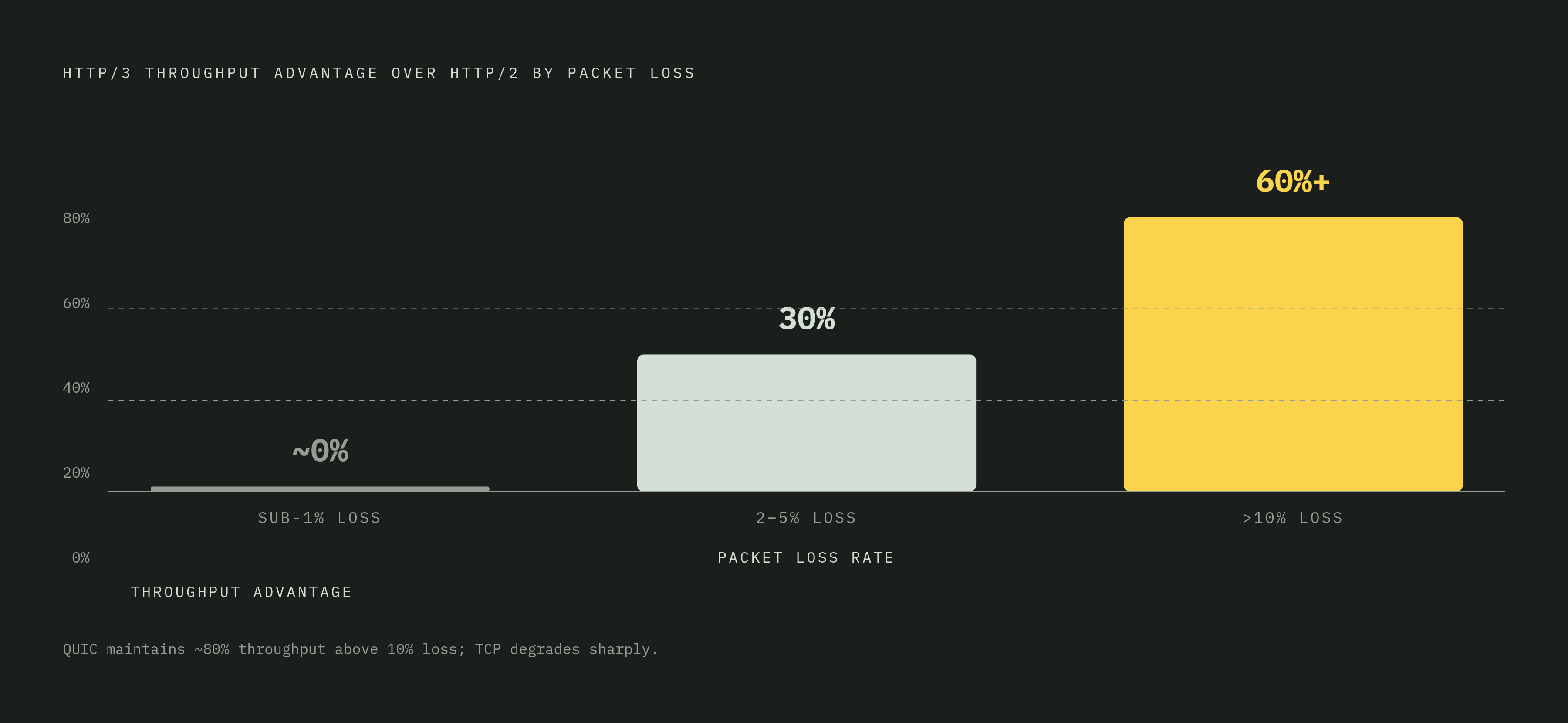
How much benefit appears depends most cleanly on packet loss. At 10% packet loss, QUIC maintained nearly 80% of its throughput HTTP/3 and QUIC — The Next-Generation Network Protocol Accelerating the Web in 2026 | AnhTu.dev QUIC vs. TCP: Which Performs Better in Lossy Networks? – Design Gatew… QUIC Cloud CDN Performance Tests on HTTP 3 Workloads HTTP/3 and QUIC in Production: A Practical Deployment Guide for 2026 - DEV Community Google research during QUIC development. At moderate loss, in the 2 to 5% range, HTTP/3 runs roughly 30% faster than HTTP/2, and once loss crosses 10%, that gap widens to 60% or more HTTP/3 and QUIC — The Next-Generation Network Protocol Accelerating the Web in 2026 | AnhTu.dev QUIC vs. TCP: Which Performs Better in Lossy Networks? – Design Gatew… QUIC Cloud CDN Performance Tests on HTTP 3 Workloads HTTP/3 and QUIC in Production: A Practical Deployment Guide for 2026 - DEV Community Google research during QUIC development. Loss rate is a major variable in this story. Loss rate determines whether HTTP/3 is a nice-to-have or a must-have.
Treat this as an illustration of what's possible under favorable conditions. A real benchmark on the same site showed response time progression from HTTP/1.1 at 3s to HTTP/2 at 1.5s to HTTP/3 at 0.8s, a roughly 47% improvement over HTTP/2, useful as a concrete illustration but not a universal expectation.
Mobile traffic now makes up more than 60% of global web activity, and connection migration is a structural win for that majority regardless of packet loss, because a network switch no longer means starting the handshake over HTTP/3 and QUIC in Production: A Practical Deployment Guide for 2026 - DEV Community. A widely cited measure found that 53% of mobile users abandon a page that takes more than three seconds to load. HTTP/3 won't single-handedly rescue a slow page, but it removes one entire category of delay that used to be baked into the network layer itself. The Catchpoint Labs cross-continental study offers the strongest real-world evidence, with median TTFB improved 41.8%, median LCP improved 10.4%, and Visually Complete improved 10.5% across production sites on six continents QUIC Cloud CDN Performance Tests on HTTP 3 Workloads HTTP/3 and QUIC — The Next-Generation Network Protocol Accelerating the Web in 2026 | AnhTu.dev. 0-RTT connection resumption cuts 50–100ms off time to first byte for returning visitors on high-latency connections, and is most meaningful when base mobile latency is already 80–150ms HTTP/3 and QUIC in 2026: When to Enable It and What to Expect — CODERCOPS HTTP/3 vs HTTP/2: Should You Enable QUIC in 2026? - Buffe… QUIC Cloud CDN Performance Tests on HTTP 3 Workloads HTTP/3 and QUIC in Production: A Practical Deployment Guide for 2026 - DEV Community.
Where HTTP/3 changes little or introduces new costs
None of this helps much on a fast, stable, wired connection with sub-1% packet loss, and that needs saying before the marketing copy takes over the conversation. TCP has had decades of kernel-level optimization poured into it, and on fast, stable wired connections with sub-1% packet loss it still performs nearly identically to HTTP/3. A single large file moving across a clean datacenter link is, if anything, the workload where HTTP/2 over TCP can match or slightly beat QUIC. If your primary traffic pattern looks like that, HTTP/3 isn't going to be the lever that moves your numbers.
There's a real cost sitting on the other side of the ledger too. Most QUIC implementations, as of early 2026, burn 10 to 15% more CPU per gigabit than an equivalent TCP path, and at real traffic volume that raises the infrastructure bill directly. Implementation quality also varies more than the marketing suggests. Research out of KIT in 2025, run on a 10 Gbit/s testbed, found that the choice of application protocol alone (HTTP/3 versus something as bare as HTTP/0.9) could swing goodput by as much as 27%, and some QUIC implementations more than doubled the throughput of others under the same conditions. "HTTP/3 enabled" "HTTP/3 enabled" is a checkbox, and treating it as a performance guarantee is exactly the mistake this piece keeps circling back to.
The protocol also has firm limits on what it can fix. It has nothing to say about a slow backend, an unoptimized image pipeline, uncompressed assets, or the plain physical distance between an origin server and a user on the other side of the planet. It operates strictly at the transport layer, and transport-layer fixes don't reach into application code.
Then there's the firewall issue, which is duller than it sounds but breaks more deployments than any of the protocol's technical limits. Corporate networks and VPN configurations frequently block UDP 443 outright, and browsers fall back to HTTP/2 without complaint, which means a meaningful chunk of enterprise users may never touch HTTP/3 until someone changes network policy. 0-RTT brings its own liability: data sent before the server has contributed fresh key material is replayable, so POST, PUT, and DELETE requests need explicit backend protection before they're allowed anywhere near a 0-RTT path. And debugging gets harder across the board, since QUIC packets are encrypted end to end and standard TCP inspection tooling simply doesn't see inside them; getting Wireshark to cooperate means configuring TLS key logging first. For a team without mature observability already in place, that's a real tax on incident response.
The actual adoption picture in 2026
By July 2026, more than 95% of major browsers support HTTP/3, and roughly 40% of the top 10 million websites have it enabled Wikipedia — HTTP/3. Three independent measurements now converge on that figure: HTTP Archive's data shows 40.7% of desktop requests and 42.2% of mobile requests over HTTP/3, and W3Techs put website-level support at 40.3% Wikipedia — HTTP/3. Three different methodologies landing within a percentage point of each other reflects a real signal. That's a plateau, or possibly an inflection point about to tip further.
But support isn't the same thing as use, and this is where the story gets more interesting than the headline number suggests. At the level of actual global request volume, 2024 data put HTTP/3 at just 20.5% of requests, with HTTP/2 still dominant at 49.6% and old-fashioned HTTP/1.x still carrying 29.9% Cloudflare Radar 2024 Year in Review. Half the servers that could serve HTTP/3 apparently aren't, at least not to most of the traffic hitting them. October 2025 marked a symbolic milestone, with global adoption crossing 35%, which is as good a marker as any for the moment HTTP/3 stopped being "future technology" and became just technology, but the support-versus-usage gap hasn't closed at anywhere near the same pace.
CDNs are doing most of the real work here. Major CDN providers ship HTTP/3 on by default or widely deployed, which means end users can already be getting HTTP/3 benefits even when the origin server has never been configured for it. Server-side activation cost is genuinely low too: Nginx has shipped built-in HTTP/3 support since version 1.25.0, and Caddy turns it on by default with zero extra configuration. So the barrier isn't technical capability. It's awareness, firewall policy, and a surprising number of teams that flipped the switch, moved on, and never actually verified the Alt-Svc header was present and correctly formed Wikipedia — HTTP/3.
How to determine whether HTTP/3 will help your specific application
Three questions settle this before anyone touches a config file. What does the packet-loss profile of the actual user base look like? CDN analytics broken down by protocol will show HTTP/2 and HTTP/3 session performance side by side, and if they look roughly the same, the transport layer was never the bottleneck to begin with. What share of traffic is mobile or coming from high-latency regions, since the Catchpoint numbers (41.8% median TTFB improvement, 84.1% in Australia) describe the ceiling for that specific segment, not an average anyone should expect across the board. And what does the request shape actually look like: many parallel small requests, as in JavaScript-heavy single-page apps, API-heavy frontends, and real-time dashboards, benefit most, while a single large sequential download benefits least.
RequestMetrics' benchmark by site type is a decent calibration tool for setting expectations. A small site, around 600KB and 20 resources, sees a 15 to 20% improvement over HTTP/2. A heavier content site, roughly 10MB across 105 resources, sees 25 to 35%. A single-page application in the roughly 15MB, ~115-resource range sees a 30 to 40% improvement. Notice the pattern: resource count and request parallelism drive the benefit far more than raw payload size does.
If the application already sits behind a CDN that enables HTTP/3 by default, origin configuration is close to irrelevant for the edge-to-user leg of the journey, and the only real task is confirming the Alt-Svc header is showing up before spending engineering time on origin-side QUIC setup. Corporate and VPN firewalls frequently block UDP 443, so confirm it's actually open while you're at it. Corporate firewalls and certain VPN setups block it silently, which produces the worst possible outcome: a feature that looks "enabled" on a dashboard while delivering zero real benefit. Treat 0-RTT as an opt-in decision made endpoint by endpoint, not a global toggle flipped once and forgotten, since it needs explicit replay protection wherever a request isn't idempotent HTTP/3 and QUIC in 2026: When to Enable It and What to Expect — CODERCOPS HTTP/3 vs HTTP/2: Should You Enable QUIC in 2026? - Buffe…. And if the basic Core Web Vitals work, trimming interaction latency, fixing the slowest backend calls, hasn't happened yet, that work will very likely outperform anything the transport layer can offer. HTTP/3 optimizes the pipe. It does not replace the plumbing work inside the building. The RequestMetrics benchmark by site type is a useful calibration tool.
Enabling HTTP/3 in practice: what the configuration requires
There are three paths here, ranked by how much work they actually demand. The cheapest by far is a CDN or edge platform, where HTTP/3 is frequently on by default already, no origin changes required, and the only job left is verifying the Alt-Svc header and checking the CDN's own analytics dashboard. This path covers the majority of real deployments without anyone writing a line of new configuration.
Running Nginx directly is more hands-on. The firewall has to allow UDP 443 through, which is the single most commonly missed step in this whole process, and it's worth double-checking that the http_v3_module was actually compiled into the binary in use. Caddy is the low-maintenance alternative: HTTP/3 comes on by default the moment a valid TLS certificate is in place, no further configuration needed.
Whatever the path, the Alt-Svc header is the actual discovery mechanism a browser relies on Wikipedia — HTTP/3. Without Alt-Svc: h3=":443"; ma=86400 present in the response, a browser never upgrades to HTTP/3 even if the server supports it. Roll it out gradually, on specific paths or a limited user segment first, since QUIC implementations still vary in maturity and some show real throughput degradation under specific conditions, a finding the KIT 2025 research made hard to ignore. Running this at the edge, across a globally distributed network rather than a single origin, sidesteps most firewall and middlebox headaches, since QUIC termination happens close to the user, and it happens to line up neatly with usage-based billing models rather than a server sitting idle and burning money. Monitoring after enablement should use CDN per-protocol analytics or the Chrome DevTools Network panel, with the Protocol column showing "h3", to confirm actual HTTP/3 usage, since "enabled" and "in use" are not the same.
HTTP/3 as infrastructure for AI agents and high-frequency API workloads
Head-of-line blocking does more damage to an AI agent than to a human browsing a page. An agent streaming tokens to a user, making tool calls, and fetching data from external APIs all at once over HTTP/2 sees all three streams freeze the moment a single TCP packet drops. A person watching a page stutter for a beat barely notices. An agent mid-interaction, with three dependent operations suddenly stalled at once, effectively breaks.
0-RTT reconnection compounds in agentic workflows in a way it never quite does for a person clicking around a website. Connection migration matters here too: an agent workflow running for minutes across cloud function scaling events or infrastructure transitions benefits from Connection ID persistence in exactly the way a phone switching cell towers does.
The Model Context Protocol is where this stops being theoretical. MCP servers increasingly run as serverless functions, and stateless deployment means the low-latency reconnection QUIC offers gets invoked every single time a request lands on a fresh function instance. The MCP Dev Summit North America, held April 2 and 3, 2026 in New York, is a reasonable signal of how quickly agentic infrastructure is institutionalizing, with protocol decisions being made at the gateway layer right now, HTTP/2 or HTTP/3, getting baked into production MCP deployments. QUIC's encryption-by-default posture is a genuine structural advantage when agents are tunneling sensitive tool calls, but the 0-RTT replay risk gets sharper in agentic workflows, where a much higher proportion of requests are state-mutating rather than simple reads. An edge network that terminates QUIC close to both the agent and the end user, rather than routing everything back through one centralized origin, is the architecture that actually removes geography as a variable in agent performance, and it's the clearest point of overlap between edge compute and this entire protocol shift. 0-RTT reconnection matters for chained tool calls, since when an agent makes dozens of sequential requests to a known endpoint, the round-trip overhead of TCP+TLS on each reconnection compounds, and QUIC's 0-RTT eliminates that overhead from the second session onward.
What separates meaningful HTTP/3 adoption from checkbox adoption
The protocol is production-ready, full stop. That question got settled somewhere between the RFC publication and the browser support numbers now sitting above 95%. What remained was never whether this should eventually get turned on." Checking whether turning it on actually did anything matters, and that means confirming the Alt-Svc header is present, confirming UDP 443 clears the firewall, and confirming the traffic profile has enough packet loss or mobile latency for the gains to appear at all. Enabling HTTP/3 without checking any of that is decoration. It's decoration.
Sources
- HTTP/3 and QUIC in Production: A Practical Deployment Guide for 2026 - DEV Community
- 3
- HTTP/3 and QUIC in 2026: When to Enable It and What to Expect — CODERCOPS
- HTTP/3 and QUIC — The Next-Generation Network Protocol Accelerating the Web in 2026 | AnhTu.dev
- QUIC vs. TCP: Which Performs Better in Lossy Networks? – Design Gateway's Technology Blog
- QUIC Cloud CDN Performance Tests on HTTP 3 Workloads
- HTTP/3 vs HTTP/2: Should You Enable QUIC in 2026? - Buffe…
- HTTP/3 explained