Edge Workers vs Traditional Serverless Functions for Latency-Sensitive APIs
V8 isolates beat containers on latency, but only when data lives at the edge.
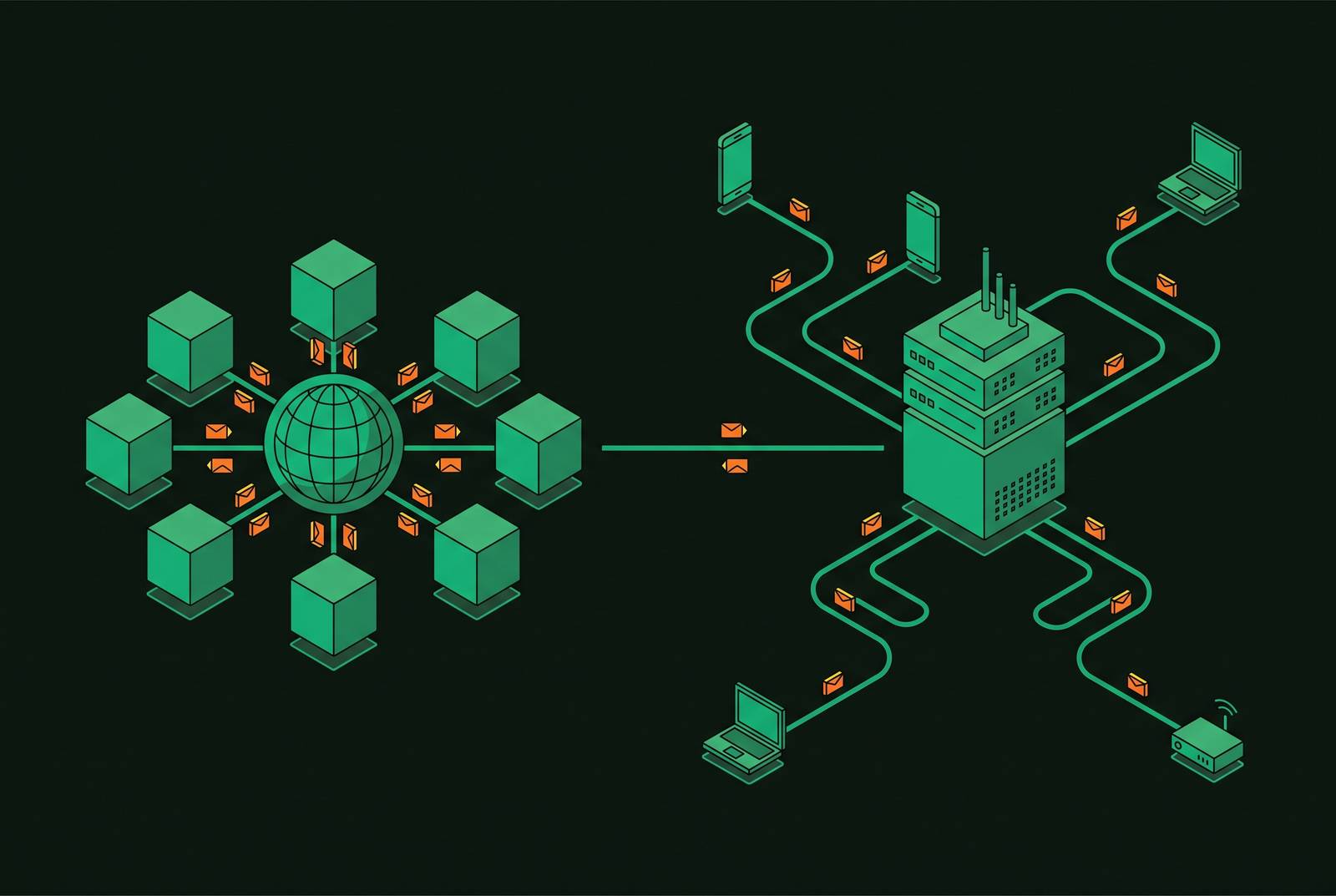
The gap between edge workers and traditional serverless functions comes down to one decision made years before either product had a marketing page: how do you isolate one customer's code from another's? Some edge platforms picked V8 isolates, the same lightweight sandboxing technology used in modern JavaScript engines. AWS Lambda picked containers, a model rooted in general-purpose compute isolation. Every gap that follows, cold starts, warm-path latency, geographic reach, memory ceilings, traces back to that single fork made early on, and it shows up everywhere downstream.
What cold starts actually measure and why the gap is so large
A cold start is the clock running from "request arrives" to "user code executes." For a container, that clock has to survive process creation, runtime boot, and dependency loading before a single line of a developer's logic runs. Each of those is a real step with a real cost in milliseconds. A V8 isolate skips nearly all of it: the runtime is already running, and the isolate is a new, memory-isolated context spun up inside it rather than a new process. It's the difference between opening a new tab and rebooting the laptop.
Picture an on-call engineer at 3 a.m. watching a dashboard as a traffic spike hits an API. With a container-based function, the latency graph spikes into the hundreds of milliseconds as new instances boot one by one, like buses that only show up after everyone's given up waiting for them. With an isolate-based function, the graph barely twitches. Call it the on-call version of a knock-knock joke: "Who's there?" "The new container instance." "The new container instance who?" "Sorry, still booting, ask again in 300 milliseconds."
The numbers back this up. A 2026 benchmark from Zeon Edge put Workers cold starts under 1 millisecond, against 250 to 800 milliseconds for Lambda@Edge running Node.js. The same Zeon Edge benchmarks found edge functions roughly 9 times faster on cold starts, with V8-based platforms initializing in under 5 milliseconds against 100 milliseconds to over a second on Lambda. Traditional serverless has closed part of that gap through various runtime optimizations in recent years. The ceiling comes from the container model itself, and tuning around it only goes so far. You can polish a process boot. You can't skip it.
Warm-path latency and what the OpenStatus benchmark reveals about everyday performance
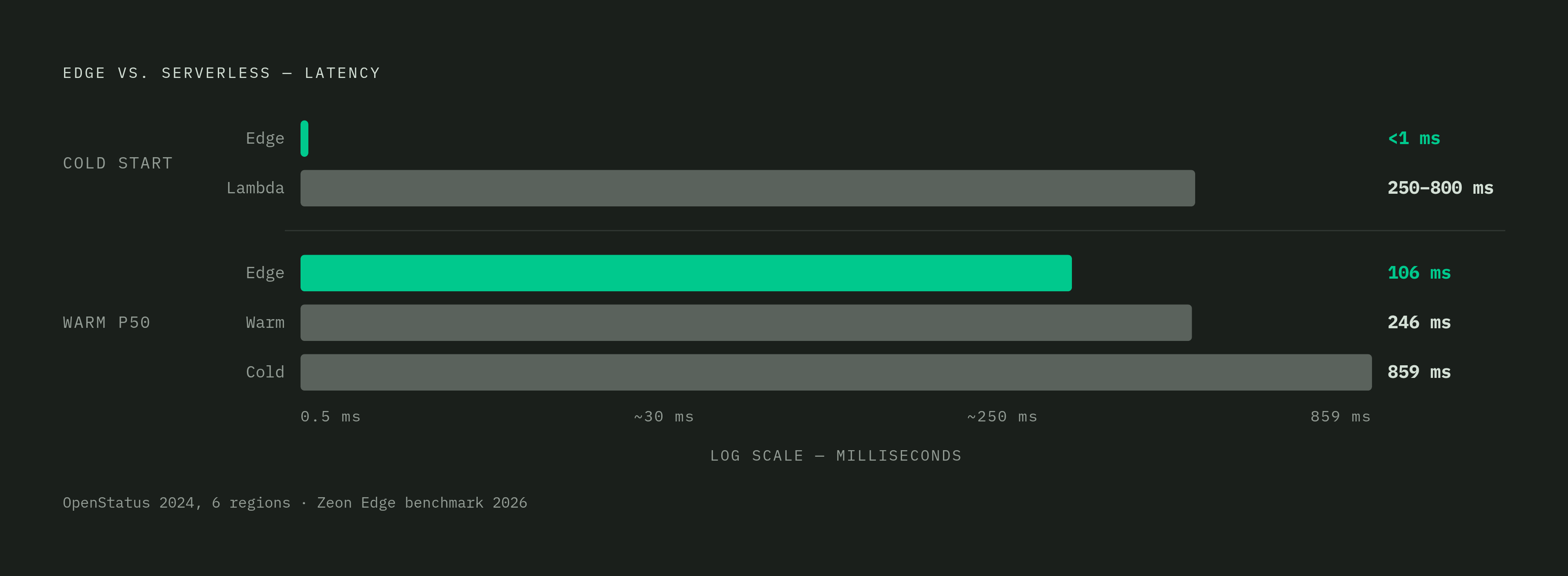
Cold starts get the attention, but most requests hit a warm instance, so warm-path latency is what users actually feel, call after call. OpenStatus ran a 2024 benchmark across six global regions and found edge functions averaging 106 milliseconds at P50, against 246 milliseconds for warm serverless and 859 milliseconds for cold serverless. That's roughly a 2x edge advantage over warm serverless, smaller than the 9x cold-start gap, but it compounds every time an API call sits in a chain of them. Zeon Edge's separate warm-path numbers tell the same story at a different scale: Workers around 2 milliseconds, Lambda@Edge around 15 milliseconds once warm.
Here's the part worth sitting with: this gap has almost nothing to do with initialization anymore. Both instances are warm. The gap comes down to geography. A warm container sitting in us-east-1 still routes a user in Singapore across an ocean and back; a warm edge worker runs in whichever of hundreds of cities sits nearest that user to begin with. OpenStatus put it plainly: edge functions carry similar latency no matter where the user sits. Once an execution model gets cheap enough per instance, running it everywhere at once stops being a cost problem and becomes the default setup.
How geographic distribution changes the latency equation for global APIs
Traditional serverless asks a developer to pick a region, maybe two, and everyone outside that footprint pays a toll on every request. The low overhead per isolate makes running edge workers in dozens or hundreds of cities a routine cost rather than a heroic infrastructure project, a model Cloudflare, which runs Workers across 330-plus data centers, has made central to its edge compute approach.
Independent benchmarks on edge platforms have consistently found time-to-first-byte P50 figures spread narrowly across US East, EU West, and APAC regions, a spread narrow enough to call flat. Local execution does that.
Here's where the advantage quietly falls apart: the moment a worker needs to talk to a single, centralized database, geography stops mattering. Run the function at the edge in Tokyo, sure, but if it's making a round trip to a Postgres instance in Virginia for every read, the total response time gets dominated by that round trip, not by how fast the function started. It's sprinting the first mile of a marathon and then waiting an hour for a shuttle bus to cover the rest; the fast part was never the bottleneck. Fixing it means replicating the data globally, through Durable Objects, distributed key-value stores, globally replicated Postgres, or, more simply, keeping the database off the hot path entirely. Auth token checks, request routing, A/B bucket assignment, geolocation redirects, and header rewrites never touch a central database, so all of them get the geographic win with no fine print attached. Some platforms are also exploring placement strategies that flip the logic when the real bottleneck is a backend data source, moving compute closer to the data rather than the user to trim round-trip latency.
Where traditional serverless still has a structural advantage
Containers keep a clear role here, and pretending otherwise would be dishonest. Workers carries hard resource limits tied to the isolate model's design, constraining both available memory and maximum execution time. Traditional serverless platforms offer a meaningfully bigger resource envelope, with longer execution times and far more available memory.
That headroom matters for a specific class of job: PDF generation, video transcoding, large data exports, image manipulation at scale, running a machine learning model locally, anything sustained and CPU-heavy rather than quick and frequent. These were never edge workloads to begin with; treating them as one is a category error, not an optimization opportunity. Containers also carry the full Node.js ecosystem without asking permission first: native modules, packages with C bindings, anything that assumes a real POSIX environment underneath it. On burst scaling, both models avoid the overhead of always-on server fleets, so that dimension doesn't cleanly separate edge from serverless. The honest split: isolates win the latency-sensitive API fight, containers win the heavy-batch-compute fight, and neither is trying to win the other's fight. Asking an isolate to transcode a two-hour video is like asking a scalpel to chop firewood. Wrong tool, wrong job, no amount of sharpening fixes that.
Why production architectures increasingly use both models rather than choosing one
Framing this as edge-versus-serverless treats an architectural decision like a shopping trip. Nothing stops an application from running both, and most serious ones do. The split that actually works: edge workers take the hot path, auth checks, routing, personalization, rate limiting, while traditional serverless takes the heavy lifting, background jobs, data processing, report generation.
Auth is the cleanest example. Validating a JWT at the city nearest the user, before the request ever reaches an origin server, cuts an entire network round trip from every authenticated call an API serves. Bot detection, geolocation checks, and A/B assignment follow the same logic: they're decisions made purely from request metadata, and every user pays the latency cost of that decision on every request, so it belongs as close to the user as possible. Heavy work gets queued instead of run inline. The edge worker takes the request, hands a job to the traditional serverless function, and returns right away, so the user sees a fast acknowledgment while the expensive work runs out of sight. Each kind of work goes to the model built for it, instead of splitting the difference between two imperfect options. It's a division of labor, the way a relay team doesn't bench its distance runner just because someone else has a faster start.
How agentic AI workloads are stress-testing both architectural models
AI agents are a present-day production load. Recent survey data found over 57% of enterprises already running them in production, and Gartner has projected that 40% of enterprise applications will include task-specific agents by 2026, up from under 5% in 2025. Agentic workloads chain API calls, tool invocations, and model inference steps into one logical task, and latency compounds across every hop in that chain.
A 250-millisecond cold start on one step of a multi-step agent chain isn't 250 milliseconds of pain; it's potentially several seconds if more than one step lands cold. The isolate model's sub-millisecond startup gets proportionally more valuable the longer the chain runs. Agents also need to hold onto things across steps, tool context, intermediate results, running state, and that pushes hard against the stateless assumption both edge workers and traditional serverless were built on. Research into pre-warming policies built specifically for agentic serverless deployments is catching up to patterns already running in production. The shape that's emerging: lightweight orchestration and tool dispatch at the edge, heavy inference and stateful reasoning in traditional serverless or dedicated compute, durable state parked in a globally replicated store. Workers AI running inference across 200-plus cities points at the same idea from another angle: put the inference next to the orchestration and the edge-to-inference round trip stops taxing every agentic step.
Reading benchmark results correctly — what the CPU performance controversy taught developers
Benchmarks circulated in late 2025 showed Workers trailing other platforms on CPU-intensive operations, results that seemed to undercut everything above. The real story turned out to involve V8's internal configuration rather than raw compute throughput.
Other comparisons testing compute-bound server-side rendering found competing platforms beating Workers in certain cases, but those comparisons often ran Workers under standard shared-CPU constraints against competitors running with significantly more RAM and dedicated vCPU resources. That's closer to a hatchback racing a delivery van and reporting on cargo capacity than a fair test of isolate against container. The rule worth keeping: when a benchmark shows an edge worker losing on CPU throughput, check whether it's comparing isolate against container, or isolate against dedicated vCPU and generous RAM. Only the first one is a fair fight, and most of these comparisons quietly aren't. For latency-sensitive APIs specifically, the benchmarks that matter are cold start time, warm-path P50, and geographic spread; raw CPU throughput on compute-bound work measures something neither model was built to win. Judge platforms on equivalent hardware tiers, on P50 and P95 rather than flattering averages, on multi-region numbers rather than one friendly region, and on whether the test workload actually looks like the API being shipped.
Matching the architectural model to the actual request profile of a latency-sensitive API
The right question was never "which platform is faster." It's "what does fast mean for this specific request." Edge workers fit when requests are short-lived and comfortably under the memory and CPU ceiling, when users are spread globally and the latency in question is user-facing rather than internal, when the hot path doesn't lean on a centralized database, and when traffic is frequent or spiky enough that cold starts happen often enough to matter. Auth middleware, API gateway logic, personalization headers, rate limiting, and edge-side rendering of cacheable content all sit comfortably in that zone.
Traditional serverless fits when execution time or memory needs blow past isolate limits, when the work is batch or background and no user sits there waiting on it, or when the code leans on native Node.js packages and POSIX assumptions the isolate model was never built to support. Report generation, data exports, video processing, and inference on large models belong here.
For most non-trivial APIs, the hybrid pattern is simply the answer: edge handles auth, routing, and the immediate response; traditional serverless or dedicated compute handles the async heavy lifting behind it. For agentic workloads specifically, edge orchestration paired with distributed inference and a globally replicated state store resolves the tension between stateless functions and stateful agents without giving up the latency win. Platform choice follows from that: look for edge and serverless primitives that share billing, share observability, and don't force a second vendor relationship just to cover the other half of the architecture. Fragmentation between edge and origin adds exactly the kind of operational drag that eats the latency gains this whole comparison was about. The V8-versus-container split explains why the numbers land where they do; the hybrid architecture is just where that explanation leads.