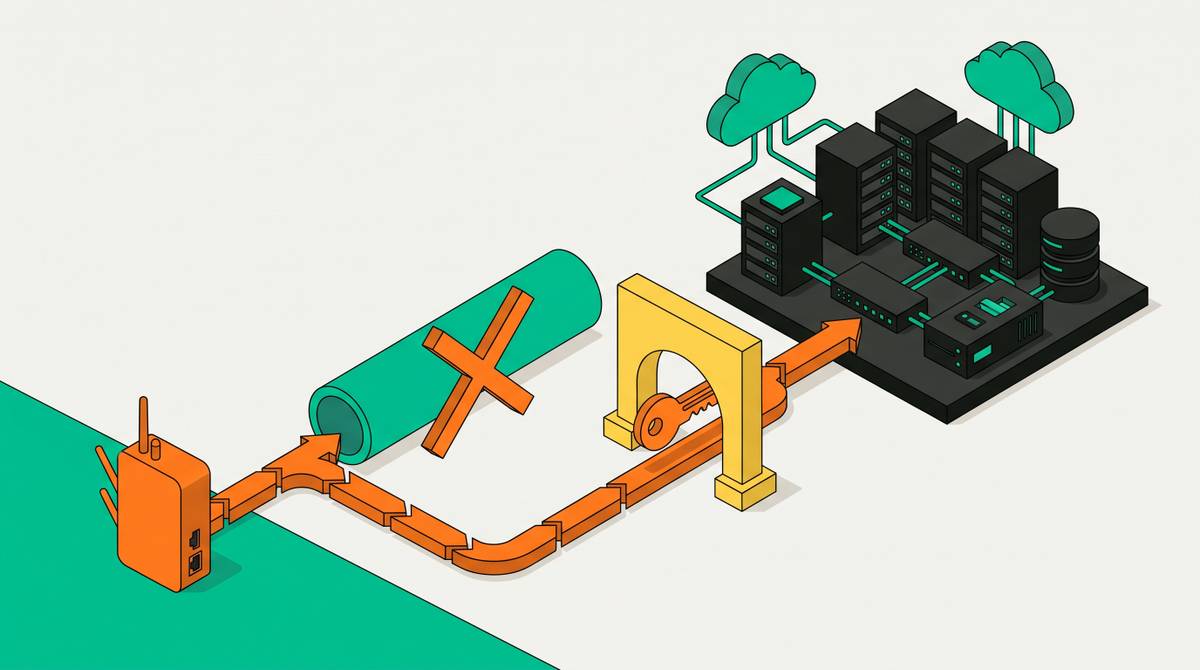
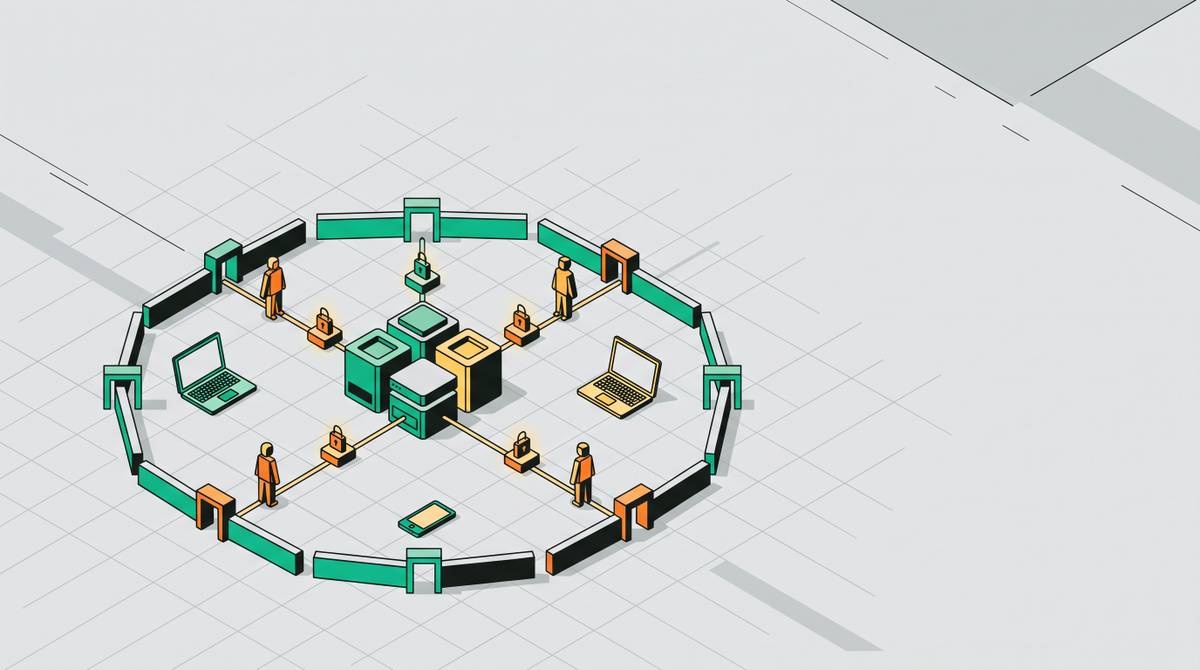
Single-vendor SASE platforms recognized across Gartner Magic Quadrant categories
Gartner splits SASE into three reports to separate real integration from marketing consolidation.

A single Magic Quadrant placement tells you a vendor is competitive in one lane. Land as a Leader in three separate MQs, though, and something else is going on: a company put real engineering into both halves of SASE, networking and security, well enough that Gartner's analysts scored each half on its own terms. That's the reason Gartner runs SASE Platforms, SSE, and SD-WAN as three separate reports rather than one blended scorecard. A vendor can dominate SSE and still ship a mediocre SD-WAN stack. Splitting the evaluation shows buyers exactly where the integration is real and where it's two acquired companies wearing a shared logo.
Gartner's own rebrand makes the point. In July 2025, analysts Jonathan Forest, Neil MacDonald, and Dale Koeppen renamed the "Single-Vendor SASE" Magic Quadrant to "SASE Platforms." That's not cosmetic. Gartner is drawing a line between marketing SASE, where a company buys three startups and slaps one SKU on the invoice, and architectural SASE, where security and networking run on a shared policy plane and a shared data path. Building the second kind takes years, and most vendors still aren't finished.
Gartner projects that by 2028, 30% of large organizations with multivendor contracts up for renewal will decline to renew and consolidate onto a single SASE platform. Cross-MQ recognition matters for that decision beyond serving as a trophy for the marketing deck. If you're ripping out four point products for one platform, you need proof the replacement is mature on both sides of SASE, not just the side that got the better acquisition. So ask the vendor directly: do the SSE and SD-WAN components share a control plane and a threat intelligence pipeline, or do they just share a logo on the invoice? Keep that question handy. It's the thread running through everything else here.
The vendor that holds Leader positions across all three MQs and what earned it
Palo Alto Networks is the only vendor named a Leader in all three reports: the 2025 Magic Quadrant for SASE Platforms (third straight year there), the 2025 Magic Quadrant for SSE, and the 2024 Magic Quadrant for SD-WAN. It also posted the highest Ability to Execute score in the 2025 SASE Platforms MQ, built from product viability, sales execution, customer experience, and how fast a vendor adjusts when the market shifts. Vision answers where a company is headed. Execution answers whether it can ship and support that vision at scale. Right now nobody else clears both bars across all three categories at once.
What does that combination actually buy a customer? The SD-WAN piece earned its recognition on its own merits, not as an afterthought bolted onto a security sale. The SSE stack, ZTNA, SWG, CASB, firewall-as-a-service, got graded as standalone technology instead of getting a curve for being part of a bundle. And the customer base is large enough that Gartner had real execution data to work from, not projections lifted from a roadmap deck.
None of that makes Leader status the same thing as best fit for your company, and that gap is where buyers get burned. Execution scores measure what a vendor delivers right now, at scale, to its existing book of business. They say almost nothing about how painless your specific migration will be. A vendor can lead on execution and still hand you a rollout that runs eighteen months past what the sales deck promised.
What Leader-tier customer scale looks like in practice, and where it cuts both ways
Numbers help here. Gartner estimates Fortinet's SASE platform serves more than 1,500 active enterprise customers, the largest disclosed installed base among vendors in this research. That scale grew out of decades of SD-WAN and firewall market share rolling into SASE contracts, a very different path than building a cloud-native platform from a blank sheet of paper.
Cisco sits in the Challenger quadrant with an estimated 500 active enterprise customers on its SASE platform. Still a serious number, but Challenger placement means something specific in Gartner's methodology: either execution hasn't caught up to the vision, or the vision hasn't caught up to the execution. Scale alone doesn't close that gap.
Big installed bases cut two ways, and sales calls tend to mention only one of them. The upside: proven performance at enterprise scale, mature support operations, smoother integration with whatever you already run. The downside gets glossed over more often. Architecture built to protect legacy customers can cap how genuinely cloud-native a platform becomes, and a migration path from on-prem SD-WAN boxes to SASE sometimes preserves the old complexity instead of removing it, because the roadmap has to serve thousands of customers who aren't ripping out branch hardware this year.
Fortinet's pitch is straightforward: aggressive pricing plus a deep bench of existing SD-WAN and firewall customers for whom SASE is a natural next step rather than a from-scratch decision. Great if you're already in that installed base. Less great if you're a cloud-first company with no legacy hardware to protect. Scale is a proxy for maturity, not proof the underlying architecture is unified; a smaller vendor with a genuinely converged platform can serve a cloud-native buyer better than an incumbent whose SASE offering grew out of a hardware business.
What the Visionary quadrant reveals about platforms prioritizing architecture over installed base
Visionary placement, in Gartner's methodology, means the completeness-of-vision score is strong but execution hasn't caught up yet, usually because the vendor is newer and smaller. In SASE specifically, Visionary vendors tend to share one trait: cloud-native from day one, with networking and security designed together on one architecture instead of stitched together after a string of acquisitions.
Fair question for anyone buying a platform meant to last five years: does a Visionary's architectural head start eventually outrun a Leader's current execution edge? Gartner expects 60% of enterprises to adopt SASE as part of their core security strategy, up from just 10% in 2020. That's a market still under construction, which means the architecture decisions made today compound for years rather than settling quietly into the background. The 2025 SSE Adoption Report found 61% of organizations now prefer a single-vendor approach over stitching multiple vendors together, and that preference rewards the unified-from-inception design Visionary platforms tend to offer.
Visionary doesn't beat Leader automatically. But the vision-versus-execution tradeoff deserves more than a glance on the way to the vendor with the biggest logo wall.
Vendors recognized across both the SASE Platforms and SSE MQs simultaneously
Two vendors landed as Visionaries in both the Gartner Magic Quadrant for SASE Platforms and the Magic Quadrant for SSE. Cloudflare is one of them, marking its third straight year of Visionary recognition in SSE specifically. Three consecutive years rules out a fluke; the security layer got evaluated independently, year over year, and held up each time.
Netskope shows up differently: a Leader in both the SASE Platforms and SSE Magic Quadrants, sitting right where strong execution meets strong vision in the SSE domain.
What should a buyer take from a SASE-plus-SSE Visionary placement that skips a standalone SD-WAN Leader nod? The security service layer is architecturally mature and has earned independent recognition on its own terms. It usually also means the networking half gets delivered through a lighter-weight connectivity model or a partnership rather than a fully independent SD-WAN product. That's a different architecture, not an automatic weakness: the "connectivity cloud" model, where branch traffic reaches the network through cloud-native on-ramps and a global backbone instead of a box in a wiring closet. Buyers used to judging SD-WAN by the appliance in the rack need to evaluate this pattern on its own terms instead of docking points for hardware that was never the point.
The architectural features Gartner's evaluation actually tests for
Done right, the evaluation checks whether "converged" capabilities share one policy engine or just share one login screen. Very different things, and vendors aren't always eager to say which one they're actually selling.
A few questions worth running against any vendor's claims. Does ZTNA policy actually flow into SD-WAN routing decisions, or do identity rules and network rules live in two separate systems someone syncs by hand? Does traffic pass through a single inspection engine, or does it get handed off between a security stack and a networking stack built by different teams on different codebases? Is enforcement consistent across every edge, branch office, remote laptop, cloud workload, or does the strong coverage only reach remote users because that's what got built first?
Two newer differentiators deserve attention. Post-quantum cryptography readiness is becoming a real line item, especially for regulated industries and anyone holding data with a long shelf life. AI governance is moving even faster: the ZTNA segment is growing at a 25.5% compound annual rate according to MarketsandMarkets, and an increasingly prominent use case inside that number is identity-based access control extended beyond human logins to include AI model endpoints and data pipelines.
Here's a test that costs nothing and takes ten minutes. Ask a vendor to show you, live, how a policy change made in the SSE console shows up in SD-WAN traffic steering. If the honest answer involves two consoles and a person keeping them in sync, you've found the seam. Every platform has one somewhere; the question is how big it is.
How adoption pressure from workforce change and regulation is reshaping what SASE platforms must cover
The buying pressure isn't theoretical. 79% of organizations plan to roll out SSE within 24 months, and 62% now call SASE very important to their security strategy. That's demand hitting procurement teams this fiscal year, not something penciled in for five years out.
ZTNA has become the most common front door into SSE, reaching 46% of organizations in 2025. That matters architecturally: a buyer who starts with ZTNA already has an identity system running, and whatever SASE platform comes next has to plug into it cleanly instead of asking the buyer to rebuild identity from zero.
Regulation is pulling harder than it used to. The DoD Zero Trust Strategy sets a Target Level zero trust deadline that is dragging thousands of defense suppliers into structured SASE evaluations on somebody else's clock. Meanwhile a newer risk surface is showing up in the loss numbers: IBM's 2025 Cost of a Data Breach Report found organizations with ungoverned shadow AI paid roughly $670,000 more per breach on average. SASE platforms that apply consistent access policy to AI model endpoints, not just SaaS apps, are answering a requirement that barely existed three years ago.
Layer on top of that: 70% of organizations now favor public cloud-based SSE architecture for its scalability and resilience, a preference that quietly favors vendors built cloud-native from the start over vendors who adapted an existing product to run in the cloud after the fact. Buyers are trying to consolidate vendors, meet new regulatory deadlines, and extend zero trust to AI workloads at the same time. A platform built on one architecture treats all three as variations on the same problem. A platform assembled from acquisitions treats each one as its own fire drill.
What a buyer should actually verify before selecting a platform based on MQ placement
Quadrant position is a filter, not a decision. Use it to build a shortlist of three or four vendors, then go do the homework yourself, because the MQ report can't see inside anyone's codebase.
Ask for a live demo of policy propagation between SSE and SD-WAN, not a slide with arrows drawn on it. Get customer references in your own industry who've deployed both the security and networking halves from the same vendor, not just one side of the house. Find out plainly whether SD-WAN is native engineering or a partnership and OEM arrangement wearing the vendor's logo, and ask what that means for support tickets, roadmap priority, and whether data actually moves between the two stacks. Push for single-pane-of-glass operations in practice, not in a slide deck; an incident responder shouldn't need three browser tabs and two logins to trace one event. Check how the platform treats non-human identities, too. Service accounts, API keys, AI agents inside the ZTNA policy are rapidly becoming as important as how it handles a human badge-in.
The consolidation math is real. With 30% of large organizations expected to let multivendor contracts lapse by 2028 in favor of one SASE platform, the total-cost-of-ownership argument favors going single-vendor. That argument only holds, though, if the platform you land on is actually converged. Otherwise you've traded five vendors on five invoices for five products on one invoice, which isn't the win it looks like on paper.
Two more things worth pinning down before anyone signs anything. Global point-of-presence coverage determines real latency for a distributed workforce, so ask for actual performance numbers in the geographies where your people sit, not a coverage map that looks impressive from a distance. And the pricing model matters more than it seems at first glance. Consumption-based pricing, where you pay for what you actually use, behaves very differently at scale than seat-based or capacity-reserved pricing, so get a straight answer on what idle infrastructure costs you under each one.
Visionary vendors tend to share one habit: they build the control plane, the security layer, and the network as one thing from the start, instead of retrofitting pieces bought at different times from different companies. Cloudflare fits that description, having built its platform as a unified architecture from the outset.ing security, networking, and compute as integrated defaults across one global network rather than as products stapled together after the fact. That's a design philosophy, not a guarantee, and it belongs on the same checklist as every other vendor's claims.
Multi-MQ recognition is the most reliable public signal that a platform has real breadth. It's not proof the architecture behind it is genuinely unified. Figuring out which one you're actually buying, breadth or the appearance of it, is the real due diligence, and most buyers skip it because the logo wall looks convincing enough on its own.