Machine Learning WAF Rule Generation vs Static Rulesets
ML-based WAFs adapt to new attack variations faster than static rules can be manually updated.
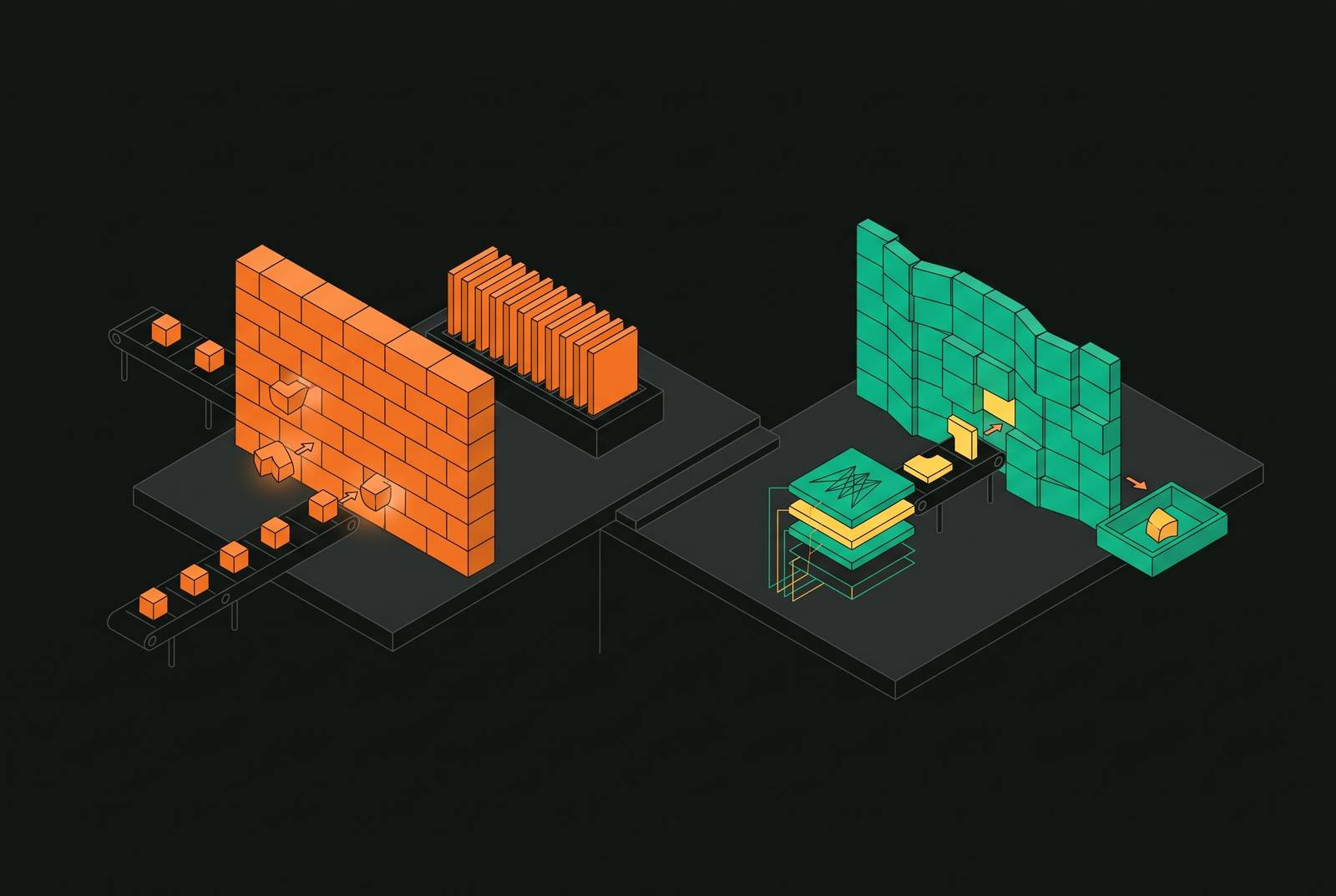
Machine learning WAF rule generation addresses a weakness that better-written static rules cannot fix on their own. A web application firewall that relies on known patterns cannot change on its own when attackers change those patterns. The strongest defense combines deterministic rules with learned detection and continuously updated exploit coverage, closing the gap between a novel payload and an enforceable defense without treating human expertise as obsolete.
Why static WAF rules are structurally mismatched to today's attack surface
Each rule encodes a known pattern, such as a string, a regular expression, or a recognizable payload shape. At inspection time, the WAF compares the incoming request with those patterns. A request that matches none of them passes through signature inspection. The rules may be carefully written, but their knowledge is fixed until someone changes them.
A rule that looks for a particular SQL injection string may miss the same query when it uses case variations, inline comments, or encoding tricks. Broader rules can cover some variations, but an uncovered variation still requires an extension to the ruleset. Durmuşkaya & Bayraklı (2025) distinguish this matching against a predefined database from anomaly detection, which identifies deviations from normal behavior and can therefore recognize novel threats.
Language models make that weakness harder to keep up with. Attackers can automatically generate syntactically varied payloads, testing different expressions of the same attack. This compresses the interval between a new technique and its weaponization while increasing the number of variants defenders face. The contest is not between equally long checklists. Defenders who rely on enumeration must list the bad patterns ahead of time, but an attacker needs just one variation that works and falls outside that set.
How the manual tuning workflow breaks down under AI-generated payloads
The traditional tuning process was designed to reconcile general-purpose security rules with the particular needs of an application. A team deploys a managed ruleset conservatively, initially using count or log mode to observe what would be blocked. Engineers then review false positives and write exceptions scoped to the affected parameters or paths. Blocking follows a period of observation and adjustment. The cycle repeats when either the application or the threat landscape changes.
Automated payload generation can make new variations faster than an engineer can check logs, decide which exceptions to allow, and push updates. Syed (SSRN, 2026) describes how generative AI changes both sides of the trade-off: it makes novel payloads cheaper and allows more accurate, self-tuning false-positive suppression. The defensive opportunity therefore extends beyond writing more signatures. It includes reducing the manual work needed to distinguish malicious variation from legitimate application behavior.
Without that change, teams absorb the mismatch as operational work. Over-broad rules block legitimate users, and new features may need changes to the WAF before they can ship safely. Meanwhile, missing coverage leaves an exposure window, especially when a newly disclosed CVE requires virtual patching within hours, ahead of the next quarterly update. Working through the queue faster does not remove the dependency on the queue.
What ML-based rule generation actually does differently at the architecture level
ML-based WAFs change the primary detection signal from enumerated strings to learned properties of traffic. Pattern matching can remain in place, but it is no longer the only basis for a decision. In anomaly detection, a model learns an endpoint’s normal parameter lengths, value distributions, request rates, and header patterns. A parameter that is unusually long can then get a closer look even if it has no known attack string.
Feature-based classification asks a different question. It uses properties such as payload length, entropy, character distribution, and structure to distinguish malicious inputs from benign ones. A reformatted injection may evade an exact string match yet retain features that a classifier associates with its attack class. Durmuşkaya & Bayraklı evaluated five classification algorithms on a hybrid dataset covering XSS, SQL injection, OS command injection, and local file inclusion. Their decision tree achieved an F1 score of 93.13%, with similarly high accuracy in real-time testing. That supports classification as a detection mechanism.
A third use of ML concerns the inspection profile itself. Agents collect data about which rules trigger, how frequently they trigger, and how long they take to process. A model uses that information to recommend profiles suited to a customer’s traffic patterns, region, and threat landscape, reducing false positives and computational overhead. Together, these uses explain what “ML-based” can mean architecturally, from detecting abnormal requests to classifying suspicious features and improving rule selection.
The false-positive asymmetry that defines the real operational trade-off
A model can block too much legitimate traffic, or it can become so reluctant to block that it misses attacks. High recall means catching a large share of attacks, while high precision means that requests identified as malicious are usually malicious. Tuning toward one can weaken the other.
An over-broad rule catches legitimate inputs and generates exception work, while an under-broad rule leaves malicious variants untouched. There is no self-correcting mechanism in the rule itself. ML changes how the boundary is learned, but the choice of where to place that boundary still has operational consequences. A learned decision is not exempt from making the wrong decision.
An extreme illustration is a WAF optimized almost entirely to avoid false positives. It can approach a zero false-positive rate while detecting only a small fraction of actual attacks. The user experience looks reassuring. The security coverage does not. On the other hand, detection that blocks too much can make the application harder to use by treating legitimate requests as threats. Neither outcome is adequately described by saying the model is accurate without explaining what it misses and what it blocks.
Per-application learning can help distinguish unusual but legitimate inputs from attacks, yet it does not remove the need for tuning and judgment. This also gives deterministic rules a continuing role. Where an exploit has a well-characterized signature, a focused rule can provide enforcement without asking a behavioral model to infer the whole case.
Why exploit-aware, continuously updated rules outperform quarterly static releases
Release cadence becomes decisive when a disclosed vulnerability is weaponized before managed rules have caught up. Even a strong rule leaves a window for attacks if it arrives after exploitation starts. Continuously updated, exploit-derived rules address it by connecting evidence of an attack to deployable coverage without waiting for a periodic snapshot. The generation process must therefore account for both what to block and how quickly protection reaches enforcement.
Miggo’s July/August 2026 release within AWS WAF illustrates this model. Miggo generates every rule from publicly available proof-of-concept code or from proof-of-concept code it generates and validates. It then tests the rule against multiple bypass and mutation variations before release. The exploit supplies the evidence for the rule. Testing variations addresses the obvious weakness of a defense that recognizes only the first published expression of an attack.
The rulesets ship on a versioned cadence with real-time threat intelligence integration. Their coverage is weighted toward technologies with the highest exploitation velocity, including AI/ML frameworks that most WAF vendors have not yet addressed. The transferable principle is the production loop. Proof-of-concept-driven generation, bypass testing, and versioned delivery turn exploit knowledge into maintained enforcement.
This is also the practical role of virtual patching. Updated rules provide a mitigation layer while engineers develop and deploy the application fix, allowing patching to proceed without blocking engineering cycles. The WAF holds the line rather than repairing the vulnerability. Continuous delivery brings that short-term protection in time, and exploit testing grounds it in more than a written description of the vulnerability.
How the WAF boundary must expand to cover agentic AI traffic
A WAF trained to recognize human web sessions has only part of the context it needs to judge agent traffic. Agent requests emerge from reasoning chains, and the same tool call can serve legitimate or malicious intent depending on context outside the HTTP request. Better string matching cannot recover context it never receives. Nor can a behavioral baseline trained on human sessions be assumed to describe an agent’s activity. The inspection boundary must expand deliberately.
OWASP’s Top 10 for Agentic Applications 2026, published December 2025, formalizes risks including prompt injection and jailbreaks, memory poisoning, and tool/plugin misuse. Traditional WAF rulesets do not adequately cover those risks. Legacy WAFs and basic API gateways also lack agent-specific coverage for infrastructure such as MCP servers. This is not simply another collection of suspicious strings. It concerns how requests relate to tools, permissions, and the agent’s surrounding context.
The AWS WAF reference architecture for securing Model Context Protocol endpoints, published October 2026, makes the network enforcement layer concrete. It has controls for protocol version enforcement, caller classification through bot control, and body-size preflights. Per-tool allowlists and rate limits make the selected tool part of the rule logic, while SSRF blocking in tool arguments and SQL injection detection in query-shaped inputs inspect what the call asks the tool to do. Those are meaningful additions to generic web request inspection. They show that the MCP boundary can support useful enforcement without pretending that HTTP inspection reveals the agent’s full intent.
That boundary still has limits. Broken access control, IDOR, and prompt injection inside an LLM’s context window require application-level fixes. WAF protection is necessary but not sufficient. For ML rule generation, the corresponding requirement is to retrain or extend models on agent traffic patterns instead of treating web application baselines as universal. A changing threat surface also changes the training requirement.
Why the strongest WAF deployments combine ML and static rules rather than replacing one with the other
Static rules and ML models serve different detection horizons. Rules provide deterministic enforcement for known, well-characterized attacks, while models generalize across behavior and payload features that were not enumerated when those rules were written. Per-application baselines can reduce false positives on legitimate but unusual traffic. Profile optimization can then adapt inspection as the application evolves. None of those gains requires discarding a high-confidence signature.
The distinction is important when interpreting the research. Durmuşkaya & Bayraklı frame ML-based WAFs as a viable alternative to rule-based WAFs, particularly because traditional rules struggle with new attack patterns. That is not itself an endorsement of a complementary architecture. The case for using them together rests on what each does well and how each can fail, including ML’s precision-recall trade-off, which remains unresolved. Novelty detection and deterministic blocking answer different parts of the same security problem.
For teams making the decision, the useful question is therefore one of layering. Which signals are sufficiently well characterized for direct rule enforcement, and which require a model’s ability to generalize? The deployment architecture then determines how coherently those answers are applied. A unified, globally distributed enforcement plane avoids the latency, configuration drift, and coverage gaps introduced by stitching a separate ML system onto a legacy WAF. Rules that update globally in seconds and models trained on edge traffic deliver their full value when their decisions meet in that shared plane.
The goal is not to retire rules but to stop asking a fixed snapshot to defend a moving target.