What Are Digital Agents and How Do They Differ From Chatbots
Agents automatically complete tasks across multiple steps, while chatbots only answer questions.
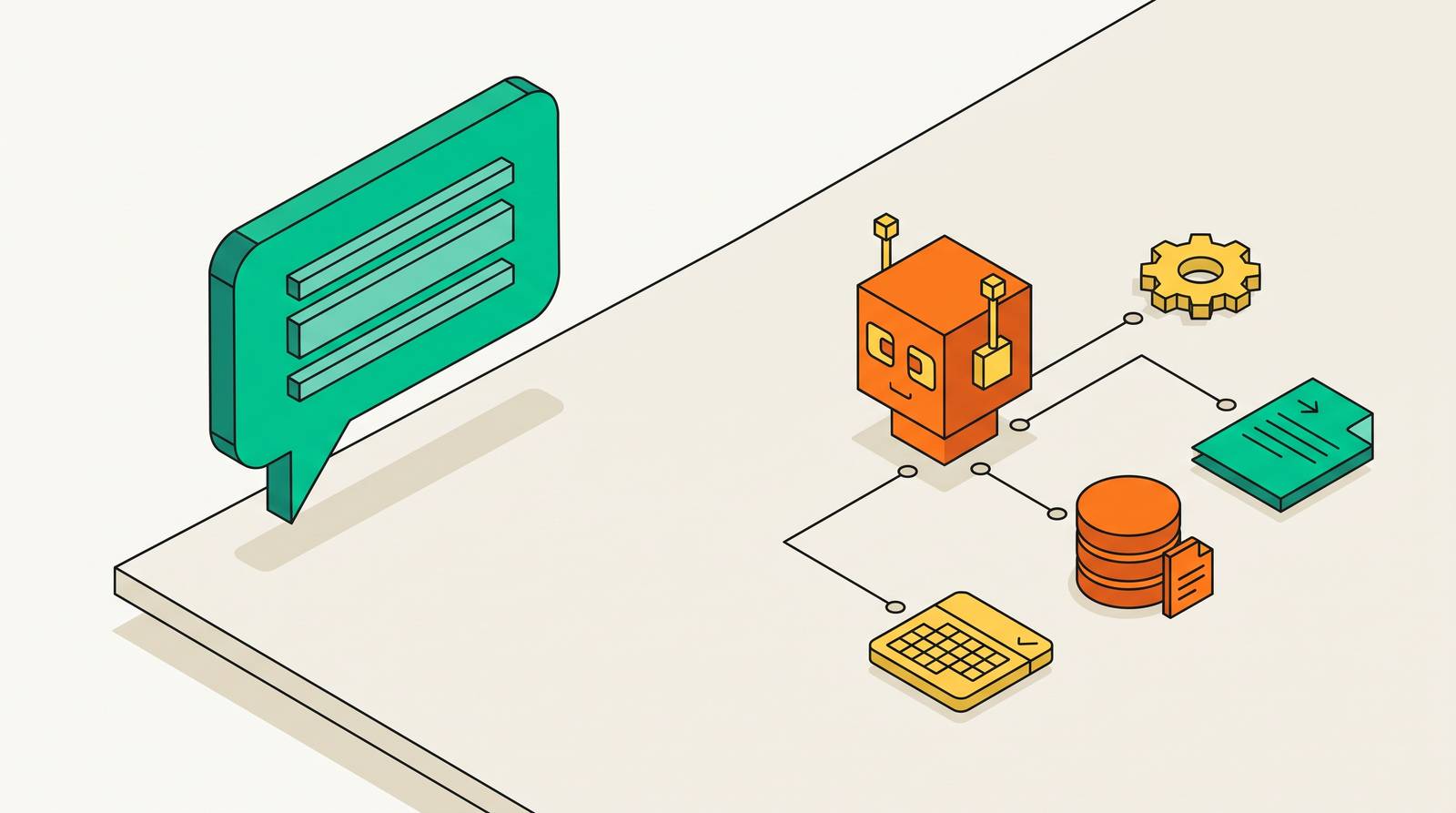
The distinction between a chatbot and a digital agent is not a matter of degree. It is a matter of kind. A chatbot is a reception desk: it takes your question, hands you a pamphlet, and waits for the next person in line. An agent is the employee who actually goes and fixes the problem. That one architectural difference has infrastructure consequences most organizations are only beginning to reckon with.
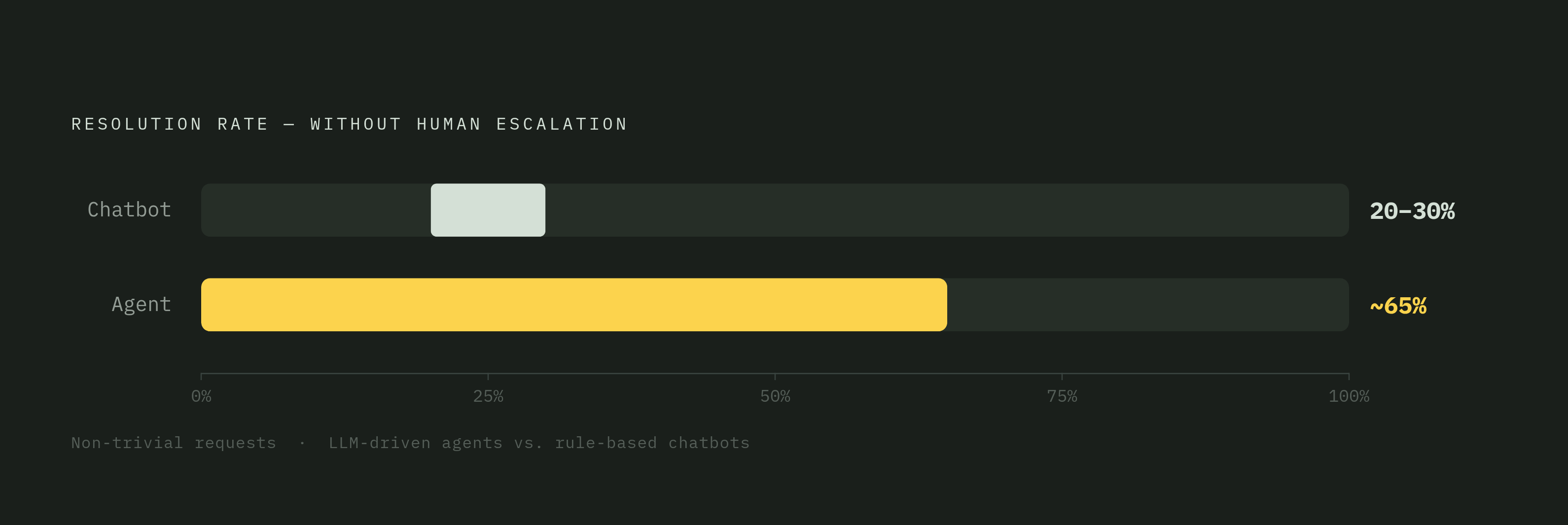
Chatbots were designed for narrow, predictable interactions: answering FAQs, routing tickets, walking users through scripted flows. They operate within a fixed loop. Receive a prompt, generate a response, wait for the next prompt. Their access to external systems is tightly scoped and largely static. A chatbot can display your account balance or log a support ticket, but it cannot go fix whatever caused the problem. Studies of deployed chatbot systems have found that chatbots handling non-trivial requests resolve roughly 20 to 30 percent without human escalation. That ceiling is not a consequence of bad implementation. It is a consequence of the architecture itself.
An agent takes a goal rather than a prompt. It decomposes that goal into ordered subtasks, selects appropriate tools, executes actions, observes what happened, and reroutes when something breaks, all without waiting for a human to hand it the next instruction. It pulls live data from external systems rather than working from a static knowledge snapshot. It carries context across tool calls rather than resetting state with each conversational turn. It invokes APIs, runs code, reads and writes files; it does not merely produce text describing those actions. And when a step fails, it detects this and reroutes rather than waiting for a human to notice the output was wrong.
Research on LLM-driven tool use has found resolution rates without human intervention reaching approximately 65 percent, compared to chatbots' 20 to 30 percent ceiling. The correct mental model is not that an agent is a smarter chatbot. An agent replaces a portion of a human workflow rather than supporting it. That is a workforce architecture change, not a feature upgrade, and organizations that conflate the two end up building the wrong infrastructure for the work they are actually trying to automate.
How Agents Reason and Plan: The Loop That Drives Autonomous Execution
Agents operate on a continuous perceive-plan-act-observe cycle. They do not terminate after each response. They run through this loop repeatedly until the objective is complete or a stopping condition is met. This sounds elegant in a diagram. In production it turns out to be complicated, and the complications are not random; they cluster around the same pressure points every time.
Given a high-level goal, an agent begins by decomposing it into subtasks, assigning tools or sub-agents to each, and tracking dependencies between them. The agent's practical capability is defined less by the underlying model and more by the tools it can invoke: search, code execution, data writes, external API calls. The model provides reasoning; the tools provide reach. Complex workflows typically delegate subtasks to specialized sub-agents, each with a narrower scope. This multi-agent architecture makes individual components easier to test and reason about in isolation, but it introduces coordination complexity that flat chatbot architectures never encounter. That complexity becomes an infrastructure problem at scale.
One design pattern has emerged as reliably effective in production: use LLMs for reasoning, intent classification, and handling ambiguous or evolving goals, while routing transactions and binary-correctness operations through deterministic logic. An LLM can understand that a user's frustrated follow-up message refers to a ticket opened three days ago. It should not be the thing deciding whether to debit an account. Mixing these approaches appropriately reduces validation errors and makes behavior more auditable, two properties that matter a great deal once the system is affecting actual customers and not just a sandbox.
Where Agents Are Already Running in Production
A spring 2025 survey conducted by MIT Sloan Management Review and Boston Consulting Group found that 35 percent of respondents had already adopted AI agents by 2023, with another 44 percent planning deployment in the near term.
The enterprise deployments that have made it into the public record are instructive. Reddit's deployment of Salesforce Agentforce produced an 84 percent reduction in case resolution times, with reported annual operational savings exceeding $100 million. Accenture embedded agents in campaign workflows and measured a 31 percent reduction in marketing cycle time. Siemens deployed predictive maintenance agents and reported more than 50 percent reduction in operational downtime. These are running in core business functions, which means the infrastructure beneath them must be production-grade; pilot tolerances do not apply once payroll depends on the outcome.
According to market research firm MarketsandMarkets, the AI agent market is projected at roughly $7.6 billion in 2025, growing at approximately 45 percent annually. Gartner projects that 40 percent of enterprise applications will include task-specific AI agents by the end of 2026, up from under 5 percent in 2025. The window between "piloting" and "expected to be running reliably" is compressing faster than most infrastructure teams are prepared for.
The Gap Between Piloting Agents and Running Them Reliably
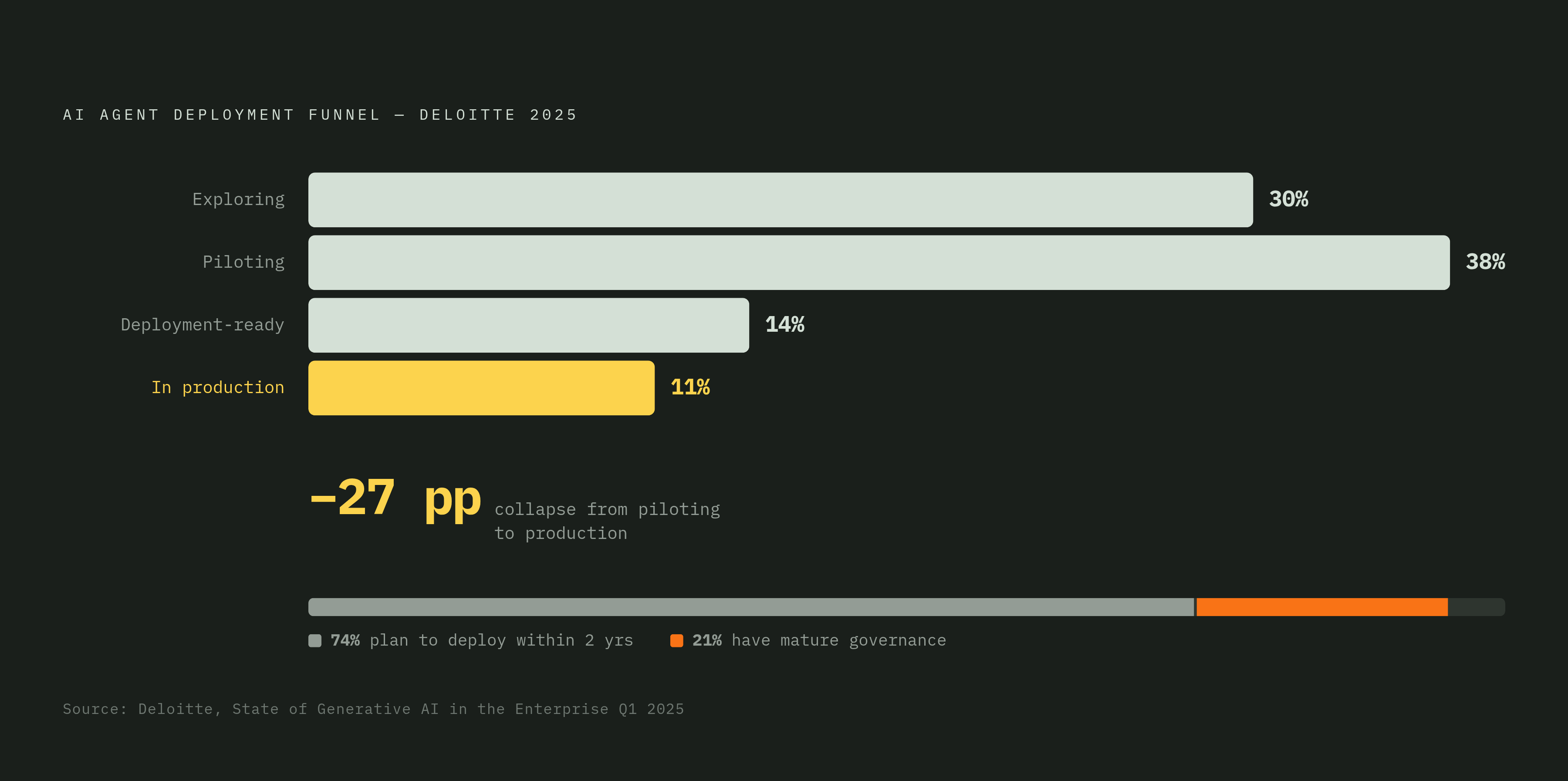
The adoption numbers obscure a more uncomfortable truth. Deloitte's 2025 Emerging Technology Trends research found that while 30 percent of organizations are exploring agentic options and 38 percent are piloting, only 14 percent have deployment-ready solutions and just 11 percent are actively running agents in production. Enthusiasm and operational reality are not the same place, and the distance between them is larger than most roadmaps acknowledge.
The governance picture compounds this. Seventy-four percent of enterprises plan to deploy AI agents within two years. Only 21 percent have a mature governance model. Organizations are committing to automation they do not yet know how to govern. This is, admittedly, a reasonable description of how most technology eras begin. It is an unreasonable foundation for autonomous systems capable of taking irreversible actions on behalf of the business.
The gap is wider than typical AI adoption curves because agents introduce failure modes that static software and conventional ML systems simply do not have. Cost overruns are one documented example. One practitioner's agentic workflow consumed $47,000 in API credits over six months, not because the system was broken, but because it was deployed like a microservice rather than a long-running autonomous process. The billing model did not match the execution model. The open-source OpenClaw project illustrates the problem at greater scale: roughly 100 autonomous coding agents consumed more than $1.3 million in OpenAI API tokens in 30 days. The system was working as designed. The infrastructure simply had no mechanism to stop it.
The MIT Sloan and BCG research adds a finding worth noting: 80 percent of the real implementation work in agentic deployments was consumed by data engineering, stakeholder alignment, governance, and workflow integration, not prompt engineering. Model selection was secondary too. The hard work was integration and governance, which is exactly why it so frequently gets skipped until something expensive happens.
Every serious agentic deployment eventually confronts the same questions: how do you control cost, how do you observe what the agent is actually doing, how do you enforce safety boundaries around irreversible actions, and how do you manage state across a workflow that may run for 30 minutes and span a dozen tool calls. Each of these is harder for agents than for conventional services. The difficulty is architectural, not incidental, which means it does not get easier with familiarity alone.
State, Observability, and Cost: The Infrastructure Problems Agents Surface That Chatbots Never Did
Chatbots are stateless between turns by design. That is a reasonable feature for a system answering FAQs. It is a liability for a workflow that must survive an interrupt, resume after a timeout, or coordinate with a sub-agent running concurrently on a separate thread.
Every tool call an agent makes changes its internal context. Sub-agents create distributed state. A 30-minute workflow creates temporal state that must persist across partial failures. Standard stateless infrastructure was not designed for this. Patching state management into application code looks expedient early in a pilot and tends to create maintenance problems in extended production use. A six-step agentic workflow that silently restarts from scratch because the orchestration layer has no concept of checkpointing illustrates why durable execution matters.
Observability is structurally harder for agents than for any service type that preceded them. You cannot instrument an agent the way you instrument a request-response service because you cannot predict in advance what actions it will take. Tracing must be built in at the protocol level, not bolted on after deployment. The industry has converged on OpenTelemetry with agent-specific semantic conventions as the baseline; both Anthropic's Model Context Protocol and Google's Agent-to-Agent protocol include tracing as first-class features. That convergence reflects a shared recognition that ad hoc observability does not scale to multi-agent pipelines.
Cost is the problem that surprises organizations most because it has no direct analogue in web service or ML pipeline budgeting. A web request terminates in milliseconds. An agent can run for minutes or hours, invoke dozens of tool calls, and spawn sub-agents that each generate their own costs. Without hard budget enforcement at the infrastructure layer, spending is structurally unbounded. Enforcing budgets in application code requires discipline across every team touching the workflow, and that discipline can erode as new sub-agents are added. This is an infrastructure design problem being misdiagnosed as a process problem, and process solutions do not fix it.
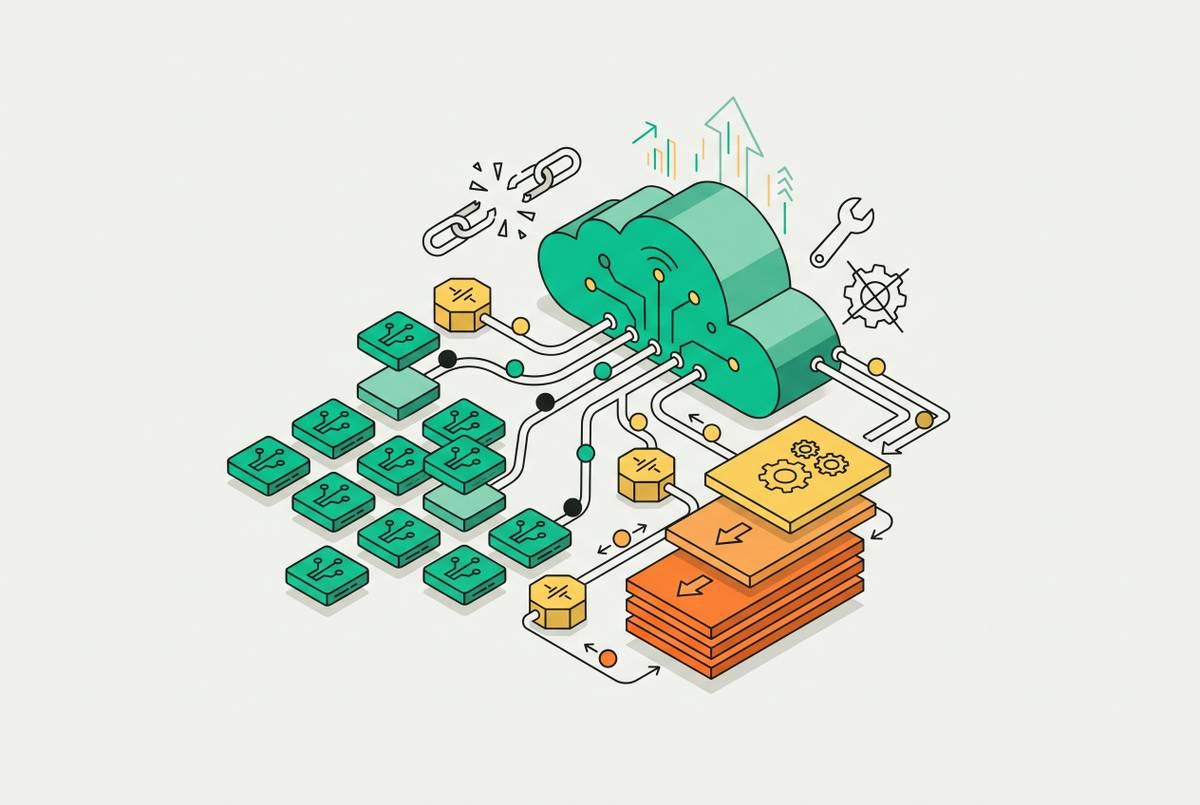
Safety and irreversibility deserve explicit treatment. Agents that write to databases, send emails, or initiate financial transactions need checkpoints at consequential decision points. The EU AI Act, in Article 14, codifies this requirement for regulated contexts. Organizations operating in regulated industries should treat this as a compliance constraint rather than an architectural nicety. Agents are long-lived, stateful, distributed, and non-deterministic. None of those properties are ones that standard serverless or microservice infrastructure was designed to handle gracefully, which is precisely why so many production deployments hit the same walls in the same order.
Why Agent Identity Is a Security Problem Chatbot Security Never Anticipated
A chatbot authenticates as a service. It calls a handful of known endpoints with credentials that do not change, under human supervision, within a conversation that terminates quickly. The security surface is small and well-understood. Security teams know how to handle it.
An agent is a non-human identity that authenticates to multiple services, accumulates permissions across a workflow, holds API keys, and takes actions whose downstream consequences may not be immediately visible. Clarity Security's 2026 Identity Security Report found that non-human identities reached a roughly 144:1 ratio versus human identities in some enterprises, a 44 percent year-over-year increase. Most security teams are still operating frameworks designed for the inverse ratio.
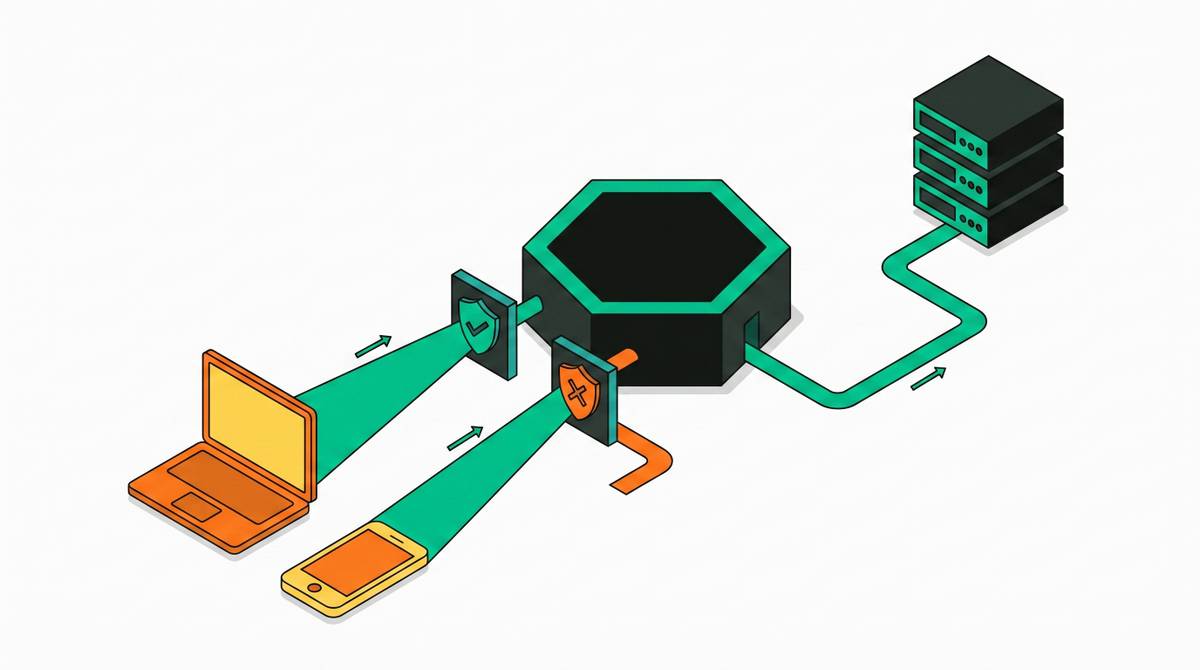
Traditional Zero Trust frameworks were built around verifying human users at session initiation. An agent does not have a session in any conventional sense; it has a workflow that may span hours, spawn child agents, and call external APIs at unpredictable intervals. A one-time login check is not a meaningful security control for this execution model. Continuous, per-action verification is. That distinction matters considerably once the agent is doing something consequential, particularly something that cannot be undone.
Shadow AI compounds the exposure considerably. IBM's 2025 Cost of a Data Breach Report found that organizations with ungoverned shadow AI in their environments paid significantly more per breach on average. Ungoverned agents accumulating credentials in the background represent a meaningful source of that exposure.
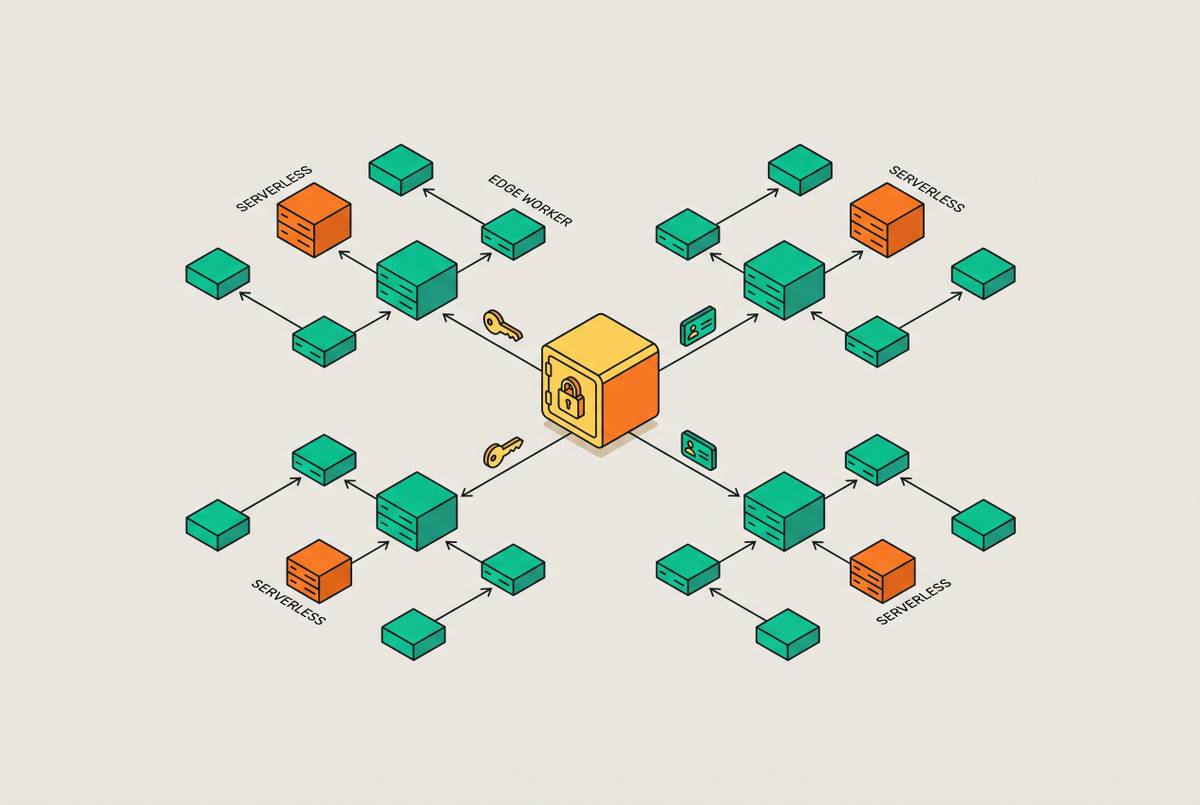
Multi-agent pipelines extend the credential chain in ways that fragmented point solutions are poorly equipped to govern. When Agent A spawns Agent B, and Agent B calls an external API, the identity and permission model must be enforced end-to-end, not just at the originating agent. The fastest-growing Zero Trust use case in 2026 is identity-centric access control over AI model endpoints, data pipelines, and agent-driven automation. This shift reflects a recognition that perimeter defense is the wrong frame for agentic workloads; security must be enforced at the network layer, per request. This is not a more stringent version of chatbot security. It is a different security model applied to a fundamentally different threat surface.
What Infrastructure Built for Agents Actually Looks Like
Agents need compute that does not penalize duration. A workflow running for 30 minutes should not accumulate charges during model inference pauses or external API waits. When the billing model does not match the execution model, cost overruns follow as a design consequence.
Global distribution matters. Agents acting on behalf of users need to execute close to both the user and the data sources they are querying. Latency compounds across multi-step tool chains in ways it never does in a single-response chatbot turn. A 200-millisecond round trip that is imperceptible in a chat interface becomes two seconds across ten sequential tool calls, which becomes a structural bottleneck in any workflow a user is actively waiting on.
Coordination and state management belong at the infrastructure layer, not in application code. Durable execution, checkpointing, and resume-on-failure are platform responsibilities. Organizations that patch these into application logic accumulate technical debt as their agent workflows grow in complexity.
Observability must be first-class: traces, logs, and cost metrics surfaced per agent, per tool call, and per workflow, not aggregated into the same bucket as web request logs. An engineer debugging a failed multi-agent workflow needs to reconstruct the exact sequence of tool calls and intermediate states. That requires instrumentation designed for agentic execution, not observability tooling repurposed from request-response services.
Identity and access must be enforced per action, not per session. Every tool call an agent makes should carry verified identity, least-privilege scope, and an auditable record. Infrastructure that cannot enforce this at the network layer will require each application team to implement it independently, which is the reliable path to inconsistency and eventually to the kind of incident that generates a postmortem nobody wants to write.
Vendor lock-in at the orchestration layer is a real risk worth naming plainly. Agent orchestration frameworks are maturing rapidly, and the infrastructure beneath them should work with standard protocols, specifically MCP, A2A, and OpenTelemetry, rather than proprietary abstractions that trap teams when requirements evolve or better options appear.
The production gap, 11 percent of organizations actively running agents against the much larger share piloting or planning, is partly a tooling problem and partly an infrastructure mismatch. The organizations closing it fastest treat agentic workflows as a first-class compute workload with its own infrastructure requirements. The ones still struggling are waiting for their existing infrastructure to accommodate a fundamentally different execution model, and that accommodation is simply not coming.