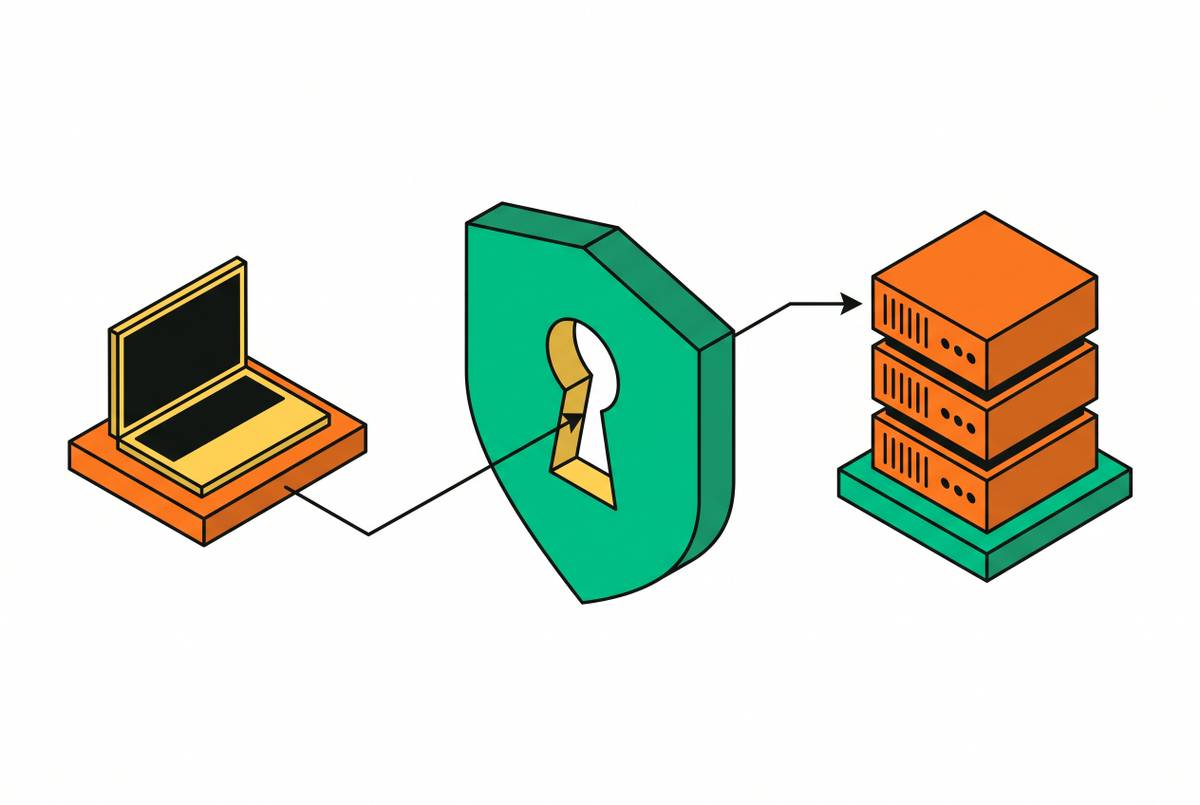
API Security Best Practices for Zero Trust Architectures
Mutual TLS and short-lived credentials replace static secrets with cryptographic proof of identity.
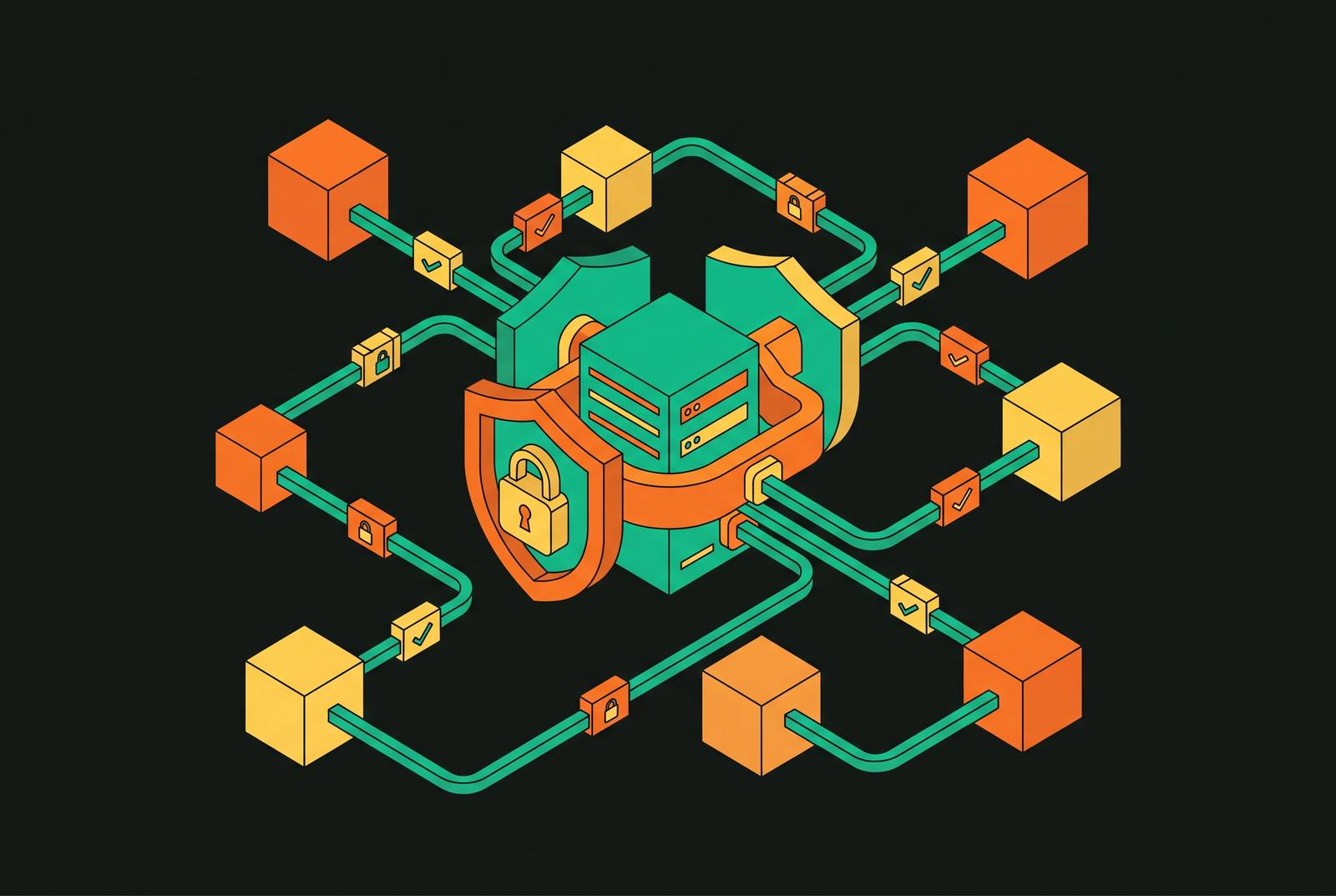
API security in a Zero Trust architecture depends on identity. Every request must be authenticated, authorized, and evaluated in context, wherever it starts. The practical answer combines short-lived credentials, mutual TLS, gateway controls, per-request authorization, and continuous monitoring. Together, these practices turn “never trust, always verify” from a slogan into a working security posture.
Why perimeter-based API security fails in a distributed, multi-cloud world
Traditional firewalls understand IP addresses and ports, leaving the question of which account records a caller may read outside their scope. That distinction matters when services span multiple clouds, third-party integrations, and organizational boundaries. Containers are ephemeral, and services can appear and disappear in seconds. There is no stable “inside” to which trust can safely attach.
Yet protecting human access with MFA and SSO can leave workload-to-workload communication governed by network location. A VPN tunnel may admit traffic without carrying the originating identity through to the destination service. Likewise, a long-lived token can become a distributed policy cache that keeps permissions in place long after the conditions behind them have changed. These setups keep perimeter trust in place within a smaller perimeter. Proof of which workload is acting must reach the place where its request is fulfilled.
The three Zero Trust principles that API security must be built on
Kindervag created Zero Trust at a research firm. Its three principles are verify explicitly, enforce least privilege, and assume breach. For APIs, explicit verification means requiring proof of identity and entitlement at every interaction. Authentication must therefore still prove who is calling as a request passes from one service to another.
Least privilege means granting only the permissions required for the task, so a read call cannot become a write or delete. It makes fine-grained authorization and narrowly scoped credentials architectural requirements. Assume breach adds encryption in transit, segmentation, logging, detection, and containment, so one compromised component cannot freely move laterally. Together, these principles shift policy from determining whether a workload can reach a system to deciding whether its identity should perform a specific action now. Identity, current security posture, and environmental context become inputs to that decision.
Choosing the right authentication pattern for each API trust relationship
The choice of authentication should depend on how the caller and service relate to each other. OAuth 2.1 suits delegated authorization, where a client acts for a user or another service within explicit scope boundaries. JWT carries stateless identity claims that policy engines can evaluate, but a long expiration turns the token into a static credential in different packaging.
For service-to-service communication, mutual TLS fits the need for both parties to prove their identities cryptographically. API keys still fit low-risk, read-only integrations, but only when the threat model truly allows for a long-lived shared secret. Convenience is not a threat model, however neatly it fits in a configuration file. Hardcoded keys and persistent tokens leave a risk in place that short-lived or secretless patterns are designed to remove. The choice is therefore not just how a caller presents proof, but how much access that proof grants and how long it remains useful.
How mutual TLS enforces identity at the service boundary, not just the edge
With conventional TLS, the server proves its identity to the client. Mutual TLS requires both parties to show certificates, so each must prove that it holds the corresponding private key. Service meshes are a natural enforcement point for this east-west traffic inside a microservices cluster. The Kubernetes Gateway API separates global controls, including mTLS bindings and WAF rules, from per-namespace routing decisions.
If a tunnel terminates at the network interface and the downstream application sees only the proxy’s identity, encryption has not preserved the originating workload’s identity. Where mTLS alone cannot carry that identity end-to-end, request signing or signed headers propagating trace context maintain the chain across proxies and load balancers. In a multi-hop chain, each service should validate the incoming identity and re-sign before forwarding. Otherwise, the first hop performs a careful identity check and the remaining hops accept a forwarding address.
What the API gateway enforces — and what it cannot
The API gateway is a Policy Enforcement Point for north-south traffic entering the system. Centralized JWT signature, expiry, and audience validation addresses weaknesses associated with Broken Authentication in the OWASP API Security Top 10 (2023 edition). Rate limits and payload size limits address Unrestricted Resource Consumption. Enforcing requests against an OpenAPI Specification 3.1 contract also keeps malformed payloads away from backend code.
Removing undocumented fields can help with Broken Object Property Level Authorization, but the gateway cannot tell whether a caller has a valid business reason to view a declared field. Broken Object Level Authorization also requires a check of the caller’s permission for a specific object against live state that the gateway does not hold. That check belongs in the downstream service. The gateway separates credential validation and traffic management from backend logic, but that separation is not permission to omit authorization from the backend.
Per-request authorization and fine-grained access control beyond the gateway
At each access point, policy should evaluate the verified identity, its current security posture, and the circumstances of the requested action. For object access, that means comparing the caller’s identity with the specific object ID in the request path or body using live state.
Open Policy Agent (OPA) lets teams write authorization rules as code, check them the same way across services, and audit the versions they keep. Separating policy from application logic lets access rules change without redeploying backend services. At the routing layer, role-based access control and scope validation must cover each HTTP path and verb, because policy can miss wildcard-routed or unmapped admin endpoints. AI agents need the same least-privilege treatment, especially when their calls fan out across services. Their authority should be limited to the current task.
Short-lived credentials and secretless architecture as the practical implementation of least privilege
Authorization rules do much less to protect a system when credentials stay valid forever. A key that leaks through a repository commit, a log file, or an insider can still be used until someone rotates it. A vault improves on plaintext storage, but a long-lived vault access credential preserves the underlying dependence on possession of a secret. The architectural change is to issue access from verified workload identity instead.
Platform mechanisms including AWS instance metadata, Kubernetes service account tokens, and GitHub Actions OIDC tokens provide the basis for that identity. A trust provider verifies the workload and issues ephemeral credentials scoped to its task and current context. SPIFFE/SPIRE applies this model to service workloads through short-lived X.509 SVIDs that rotate automatically. Expiration limits how long a compromised credential remains useful, while scope limits what it can do during that window. Issuance and validation can then support continuous authorization, rather than leave a stored secret standing in for a fresh decision on each request.
How agentic AI traffic changes the API authorization surface
AI agents introduce a new class of API caller subject to identity controls. They act autonomously, cross organizational boundaries, and can turn one prompt into many downstream calls. Limits must account for the cost and scope of the downstream actions a request can trigger.
Each agent should receive a unique identity with time-bound credentials scoped to its current task. When the task changes or completes, that credential expires and a new one is issued for the next task. In workflows where one agent calls another, identity must propagate through the chain rather than disappear or be established afresh without continuity. Signed-header propagation serves the same purpose here as it does across service hops. Controls must also enforce which tools and actions the agent may invoke, on what data, and under which conditions, with an agent-to-tool protocol serving as a governance boundary rather than a substitute for authorization at execution.
Running security enforcement at the network edge rather than at the origin
Identity decisions also have a location, and that location affects the cost of defense. Edge enforcement evaluates malicious traffic before it consumes origin infrastructure. Distributed points of presence absorb volumetric DDoS traffic through network capacity that a single origin server cannot match. Blocking a credential-stuffing bot near its source likewise prevents the application server from allocating compute to its requests.
Credential stuffing, however, uses valid login requests with real stolen credentials, so malformed-payload detection is not enough. Behavioral detection must spot patterns of automation across IPs, devices, and sessions. Sophisticated bots that mimic browsers, rotate IPs, and solve CAPTCHAs require models that analyze behavior across large volumes of requests. Running those models at the serving point of presence avoids a separate trip to the origin for detection. WAF enforcement and bot detection therefore complement each other, with the former addressing exploit payloads and schema violations and the latter addressing automation that arrives in perfectly respectable syntax.
Continuous monitoring, logging, and anomaly detection as the operational layer of Zero Trust
Every API request should produce an audit record of who called, what they requested, what was returned, and whether it matched the expected schema. Those records support incident response and reveal patterns that individual authorization decisions can miss. Unusual call sequences, access to object IDs outside normal distributions, and off-hours activity can expose “low and slow” misuse of valid credentials and payloads.
Runtime discovery finds shadow and zombie APIs in live traffic, but traffic-only discovery cannot see routes that get no traffic. Agent workflows also need runtime evaluation, so runaway loops or escalating resource consumption trigger alerts before damage occurs. OpenTelemetry provides a vendor-neutral framework for collecting traces, metrics, and logs across service boundaries. Carrying identity and request context into that telemetry makes anomalies more useful than an unexplained rise on a dashboard. Monitoring cannot supply missing access controls, however, and its value depends on credentials, scopes, and segmentation already limiting what a compromised caller can do.
Translating these practices into a phased implementation path
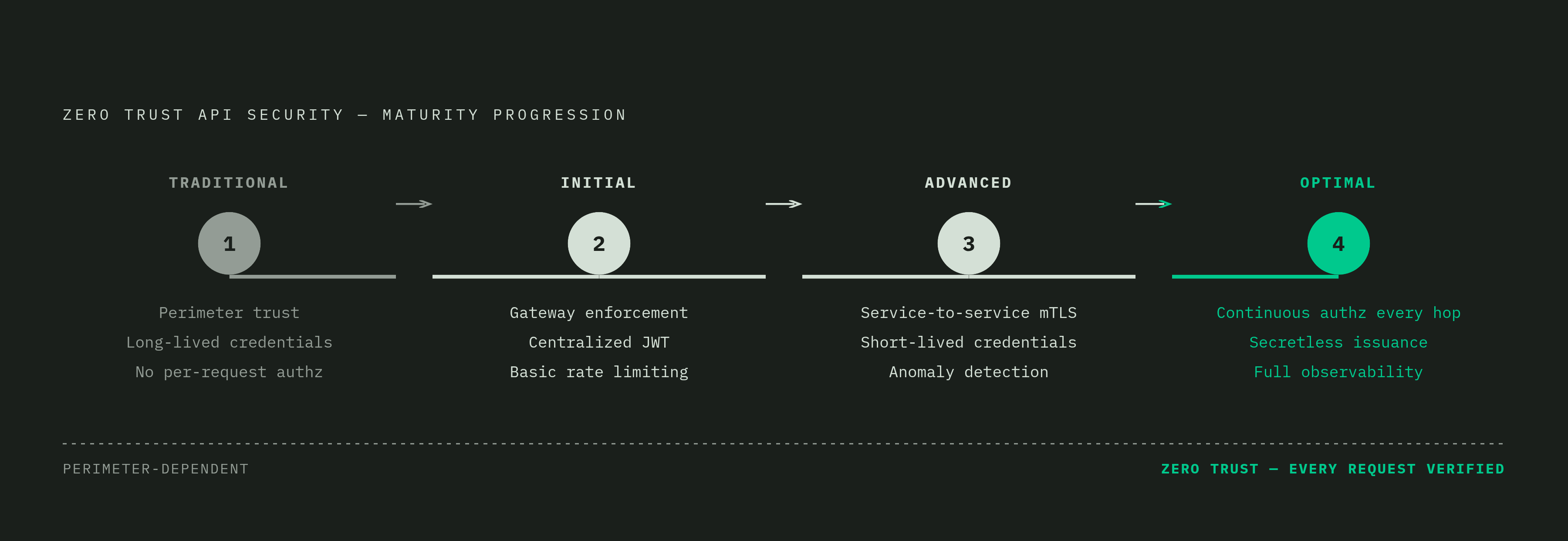
Teams can do this work in phases, with a timeline that fits their needs. A traditional starting point combines perimeter trust with long-lived credentials and no per-request authorization. The initial phase establishes gateway enforcement, centralized JWT validation, and basic rate limiting for external traffic. Starting with that authentication foundation fixes weaknesses in the design before teams take on authorization that depends more on context and enforcement within internal services.
The advanced phase adds service-to-service mTLS, short-lived credentials, fine-grained authorization, and anomaly detection. The optimal phase extends continuous authorization to every hop, uses secretless credential issuance, and provides full observability, including agentic traffic. At each stage, teams risk over-privilege and leaving some environments without full enforcement. A plan therefore has to cover all API surfaces, including those difficult to place behind a gateway.
Integration belongs in that work from the outset. A unified policy framework for gateway enforcement, DDoS and bot management, WAF, and observability can reduce the burden of keeping separate controls consistent. The aim is not to collect security components but to connect their decisions. Identity-first API security is a solvable problem with known practices, and each practice makes the others more effective.