SaaS Security Posture Management Tools for Cloud-First Teams
Continuous monitoring catches SaaS misconfigurations faster than annual audits ever could.
This article covers SaaS Security Posture Management, the category of tooling that cloud-first teams now use to monitor dozens or hundreds of applications continuously. The problem it solves is a mismatch between how fast SaaS environments change and how slowly legacy audit processes move. Configurations drift, permissions pile up, and integrations multiply in the weeks between audits, so by the time a quarterly or annual review delivers its findings, it is describing a posture that no longer exists.
Part of this comes down to who actually controls the settings. Infrastructure teams used to own security configuration because they owned the infrastructure. SaaS broke that chain of custody. Now the person adjusting sharing permissions on the CRM is a marketing manager, the person setting access controls on the billing platform is in finance, and the application that arrived through a free trial six months ago answers to nobody in particular. None of these people think of themselves as security administrators, and most of them aren't wrong to feel that way: it was never their job description. But the settings still need watching, and an annual audit checks in on them about as often as a smoke detector gets a fresh battery, which is to say, less often than it should.
Shadow SaaS makes the gap wider. These applications get adopted without formal IT review, so they create blind spots, and traditional security tooling, built for sanctioned infrastructure, cannot see into them. A security team cannot audit what it does not know exists, and a point-in-time review cannot catch what was never on the list to begin with. Drift between audits plus applications no audit ever covered combine, so periodic review isn't just imperfect, it is structurally insufficient.
What SSPM is, and what it is not
SSPM, stripped of vendor branding, is the continuous assessment and correction of how SaaS applications are configured, who can access them, what those users are permitted to do, and what evidence can be produced to prove all of it held up under scrutiny. That four-part definition holds regardless of which company's logo sits on the dashboard, and it is the test to apply to any product pitched under this label.
Gartner's cloud security reference architecture, published November 2025, defines SSPM as tooling that "continuously assesses a SaaS application's security risk and manages its security posture." The architecture places SSPM and SaaS management platforms as two distinct components sitting next to each other, not as competing descriptions of the same thing. That distinction matters for anyone shopping this category: a SaaS management platform tracks licenses, spend, and application inventory. SSPM tracks security configuration and risk. They can overlap in a vendor's product line, but they answer different questions, and conflating them is how procurement teams end up with a tool that manages subscriptions beautifully while an exposed admin console goes unnoticed.
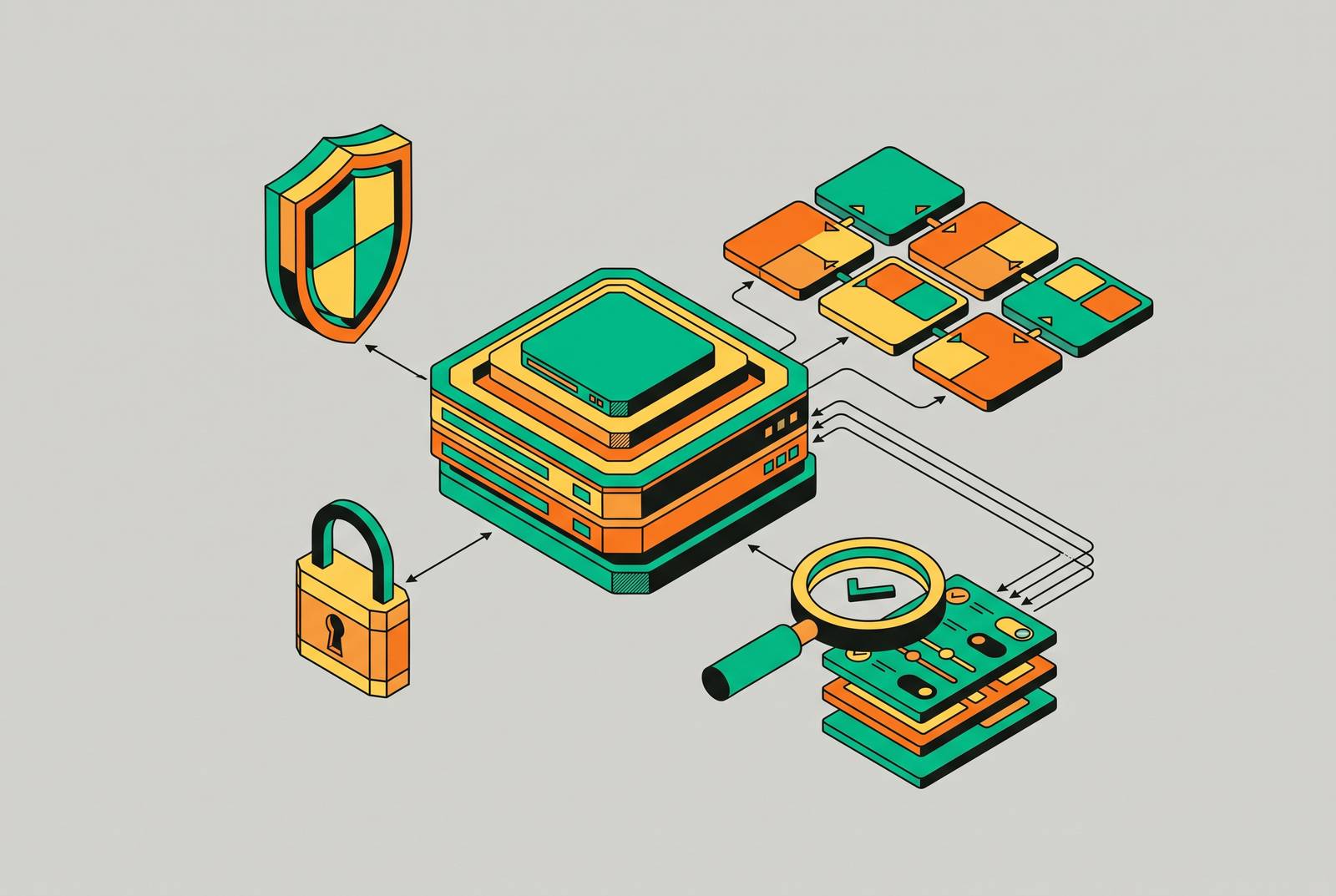
Five functional pillars sit underneath that definition, and any serious SSPM product needs to cover all five. Application settings cover what the app shipped with by default, but also whether configuration has drifted since then. Identity and access covers who holds an account, under what role, whether that account is still active, and at what privilege level. Third-party integrations cover OAuth grants and app-to-app connections, along with the scopes each one was handed at approval time. Data exposure covers public links, external sharing settings, guest accounts, and file-level permissions. Compliance evidence covers proof that controls ran, delivered in a form an auditor will accept, not one that needs translation first. Which of these five pillars is failing at a given organization should determine the purchase: a team bleeding orphaned accounts needs a different emphasis than a team leaking files through public sharing links, even if both problems get filed under the same "SaaS security" budget line.
How continuous monitoring works differently from periodic configuration scanning
The shift from static configuration checks toward continuous monitoring and automated remediation is one of the defining trends reshaping the SSPM market, and it changes the mechanics of detection, not just the frequency. Modern platforms maintain centralized visibility into SaaS configurations, user permissions, third-party integrations, and data exposure in real time, rather than reconstructing that visibility from a scan scheduled weeks or months apart.
Mechanically, platforms connect to each SaaS application through its API and watch continuously for configuration drift, any deviation from a defined secure baseline, instead of waiting for a scheduled pass to surface it. When drift is detected, automated remediation can restore the secure baseline directly, which shrinks the exposure window without requiring someone to notice, file a ticket, and wait for a human to act on it.
Continuous monitoring reduces how much an organization depends on point-in-time snapshots, without eliminating the need for formal audits. What changes is the shape of audit preparation itself: instead of reconstructing evidence of what the environment looked like six months ago, teams retrieve evidence that has been accumulating the entire time. That shift, from reconstruction to retrieval, is also what makes identity risk and third-party integration risk visible close to the moment they appear.
Identity and non-human accounts as the highest-urgency monitoring target
Identity has become the primary attack surface inside SaaS environments. A compromised OAuth token, a hijacked session, or a reused credential sitting on some half-forgotten integration is now the dominant way attackers get in, and SSPM's identity and access pillar exists specifically to catch the conditions that make those entry points possible before they get used.
Identity risk splits into layers, and each layer needs its own detection logic. On the human side, leavers retain active accounts in applications that sit outside the identity provider's reach, employees accumulate administrative rights over successive projects without ever being scoped back down, and roles granted for one urgent task outlive the task by months or years. On the non-human side, service accounts, API keys, and OAuth integrations get approved by individual employees acting on their own authority, then sit unreviewed indefinitely, because offboarding processes trigger from HR data and the applications themselves never raise the flag.
AI agents add a third layer, and most SSPM coverage has not caught up to it yet. Every copilot, autonomous agent, and MCP connection is a new identity with its own permission scope and its own blast radius if it gets compromised, and most deployed AI agents now run without consistent security oversight or logging. An AI agent produces a structural governance gap: it never appears in an HR system, is never offboarded the way a departing employee is, and does not consume a license seat that would catch finance's attention. None of the tripwires that normally prompt an identity review ever fire, so an agent's access can sit unscoped indefinitely, and nobody is positioned to notice.
The State of AI Agent Security 2026 Report found that 25.5% of deployed agents can create and task other agents, a compounding risk that is already measurable, and once an agent is spinning up further agents, the resulting chain of command becomes close to impossible to audit after the fact. Point-in-time review was already a poor match for human identity sprawl. It is categorically unequipped for an identity class that can reproduce itself between review cycles. DoControl's SSPM explainer states that an SSPM platform needs to surface every OAuth grant and API connection along with its scopes, flag integrations holding excessive permissions, and offer a remediation path that does not require someone to go hunting through a dozen separate app admin consoles by hand.
SSPM and Compliance Obligations for Cloud-First Teams
Compliance has shifted from a rationale security teams reach for after the purchase to a requirement that shapes the purchase itself. The EU Digital Operational Resilience Act, effective January 17, 2025, requires financial entities to continuously monitor the security posture of their third-party providers, which is close to a textbook description of what SSPM already does. SSPM supplies the auditable record of SaaS security posture that regulators and auditors are asking for, not as a side benefit but as the point of the compliance evidence pillar.
That pillar does something no manual process matches at scale: it produces proof that controls actually ran, in a form an auditor will accept, without anyone rebuilding that proof from a spreadsheet every time an audit cycle comes around. CISA's "Journey to Zero Trust" guidance lays out the architectural logic this sits inside: zero trust architectures support policy-based access decisions built on identity, device posture, application context, data sensitivity, and network conditions, replacing implicit trust with continuous verification and least-privilege access. That is the same logic SSPM applies inside each SaaS application, just scoped down from the network level to the application level.
None of this is confined to financial services. Guidance on security posture management sequencing recommends starting coverage with CSPM, then layering in identity posture management and SSPM within six months, with AI posture management and data, application, and Kubernetes domains arriving later. So that sequencing treats SSPM as an early, near-term compliance foundation, not a sophistication layer you add once the basics are handled. Compliance obligations set the floor a platform has to clear. What varies is which platform clears it most efficiently for a given organization, and that is a question of evaluation, not obligation.
How the consolidation trend should shape SSPM evaluation
The market is consolidating. Enterprises are cutting down tool sprawl by folding SSPM capability into broader cloud and identity security platforms that combine it with identity governance, ITDR, SIEM, SOAR, and cloud security tooling, and SSPM is increasingly treated as a layer inside a larger architecture. That trend is real and documented, but it is not the end of the argument.
The strongest case against consolidation-first buying is depth. Some platforms cover a wide range of SaaS applications but offer shallow controls on each one, while pure-play SSPM tools go deep into the handful of applications that actually carry the organization's risk. An enterprise with a large SaaS estate does not need equally deep coverage across every application it runs. It needs serious depth on the five or ten that hold the sensitive data and the privileged access, and breadth across the rest is a weak substitute if the deep coverage isn't there where it counts.
The practical heuristic splits along organizational shape. Pure-play SSPM tends to win when an organization runs a large SaaS estate with specific, named compliance requirements that a generalist platform handles as an afterthought. Platform consolidation tends to win when the team already runs the vendor's CSPM, CASB, or endpoint product, and then operational simplicity outweighs the marginal depth a specialist tool would add. Neither answer is universally correct, and a team that picks based on vendor momentum rather than its own shape is buying the wrong thing for reasons that have nothing to do with security.
The five capabilities to evaluate in any SSPM platform
You have to test an SSPM platform against the same five functional capabilities that define the category, because vendor marketing uses inconsistent labels for identical functions, and if you work from feature-sheet language alone, you end up comparing products that are not actually comparable. The first capability is configuration monitoring across every connected application's settings, checked against a defined secure baseline, not whatever the vendor's default happens to be. The second is identity and access visibility, and it covers human accounts, including leavers and over-privileged roles, as well as non-human accounts, including service accounts and API keys that no one individually approved through a formal process. The third is third-party integration and OAuth grant visibility, with the scopes each integration holds surfaced clearly enough in a central view that an excessive grant becomes obvious. The fourth is data exposure detection across public links, external sharing, guest accounts, and file permissions, since this is where a single misconfigured folder turns into a headline. The fifth is compliance evidence generation in a form an auditor accepts without translation, because a platform that detects every risk but cannot produce usable proof of remediation leaves the audit prep gap open. A platform that covers all five with genuine depth, not just a checkbox next to each, is the one actually built for a cloud-first team managing a SaaS estate too large for any human to track by memory.